Enterprise software companies are notoriously difficult to sell into and surprisingly easy to research. They publish product roadmaps, hire publicly for strategic initiatives, present at conferences about their technology direction, and file detailed earnings reports every quarter. The intelligence is available. The skill is knowing how to read it and translate it into a conversation that gets you past the first meeting.
Account research for enterprise software sales requires understanding a company's product strategy, engineering investments, competitive positioning, and organizational maturity. The buying signals in this market are different from other industries because the prospects themselves are technology companies. They evaluate vendors with the same rigor they apply to their own product decisions.
TL;DR: Research enterprise software companies using product roadmap signals, engineering hiring patterns, earnings call commentary, competitive moves, and conference activity. Build a 10-minute framework that identifies technology priorities, organizational scaling challenges, and competitive pressures. The strongest buying signals are product launches in adjacent categories, engineering leadership hires, and earnings commitments to infrastructure investment.
Why Enterprise Software Accounts Need Specialized Research
Selling to enterprise software companies is different because your buyers understand technology deeply. They will see through generic pitches immediately. The bar for demonstrating relevance is higher.
Product strategy drives everything. Enterprise software companies make purchasing decisions based on how a tool fits their product roadmap, engineering workflow, and go-to-market motion. Research that reveals their product direction tells you how to position your solution as an enabler of their strategy, not just another tool.
Engineering culture signals technology preferences. How a company builds software reveals what they will buy. Companies with strong open-source cultures evaluate differently than companies building proprietary stacks. Companies using microservices have different infrastructure needs than monolith-based teams. These signals are visible in GitHub activity, conference talks, and engineering blog posts.
Competitive dynamics create urgency. Enterprise software markets move fast. A competitor's product launch, a new market entrant, or a category shift can push a company to accelerate technology investments that were previously on a 12-month timeline. Tracking competitive moves in your prospect's market gives you timing intelligence — a core principle of signal-based selling.
Scale creates operational complexity. As enterprise software companies grow from 500 to 5,000 employees, the tools that worked in the early stage break. Sales teams need CRM infrastructure, engineering teams need observability platforms, and everyone needs better data. Understanding where a company sits on this growth curve tells you what they need.
The Key Sources to Monitor for Enterprise Software Accounts
Effective account research for enterprise software requires combining product intelligence, financial data, and organizational signals.
Product Hunt and Product Announcements
Product Hunt tracks product launches and feature releases. For enterprise software companies, monitor:
- New product launches (signals expansion into adjacent markets)
- Major feature releases (reveals engineering priorities)
- Product positioning changes (indicates market strategy shifts)
Company blogs, changelog pages, and product update emails provide direct intelligence about where the company is investing engineering resources.
GitHub and Open Source Activity
For companies with public repositories, GitHub is a window into engineering priorities:
- New repositories signal new product areas or infrastructure investments
- Commit frequency and contributor patterns show team size and investment level
- Issue labels and project boards reveal active development areas
- Dependency changes signal technology stack decisions
Job Postings
Hiring patterns at enterprise software companies are among the most reliable leading indicators:
- Engineering roles: Specific technology mentions (Kubernetes, Snowflake, gRPC) reveal infrastructure decisions
- Sales and marketing roles: GTM hiring bursts signal market expansion
- New function creation: A first-ever "Head of AI" or "VP of Platform" role signals strategic pivots
- Seniority shifts: Moving from IC hires to VP hires in a function indicates maturation
Earnings Calls and Investor Presentations
For public enterprise software companies, earnings calls contain specific intelligence about technology investments, customer acquisition metrics, and competitive positioning. Listen for:
- R&D spending as a percentage of revenue (signals investment appetite)
- Commentary about "platform consolidation" or "build vs. buy" decisions
- Customer cohort expansion rates (indicates product stickiness and upsell opportunity)
- Competitive mentions and positioning language
Conference Talks and Industry Events
Enterprise software leaders frequently present at conferences (AWS re:Invent, KubeCon, SaaStr, Dreamforce). Their talk topics, sponsored sessions, and booth presence reveal strategic priorities. A company presenting about AI integration at a developer conference is signaling where their product is heading.

“The moment we turned on Salesmotion, it became essential. No more hours on LinkedIn or Google to figure out who we're talking to. It's just there, served up to you, so it's always 'go time.'”
Adam Wainwright
Head of Revenue, Cacheflow
The 10-Minute Research Framework for Enterprise Software
Minutes 1-3: Company Profile and Growth Stage Check Crunchbase for funding and headcount. For public companies, note market cap and recent stock performance. Identify the core product category, target market segment, and business model (subscription, usage-based, hybrid).
Minutes 3-5: Product Direction and Engineering Signals Check their product blog or changelog for the last 3 months of releases. Scan GitHub for new repositories or major dependency changes. Look at Product Hunt for recent launches. Note any product direction relevant to your solution.
Minutes 5-7: Competitive Landscape and Market Position Identify their top two competitors. Check for recent competitive product launches, pricing changes, or market entries in their category. Look at G2 category rankings for positioning shifts. Note any analyst coverage (Gartner, Forrester) that has changed recently.
Minutes 7-9: Leadership and Organizational Changes Check LinkedIn for recent C-suite or VP-level hires. Look for organizational signals: new teams being created, functions being restructured, or leadership roles being upgraded from Director to VP level. Press releases about strategic hires are often posted before LinkedIn updates.
Minutes 9-10: Synthesize Your Angle Tie a product or organizational signal to your solution. "You just launched your AI module and are scaling the engineering team behind it. Here is how we help teams maintain sales velocity during product expansion" connects your research to their reality.
Salesmotion consolidates earnings data, leadership changes, news, and strategic signals into a single account brief, reducing the research workflow from 30-60 minutes of manual source-hopping to under 5 minutes. Cacheflow, an enterprise software startup, cut their meeting prep time by 60% after centralizing their account intelligence.
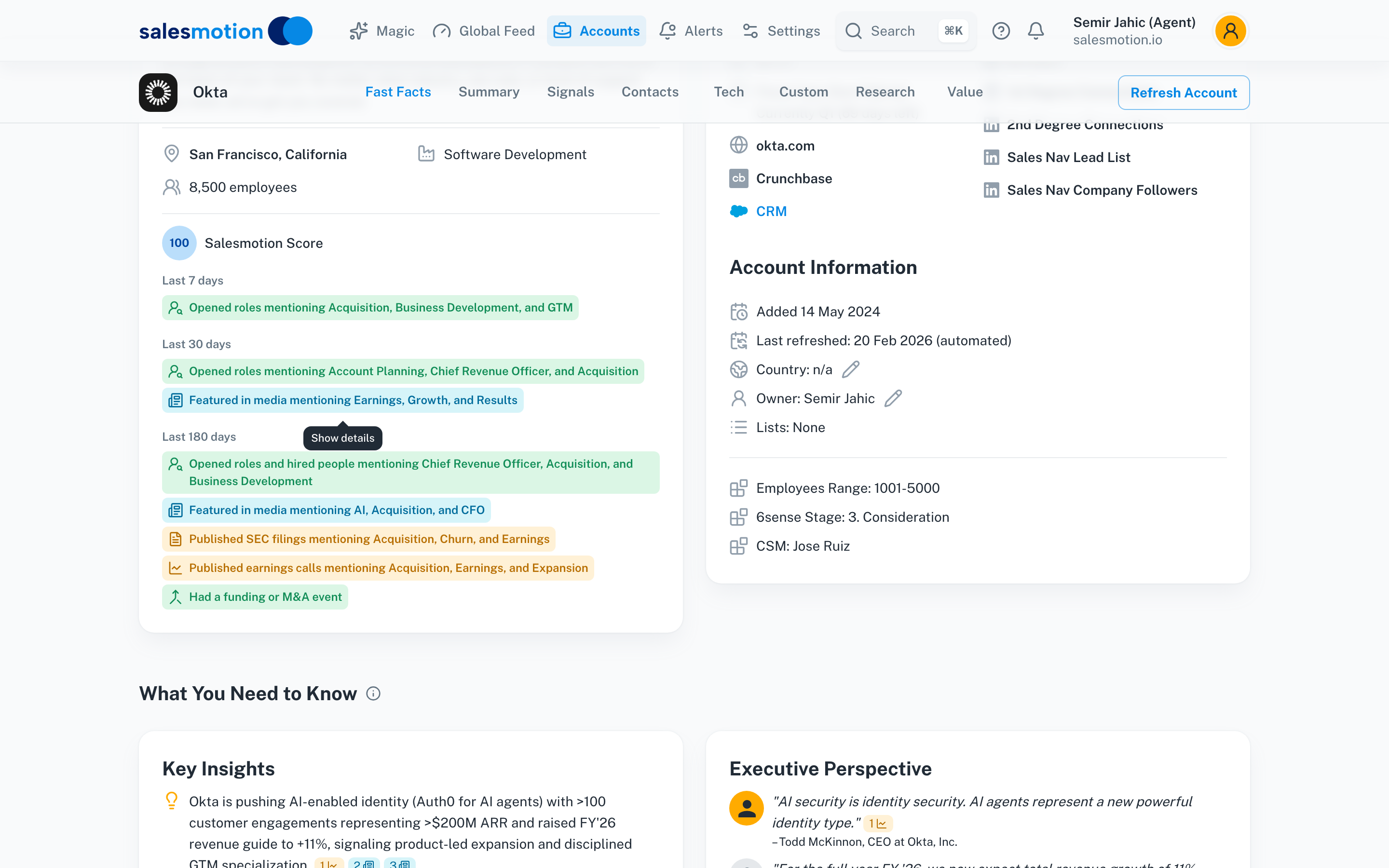 Salesmotion automates account research across 1,000+ sources — delivering key insights, executive commentary, opportunities, and competitive intelligence in a single brief.
Signals That Indicate Enterprise Software Purchase Readiness
The buying signals for enterprise software accounts are tied to product strategy, organizational growth, and competitive dynamics.
High-Intent Signals
- New VP or C-level hire in your target function: Technology leaders at enterprise software companies evaluate vendors within their first 90 days. A new CTO, VP of Engineering, or VP of Sales is your top signal.
- Product launch in an adjacent category: Expansion creates downstream needs for infrastructure, analytics, and operational tools.
- Earnings commitment to R&D or infrastructure investment: Public commitments to technology spend create budget certainty.
- Rapid headcount growth (50%+ YoY): Scaling fast breaks existing tooling and creates urgent operational needs.
Medium-Intent Signals
- Engineering blog post about technology migration: Moving from one infrastructure to another signals active vendor evaluation.
- Conference keynote about a new strategic direction: Public strategic commitments get operationalized within quarters.
- Competitor acquisition or major competitive shift: Creates urgency to strengthen their own capabilities.
Lower-Intent (Longer-Term) Signals
- Open source project launch: Signals technology direction 6-12 months ahead.
- Job posting for a role that uses your product category: Confirms the function exists or is being created.
- Analyst report placement or category leadership changes: Shapes how the company thinks about their market.
“Automatic account profile detail I can use to manage my territory. Using Salesmotion AI to generate value statements per persona, account, etc. Using Salesmotion to give me a starting point based on new hires, or news alerts is critical.”
Adam Wainwright
Head of Revenue, Cacheflow
Tools Comparison: Researching Enterprise Software Accounts
| Approach | Coverage | Time per Account | Signal Freshness | Enterprise SW Depth |
|---|---|---|---|---|
| Manual (GitHub, Product Hunt, LinkedIn, Crunchbase) | Good but fragmented | 30-60 minutes | Varies | High with expertise |
| General sales intelligence (ZoomInfo, Apollo) | Contact data, firmographics | 5-10 minutes | Daily | Low for product signals |
| Developer intelligence (BuiltWith, StackShare) | Tech stack and integrations | 5-10 minutes | Monthly | Medium |
| Salesmotion | Earnings, leadership, news, strategic signals | Under 5 minutes | Continuous | High for growth and event signals |
The most effective approach combines automated signal monitoring for leadership changes, earnings commentary, and news across your territory with targeted product and engineering research for accounts in your active pipeline.
For the complete guide to sales intelligence for enterprise software, including workflows for selling into product-led, sales-led, and hybrid organizations, explore our industry resource.
Key Takeaways
- Enterprise software accounts require product-focused research: roadmap signals, engineering hires, GitHub activity, and conference talks reveal technology direction better than financial data alone.
- Hiring patterns are the single most reliable leading indicator. The roles being created, the seniority level, and the specific technologies mentioned tell you where the company is investing.
- Competitive dynamics create time-sensitive buying windows. Track product launches and market entries by your prospect's competitors.
- Enterprise software buyers evaluate vendors with technical rigor. Research that demonstrates understanding of their product architecture and engineering culture earns credibility.
- Build a 10-minute framework covering growth stage, product direction, competitive landscape, leadership changes, and a specific outreach angle.
- Layer automated account intelligence for territory-wide monitoring with targeted product research on priority accounts.
- For related industry frameworks, see our guides to account research for SaaS and cybersecurity sales.
Frequently Asked Questions
How do you research an enterprise software company's product roadmap?
Monitor their product blog and changelog for recent releases. Check GitHub for new repositories and dependency changes. Review conference talks by their engineering leaders, which often preview upcoming capabilities 3-6 months ahead. Job postings for specific technology roles (ML engineers, platform architects) reveal where the product is heading. Earnings call transcripts for public companies include analyst questions about product strategy that elicit detailed roadmap commentary.
What GitHub signals are most useful for B2B sales?
New repository creation signals expansion into new product areas. Dependency file changes reveal infrastructure decisions (switching from one database to another, adopting new frameworks). Contributor growth indicates team investment. Issue labels like "enterprise" or "security" suggest feature prioritization. Archived repositories signal abandoned projects. For sales purposes, focus on repositories created in the last 6 months and major dependency changes rather than trying to analyze code quality.
How do conference presentations signal buying intent at enterprise software companies?
When an enterprise software company presents at a conference about a new technology area (AI, observability, security), it signals strategic commitment. Companies invest significant engineering time in preparing conference talks, so the topics represent genuine priorities rather than aspirational positioning. Watch for sponsored sessions (signals budget commitment), workshops (indicates product maturity), and keynote appearances (signals executive priority). The transition from "exploring" to "presenting results" typically happens 6-12 months before related tool purchases.
What makes selling to enterprise software companies different from other B2B sales?
The buyers are technical and evaluate vendors the way they evaluate their own code: critically. They expect deep product knowledge, integration details, and architecture fit. Procurement cycles involve engineering review alongside business review. References matter more because the buyer community is small and connected. Research that demonstrates understanding of their product architecture, engineering culture, and competitive landscape earns meetings that generic outreach cannot.