The best account intel in enterprise sales is sitting in plain sight, published on a predictable quarterly schedule, and almost nobody on your team is reading it.
Earnings calls are the only moment when a CEO and CFO speak candidly about where the company is heading, what keeps them up at night, and where the budget is flowing next quarter. Analysts ask pointed questions designed to surface exactly the kind of pain points, expansion plans, and competitive anxieties that sellers need to build a compelling point of view. And yet, the typical enterprise AE either skips the transcript entirely or skims the headline number and moves on.
The problem is not awareness. Most experienced sellers know earnings calls exist. The problem is time and method. A full transcript runs 8,000 to 12,000 words. Reading one end-to-end is a 45-minute commitment, and without a framework for extracting what matters, the effort rarely converts into a better meeting or a sharper email. So the transcript sits unread, and the rep walks into a call with the same surface-level research their competitor brought.
This post gives you a repeatable 10-minute framework for turning any public earnings call into a one-page account brief packed with selling signals you can use immediately. We will walk through the framework step by step, then apply it to a real earnings call from ServiceNow's Q4 2025 report so you can see exactly how it works. By the end, you will have a template you can hand to every AE on your team.
No finance degree required. No Wall Street jargon. Just a disciplined method for extracting the intelligence that separates a prepared seller from everyone else in the prospect's inbox.
Key Takeaways
- Earnings calls surface CEO and CFO priorities that rarely appear in news coverage or LinkedIn posts. The prepared remarks and analyst Q&A reveal budget direction, expansion bets, and pain points in the company's own words.
- A structured 10-minute framework beats unstructured 45-minute reading. Skipping to CFO remarks, scanning CEO vision, and mining the Q&A in sequence extracts 90% of the actionable intelligence in a fraction of the time.
- The analyst Q&A section is the richest source of selling signals. Analysts ask about risks, margin pressure, integration challenges, and competitive threats, all of which map directly to problems your solution may address.
- Every earnings call should produce a one-page account brief. A standardized template ensures signals convert into meeting preparation and outreach strategy, not just notes that sit in a doc.
- Salesmotion extracts and summarizes earnings insights from 1,000+ data sources, reducing the manual process from 45 minutes to seconds per account.
See Salesmotion in action
Take a self-guided interactive tour — no signup required.
Why Earnings Calls Are the Most Underused Signal in Sales
Enterprise sellers have access to more data than ever, yet research from Bain & Company shows that reps spend only about 28% of their week actually selling. Account research alone consumes 1 to 3 hours per account for reps who prepare thoroughly.
Earnings calls sit in a unique category. Unlike intent data or technographic signals, an earnings call gives you the executive's own words about their priorities, concerns, and investment thesis. And unlike a 10-K filing, the Q&A section is unscripted. Analysts press on exactly the topics executives would prefer to gloss over.
Research from Chicago Booth Review has shown that the language executives use on earnings calls contains hidden signals. When a CEO mentions terms like "lumpiness," "headwinds," or a "wait-and-see" period, it correlates with weaker performance in the following quarter. Greater use of euphemisms is associated with lower stock prices ahead, even after accounting for already-disclosed financials. For sellers, this means the transcript is not just a summary of last quarter. It is a leading indicator of where pressure will build next.
Despite this, most sales teams treat earnings calls as a finance function, not a sales function. The typical CRM has no field for "earnings-derived signals." The typical enablement program does not teach reps how to read a transcript. And the typical manager reviews pipeline mechanics, not account intelligence quality.
That gap is the opportunity. If your team is the only one walking into a meeting with a perspective informed by the CFO's own remarks about margin pressure in EMEA or the CEO's stated commitment to consolidating vendors, you are not just prepared. You are differentiated.
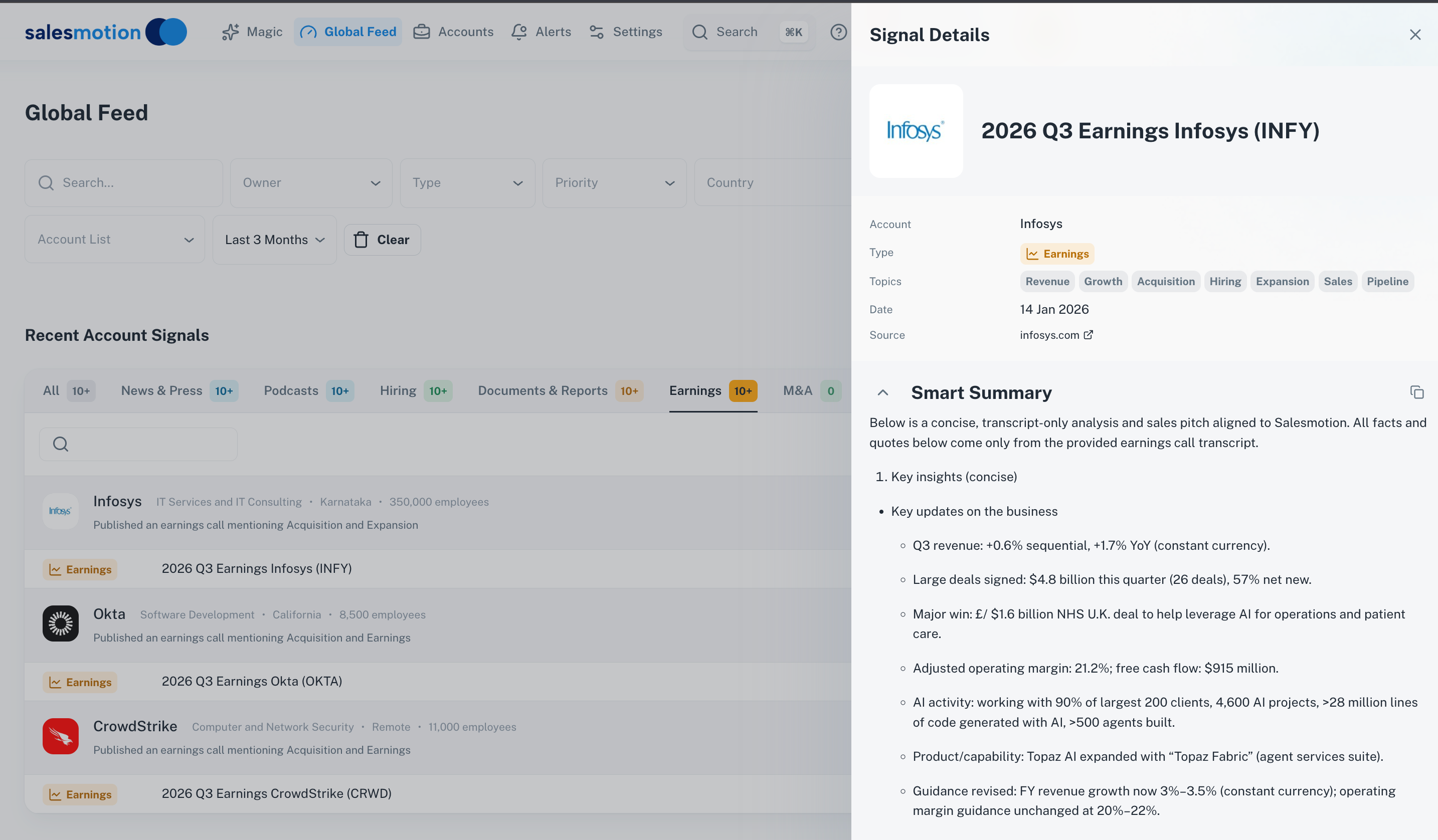 Salesmotion automatically extracts selling signals from earnings calls, surfacing budget direction, strategic priorities, and pain points.

“It's not even just about saving time — it's about uncovering things we otherwise might not research. Salesmotion helps us connect Guild to what's already publicly important to the company.”
Derek Rosen
Director, Strategic Accounts, Guild Education
The 10-Minute Earnings Call Framework
This framework is designed for CROs and enterprise AEs who need to extract selling signals fast, without getting lost in financial details that do not map to a sales conversation. Each step has a time target. The entire process should take 10 minutes or less.
Step 1: Skip to the CFO's Prepared Remarks (Minutes 1-2)
Open the transcript and scroll past the operator introduction and any legal disclaimers. Find the CFO section, which typically begins after the CEO's opening.
The CFO's prepared remarks tell you where the money is going. You are looking for three things:
- Revenue guidance for next quarter or year. Is the company guiding up or down? Upward guidance signals confidence and budget availability. Downward guidance means tighter scrutiny on new vendor spend.
- Margin commentary. Are margins expanding or compressing? Margin pressure usually triggers vendor consolidation, cost optimization projects, and efficiency mandates. These are all potential entry points.
- Capital allocation priorities. Is the company investing in R&D, acquisitions, share buybacks, or debt reduction? R&D and M&A spending signals growth mode. Buybacks and debt paydown signal efficiency mode. Each requires a different selling approach.
Write down a one-sentence summary: "Budget direction is [expanding/tightening/shifting to X]."
Step 2: Read the CEO's Strategic Vision (Minutes 2-4)
Now scroll up to the CEO's prepared remarks. The CEO section is typically the longest and covers the broadest ground. You are not reading for financial detail here. You are reading for strategic narrative.
Look for:
- Product bets. What new products, platforms, or capabilities did the CEO highlight? If they spent three paragraphs on a new AI platform, that is where internal resources and attention are flowing.
- Expansion areas. New geographies, new customer segments, new verticals. These create org-level buying triggers as the company hires, builds infrastructure, and partners.
- Competitive positioning. How does the CEO describe the company's moat? Who do they reference directly or indirectly? A CEO who says "we are the only platform that..." is telegraphing the competitive narrative your champion will hear internally.
- Customer stories. CEOs often mention specific customers or deal sizes. These are proof points about what the company values and where it is winning.
Write down the top 2-3 strategic priorities in the CEO's own language. This language will become your outreach vocabulary.
Step 3: Scan the Q&A for Pain Points (Minutes 4-7)
This is the most valuable section for sellers. Analyst questions are designed to probe weak spots, and executive responses under pressure often reveal more than the prepared script.
Spend three minutes scanning the Q&A for:
- Repeated themes. If three analysts ask about the same topic, such as gross margin headwinds, AI monetization uncertainty, or federal spending exposure, that topic is a live concern for the market and likely for the company's board.
- Defensive language. Watch for hedging phrases such as "early innings," "we are monitoring," or "it is too soon to quantify." These indicate uncertainty, which means the company is still evaluating solutions in that area.
- Specific challenges named by analysts. Questions like "How are you addressing security concerns with agentic AI?" or "What is the margin impact of your hyperscaler partnerships?" point directly to problems the company is actively working to solve.
- Forward-looking commitments. When a CEO says "we expect this to be a billion-dollar opportunity by next year," that commitment creates internal pressure to deliver, which drives budget allocation and urgency.
Write down 2-3 pain points or areas of uncertainty from the Q&A.
Step 4: Extract the Selling Signals (Minutes 7-9)
Now map your notes to your solution. This is the translation step where raw intelligence becomes sales strategy. For each finding, ask yourself:
"Does our solution address this priority, reduce this risk, or accelerate this initiative?"
Not every signal will map. That is fine. You are looking for 1-2 strong connections. A strong connection means you can say to a prospect: "Your CFO told analysts that [specific priority]. Here is how we help companies executing that same strategy."
Categorize each signal:
- Budget signal: Money is flowing to a specific initiative. Your solution supports that initiative.
- Pain signal: Analysts pressed on a weakness. Your solution addresses that weakness.
- Expansion signal: The company is entering a new market, launching a new product, or acquiring. Your solution supports the change management that comes with expansion.
- Consolidation signal: Margin pressure or efficiency mandates suggest the company is looking to do more with fewer vendors. Your solution replaces or consolidates existing tools.
For a deeper framework on identifying and acting on buying signals, see our complete guide to buying signals in sales.
Step 5: Build the Account Brief (Minute 10)
Compile your notes into a structured one-page brief. This brief is what you bring to your next team meeting, share with your champion, or use to write a highly specific outreach email.
The format is standardized so every account brief on your team looks the same, which makes pipeline reviews faster and coaching more specific. We provide the full template below.
Real Example: Breaking Down ServiceNow's Q4 2025 Earnings Call
Let us apply the framework to ServiceNow's Q4 2025 earnings call, reported on January 28, 2026. This is a real public transcript, and the signals below are drawn directly from it.
Step 1 Applied: CFO Gina Mastantuono's Remarks
CFO Gina Mastantuono guided 2026 subscription revenues at $15.53 billion to $15.57 billion, representing 19.5% to 20% year-over-year constant-currency growth. Operating margin guidance was 32%, up 100 basis points. The company announced a $5 billion share repurchase authorization and a $2 billion accelerated buyback program.
Budget direction: Expanding, but with a clear efficiency narrative. The margin expansion plus aggressive buybacks signal a company confident in cash generation but disciplined about spending. Selling into ServiceNow's ecosystem means aligning with efficiency, not just growth.
Step 2 Applied: CEO Bill McDermott's Strategic Vision
CEO Bill McDermott framed ServiceNow as "the gateway" to enterprise AI, describing the platform as "the semantic layer that makes AI ubiquitous in the enterprise." He stated that ServiceNow "drives the hyperscalers, the language models, the data lakes, the systems of record, and now the security profile of companies."
Key product bets: AI agents, the AI Control Tower for governance, and Now Assist, which is tracking toward a $1 billion-plus revenue target for 2026. McDermott emphasized that customers' biggest barrier to AI adoption was "losing control, security, governance, and compliance" and positioned AI Control Tower as the solution.
Strategic priorities in CEO language: AI agent orchestration, enterprise AI governance, platform consolidation.
Step 3 Applied: The Analyst Q&A
Analysts probed several pressure points:
- Goldman Sachs asked about gross margin headwinds from cloud infrastructure and AI investments. Mastantuono attributed the temporary margin impact to hyperscaler partnerships and said efficiencies would drive future accretion. Signal: cost pressure on infrastructure decisions.
- JMP Securities raised concerns about AI agent security and monitoring. President Amit Zavery explained the AI Control Tower's real-time monitoring, kill switches, and compliance features. Signal: enterprise customers are anxious about agentic AI governance.
- Jefferies asked about M&A strategy. McDermott said no large-scale acquisitions are on the roadmap, calling recent deals "talent and technology" focused. The Armis acquisition is expected to close in H2 2026. Signal: organic growth focus, but security is a strategic investment area.
- Federal market exposure was questioned amid government shutdown concerns. McDermott said the federal business performed well despite headwinds. Signal: public sector pipeline exists but carries political risk.
Step 4 Applied: Extracted Selling Signals
If you sell a solution that touches any of these areas, here is what you now know:
| Signal Type | Finding | Selling Angle |
|---|---|---|
| Budget | $1B+ Now Assist target, 20% subscription growth guided | AI-adjacent solutions have budget runway; align your pitch with AI enablement |
| Pain | Gross margin pressure from hyperscaler partnerships | Solutions that reduce infrastructure cost or improve efficiency will resonate |
| Expansion | AI Control Tower launch, Armis acquisition for security | Security and AI governance teams are expanding; new buyers are being hired |
| Consolidation | "One platform" narrative, 98% renewal rate | ServiceNow is displacing point solutions; if you integrate with them, lead with that |
These four signals, extracted in under 10 minutes, give you a more informed perspective than 95% of sellers reaching out to anyone in ServiceNow's ecosystem.
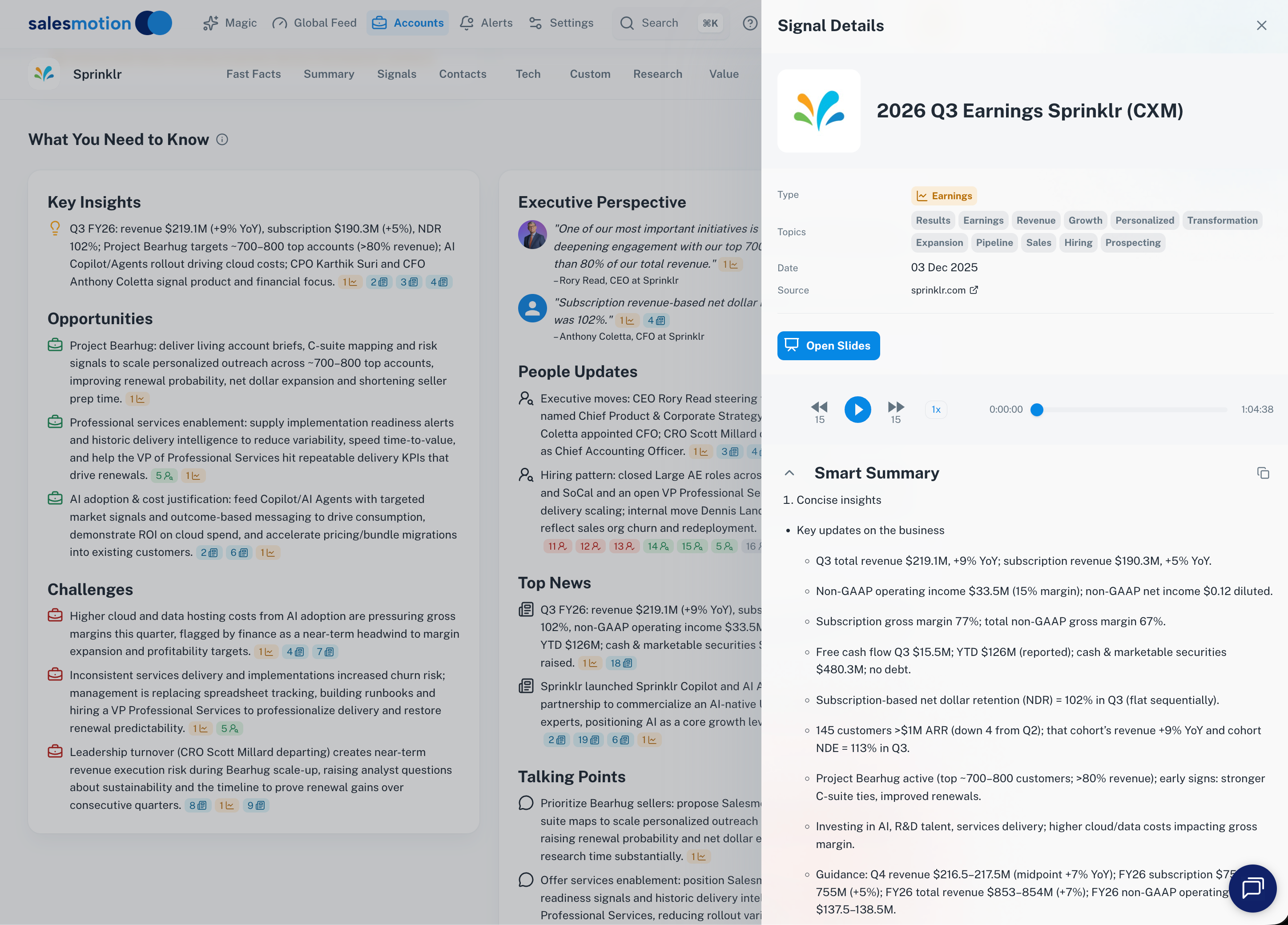 An account summary view combines earnings signals with other data sources to build a complete intelligence picture.

“Automatic account profile detail I can use to manage my territory. Using Salesmotion AI to generate value statements per persona, account, etc. Using Salesmotion to give me a starting point based on new hires, or news alerts is critical.”
Adam Wainwright
Head of Revenue, Cacheflow
The Account Brief Template
Use this template for every strategic account after reviewing their earnings call. It standardizes the output so your entire team produces consistent, actionable briefs. For a broader approach to account planning, see our account plan templates guide.
EARNINGS CALL ACCOUNT BRIEF
Company: [Name] | Ticker: [Symbol] | Quarter: [Q# FY####]
Call Date: [Date] | Transcript Source: [Link]
1. Budget Direction (from CFO remarks)
- Revenue guidance: [Up / Down / Flat] — [specific numbers]
- Margin trajectory: [Expanding / Compressing] — [commentary]
- Capital allocation: [Growth / Efficiency / Mixed] — [key investments]
- One-sentence summary: ____
2. Strategic Priorities (from CEO remarks)
- Priority 1: ____
- Priority 2: ____
- Priority 3: ____
- CEO's own language for these priorities: ____
3. Pain Points and Uncertainties (from analyst Q&A)
- Repeated concern 1: ____
- Repeated concern 2: ____
- Defensive language or hedging observed: ____
4. Expansion Plans
- New products or platforms: ____
- New geographies or segments: ____
- Acquisitions announced or pending: ____
5. Selling Signals Mapped to Our Solution
- Signal 1: [Finding] → [How our solution connects]
- Signal 2: [Finding] → [How our solution connects]
- Strength of fit: [Strong / Moderate / Weak]
6. Recommended Approach
- Target persona(s): ____
- Opening message angle: ____
- Supporting proof point: ____
- Timing consideration: ____
This template works for any publicly traded company. If your account is private, the same framework applies to annual reports, investor presentations, or CEO interviews at conferences.
One tip for making this actionable: pair the earnings brief with an ICP scoring assessment to prioritize which accounts deserve the full 10-minute treatment versus a quick skim. Not every account in your book warrants deep earnings analysis. Focus the effort on your top 20 strategic accounts.
Connecting Earnings Signals to Your Value Hypothesis
The account brief is only useful if it changes what you say and how you say it. The final step is translating signals into a value hypothesis specific to the account.
Here is the formula:
"[Account] is prioritizing [strategic priority from CEO remarks] while managing [pain point from Q&A]. Based on how [similar company] achieved [specific outcome], we believe [your solution] can help [account] [measurable result] within [timeframe]."
For the ServiceNow example, a vendor selling data infrastructure might write:
"ServiceNow is prioritizing AI agent orchestration while managing gross margin pressure from hyperscaler partnerships. Based on how [similar customer] reduced cloud infrastructure costs by 30% while scaling AI workloads, we believe our platform can help ServiceNow's engineering team improve compute efficiency within two quarters."
That is not a cold email. That is a perspective rooted in the executive's own public statements. It demonstrates preparation that most competitors will not match.
When building your ideal customer profile, consider adding "recent earnings call signals" as a qualification criterion. Accounts where the CEO publicly stated a priority that aligns with your solution are warmer than accounts where you are guessing at priorities.
How Salesmotion Automates Earnings Analysis
The 10-minute framework above works. It is also manual. For CROs managing teams of 20 or more AEs across hundreds of strategic accounts, the math breaks down. If each rep covers 50 accounts and spends 10 minutes per earnings call, that is over 8 hours per quarter per rep, just on earnings analysis, and that assumes they actually do it.
Salesmotion monitors earnings calls, financial filings, leadership changes, and strategic announcements across 1,000+ data sources and distills them into account-level signals your team can act on the same day. Instead of asking reps to read transcripts and fill out templates manually, the platform surfaces the selling signals that matter, such as budget shifts, expansion plans, leadership commentary on pain points, and maps them to the accounts in your CRM.
The result is the same quality of intelligence this framework produces, delivered automatically and at scale. Teams report cutting account research time from over an hour to under five minutes per account, freeing reps to spend that time in conversations, not in transcripts.
If you want to see how this works for your team's specific accounts, book a 15-minute demo and we will run the analysis on your actual target list.
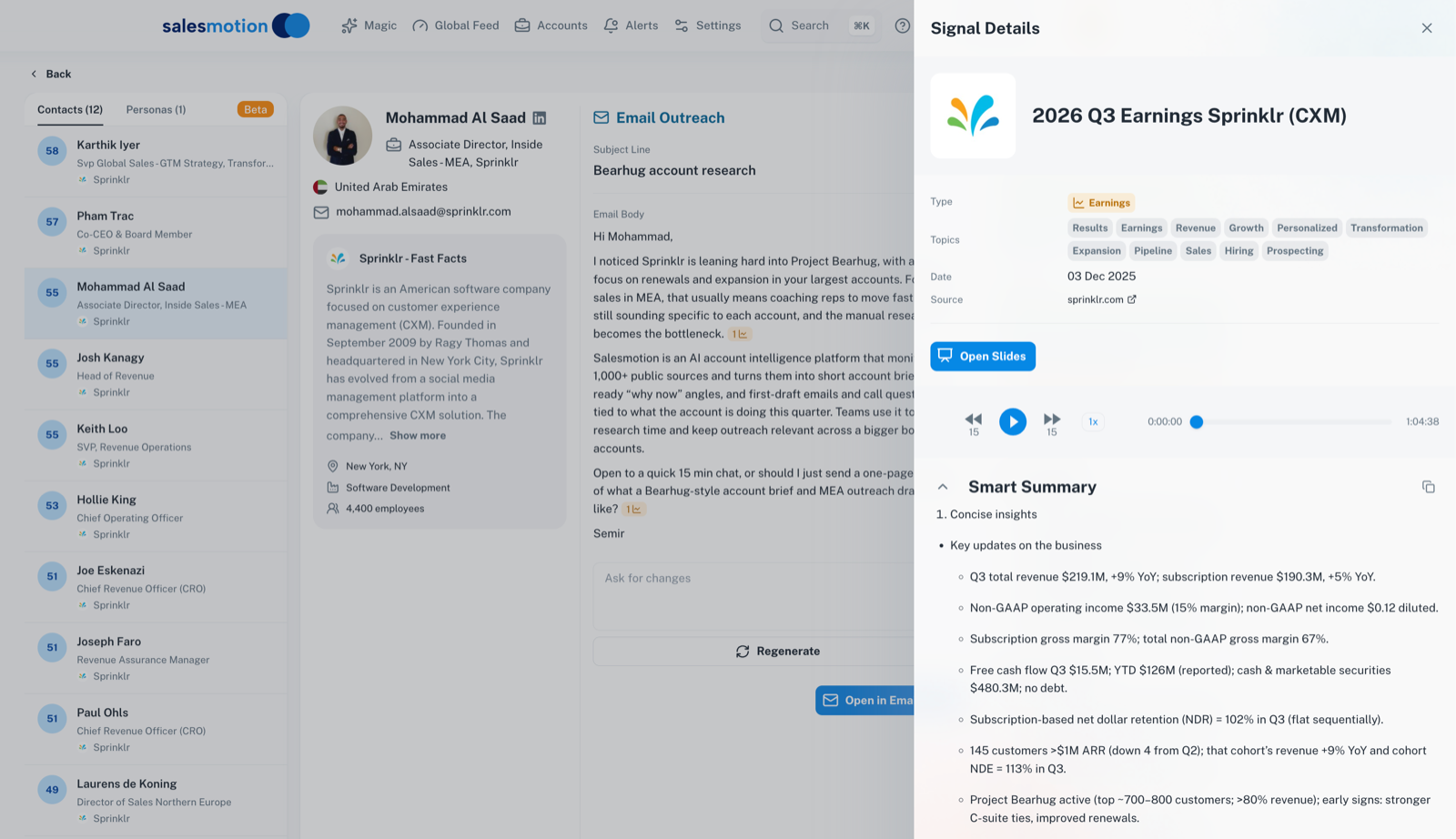 Earnings insights flow directly into outreach, so every email references the executive's own stated priorities.
Frequently Asked Questions
Where can I find earnings call transcripts for free?
Several sources provide free access to earnings call transcripts. The Motley Fool publishes full transcripts within hours of each call. Seeking Alpha offers transcripts with a free account for recent calls. Yahoo Finance also hosts transcripts under each stock's "Earnings" tab. For the most comprehensive access, the company's own investor relations page typically posts both the audio recording and a transcript within 24 to 48 hours. Most transcripts run 8,000 to 12,000 words, which is why having a framework to extract the key signals quickly is essential.
How do I identify selling signals if I am not familiar with finance terminology?
You do not need a finance background. Focus on three categories of language rather than specific metrics. First, listen for priority language: words like "investing in," "doubling down on," "accelerating," and "committed to" signal where budget is flowing. Second, watch for pressure language: phrases like "headwinds," "challenging environment," "monitoring closely," and "early innings" reveal pain points. Third, track expansion language: mentions of "new markets," "acquisitions," "partnerships," and "platform expansion" indicate growth areas that create buying triggers. The Chicago Booth Review research confirms that executive language patterns are predictive, even without deep financial analysis.
Should I analyze earnings calls for every account in my territory?
No. The 10-minute framework is designed for your top strategic accounts, typically the 10 to 20 accounts where deal size and strategic importance justify the investment. For the rest of your territory, a headline scan of guidance direction, up or down, is sufficient. The account brief template is most valuable when you are preparing for a specific executive meeting, building a strategic account plan, or developing outreach to a new logo. Prioritize accounts where the earnings signal directly aligns with your solution's value proposition.
What is the difference between the prepared remarks and the Q&A section?
The prepared remarks are scripted and reviewed by legal counsel before the call. They present the company's preferred narrative: strong results, strategic progress, and a confident outlook. The Q&A section is largely unscripted. Analysts ask questions the company did not choose, often targeting weak spots such as margin compression, competitive threats, integration risks, or slowing growth in specific segments. For sellers, the Q&A is almost always more valuable because it surfaces the concerns and uncertainties that executives would not voluntarily highlight. That is where you find the real buying signals.
How quickly after an earnings call should I act on the signals?
Within 48 hours. Earnings calls create a brief window where the company's priorities are top of mind for their entire leadership team. Board discussions, all-hands meetings, and strategy sessions typically happen in the week following the call. An outreach message that references the CEO's stated priority within that window demonstrates real-time awareness that stands out. After two weeks, the earnings narrative fades into background noise and your reference loses its immediacy. Set a calendar reminder for each strategic account's earnings date so you are ready to act the same day the transcript drops.
Can I use earnings call analysis for private companies that do not file public reports?
The framework adapts well to private companies, though the source material changes. Private companies publish annual reports, investor presentations at industry conferences, CEO interviews on podcasts and in trade publications, and press releases about funding rounds or strategic partnerships. The same signal categories apply: budget direction, strategic priorities, pain points, and expansion plans. For PE-backed or VC-backed companies, the investor's quarterly letter or the company's blog often contains the same forward-looking language you would find in an earnings call. The key is applying the same structured extraction method to whatever public statements the company's leadership has made.