Selling into health systems, hospitals, and healthcare technology companies requires a different research playbook than most B2B sales. The data is public, abundant, and scattered across government databases, regulatory filings, and industry quality reports. Most reps either skip the research entirely or spend 90 minutes clicking through CMS databases without knowing what to look for.
Account research for healthcare sales is about understanding operational pressures, compliance posture, leadership priorities, and patient volume trends. The reps who consistently win in healthcare are the ones who walk into meetings understanding the specific challenges their prospect faces, backed by data from sources that healthcare executives actually trust. This is signal-based selling applied to one of the most data-rich industries in B2B.
TL;DR: Healthcare account research requires industry-specific sources like CMS databases, Hospital Compare, Joint Commission reports, and state licensing data. Build a focused 10-minute framework that surfaces operational challenges, compliance issues, and leadership changes. The best healthcare sales reps connect their solutions to specific regulatory or operational pressures rather than generic pain points.
Why Healthcare Account Research Requires a Different Approach
Healthcare is one of the most regulated industries in the US. Every hospital, health system, and payer operates under layers of federal and state oversight that generate massive amounts of public data. This is both an advantage and a challenge for sales teams.
The advantage: you can learn more about a hospital's financial health, quality scores, staffing ratios, and compliance record from public sources than you can about almost any other type of prospect. The challenge: knowing which sources matter, what the data means, and how to translate operational metrics into a sales conversation.
Three factors make healthcare research fundamentally different:
Regulatory-driven purchasing. Healthcare organizations buy technology to meet compliance requirements, prepare for regulatory changes, or address quality deficiencies. Understanding the current regulatory landscape and your prospect's specific compliance posture gives you an angle that generic feature pitches cannot match.
Long sales cycles with clinical and administrative stakeholders. A technology purchase at a 500-bed hospital might involve the CIO, CMIO, VP of Nursing, CFO, and compliance officer. Each has different priorities. Your research needs to surface intelligence relevant to multiple stakeholders, not just one.
Budget cycles tied to reimbursement and patient volumes. Hospital budgets are driven by Medicare/Medicaid reimbursement rates, patient admissions, payer mix, and operating margins. Understanding these financial dynamics tells you whether a prospect is in growth mode, cost-cutting mode, or investing in transformation.
The Key Sources to Monitor for Healthcare Accounts
Effective account research for healthcare requires knowing where to find the data that healthcare leaders actually use to make decisions.
CMS Databases
The Centers for Medicare & Medicaid Services publishes detailed data on every Medicare-certified hospital in the country. Key resources include:
- Hospital Compare: Quality scores, patient satisfaction (HCAHPS), readmission rates, mortality rates, and safety indicators. These scores directly affect reimbursement.
- Cost Reports: Financial data showing operating margins, revenue by department, and staffing costs. Available through the Healthcare Cost Report Information System (HCRIS).
- Provider Enrollment Data: Identifies which facilities are active, their specialties, and ownership changes.
Joint Commission and Accreditation Data
The Joint Commission accredits more than 22,000 healthcare organizations. Their accreditation reports, survey findings, and quality improvement requirements create purchasing pressure. A hospital that just received survey findings with "Requirements for Improvement" is actively looking for solutions to address those gaps.
State Health Department Data
Every state publishes hospital licensing data, certificate of need filings, inspection reports, and staffing ratios. Certificate of need applications reveal planned expansions, new service lines, and capital investments before they appear in press releases.
SEC Filings and Earnings (Publicly Traded Systems)
For-profit health systems like HCA Healthcare, Tenet Health, and Community Health Systems file detailed financial reports. Their 10-K filings include same-facility admissions growth, revenue per admission, and technology investment commentary. Non-profit health systems file IRS Form 990s, which disclose executive compensation, revenue, and major investments.
Industry Trade Publications
Becker's Hospital Review, Modern Healthcare, and Healthcare Dive cover executive moves, M&A activity, strategic initiatives, and technology investments. These publications often break news about leadership changes and organizational restructuring before LinkedIn updates appear.

“There's been a big focus on hyper personalization and relevance in our outbounding efforts. Salesmotion has been a key partner in hitting our significantly increased meeting targets. What stands out is how simple it is. Reps can log in and get valuable account insights within 30 seconds to a minute.”
Joe DeFrance
VP of Sales, Incredible Health
The 10-Minute Research Framework for Healthcare Accounts
Here is a structured approach to researching a healthcare account in 10 minutes that gives you enough context for a compelling first conversation.
Minutes 1-3: Organizational Snapshot Identify the system size (number of facilities, beds, employees), ownership type (non-profit, for-profit, academic), and geographic footprint. Check their "About" page and recent press releases. Note the CEO and key executives in your buying function.
Minutes 3-5: Financial and Operational Health Pull Hospital Compare data for their flagship facility. Note quality star ratings, patient experience scores, and any below-average metrics. For publicly traded systems, check the latest earnings call transcript. For non-profits, search for their most recent Form 990 or bond rating.
Minutes 5-7: Regulatory and Compliance Posture Check Joint Commission accreditation status and any recent survey findings. Search state health department records for inspection results or corrective action plans. Look for any CMS penalties related to readmissions, hospital-acquired conditions, or meaningful use.
Minutes 7-9: Strategic Initiatives and Leadership Changes Search Becker's and Modern Healthcare for recent coverage. Check LinkedIn for new C-suite or VP-level hires in your target function. Look for announcements about new service lines, facility expansions, EHR migrations, or digital transformation initiatives.
Minutes 9-10: Synthesize Your Angle Connect one specific finding to your solution. A hospital with below-average patient satisfaction scores and a new Chief Patient Experience Officer is a very different conversation than a health system expanding into ambulatory surgery centers.
Teams using Salesmotion compress this entire process. The platform pulls earnings data, leadership changes, news coverage, and strategic initiatives into a single account brief, eliminating the need to toggle between CMS, LinkedIn, SEC filings, and Google. Incredible Health, a healthcare technology company, increased quarterly meetings booked by 50% after adopting a signal-driven research approach.
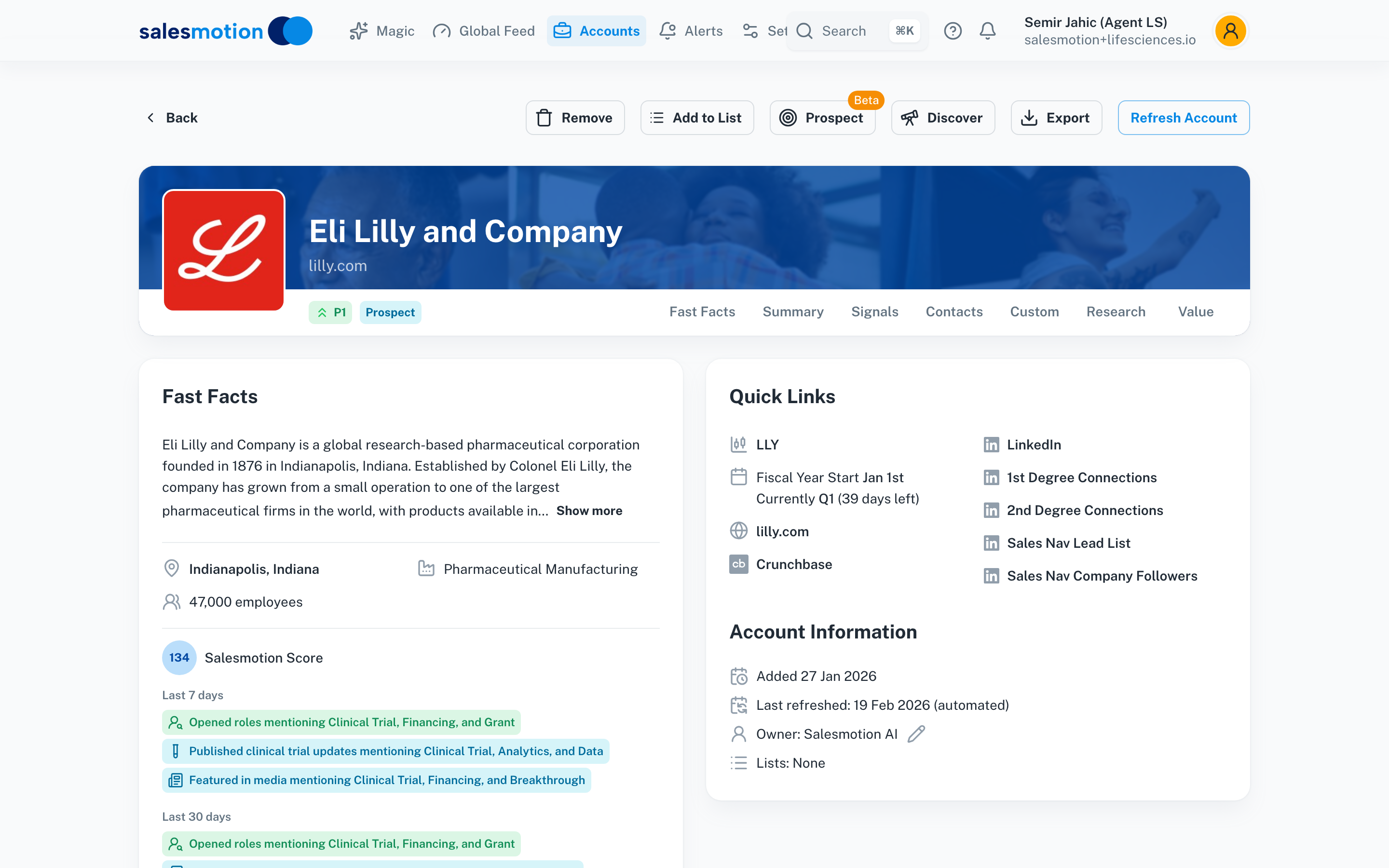 Salesmotion generates complete account briefs for life sciences companies — clinical trial activity, leadership changes, strategic priorities, and competitive intelligence — in minutes instead of hours.
Signals That Indicate Healthcare Purchase Readiness
The buying signals that matter most in healthcare sales are specific to the industry's regulatory and operational dynamics.
High-Intent Signals
- New CIO, CMIO, or VP-level hire in your target function: Leadership changes trigger technology evaluations within 60 to 90 days. A new CIO almost always conducts a technology assessment in their first quarter.
- EHR migration or major system upgrade: Epic or Cerner implementations create downstream needs for analytics, integration, and workflow tools.
- CMS penalty or quality score decline: Organizations penalized for readmissions, infections, or patient safety events are under immediate pressure to invest in solutions.
- Merger or acquisition announcement: M&A activity creates technology consolidation needs and often unlocks new budget for integration projects.
Medium-Intent Signals
- Certificate of need filing: Planned facility expansions or new service lines signal capital investment cycles.
- Joint Commission survey findings: Requirements for improvement create compliance-driven purchasing urgency.
- Executive commentary on "digital transformation" or "operational efficiency": Earnings call language that signals technology investment appetite.
Lower-Intent (Longer-Term) Signals
- Workforce expansion postings: Hiring for clinical or operational roles signals growth.
- Academic partnerships or research grants: New research programs may need supporting technology.
- Payer contract changes: New value-based care arrangements drive analytics and population health needs.

“We're saving about 6 hours per week per seller on account research alone. That's time they can reinvest in actually selling.”
Derek Rosen
Director, Strategic Accounts, Guild Education
Tools Comparison: Researching Healthcare Accounts
| Approach | Data Coverage | Time per Account | Signal Freshness | Healthcare Depth |
|---|---|---|---|---|
| Manual (CMS, Joint Commission, state sites) | Deep but fragmented | 60-90 minutes | Varies by source | Very high |
| General sales intelligence (ZoomInfo, LinkedIn) | Contact data, basic firmographics | 5-10 minutes | Daily | Low, misses operational data |
| Healthcare-specific databases (Definitive Healthcare) | Comprehensive clinical and financial data | 10-20 minutes | Monthly | Very high |
| Salesmotion | Financial, leadership, news, strategic signals | Under 5 minutes | Continuous | Strong for public and news data |
The best approach for healthcare sales teams is to combine automated signal monitoring for leadership changes, news, and strategic initiatives with targeted CMS and state database research for accounts in your active pipeline. This gives you both breadth across your territory and depth on priority accounts.
Building a Healthcare-Specific Research Routine
For teams selling into healthcare at scale, consider building these industry-specific research habits into your weekly workflow:
Monday territory scan: Review any account intelligence alerts from the previous week. Prioritize accounts with leadership changes, regulatory events, or M&A activity.
Before every meeting: Pull the account's Hospital Compare quality scores and most recent financial data. Reference at least one specific operational metric in your discovery questions.
Monthly pipeline review: For accounts in your pipeline, update your understanding of their strategic priorities by reviewing the latest earnings call transcript or press releases. Track any changes in quality scores or accreditation status.
For a comprehensive guide to applying sales intelligence in healthcare, including workflows for health system, payer, and healthtech sales, visit our industry-specific resource page.
Key Takeaways
- Healthcare account research requires CMS databases, Hospital Compare, Joint Commission reports, and state licensing data that general sales tools do not cover.
- Quality scores, patient satisfaction data, and compliance records are publicly available and reveal specific operational challenges you can address.
- The highest-intent buying signals in healthcare are C-suite hires, EHR migrations, CMS penalties, and M&A announcements.
- Build a weekly research routine that combines automated signal monitoring with targeted deep research on priority accounts.
- Connect every outreach to a specific operational metric, regulatory pressure, or strategic initiative rather than generic pain points.
- Healthcare buying cycles involve multiple stakeholders. Research that surfaces intelligence relevant to clinical, financial, and operational leaders wins over single-stakeholder pitches.
- For research frameworks in other regulated industries, see our guides to account research for cybersecurity and professional services.
Frequently Asked Questions
What public data sources are most useful for healthcare account research?
CMS Hospital Compare is the most accessible starting point, offering quality scores, patient satisfaction data, readmission rates, and safety indicators for every Medicare-certified hospital. Combine this with Joint Commission accreditation data, state health department inspection reports, and either SEC filings (for-profit systems) or IRS Form 990s (non-profit systems) for financial health. Together, these free sources provide a comprehensive view of a healthcare organization's operational and financial status.
How do you identify the right stakeholders in a health system?
Healthcare technology purchases typically involve the CIO or CMIO for clinical systems, CFO for financial impact, VP of Nursing or CMO for clinical workflow, and compliance officers for regulatory solutions. Start with the C-suite listed on the organization's leadership page, then use LinkedIn to identify VPs and directors in your target function. Certificate of need filings and strategic plan documents often name the executives leading specific initiatives.
How long are healthcare sales cycles?
Healthcare sales cycles typically run 6 to 18 months depending on deal size and stakeholder complexity. Technology purchases over $250,000 usually require board approval at non-profit systems. Academic medical centers and large integrated delivery networks tend to have longer cycles due to additional governance layers. Timing outreach to a regulatory event, leadership change, or strategic initiative can compress cycles by entering the conversation when urgency already exists.
What signals indicate a hospital is ready to buy new technology?
The strongest signals are a new CIO or CMIO appointment (they evaluate technology in their first 90 days), an EHR migration announcement (creates downstream integration needs), CMS penalties or quality score declines (regulatory pressure), and earnings call language about "digital transformation" or "operational improvement." M&A announcements also reliably create technology buying windows as systems consolidate their technology stacks during integration.