Smart sales outreach starts long before sending the first message. Account research gives you the context to reach out with relevance — turning cold contacts into warm opportunities.
What Is Account Research?
Account research refers to the structured process of gathering and analyzing detailed information about target companies and their stakeholders before any outreach begins. This includes firmographic data (industry, size, revenue), technographic or tech-stack information, recent company developments (leadership changes, funding, product launches), and trigger events that signal readiness or fit. For an in-depth look at this discipline, see our guide to account research.
Unlike simple lead research (which focuses on individuals), account research means evaluating the whole organization as a potential buyer. You treat the company as the “unit” — understanding its structure, priorities, and potential needs. DataBees: What Is Account Research?
See Salesmotion in action
Take a self-guided interactive tour — no signup required.
Why Account Research Matters More Than Ever
- Personalised outreach improves engagement and conversion. Generic mass outreach rarely works in modern B2B — account research ensures your messaging resonates with real business context. UserGems – Account-Based Prospecting guide
- Focus on high-value accounts increases efficiency. By targeting fewer but better-fit companies, you optimize sales resources and avoid time wasted on poor-fit leads. DataBees – Account Research helps identify high-value accounts
- Simpler, shorter, more relevant sales cycles. With deep account understanding, you approach prospects who already show contextual fit — reducing the time and friction needed to build trust. B2Brain – Comprehensive Guide to Account Research
- Better alignment across teams (sales, marketing, success). In account-based models, shared intelligence about accounts helps marketing and sales coordinate effectively. Gartner – The Account-Based Everything Framework

“It's not even just about saving time — it's about uncovering things we otherwise might not research. Salesmotion helps us connect Guild to what's already publicly important to the company.”
Derek Rosen
Director, Strategic Accounts, Guild Education
Where Account Research Fits: ABM, ABP & ABS
Account research is foundational for modern B2B go-to-market strategies like:
- Account-Based Marketing (ABM): Targeting a defined set of high-value accounts rather than broad demand generation. Wikipedia – Account-Based Marketing
- Account-Based Prospecting (ABP): Doing deep research and outreach to a curated list of high-fit accounts — ideal when there is no active opportunity yet. UserGems – Account-Based Prospecting explained
- Account-Based Selling (ABS): Once a lead is engaged, using account intelligence to guide the sales process through multiple stakeholders, cross-sell, upsell and long-term account expansion. Wikipedia – Account-Based Selling
In other words: account research is the intelligence engine that fuels account-based strategies. Without it, outreach becomes generic, scattershot and much less effective. SalesHive – Account Research is central to outbound strategy
What Good Account Research Includes
Effective account research goes beyond basic firmographics. At minimum, a robust research process should include:
- Firmographics: Company size, industry, revenue band, number of employees, headquarters location. SalesHive definition
- Technographics & Tech Stack Details: Tools, platforms, software currently in use — helpful to evaluate fit and potential integration needs. B2Brain – Account Research guide
- Trigger Events & Signals: Recent funding rounds, leadership changes, product launches, growth hiring, business expansion, strategic shifts. These buying signals often indicate readiness for new solutions. DataBees – Account Research use-case
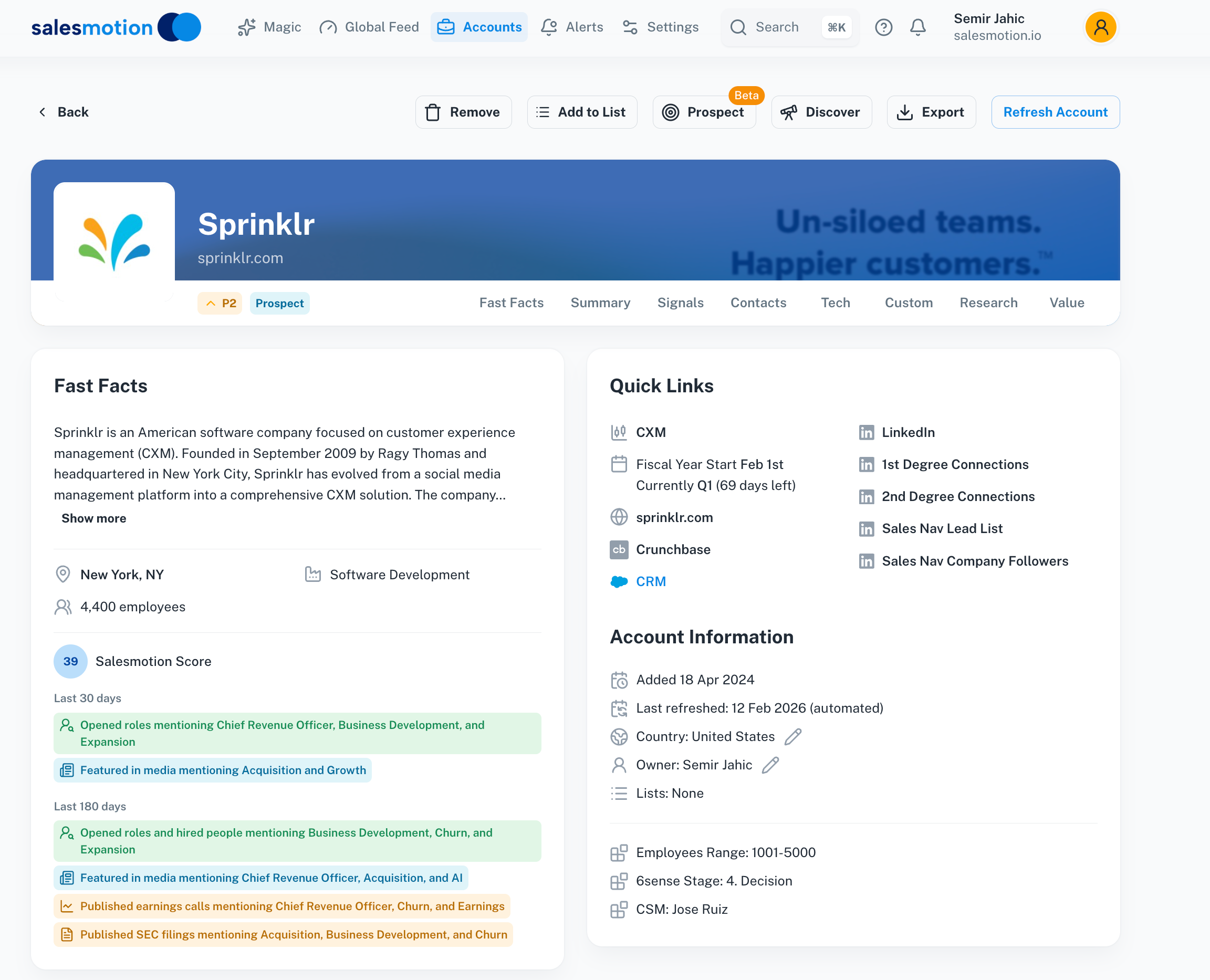 Salesmotion consolidates firmographics, technographics, trigger events, and stakeholder data into a single account research view.
- Organizational Structure & Decision-Makers: Key stakeholders, buying committee, decision-making structure — to ensure you reach the right people. SalesHive definition
- Intent & Behavioral Signals: Website visits, content consumption, public announcements, tech stack moves, hiring ads — all can hint at current challenges or buyer intent data. Gartner – Account-Based Everything framework

“Automatic account profile detail I can use to manage my territory. Using Salesmotion AI to generate value statements per persona, account, etc. Using Salesmotion to give me a starting point based on new hires, or news alerts is critical.”
Adam Wainwright
Head of Revenue, Cacheflow
Common Challenges & How to Overcome Them
While account research delivers substantial benefits, many teams struggle with:
- Time and scalability: Manual research is tedious and doesn’t scale if you target many accounts. B2Brain guide
- Data accuracy and freshness: Company data changes — outdated firmographics or stale tech-stack info lead to irrelevant outreach. Gartner framework
- Poor alignment with actual sales goals: Collecting data that looks interesting but doesn’t impact buying decisions — wasting effort. DataBees use-case
- Lack of process or ownership: Without a structured workflow, insights stay siloed, outreach becomes inconsistent and efforts get duplicated. SalesHive definition
To mitigate these challenges, many high-performing sales organizations adopt dedicated tools, documentation and repeatable workflows. For a practical walkthrough, see how to research any account in 5 minutes. DataBees – outsourced account research
Tools & Practical Tactics for Account Research in 2025
Here are some commonly used (and freely or affordably accessible) tools and tactics that sales teams use to power account research:
- Free & affordable tools for early-stage research: For example, public sources like company websites, press releases, job boards, funding databases, and publicly available firmographic directories. Even simple automation via alerts can catch trigger events. (See general guidance from ABM/ABP resources such as SalesHive and DataBees.)
- Dedicated B2B data platforms / intelligence providers: These sales intelligence tools give firmographics, technographics, buying signals, and contact data — useful when scaling to many accounts. DataBees – outsourcing account research
- Cross-functional data sharing: Align marketing, sales development, sales and customer success around a shared account data repository / CRM to ensure consistency and actionable insights. Gartner – Account-Based Everything framework
- Signal monitoring and triggering workflows: Instead of one-off research, build ongoing processes to watch for trigger events (funding, hiring, leadership changes, expansions) — then use those buying signals to trigger personalized outreach. UserGems – Account-Based Prospecting
- Advanced research methods: Go beyond surface-level data with advanced account research techniques like earnings call analysis, SEC filings, and competitive intelligence.
From Research to Outreach: A Simple, Repeatable Outreach Framework
Once you have account-level insights, the next step is translating them into outreach that feels personal, relevant, and scalable. A simple but effective formula looks like this:
Signal → Role Priority → Problem Framing → Micro Proof → Light Ask
Here’s how each part works:
- Signal: Use a real, company-level insight — e.g. recent funding, hiring spree, product launch, leadership change. Shows you did your homework.
- Role Priority: Connect that signal to what the recipient cares about — e.g. VP Sales cares about pipeline coverage and deal velocity, RevOps about data quality and tool consolidation, etc.
- Problem Framing: Describe a problem they likely face in their terms — avoid product-feature speak, focus on their need or pain.
- Micro Proof: A short but credible statement to show you’ve helped others, e.g. research time reduced by 50%. Builds trust without boasting.
- Light Ask: A non-pushy, curiosity-driven next step — “Worth comparing notes?”, “Should I send over a short example?” etc.
This framework makes outreach feel thoughtful rather than templated — especially when applied consistently across accounts. It scales without losing personalization. Many high-performing account-based organisations use very similar logic in their outreach. UserGems – ABP guide
How to Get Started — Build a Simple Account Research Workflow
- Define your Ideal Customer Profile (ICP): Which companies are most likely to benefit from your solution? What firmographics, technographics, or trigger-event history should they have? UserGems – ABP guide
- Build a target account list: Based on ICP, select a manageable number of accounts (for example: 50–100). This focused list helps avoid spreading resources too thin. UserGems – ABP guide
- Use tools & intelligence sources: Combine firmographic/technographic databases, news alerts, job postings, funding data, public filings — anything that gives insight into company changes. Even low-budget/free tools can work at first. (See tools section above.)
- Document and centralize intelligence: Use a CRM or shared database so your whole GTM team sees the same signals, priorities, and outreach history — enabling coordinated multi-stakeholder outreach. Gartner – ABE framework
- Create outreach templates based on real signals: Use the “Signal → Role Priority → Problem → Proof → Ask” framework to build message templates, then customize per account/context.
- Review and iterate: After outreach, track response rates, conversion, feedback. Use what performs well to refine ICP, signals, and messaging. Continuous improvement is key. UserGems – ABP guide
Key Takeaways
- Account research treats the entire company as the buyer, going beyond individual lead data to understand an organization's structure, priorities, and potential needs.
- Effective research covers firmographics, technographics, trigger events, organizational structure, and intent signals to build a complete picture of each target account.
- The biggest challenges in account research are scalability, data freshness, and alignment with sales goals; dedicated tools and repeatable workflows address all three.
- Account research is the intelligence engine powering account-based strategies like ABM, ABP, and ABS; without it, outreach becomes generic and scattershot.
- The outreach framework of Signal, Role Priority, Problem Framing, Micro Proof, and Light Ask turns raw research into personalized messages that feel thoughtful rather than templated.
Conclusion: Account Research Isn't Optional — It's the Foundation of Modern B2B Sales
In an era where buyers are inundated with generic, templated outreach, companies that invest time and process into account research stand out. By treating each prospect as a unique organization, you create messages that resonate — leading to better engagement, faster cycles, and stronger relationships. When combined with a repeatable outreach framework, account-based research becomes a scalable engine that fuels consistent growth and high-value deals.
If your team is still relying on mass outreach or basic lead lists, now is the time to start building an account research practice. For a step-by-step walkthrough, see our ultimate account research checklist. A small shift in process and mindset can pay off many times over in results.
Industry-Specific Account Research Guides
Different industries require different research sources, signals, and frameworks. Explore our vertical-specific guides for tailored approaches:
- Account Research for SaaS Sales — funding data, tech stack analysis, and product launch signals
- Account Research for Enterprise Software — product roadmaps, engineering hires, and competitive moves
- Account Research for Healthcare — CMS databases, compliance records, and health system financials
- Account Research for Cybersecurity — SEC breach disclosures, compliance frameworks, and CISO outreach
- Account Research for Manufacturing — supply chain data, facility permits, and automation signals
- Account Research for Professional Services — lateral hires, practice expansions, and industry rankings
Frequently Asked Questions
How is account research different from lead research?
Lead research focuses on gathering information about individual contacts, such as their job title, email, and phone number. Account research takes a broader view, evaluating the entire organization as a potential buyer. It examines the company's structure, strategic priorities, financial health, and trigger events to determine whether the organization is a good fit and when outreach should happen.
How many accounts should a sales team research at once?
A manageable starting point is 50 to 100 accounts based on your Ideal Customer Profile. This keeps the list focused enough for deep research while providing enough volume to generate meaningful pipeline. As your research process matures and you adopt automation tools, you can expand the list.
What are the most important signals to look for during account research?
Focus on trigger events that indicate readiness or change: new funding rounds, executive hires, product launches, expansion announcements, and hiring sprees in specific departments. These signals create a timely reason to reach out and dramatically improve response rates compared to generic outreach.
Can account research be automated?
Yes. Dedicated B2B data platforms and sales intelligence tools automate the collection of firmographic, technographic, and signal data across large account lists. While automation handles the data gathering at scale, human judgment is still essential for interpreting insights and crafting personalized outreach strategies.