Manufacturing companies make purchasing decisions based on operational realities that most B2B sales reps never bother to understand. Supply chain disruptions, facility expansions, automation investments, and environmental compliance requirements all create buying windows. But these signals are buried in SEC filings, facility permits, industry trade publications, and environmental disclosures rather than in the LinkedIn posts and press releases that SaaS-focused reps typically monitor. A signal-based selling approach helps surface these events automatically so reps can act on them before competitors do.
Account research for manufacturing sales requires a fundamentally different source set and a different framework for interpreting what you find. The companies that buy from you are making physical products in physical facilities, and their technology decisions are driven by throughput, quality, safety, and increasingly, sustainability mandates.
TL;DR: Manufacturing account research depends on industry trade publications, SEC filings, facility permit data, environmental filings, and supply chain intelligence. Build a 10-minute research framework that identifies capital investment cycles, automation initiatives, and operational challenges. The strongest buying signals in manufacturing are new facility permits, automation-related job postings, earnings commentary about operational transformation, and environmental compliance pressures.
Why Manufacturing Research Follows Different Rules
Selling into manufacturing requires understanding an entirely different decision-making framework than selling into technology, healthcare, or financial services.
Capital expenditure cycles drive everything. Manufacturing companies plan major technology investments around capital budgets that are set annually and tied to facility upgrades, equipment purchases, and automation projects. Understanding where a company sits in its capex cycle tells you whether budget exists for your solution.
Operational efficiency is the constant priority. Every manufacturing executive is focused on throughput, yield, downtime reduction, and cost per unit. Your research needs to surface specific operational metrics and challenges rather than generic business pain points. A company with 15% unplanned downtime has a different set of needs than one investing in lights-out automation.
Supply chain complexity creates technology needs. Modern manufacturing supply chains span continents and involve dozens of suppliers, logistics providers, and distribution partners. Disruptions, reshoring initiatives, and dual-sourcing strategies all create specific technology requirements that you can identify through public signals.
Environmental and safety regulations shape investments. EPA filings, OSHA citations, sustainability reports, and carbon reduction commitments increasingly drive technology purchasing decisions. A company that has publicly committed to net-zero by 2030 needs different technology than one focused purely on production efficiency.
The Key Sources to Monitor for Manufacturing Accounts
Effective account research in manufacturing requires sources that most sales teams never check.
Industry Trade Publications
Trade publications are the single best source for manufacturing intelligence. IndustryWeek, Manufacturing.net, The Fabricator, and sector-specific publications cover:
- Facility expansions and new plant announcements
- Automation and Industry 4.0 initiatives
- Executive moves and organizational changes
- Technology adoption case studies and vendor partnerships
SEC Filings and Earnings Calls
Publicly traded manufacturers file detailed reports that include capital expenditure plans, segment-level financial performance, and strategic commentary. Key items to track:
- Capex guidance: Annual capital expenditure plans reveal investment capacity and priorities
- Segment reporting: Revenue and margin by division shows where growth and challenges exist
- Management commentary on automation, digital transformation, or supply chain: Direct signals of technology investment intent
- Restructuring charges: Often signal facility consolidation and technology modernization
Facility Permits and Public Records
Building permits, environmental permits, and zoning applications reveal facility investments before press releases. State and local government permit databases show:
- New facility construction or expansion
- Equipment installations that suggest process changes
- Environmental permits for new production lines
- Property acquisitions near existing facilities
Environmental Filings and Sustainability Reports
The EPA's Toxics Release Inventory (TRI), state environmental databases, and corporate sustainability reports provide insight into environmental compliance posture. Companies under EPA consent orders or facing emissions reduction deadlines have specific technology needs related to monitoring, reporting, and process optimization.
Job Postings
Manufacturing job postings reveal operational priorities with unusual specificity:
- Automation engineer or robotics engineer roles signal manufacturing automation investments
- ERP administrator postings confirm platform decisions (SAP, Oracle, Infor)
- Quality engineer or continuous improvement roles indicate operational excellence initiatives
- Industrial IoT or data science roles signal Industry 4.0 adoption

“We're saving about 6 hours per week per seller on account research alone. That's time they can reinvest in actually selling.”
Derek Rosen
Director, Strategic Accounts, Guild Education
The 10-Minute Research Framework for Manufacturing
Minutes 1-3: Company Profile and Operational Footprint Identify the company's size, industry segment (automotive, aerospace, food and beverage, chemicals, electronics), number and location of facilities, and primary products. Check their investor relations page for the latest annual report or 10-K.
Minutes 3-5: Financial Health and Capital Investment Review earnings call transcripts or annual reports for capex guidance, segment performance, and operational efficiency commentary. For private companies, check industry rankings (IndustryWeek 500) and trade publication coverage for growth indicators.
Minutes 5-7: Operational Initiatives and Technology Signals Search trade publications and press releases for announcements about automation projects, ERP implementations, supply chain digitization, or sustainability initiatives. Check job postings for technology-specific roles that signal platform decisions.
Minutes 7-9: Regulatory and Environmental Context Check EPA databases for TRI data or recent enforcement actions. Review the company's sustainability report for carbon reduction commitments with specific timelines. Look for OSHA citations or safety-related press coverage.
Minutes 9-10: Synthesize Your Angle Connect a capex signal, automation initiative, or regulatory pressure to your solution. "Your 10-K mentions a $400M automation investment over the next 3 years, and your Q2 job postings show 15 new automation engineering roles. Here is how we support that kind of transformation" shows you did the work.
Salesmotion aggregates earnings data, leadership changes, news, and strategic signals into a single view, letting sales teams monitor manufacturing accounts for investment signals without manually tracking SEC filings and trade publications. This approach helps teams focus their time on the accounts showing active buying intent rather than working territory lists alphabetically.
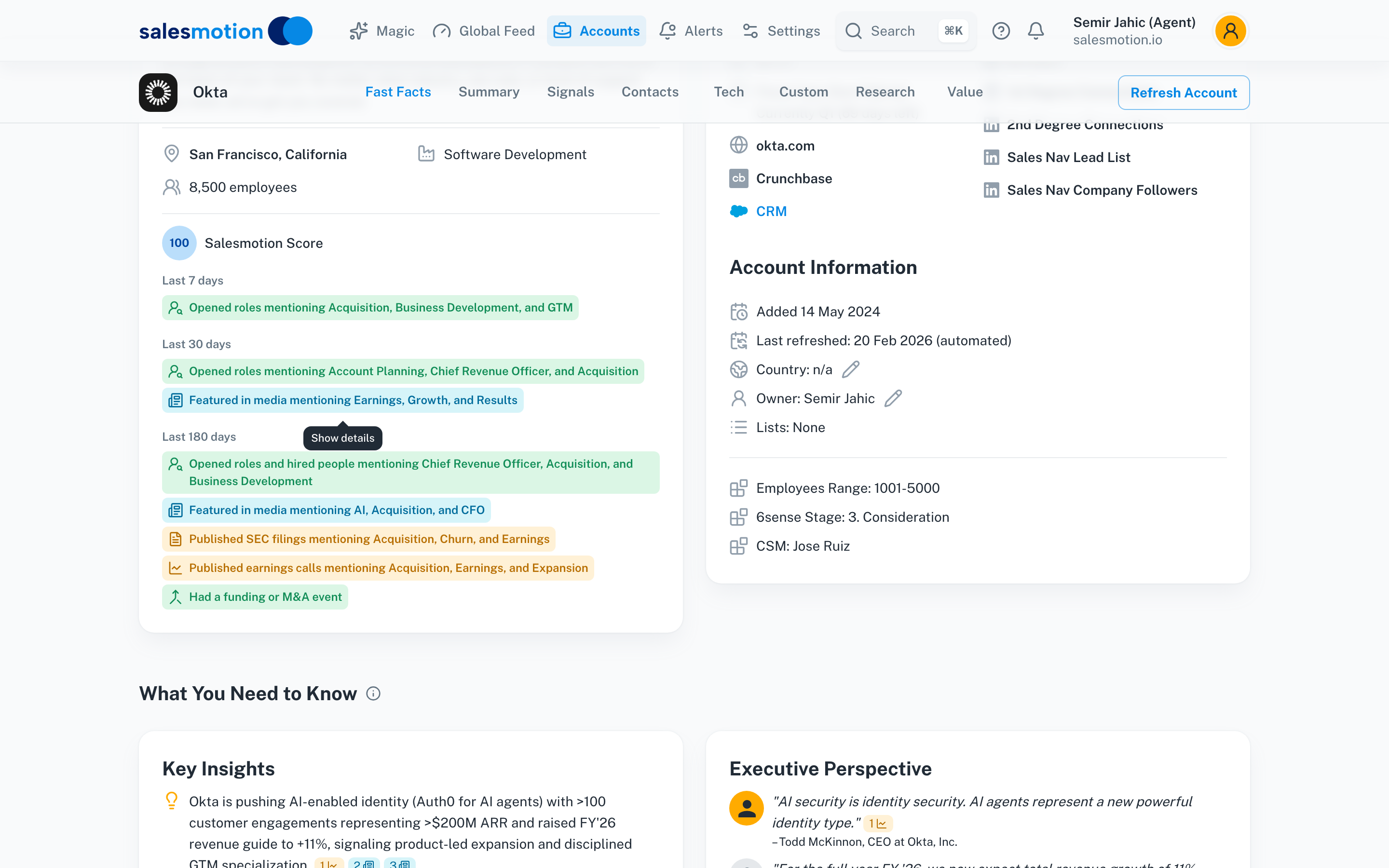 Salesmotion automates account research across 1,000+ sources — delivering key insights, executive commentary, opportunities, and competitive intelligence in a single brief.
Signals That Indicate Manufacturing Purchase Readiness
The buying signals in manufacturing are tied to capital investment, operational events, and regulatory pressures.
High-Intent Signals
- New facility permit or expansion announcement: Capital construction creates technology needs across automation, monitoring, and operations management.
- Earnings call commitment to automation or Industry 4.0: Public spending commitments create accountability and budget allocation.
- New VP of Manufacturing, VP of Operations, or CTO hire: Operational leadership changes trigger technology assessments in the first two quarters.
- ERP migration announcement: Moving from legacy ERP to SAP S/4HANA, Oracle Cloud, or similar platforms creates extensive integration and analytics needs.
Medium-Intent Signals
- Supply chain disruption or reshoring initiative: Companies bringing manufacturing back onshore need facility technology, supplier management platforms, and quality systems.
- OSHA citation or safety event: Creates compliance-driven purchasing urgency for safety, training, and monitoring technology.
- Sustainability commitment with specific targets: Net-zero pledges with dates create downstream technology requirements.
Lower-Intent (Longer-Term) Signals
- Trade show participation in new categories: Signals exploration of new markets or technologies.
- Patent filings for new manufacturing processes: Indicates R&D investment direction.
- Workforce training program announcements: Suggests operational transformation is in planning stages.

“At first it sounded like a simple utility. But once we deployed it, it became clear there's nothing else like it. Any sales, business development, or client services team should try this. It changes the way you work.”
Andrew Giordano
VP of Global Commercial Operations, Analytic Partners
Tools Comparison: Researching Manufacturing Accounts
| Approach | Coverage | Time per Account | Signal Freshness | Manufacturing Depth |
|---|---|---|---|---|
| Manual (trade pubs, SEC, EPA, permit databases) | Very comprehensive but fragmented | 60-90 minutes | Varies by source | Very high |
| General sales intelligence (ZoomInfo, LinkedIn) | Contact data, firmographics | 5-10 minutes | Daily | Low, misses operational data |
| Industry databases (ThomasNet, IndustryWeek data) | Facility and capability data | 15-20 minutes | Monthly | High for facility-level data |
| Salesmotion | Earnings, leadership, news, strategic signals | Under 5 minutes | Continuous | High for public intelligence |
The most effective approach for manufacturing sales layers automated signal monitoring across your territory with targeted deep research using trade publications, permit databases, and environmental filings for your highest-priority accounts.
For the complete guide to sales intelligence for manufacturing, including workflows for selling into discrete, process, and hybrid manufacturers, explore our industry resource page.
Key Takeaways
- Manufacturing account research requires industry-specific sources: trade publications, facility permits, environmental filings, and capex data from earnings reports that general sales tools miss.
- Capital expenditure cycles drive technology purchases. Research your prospect's capex guidance to understand budget availability and investment timing.
- Job postings in manufacturing are unusually revealing. Automation engineer, ERP admin, and industrial IoT roles signal specific technology decisions with high confidence.
- Environmental and safety compliance pressures are increasingly driving technology investments. Track EPA filings, OSHA citations, and sustainability commitments.
- Build a 10-minute framework covering operational footprint, financial health, technology initiatives, regulatory context, and a specific outreach angle.
- Combine automated account intelligence for territory-wide signal monitoring with targeted operational research on active pipeline accounts.
- For research frameworks in other industries, see our guides to account research for healthcare and enterprise software.
Frequently Asked Questions
What are the best sources for researching manufacturing companies before a sales call?
Industry trade publications like IndustryWeek and Manufacturing.net provide the most accessible starting point for understanding a manufacturing company's strategic priorities. Combine this with SEC filings for financial data and capex guidance, job postings for technology signals, and EPA databases for environmental compliance context. Facility permit data from state and local government databases reveals capital investments before they appear in press releases.
How do you identify buying windows in manufacturing sales?
The strongest buying window indicators are new facility permits or expansion announcements, earnings call commitments to automation or digital transformation spending, new VP-level hires in operations or technology functions, and ERP migration announcements. These events create specific, time-bound technology needs. Environmental compliance deadlines with specific dates (net-zero by 2030, emissions reduction by 2028) also create predictable investment timelines.
What job postings signal technology purchases at manufacturing companies?
Automation engineer, robotics engineer, and industrial IoT roles signal manufacturing automation investments. ERP administrator or SAP consultant postings confirm platform decisions. Quality engineer and continuous improvement specialist roles indicate operational excellence programs. Data scientist or analytics roles at a manufacturer suggest Industry 4.0 adoption. The volume and seniority of these postings indicate whether the initiative is exploratory or fully funded.
How long are sales cycles in manufacturing?
Manufacturing technology sales cycles typically range from 6 to 18 months for enterprise deals. Capital equipment and automation purchases often require board-level approval and align with annual budget cycles. ERP implementations and large platform decisions can take 12 to 24 months from initial conversation to contract. Compliance-driven purchases (environmental monitoring, safety systems) tend to move faster due to regulatory deadlines. Timing your outreach to annual budget planning cycles, typically Q3-Q4 for the following year, improves your chances of entering the process early.