Researching a SaaS company before a sales call should take minutes, not hours. The irony is that SaaS companies generate more publicly accessible data than nearly any other type of prospect: funding announcements, product launches, tech stack footprints, hiring patterns, and review site activity. Yet most reps default to skimming the "About" page and checking LinkedIn for mutual connections.
Account research for SaaS sales is about reading the signals that indicate where a company sits in its growth trajectory, what technology decisions it is making, and whether the timing is right for your solution. The difference between a generic outreach and a response-worthy message often comes down to knowing which funding round they just closed, what infrastructure they are building, and which competitor they just lost a deal to. This is signal-based selling in practice: using timely events to drive relevant conversations.
TL;DR: SaaS account research should focus on funding data, tech stack analysis, product launch activity, hiring patterns, and review site signals. Build a 10-minute framework that identifies growth stage, technology gaps, and buying triggers. The highest-intent signals are new funding rounds, product launches in adjacent categories, and leadership hires in your target function.
Why Researching SaaS Companies Requires a Specific Approach
SaaS companies move fast. A company that was a 50-person Series A startup six months ago might be a 150-person Series B company today with entirely different technology needs, budget capacity, and organizational complexity.
Three characteristics make SaaS account research distinct:
Rapid growth creates constant change. SaaS companies can double headcount in a single year. Each growth phase brings new operational challenges: the tools that worked for 50 people break at 200. Reps who understand where a prospect sits on this growth curve can identify technology gaps before the prospect publicly acknowledges them.
Technology choices are visible. Unlike manufacturing or financial services, SaaS companies leave a visible tech stack footprint. Tools like BuiltWith, Wappalyzer, and even job postings reveal what platforms, frameworks, and integrations a company uses. This intelligence lets you tailor your pitch to their specific environment.
Product-led growth and community activity generate public signals. SaaS companies are often active on GitHub, Product Hunt, developer forums, and social media. Product launches, feature updates, and community engagement all signal strategic direction and investment priorities.
The Key Sources to Monitor for SaaS Accounts
Effective account research for SaaS prospects means combining financial intelligence with product and technology signals.
Crunchbase and Funding Data
Crunchbase remains the most comprehensive source for SaaS funding history. Track:
- Recent funding rounds: A new Series B or C unlocks budget for infrastructure, tools, and team expansion.
- Investor profiles: The investors behind a company often signal the growth playbook. Enterprise-focused VCs push different priorities than PLG-focused investors.
- Valuation and revenue signals: While not always public, funding round sizes relative to stage give you directional revenue estimates.
BuiltWith and Tech Stack Analysis
BuiltWith and similar tools reveal the technology a SaaS company uses on its own website and product. This is uniquely valuable because:
- You can identify competitors already in their stack
- You can spot technology gaps your solution fills
- You can see when they recently adopted or dropped a tool (signals active evaluation)
G2, Capterra, and Review Sites
Review platforms reveal competitive dynamics. Check:
- Your prospect's own product reviews: Negative reviews in specific areas signal internal pain points they are working to fix.
- Reviews they have left for other products: Some platforms show which tools a company's employees have reviewed, indicating what is in their stack.
- Competitive comparison activity: If a prospect's employees are actively comparing tools in your category, they may be in a buying cycle.
Earnings Calls and Financial Data (Public Companies)
For publicly traded SaaS companies, earnings calls are gold. Listen for commentary on customer acquisition costs, expansion revenue, product roadmap priorities, and technology investments. The language executives use about "infrastructure modernization" or "platform consolidation" directly signals purchasing intent.
GitHub and Developer Activity
For developer-tool and infrastructure companies, GitHub activity reveals engineering priorities. Active repositories, recent commits, and open issues show where the team is investing technical effort. New repositories in a specific domain (observability, security, data infrastructure) signal product expansion.
Job Postings
Hiring patterns are among the most reliable leading indicators for SaaS companies. A burst of job postings for sales roles signals go-to-market acceleration. Postings for specific technology roles (Snowflake engineer, Salesforce admin, security architect) reveal infrastructure decisions and tool investments.

“The moment we turned on Salesmotion, it became essential. No more hours on LinkedIn or Google to figure out who we're talking to. It's just there, served up to you, so it's always 'go time.'”
Adam Wainwright
Head of Revenue, Cacheflow
The 10-Minute Research Framework for SaaS
Minutes 1-3: Company Stage and Trajectory Check Crunchbase for funding history, headcount, and recent news. Identify the growth stage (seed, Series A/B/C, public) and any recent milestones. Look at headcount growth on LinkedIn to gauge hiring velocity.
Minutes 3-5: Tech Stack and Product Signals Run the company through BuiltWith. Check their product changelog or blog for recent launches. Look at GitHub activity if they have public repositories. Note any technology decisions relevant to your solution.
Minutes 5-7: Competitive Landscape and Market Position Check G2 for their product category ranking and recent reviews. Identify their top two competitors. Note any recent wins, losses, or positioning changes visible in press coverage.
Minutes 7-9: Leadership and Organizational Changes Check LinkedIn for recent C-suite or VP-level hires in your target function. Look for press releases about new leadership, strategic partnerships, or market expansions. Note any organizational restructuring signals from job postings (new team names, new functions).
Minutes 9-10: Synthesize Your Angle Combine a growth signal (funding, hiring, product launch) with a specific gap your solution addresses. "You just raised Series C and are scaling your sales team from 20 to 50. Here is how we help teams maintain research quality as they scale" is stronger than any template.
Salesmotion automates much of this workflow by pulling funding data, leadership changes, earnings commentary, and news into a single account view. Instead of toggling between Crunchbase, LinkedIn, G2, and BuiltWith, reps start with a complete picture and spend their time on synthesis and outreach strategy.
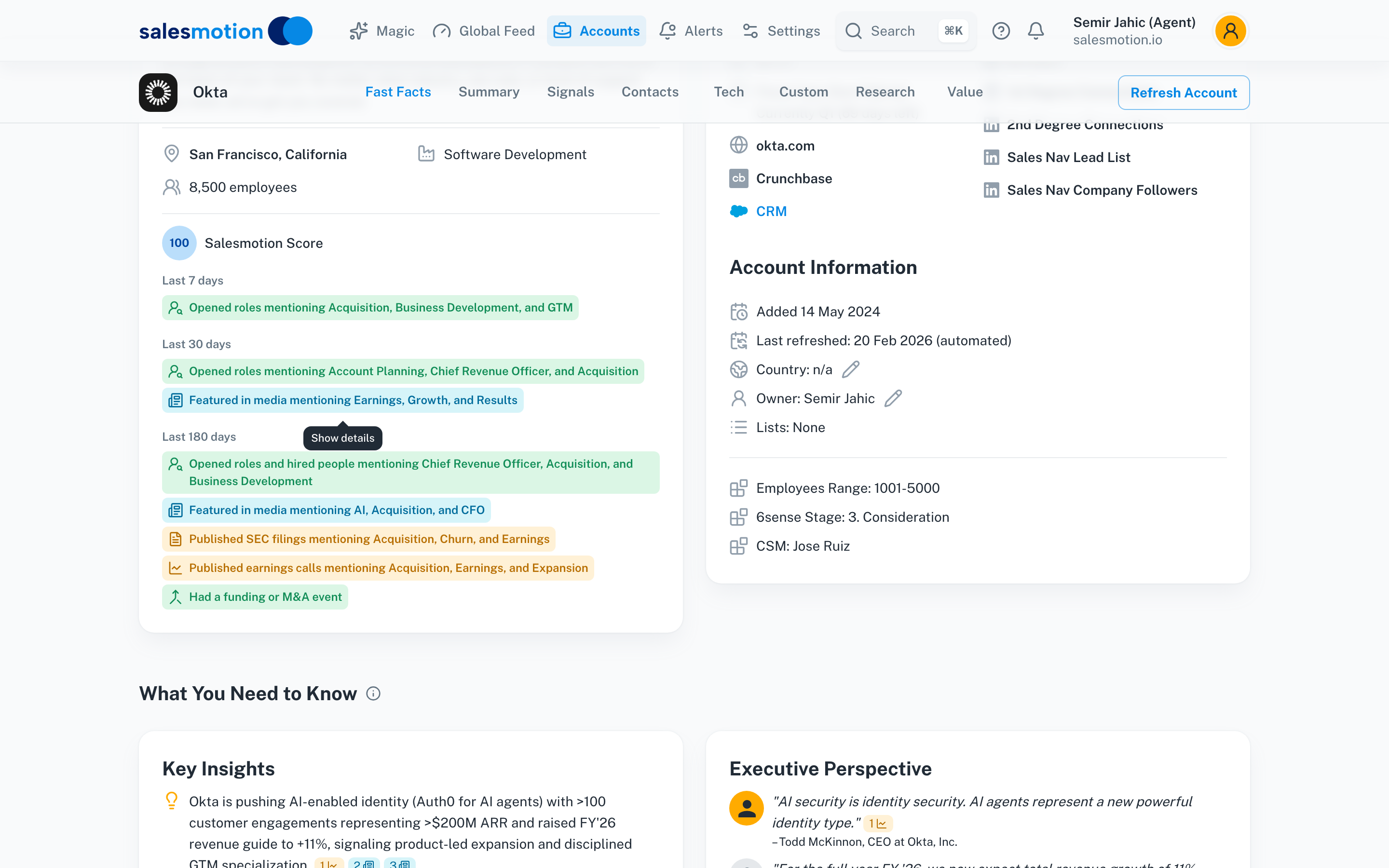 Salesmotion automates account research across 1,000+ sources — delivering key insights, executive commentary, opportunities, and competitive intelligence in a single brief.
Signals That Indicate SaaS Purchase Readiness
The buying signals most predictive of purchase readiness in SaaS are tied to growth events and technology decisions.
High-Intent Signals
- New funding round (Series B+): Fresh capital plus growth expectations create a 90-day window where technology purchases accelerate.
- VP or Director hire in your target function: New leaders evaluate and replace tools in their first quarter. A new VP of Sales, VP of Engineering, or VP of Marketing is your most reliable buying signal.
- Product launch in an adjacent category: When a SaaS company expands its product surface area, it needs supporting infrastructure across analytics, security, and operations.
- Job postings for your product's admin role: Postings for "Salesforce Admin," "HubSpot Manager," or specific tool roles confirm active adoption or migration.
Medium-Intent Signals
- Competitive technology switch: Dropping a competitor and adopting a new tool in a related category signals active vendor evaluation.
- Headcount growth exceeding 30% year-over-year: Rapid scaling breaks existing tools and creates urgent operational needs.
- Earnings call language about "operational efficiency" or "platform consolidation": Signals readiness to evaluate new solutions.
Lower-Intent (Longer-Term) Signals
- Conference speaking or thought leadership activity: Signals strategic priorities and emerging focus areas.
- Community and open-source contributions: Technical direction indicators for developer-focused companies.
- G2 review patterns: Increasing negative reviews of a competitor in their stack signals growing dissatisfaction.

“Salesmotion has been a game-changer for me. I used to spend 12 hours a week on prospect research, now it's down to 4. Plus I'm finding stuff I was totally missing - podcasts, news mentions, the good bits.”
George Treschi
Account Executive, FY25 President's Club, Sigma
Tools Comparison: Researching SaaS Accounts
| Approach | Coverage | Time per Account | Signal Freshness | SaaS-Specific Depth |
|---|---|---|---|---|
| Manual (Crunchbase, LinkedIn, G2, BuiltWith) | Good, but fragmented | 30-60 minutes | Varies | High with effort |
| General sales intelligence (ZoomInfo, Apollo) | Contact data, firmographics, intent | 5-10 minutes | Daily | Medium |
| Product analytics (BuiltWith, Wappalyzer) | Tech stack only | 5 minutes | Monthly | High for technology signals |
| Salesmotion | Financial, leadership, news, strategic signals | Under 5 minutes | Continuous monitoring | High for growth and event signals |
For SaaS-specific sales, the most effective approach layers automated signal monitoring across your entire territory with targeted tech stack analysis for accounts entering your pipeline. Frontify, a SaaS company selling into enterprise, increased their sales velocity 42% year-over-year after centralizing their account research into a signal-driven workflow.
For the complete guide to sales intelligence for SaaS, including workflows for PLG, sales-led, and hybrid go-to-market motions, explore our industry resource.
Key Takeaways
- SaaS account research should prioritize funding data, tech stack analysis, hiring patterns, product launch signals, and review site activity.
- Growth stage determines technology needs. Series B companies face different challenges than public companies, and your research should reflect that.
- Tech stack visibility is a unique advantage in SaaS research. Use BuiltWith and job postings to understand what tools a prospect already uses and where gaps exist.
- The highest-intent signals are new funding, leadership hires in your function, product launches in adjacent areas, and technology migration indicators.
- Build a 10-minute research framework that covers company stage, tech stack, competitive position, leadership changes, and a synthesized outreach angle.
- Layer automated account intelligence for territory-wide monitoring with manual deep research on active pipeline accounts.
- For industry-specific frameworks, see our guides to account research for enterprise software and manufacturing.
Frequently Asked Questions
What is the fastest way to research a SaaS company before a sales call?
Start with Crunchbase for funding history and company stage, then run the company through BuiltWith for tech stack data. Check LinkedIn for recent leadership changes in your target function, and scan G2 for recent product reviews. This four-source approach takes under 10 minutes and covers the signals most relevant to SaaS purchasing decisions. Signal monitoring platforms consolidate these sources into a single account brief.
How do you use tech stack data in SaaS sales?
Tech stack data from BuiltWith, Wappalyzer, or job postings reveals three things: which competitors are already in the account (so you can position accordingly), which technology gaps exist that your solution fills, and whether the company recently adopted or dropped tools (signaling active evaluation). Mentioning a specific integration or compatibility with tools already in their stack significantly increases response rates compared to generic outreach.
What hiring signals indicate a SaaS company is about to buy?
Job postings for specific tool administrators (Salesforce Admin, HubSpot specialist) confirm platform adoption decisions. VP or Director hires in sales, marketing, or engineering signal imminent technology evaluations. Rapid headcount growth (30%+ year-over-year) indicates operational scaling that typically breaks existing tools. Look at the ratio of engineering to sales hires as well: a shift toward sales hiring signals go-to-market acceleration and supporting tool purchases.
How do you research privately held SaaS companies with limited public data?
Focus on signals that do not require financial disclosures: job postings (quantity, roles, and seniority indicate growth trajectory), tech stack data from BuiltWith, product changelog activity, GitHub contributions, conference presentations, and press coverage. Crunchbase provides funding history even for private companies. Customer reviews on G2 and employee reviews on Glassdoor offer additional insight into company priorities and challenges.