AI readiness signals are public pieces of evidence that show how far an account has moved from talking about AI to funding it: what executives say on earnings calls, who they hire to lead data and AI, which technologies appear in their job postings, and who they partner with. Read together, they place an account on a maturity scale. The stage tells you whether the account will buy AI services this year, and which service.
TL;DR: You can assess a prospect's AI maturity from the outside. Collect five kinds of public evidence (executive language, leadership hires, job postings, confirmed technology, partnerships and deals), place the account in one of five stages, then pitch the one offering that removes the constraint between its current stage and the next. A fixed checklist turns a two-hour research job into a short, repeatable pass.
Why Do AI Readiness Signals Matter for Services Sellers Now?
They matter because almost every enterprise now says it is doing AI, so the statement alone no longer separates buyers from talkers. The evidence behind the statement does.
The numbers show how crowded the topic has become. FactSet found that 331 of 493 S&P 500 earnings calls (67%) cited "AI" for the second quarter of 2026, against a 10-year average of 114 calls. An IBM Institute for Business Value study of 2,000 CEOs and senior leaders reports that 76% of surveyed organizations now have a Chief AI Officer, up from 26% a year earlier.
The budget is there too. Gartner's January 2026 forecast, as reported by TelecomTV, puts AI services spending at $588.6 billion in 2026, up from $439.4 billion in 2025. Bain's Tech Services Buyer Survey of 280 executives found that 75% expect to put 5% to 10% of technology spending into AI and machine learning, while total IT budgets stay roughly flat. The same survey says buyers want repeatable solutions, not experimental pilots.
So the money is moving, and it is moving toward sellers who show up with a specific answer. A value-selling lead at a banking software vendor told us, "80% of my conversations are about cost [and] regulation." He wants to find the most AI-forward banks early, so the conversation starts somewhere more interesting. In recent calls with IT services and consulting sellers, a client's AI maturity and roadmap came up as the thing every account team is trying to read right now.
How Do You Assess a Prospect's AI Maturity From Public Evidence?
Place the account in one of five stages, using only what it has published or what has been published about it. Each stage leaves a different trail, and each trail sits in a known place.
| Stage | What you observe | Where to look | What the account buys |
|---|---|---|---|
| 1. Silent | No AI language from executives. "Digital" appears only in general terms. No data or AI leadership roles. | Annual report, earnings call transcripts, leadership page | Little. Education and an assessment at most. |
| 2. Exploring | AI named as a priority without numbers or dates. First pilots announced. A handful of data or AI job postings. Assistant licenses on trial. | Earnings calls, press releases, careers page, executive interviews | Use-case discovery, readiness assessments, proofs of concept |
| 3. Building foundations | A Chief Data Officer or Chief AI Officer is hired. Job postings name cloud and data platforms. A hyperscaler partnership is announced. Governance language appears. | Leadership announcements, job postings, partner press releases, annual report risk section | Data platform work, cloud migration, governance and security design |
| 4. Scaling | Executives cite named use cases in production with metrics. Hiring shifts to platform, operations, and product roles in volume. A central AI team exists. | Earnings calls, investor day decks, job postings, conference talks | Integration, managed services, model operations, change management |
| 5. AI in the operating model | AI shows up in reported results, product launches, and reorganizations. Acquisitions of AI firms. Agents deployed in core processes. | Filings, earnings calls, M&A announcements, product pages | Specialist capacity, cost and performance tuning, co-development |
Three rules keep the staging honest.
Stage on evidence, not adjectives. "AI is central to our strategy" is stage 2 language. "Claims triage runs on the new model in four markets" is stage 4 language. Numbers, dates, and named systems move an account up. Enthusiasm does not.
Require two independent sources. An executive quote plus a matching hiring pattern is a stage. An executive quote alone is a press line.
Date everything. A stage read from a transcript that is a year old is a guess. Re-stage after each earnings call. The post on how to use earnings calls for sales covers what to pull from a transcript in one pass.

“We're saving about 6 hours per week per seller on account research alone. That's time they can reinvest in actually selling.”
Derek Rosen
Director, Strategic Accounts, Guild Education
Which AI Transformation Buying Signals Should You Track?
Track eight signals. Each one has a public source, says something specific about the account, and points to a different offering.
| Signal | Source | What it implies | Offering it maps to |
|---|---|---|---|
| AI language on earnings calls and in investor-relations material | Transcripts, investor day decks, annual report | Board-level commitment. Specific metrics and dates mean funded work. | Depends on the named use case. Anchor the pitch to it. |
| Chief AI Officer or Chief Data Officer hire | Press releases, leadership page, professional networks | A new owner with a mandate and a first-year plan to deliver. | Assessment, roadmap, operating-model design |
| Technology named in job postings | Careers page, job boards | The stack being built, and the skills the account cannot find. | Staff augmentation, platform build, managed services |
| Confirmed technology (cloud provider, ERP, assistant rollouts) | Vendor case studies, job postings, partner announcements | What your work must integrate with, and which practice should lead. | Integration, migration, adoption programs |
| Digital-transformation mandate | Annual report, CEO letter, earnings calls | A multi-year program with a named sponsor and budget line. | Program delivery, change management |
| M&A and post-merger integration | Deal announcements, filings | Two stacks and two data estates to merge on a deadline. | Data integration, application consolidation |
| Partnership with a hyperscaler or model provider | Joint press releases, partner directories | The platform choice is made. Implementation capacity is the next need. | Implementation on that platform, certified skills |
| Executive podcasts and interviews | Podcast feeds, video, trade press | Unscripted priorities and frustrations, in the executive's own words. | Opening line and discovery questions |
Job postings deserve extra attention because they are the least polished source. Bain's survey lists AI and machine learning engineering and data science among the hardest skills for buyers to source, which is why hiring gaps so often turn into services demand. The guide to job posting analysis shows how to read them.
A signal with a date attached, such as a merger close or a new executive's first 100 days, is also a compelling event.
A Signal Fired. Now What Do You Pitch?
Pitch the one offering that removes the constraint between the account's current stage and the next one, and open with their words, not yours.
This is where signal programs stall. A seller at a global IT services firm told us, "just reading the signal, many people will not be able to understand, okay, how can I relate it to my internal offering? What are the next steps?" A signal without a mapping is trivia.
Use four steps.
- Name the stage. Use the table above and two sources. Write it down with dates.
- Name the constraint. Ask what stops this account from reaching the next stage. Stage 2 accounts lack a prioritized use case. Stage 3 accounts lack clean, governed data. Stage 4 accounts lack the capacity to run what they built.
- Pick one offering. Choose the single service or product from your portfolio that removes that constraint. One, not the catalog. If nothing fits, the account is not a target this quarter.
- Write the first question. Quote the public evidence and ask about the constraint. Do not describe your firm.
A stage-to-pitch cheat sheet helps a whole team answer the same way.
| Stage | Likely constraint | Lead offering | First-conversation question |
|---|---|---|---|
| 2. Exploring | No agreed use case, no business case | Use-case discovery and readiness assessment | "Your CEO named AI as a priority in the last call. Which process is first in line, and who owns the case for it?" |
| 3. Building foundations | Data scattered, governance undefined | Data platform and governance work | "You are hiring for the new data platform. What has to be true about the data before the first model goes live?" |
| 4. Scaling | Capacity, integration, adoption | Integration and managed operations | "Two use cases are in production. What is slowing down the third?" |
| 5. Operating model | Cost, performance, specialist depth | Specialist teams and tuning | "Where is the run cost of AI growing faster than the value?" |

“The talking points are gold. If they're in Salesmotion, I know they're being discussed inside that business. That makes it easy to spark a real conversation, which is 90 percent of the battle.”
Andrew Giordano
VP of Global Commercial Operations, Analytic Partners
A Worked Example: Northfield Mutual (Illustrative)
Northfield Mutual is a fictional regional insurer, invented for this example. Every detail below is illustrative.
The evidence, collected in one pass:
- Earnings call, second quarter. The CEO says claims triage "will be running on our new models in two lines of business by year end" and gives an expense-ratio target.
- Leadership. A Chief Data and AI Officer joined in June, reporting to the CEO.
- Job postings. Fourteen open roles name a cloud data platform, a specific hyperscaler's AI services, and model governance. Three are for claims data engineers.
- Partnership. A joint press release with a hyperscaler, announced in the spring.
- M&A. The acquisition of a smaller insurer is due to close in the fourth quarter.
Stage. Late stage 3, pushing into stage 4. There is a named owner, a platform choice, a dated use case, and a metric. Nothing is reported as in production yet.
Constraint. The acquisition brings a second claims system and a second data estate two months before the first production deadline. The hiring pattern says the internal team is short on data engineering and governance.
Offering. Claims data integration for the acquired book, with governance design alongside it. Not a general AI strategy workshop, which the account has moved past.
First message, to the new executive:
"On the Q2 call your CEO committed to claims triage on the new models in two lines by year end. The acquisition closes in Q4 and brings a second claims system. Teams in that position usually find the acquired data is the thing that moves the date. Is the integration plan for that book already staffed, or still open?"
The message names the commitment, the date, and the risk, and asks one question.
How Do You Cut Research Time Per Account?
Standardize the pass, do the deep version once a quarter, and let monitoring cover the weeks in between. Research time falls when the seller stops deciding where to look.
The time problem is real. Sellers at IT services firms describe one account's research taking between one and two hours when done by hand. At 50 or 60 named accounts per rep, a single pass takes weeks of selling time.
Four changes bring it down.
- Fix the checklist. Five sources in the same order every time: latest earnings call or annual report, leadership changes in the last six months, open job postings, partnership and M&A announcements, one recent executive interview. Stop when the stage is clear.
- Fix the output. One page: stage, two dated pieces of evidence, constraint, offering, first question.
- Tie the deep pass to the earnings calendar. Re-stage public accounts in the two weeks after they report. That is when the evidence changes.
- Monitor between passes. Leadership hires, new job postings, and deal announcements do not wait for the quarter. Something has to watch for them.
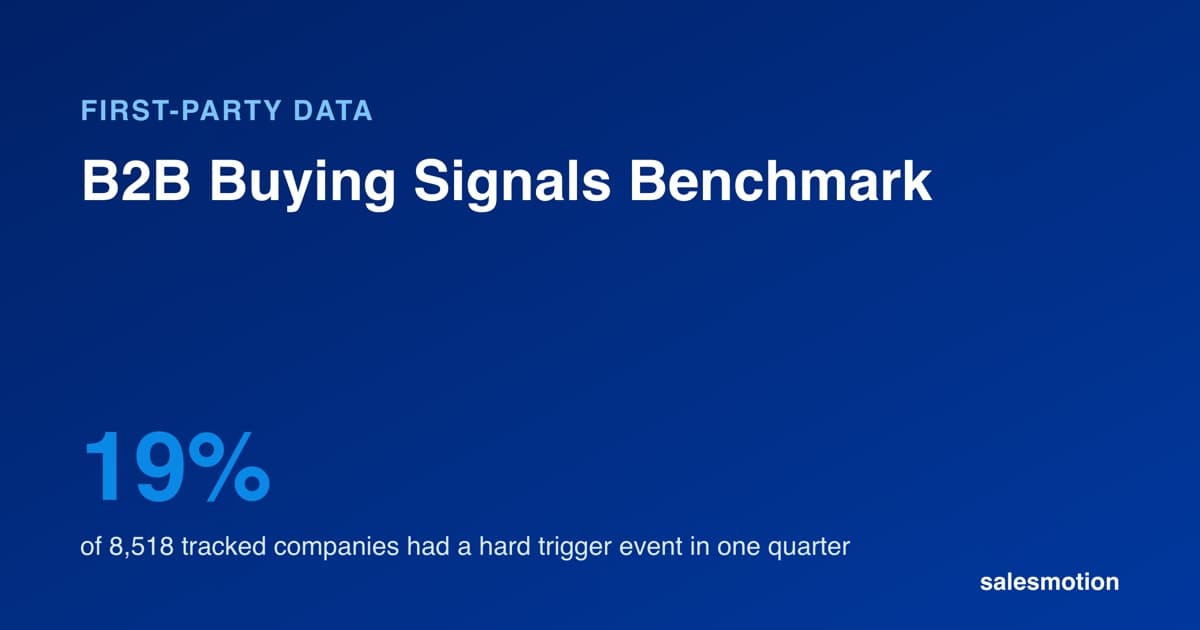
General AI assistants handle a one-off deep pass well when a seller gives them the sources. Account intelligence platforms handle the watching, which matters because AI mentions are now everywhere: in Salesmotion's B2B buying signals benchmark, technology or AI news reached 17.5% of tracked companies in a single quarter. The signal-based selling guide covers how to turn that into timed outreach. Salesmotion's Signal Agent, for example, monitors earnings calls, SEC filings, job postings, leadership changes, M&A, and podcasts across a named account list, and its Research Agent turns them into an account brief with earnings synthesis and talking points. Analytic Partners reduced account research time by 85% this way, according to Andrew Giordano, VP of Global Commercial Operations.
For the wider motion, see sales intelligence for IT services and sales intelligence for management consulting. Two related guides go further on the selling side: IT consulting sales prospecting and selling to IT services companies.
One caution before you start. With two thirds of large public companies citing AI on earnings calls, a mention is the baseline, not the signal. Stage first, bring one offering, and use evidence from this quarter.
Begin with ten accounts. Stage each one, write the one-page output, and send the first question. When the next AI leadership hire or earnings commitment lands, the pitch is already half written.
Frequently Asked Questions
What are AI readiness signals?
AI readiness signals are public indicators of how far a company has progressed with AI adoption. They include executive language on earnings calls, data and AI leadership hires, technologies named in job postings, confirmed technology choices, partnerships with cloud and model providers, and M&A activity. Sellers use them to judge whether an account will buy AI-related services or software, and which kind.
How do you assess a prospect's AI maturity before a first meeting?
Collect evidence from five places: the latest earnings call or annual report, recent leadership changes, open job postings, partnership and deal announcements, and one executive interview. Place the account in one of five stages, from silent to AI in the operating model. Require two independent sources and date each one.
Which signal is the strongest indicator that an account will buy AI services?
A dated, measurable commitment from an executive combined with a hiring pattern that shows a skills gap. The commitment proves budget and a deadline. The open roles show the work the internal team cannot cover. Either one alone is weaker.
How do you turn an AI buying signal into a pitch?
Name the account's stage, identify the constraint that stops it from reaching the next stage, and choose the single offering that removes that constraint. Open with a question that quotes the account's own public statement. Leave the rest of the portfolio for later conversations.
Can you assess AI maturity for private companies?
Yes, with less material. Private companies have no earnings calls, but job postings, leadership announcements, partner press releases, funding news, and executive podcasts are usually available. Weight job postings more heavily, because they are the most specific source a private company publishes.