A compelling event in sales is a dated business event that carries a consequence if the buyer does nothing. It has three parts: a date the buyer did not choose for your benefit, an owner who answers for the outcome, and a cost that lands if the date passes. A trigger event tells you something changed. A compelling event tells you the buyer has to act, and by when.
TL;DR: Most accounts in a territory have news. Few have a deadline. Test every event for a date, an owner and a cost of inaction. Rank accounts by event strength and recency. Look upstream (filings, hiring, "planning" language) for events competitors have not seen yet. The 14 examples below show where each appears publicly.
What is a compelling event in sales?
A compelling event is the specific, time-bound reason a buyer must act. SalesHood defines it as "a time sensitive response to an internal or external business pressure that drives action within a defined time period with consequences of inaction," and it names the same three ingredients: an economic owner, a date and a consequence.
The definition matters because the alternative is expensive. Matthew Dixon and Ted McKenna analyzed more than 2.5 million recorded sales conversations and found that between 40% and 60% of deals are lost to customers who say they intend to buy and then fail to act. Interest without a deadline is the normal state of a pipeline.
Your quarter end, an expiring discount and a general priority ("digital transformation is a focus this year") are not compelling events. The first two are your dates, not the buyer's. The third has no date and no owner.
How to test whether an event is compelling
Ask three questions: what is the date, who owns it, and what does it cost if the date passes. An event that fails any one of the three is a trigger, and belongs in prospecting, not in the forecast.
1. The date. It must be specific and set by something outside your deal: a regulation, a contract, a board, a customer of theirs.
2. The owner. One named executive whose objectives or compensation depend on the outcome.
3. The cost of inaction. A number or a named penalty: a fine, a missed synergy target, a renewal at a higher price, a launch that slips a quarter. If doing nothing is free, expect nothing.
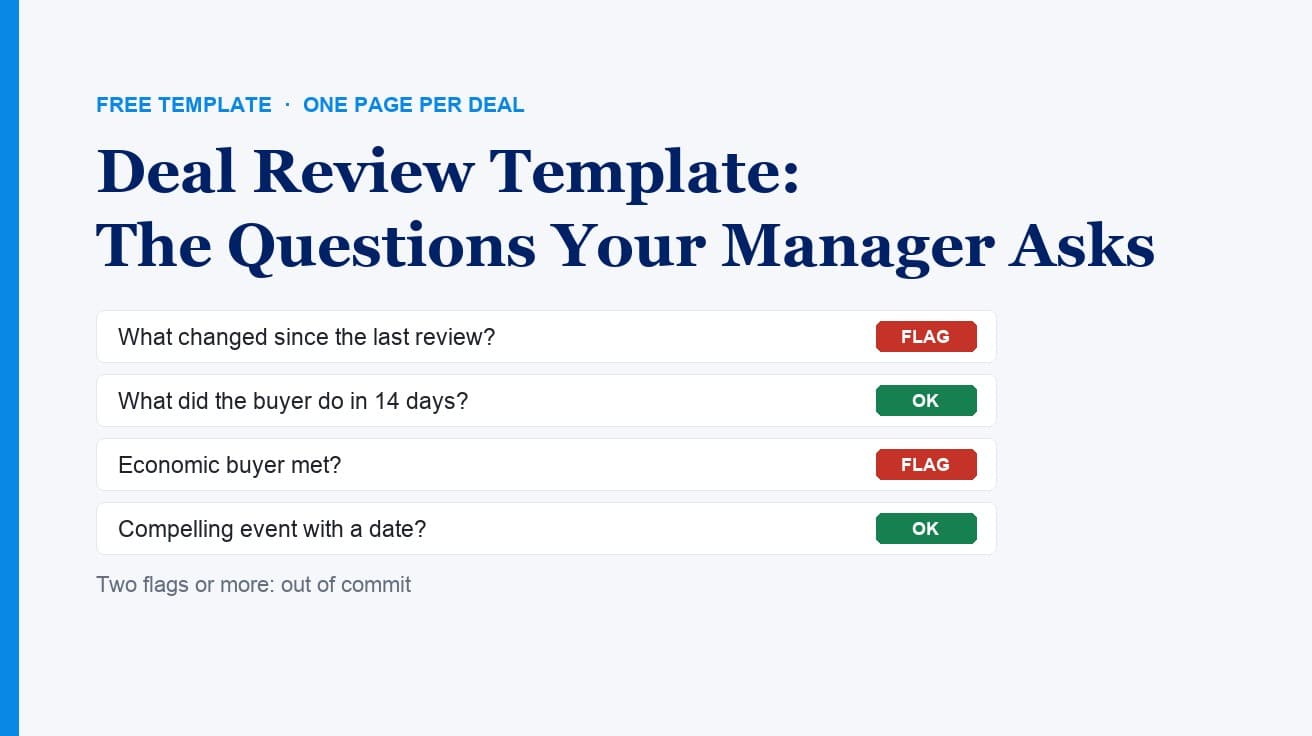
Score one point each for an external date, a named owner, a quantified cost and public evidence you can cite. Four is forecastable, and it is the first question in a deal review. Two or three is a trigger worth working. Zero or one is news.
Compelling event vs trigger event vs buying signal: what is the difference?
They are three levels of evidence. A buying signal is any observation that suggests an account is more likely to buy. A trigger event is a specific change at the account that opens a window. A compelling event is a trigger with a deadline and a penalty attached. For how often trigger events occur, see the B2B buying signals benchmark.
| Buying signal | Trigger event | Compelling event | |
|---|---|---|---|
| What it is | An observation that raises the odds | A discrete change at the account | A dated event with a cost of inaction |
| Example | Three job posts mention a data platform | A new CFO starts | The incumbent contract ends 31 March and renewal carries a price increase |
| Has a date | Rarely | The date it happened | The date something has to be done by |
| What it tells you | Look closer | Reach out now | This deal can close, and here is the latest date |
The practical point: a trigger earns you a conversation, and a compelling event earns you a close date. Most trigger events never become compelling events. A funding round is a trigger. A funding round with a board commitment to open two sites by the third quarter is compelling. The guide to sales trigger events lists triggers by category, and this story of how one spin-off trigger turned into the biggest deal of the year shows one becoming compelling.

“Salesmotion is instrumental in helping me prioritize net-new accounts, understand their strategic initiatives, and cover more ground. With a lot of green-field accounts, I'm heavily leaning on the AI insights to tier my accounts and focus my time. The platform is incredibly intuitive and easy to use.”
Rob Webster
Enterprise Account Executive, Synthesia
Where does the compelling event fit in MEDDIC and MEDDPICC?
It is not one of the letters. MEDDIC stands for Metrics, Economic Buyer, Decision Criteria, Decision Process, Identify Pain and Champion, and MEDDPICC adds Paper Process and Competition. Andy Whyte, founder of MEDDICC, describes the compelling event as "the specific, time-bound reason a buyer must act," and says that in MEDDPICC it isn't a separate step. It is the thread that runs through the other elements.
In practice it connects four of them. Identify Pain gives the event its cost. The Economic Buyer usually owns the date. Decision Process and Paper Process get planned backwards from it: if the date is 31 March and legal review takes six weeks, the real deadline is mid-February.
Whyte's test for authenticity is the most useful sentence on the topic: a real compelling event "exists whether or not you're in the room," and a manufactured one disappears when you stop pushing. The MEDDIC vs MEDDPICC comparison covers the letters themselves.
What are examples of compelling events, and where do they show up publicly?
Most compelling events leave a public trace before the buyer mentions them. The table lists 14, grouped by type, with the first place each usually appears. Lead times are planning assumptions for enterprise deals, not statistics.
| Type | Compelling event | Where it shows up first | Typical lead time |
|---|---|---|---|
| Regulatory | A rule takes effect on a fixed date | Regulator notices, 10-K risk factors, compliance job posts | 6 to 18 months |
| Regulatory | An enforcement action with remediation milestones | Regulator enforcement databases, 8-K | 3 to 12 months |
| Regulatory | Crossing a size threshold that changes which rules apply | Quarterly financials, earnings call Q&A | 12 to 24 months |
| Contract | An incumbent vendor contract expires or auto-renews | 10-K contract disclosures, 8-K Item 1.01, RFP notices, discovery | 6 to 12 months |
| Contract | A vendor retires a product on a stated date | Vendor end-of-life notices, architecture job posts | 12 to 24 months |
| Leadership | A new executive with a stated mandate | 8-K Item 5.02, press release, LinkedIn | 1 to 6 months |
| Financial | A cost target promised to investors by a date | Earnings call language, investor day slides | 2 to 4 quarters |
| Financial | A restructuring or exit program | 8-K Item 2.05, earnings call | 1 to 3 quarters |
| Financial | A funding round with stated use of proceeds | Form D, press release, hiring | 1 to 6 months |
| M&A | Integration with a published synergy target | Merger announcement, earnings calls, integration job posts | 6 to 24 months |
| M&A | A divestiture or spin-off with a transition services end date | 8-K, 10-K, separation job posts | 6 to 18 months |
| Growth | A market, site or product launch with an announced date | Press release, job posts by location, earnings call | 3 to 12 months |
| Risk | A material cybersecurity incident | 8-K Item 1.05, breach notifications | 0 to 6 months |
| Operational | A program with a committed go-live | Job posts naming the program, systems integrator announcements | 3 to 12 months |
Two filing rules explain why public companies are easier to time than most reps assume. A US public company generally has to file a Form 8-K within four business days of a reportable event, which includes material agreements (Item 1.01), restructuring costs (Item 2.05) and officer departures and appointments (Item 5.02). Private companies raising under Regulation D must file a Form D notice within 15 days after the first sale of securities, which often precedes the press release.

“We're no longer fishing. We know who the right customers are, and we can qualify them quickly. Salesmotion has had a direct impact on pipeline quality.”
Andrew Giordano
VP of Global Commercial Operations, Analytic Partners
How do you rank a territory by event recency and strength?
Score every account on two axes, strength of the event and how recently it surfaced, then work the top of the list first.
The pain behind this is consistent across sales conversations between June and October 2026. A sales leader at a healthcare technology company told us, "I just feel like we have a lack of visibility into ... what accounts are actually hot." An SDR at a financial data provider described account selection as "kind of a free-for-all." One enterprise rep covered roughly 700 accounts and estimated that fewer than 100 mattered at any given time.
A workable model:
| Recency of first public evidence | Strength 4 | Strength 2 to 3 | Strength 0 to 1 |
|---|---|---|---|
| Last 14 days | Call today | This week | Watch |
| 15 to 60 days | This week | This month | Watch |
| 61 to 180 days | Check whether the date still holds | Nurture | Drop from active list |
Re-rank weekly, because recency decays. Treat stacked events as stronger than single ones: a new CFO plus a cost target on the earnings call beats either alone. The account prioritization framework goes deeper on tiering.
Speed matters as much as scoring. A commercial operations leader at a large life-science tools company described pushing alerts to reps and hearing back, "I already saw that in the news three weeks ago." A BD lead at a mid-size CRO put the cost of lateness plainly: "if you don't get the timing right you're just chasing shadows."
What do you do when everyone sees the same signal?
Go upstream of the announcement. A press release is the last public evidence of an event, not the first. Tracking press releases still pays off as confirmation.
A BD leader at a specialized CRO described what a funded biotech receives: "When they raised that money, they get the same message from 400 people. Hey, congratulations on your series." The edge is earlier and more specific evidence:
- "Planning" language. Earnings calls, investor presentations and conference talks contain phrases like "we are evaluating," "we intend to" and "over the next 12 months" well before a program is announced.
- Hiring before announcement. A job post for a program lead, an integration manager or a first compliance hire in a new region precedes the announcement of the thing they will run.
- Filings before press. 8-Ks, Form Ds and annual report risk factors often carry the fact before the marketing version exists.
- A narrower claim. "Congratulations on the raise" is noise. "Your 8-K puts the transition services agreement end at June, and separation hiring started last month" is a reason to reply.
Doing this by hand works for 20 accounts. Beyond that it needs monitoring. Salesmotion's Signal Agent is one option: it watches news, earnings calls, SEC filings, job postings, leadership changes, funding rounds and M&A across more than 1,000 sources and surfaces buying signals per account. EDGAR alerts and saved job searches are another.
Worked example: from one event to a first message
Take a hypothetical mid-size industrial distributor that acquired a regional competitor. You sell order-management software.
Step 1: Find the event. The acquisition announcement is the trigger. Everyone saw it. The compelling event is on the next earnings call: the CFO commits to a stated synergy figure "within 18 months of close" and says the two businesses will run "on a single order platform by the end of next fiscal year."
Step 2: Run the test. Date: end of next fiscal year, set in front of investors. Owner: the CFO made the commitment, and a newly posted "VP, Integration" role reports to the COO. Cost of inaction: a missed synergy target, reported publicly. Evidence: transcript and job post. Score: 4.
Step 3: Plan backwards. A single platform by fiscal year end means vendor selection two to three quarters earlier, once implementation and paper process are subtracted.
Step 4: Write to the owner's problem, not to the news.
Subject: Single order platform by FY end
On the Q2 call you committed to one order platform across both businesses by fiscal year end. Working back from that date, vendor selection lands around January. The integration role you posted last week suggests the plan is being staffed now.
Distributors merging order systems on this kind of timeline often hit one sequencing issue: pricing rules need reconciling before cutover, not after. Worth 20 minutes to compare notes on how to order the work?
The message names the date, the owner's commitment and one specific risk. It does not congratulate anyone.
A territory rarely lacks news. It lacks deadlines. Find the accounts where a date, an owner and a cost already exist, and the "why now" writes itself.
Frequently Asked Questions
What is a compelling event in sales?
A compelling event is a dated business event that carries a consequence if the buyer does not act. It has a specific date, an executive who owns the outcome and a cost of inaction. Examples include a regulatory effective date, an incumbent contract expiry and an integration deadline promised to investors.
What is the difference between a compelling event and a trigger event?
A trigger event is a change at an account, such as a new executive or a funding round, that creates a reason to reach out. A compelling event adds a deadline and a penalty. Triggers open conversations. Compelling events set close dates.
Is compelling event part of MEDDIC or MEDDPICC?
It is not one of the letters in either acronym. MEDDICC founder Andy Whyte describes it as the thread running through the elements, most directly Identify Pain, Economic Buyer, Decision Process and Paper Process. Teams usually record it alongside the pain and use it to plan the decision timeline backwards.
Can you create a compelling event if the buyer does not have one?
You can uncover one the buyer has not connected to your solution, and you can help quantify a cost they have not measured. You cannot invent one. Seller-made deadlines such as expiring discounts fail the test of existing whether or not you are in the room, and deals built on them tend to slip.
Where do you find compelling events before competitors do?
Look upstream of press releases. Earnings call language, 8-K and Form D filings, annual report risk factors and job posts for program or integration roles usually carry the evidence earlier. Regulator calendars and enforcement databases give dated events months ahead.