Every sales tool vendor now claims to offer AI sales agents. Most are rebranding automation features that have existed for years. The actual shift from AI assistants to agentic AI is significant, but understanding what changes in practice (versus what is marketing) determines whether your team benefits or wastes budget on hype.
TL;DR: Agentic AI in sales moves beyond content generation to autonomous decision-making and execution. The AI sales market is projected to grow from $58 billion in 2025 to $240 billion by 2030. Gartner reports that over 65% of enterprise sales teams already deploy AI agents for prospecting and qualification. McKinsey research shows companies using agentic AI see 3-15% revenue increases and up to 40% faster deal cycles. The key distinction: generative AI writes emails, agentic AI decides which accounts to prioritize, when to engage, and what action to take, then executes without waiting for a human prompt.
Generative AI vs. Agentic AI: What Actually Changed
Generative AI, the technology behind ChatGPT and most "AI-powered" sales tools, creates content on demand. You prompt it and it responds. It writes emails, summarizes calls, drafts proposals. Every output requires a human to initiate, review, and act on.
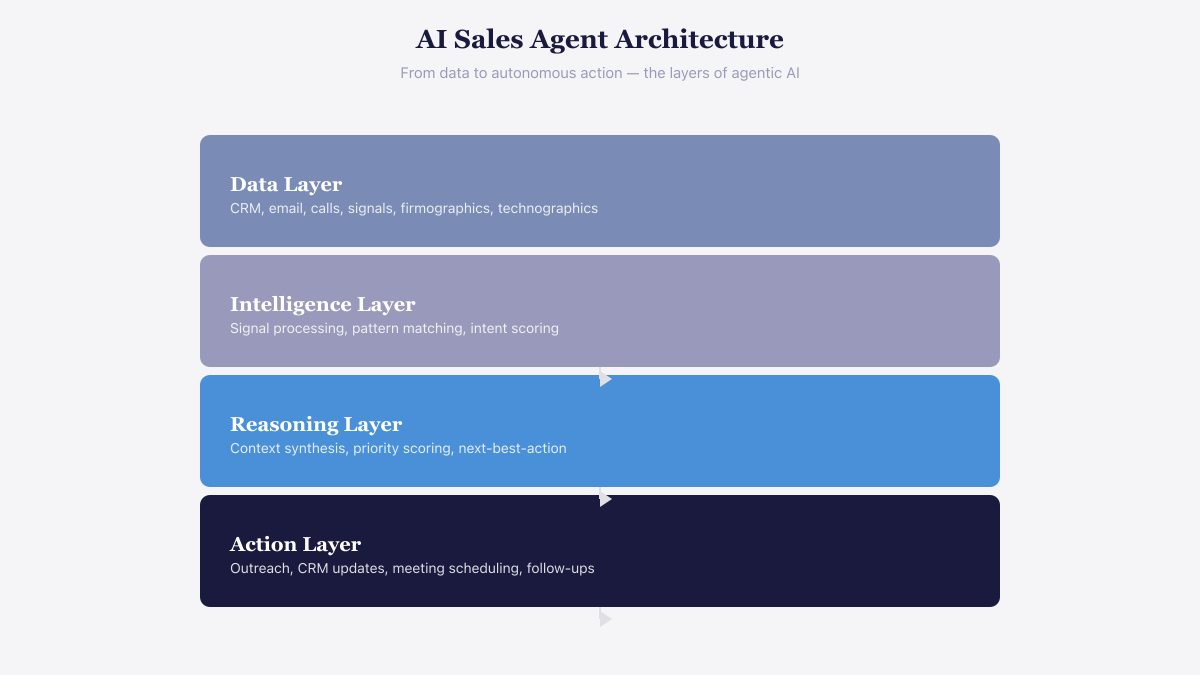 Agentic AI builds from data through intelligence and reasoning to autonomous action.
Agentic AI operates differently. It monitors, decides, and acts autonomously within defined boundaries. An agentic system does not wait for a prompt. It continuously processes signals, evaluates conditions against goals, and takes action when criteria are met.
In sales, the practical difference looks like this:
Generative AI: Rep asks AI to write a follow-up email. AI generates the email. Rep reviews and sends it.
Agentic AI: System detects that a target account just posted three new sales roles, visited the pricing page twice this week, and has a past champion who changed jobs to this company. System scores the account, moves it to the top of the rep's priority list, drafts a personalized message referencing the specific triggers, and alerts the rep in Slack to review and approve.
The first approach saves time on content creation. The second approach changes which accounts get attention, when, and with what context. That is the difference between productivity gains and revenue impact.
See Salesmotion on a real account
Book a 15-minute demo and see how your team saves hours on account research.
Where Agentic AI Delivers Real Value
Not every sales function benefits equally from agentic AI. The highest-impact applications share a common trait: they replace manual pattern recognition and prioritization decisions that humans perform slowly and inconsistently.
Account Prioritization
The daily question "which accounts should I focus on today?" is one that most reps answer with a combination of gut feeling, recent CRM activity, and whoever emailed them last. Agentic systems answer it with real-time signal analysis across every account in the territory.
An agentic prioritization agent continuously monitors buying signals like hiring patterns, funding events, executive changes, website engagement, and intent data spikes, then reorders the rep's focus list automatically. The rep opens their CRM each morning to a prioritized list with supporting context for each recommendation.
Deal Risk Detection
Deals do not die suddenly. They show warning signs for weeks: slowing email engagement, missing stakeholders from calls, delayed next steps, champion going quiet. Human managers catch some of these signals during pipeline reviews, but only for the deals they examine closely.
Agentic systems monitor every deal continuously. When engagement velocity drops below threshold, when a key stakeholder stops responding, or when a deal sits in the same stage beyond the historical average, the system flags it automatically and recommends specific recovery actions.
Expansion Signal Detection
Existing customers showing signs of expansion readiness, increased usage, new department adoption, leadership changes that create budget, represent the highest-ROI opportunities most teams miss because nobody is watching for them systematically.
An expansion-focused agent monitors customer accounts for triggers that indicate readiness: usage growth patterns, new stakeholders appearing in the org chart, budget cycle timing, and contract renewal proximity. When triggers align, the system alerts the account manager with context and recommended next steps.
CRM Hygiene
Sales reps spend hours each week on CRM updates that agentic systems can handle automatically. Logging meeting notes, updating deal stages based on conversation outcomes, enriching contact records with new information, and flagging stale data. Automating this administrative work returns selling time to reps without requiring behavior change.

“We're saving about 6 hours per week per seller on account research alone. That's time they can reinvest in actually selling.”
Derek Rosen
Director, Strategic Accounts, Guild Education
The Multi-Agent Architecture
The most sophisticated implementations use multiple specialized agents working together rather than one monolithic AI system. This mirrors how human revenue teams operate: different specialists handling different functions in coordination.
A typical multi-agent setup includes:
- Signal monitoring agent that tracks external market signals across all target and customer accounts
- Prioritization agent that scores and ranks accounts based on signal strength and historical patterns
- Risk detection agent that monitors deal health indicators across the active pipeline
- Enrichment agent that keeps CRM data current by pulling from external sources
- Execution agent that drafts communications, suggests next steps, and prepares meeting briefs
Each agent operates autonomously within its domain but feeds information to the others. The prioritization agent cannot rank accounts accurately without the signal monitoring agent's output. The risk detection agent needs the enrichment agent's data to identify missing stakeholders. The system's value comes from coordination, not from any single agent.
The Adoption Reality Check
The statistics are impressive: 65% of enterprise teams deploying AI agents, 80% of enterprise apps expected to embed agents by 2026, projected 40% faster deal cycles. But adoption statistics hide a wide range of implementation depth.
What most teams actually have: AI-assisted email writing, basic lead scoring, and automated CRM data entry. These are valuable but they are not agentic. They still require human initiation and decision-making at every step.
What leading teams have: Autonomous signal monitoring, real-time account reprioritization, proactive deal risk alerts, and account intelligence that surfaces insights without being asked. These implementations represent maybe 10-15% of the companies that claim to "use AI agents."
The implementation gap matters because agentic AI requires clean data, integrated systems, and clear governance rules. A team that deploys an agentic prioritization system on top of unreliable CRM data will get confidently wrong recommendations. The system's autonomy amplifies data quality problems rather than compensating for them.

“The Business Development team gets 80 to 90 percent of what they need in 15 minutes. That is a complete shift in how our reps work.”
Andrew Giordano
VP of Global Commercial Operations, Analytic Partners
Governance: The Non-Negotiable
The top concerns around agentic AI are hallucinations (cited by 32% of organizations) and giving agents too much autonomy (28%). Both concerns are valid and both have practical solutions.
Define decision boundaries. Agents should have clear rules about what they can do autonomously versus what requires human approval. Updating a CRM field is low-risk and can happen automatically. Sending an email to a C-level executive at a strategic account should require human review.
Maintain human-in-the-loop for high-stakes actions. The most effective implementations use agentic AI for analysis and recommendation while keeping humans in control of customer-facing execution. The agent identifies the right account, drafts the right message, and recommends the right timing. The rep reviews and approves.
Monitor outputs continuously. Track the accuracy of agent recommendations over time. What percentage of prioritized accounts actually convert? What percentage of risk flags were accurate? This data refines agent performance and builds organizational trust.
Key Takeaways
- Agentic AI monitors, decides, and acts autonomously. Generative AI creates content on demand. The revenue impact comes from execution, not content creation.
- Highest-value applications: account prioritization, deal risk detection, expansion signal identification, and CRM automation.
- Multi-agent architectures outperform single AI tools because they coordinate specialized functions like a human revenue team.
- The AI sales market is projected to reach $240 billion by 2030. Over 65% of enterprise teams already deploy some form of AI agents.
- Implementation depth matters more than adoption. Most teams using "AI agents" are still at the assisted, not autonomous, level.
- Governance is non-negotiable. Define decision boundaries, keep humans in the loop for high-stakes actions, and monitor output accuracy.
- For vendor-specific evaluations, see our Rox alternatives guide. Poggio's product has not been supported since 1 October 2026, when the team joined Baseten; our Poggio alternatives guide covers replacements.
Frequently Asked Questions
Will AI sales agents replace human sales reps?
Not in the foreseeable future. AI agents excel at processing signals, identifying patterns, and handling repetitive tasks at scale. Humans excel at building relationships, navigating complex negotiations, and exercising judgment in ambiguous situations. The teams seeing the best results use AI agents to augment human reps, not replace them. McKinsey data shows 3-15% revenue increases from agentic AI, primarily from improved efficiency and timing rather than headcount reduction.
How much does it cost to implement agentic AI for sales?
Costs vary enormously by approach. Embedded AI in existing platforms is priced as an add-on or by consumption; Salesforce lists Agentforce for Sales from $125 per user per month. Purpose-built agentic platforms for mid-market teams typically cost $25,000-75,000 per year. Enterprise implementations with custom multi-agent architectures can exceed $200,000 annually. Start with the agentic capabilities already embedded in your existing tools before investing in standalone platforms.
What is the biggest risk of deploying AI sales agents?
Deploying agentic AI on top of unreliable data. If your CRM data is incomplete, outdated, or inconsistent, an autonomous agent will make confident decisions based on bad information. Unlike a human rep who can compensate for data gaps with experience and judgment, an agentic system treats whatever data it receives as ground truth. Fix data quality and system integration before deploying agents that make autonomous decisions.