Your AI outbound tool can generate 1,000 personalized emails per day. Your domain reputation cannot survive sending them. The gap between what AI sales emails enable and what inbox providers allow is where most teams destroy their deliverability, often without realizing it until reply rates crater.
TL;DR: Cap AI-generated sales emails at 200 per SDR mailbox per day. Google, Yahoo, and Microsoft now enforce strict bulk sender rules with permanent rejection for non-compliant senders. Spam complaint rates above 0.3% trigger enforcement, but you should target under 0.1%. The teams winning with AI outbound send fewer, better emails to signal-matched accounts, not more emails to larger lists.
Why AI Email Volume Is a Trap
AI makes it trivially easy to generate hundreds of "personalized" emails. Most AI outbound tools can draft unique messages at scale, each referencing the prospect's company, role, and recent activity. The technical barrier to high-volume outreach has essentially disappeared.
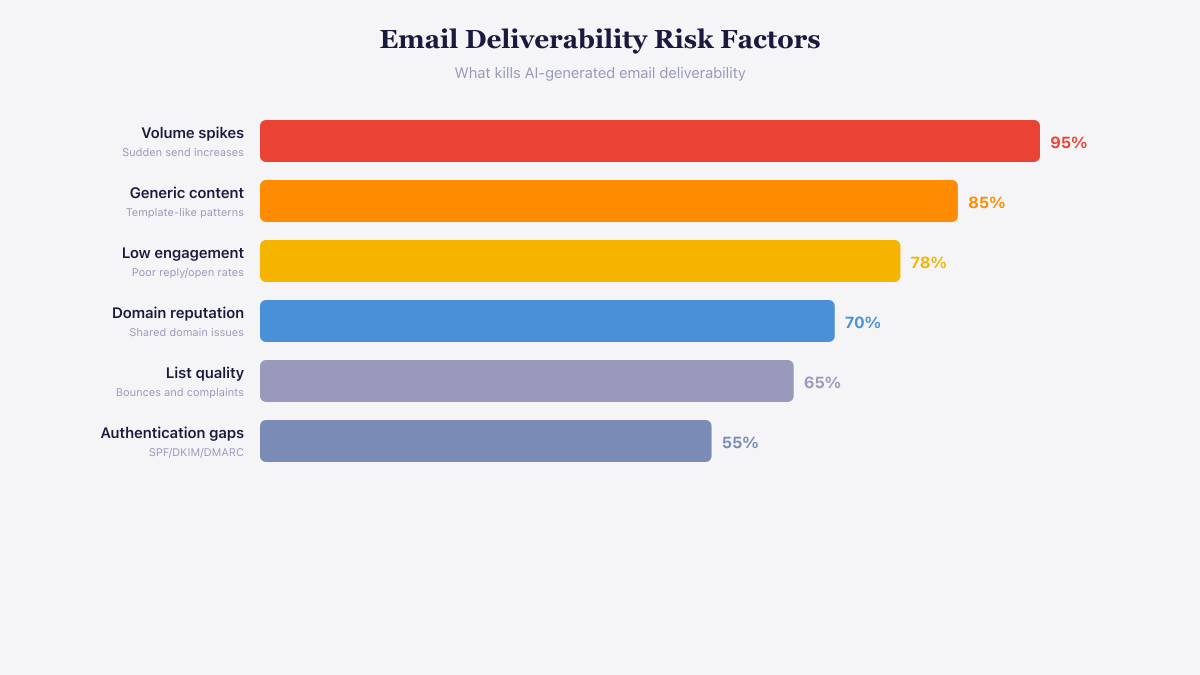 Volume spikes and generic content are the top killers of AI email deliverability.
But inbox providers do not care how your emails were generated. They care about engagement. Opens, replies, and click-throughs improve your sender reputation. Ignores, deletes, and spam complaints destroy it.
When you scale AI emails beyond what your domain can support, you trigger a predictable decline:
- High volume with low engagement drops your sender reputation score
- Inbox providers start routing your emails to spam or promotions
- Fewer prospects see your messages, further reducing engagement
- Your domain reputation enters a downward spiral that takes weeks or months to recover
The irony: the technology that lets you send more emails is most effective when you use it to send fewer, better ones.
See Salesmotion on a real account
Book a 15-minute demo and see how your team saves hours on account research.
The 200-Per-Day Rule
Based on platform guidance from tools like Outreach and real-world deliverability testing, 200 emails per SDR mailbox per day is the safe ceiling. This number keeps your sending behavior within the range that inbox providers consider "human-like."
Above 200 per day from a single mailbox, you start triggering volume-based spam filters. Even if your content is strong and personalized, the sheer volume signals automated behavior to email providers.
Within that 200-email budget, allocate carefully:
- 50 new prospects per day added to sequences (the most deliverability-safe enrollment rate)
- 150 follow-up emails from active sequences already in progress
- Zero mass blasts to cold lists outside your ICP
This is not about being conservative for its own sake. It is about maximizing the value of every email you send. A 200-email day with 15% reply rates generates 30 conversations. A 500-email day with 3% reply rates generates 15 conversations and damages your domain for next week.

“Automatic account profile detail I can use to manage my territory. Using Salesmotion AI to generate value statements per persona, account, etc. Using Salesmotion to give me a starting point based on new hires, or news alerts is critical.”
Adam Wainwright
Head of Revenue, Cacheflow
What Google, Yahoo, and Microsoft Now Enforce
The bulk sender landscape changed dramatically in 2024-2025. All three major inbox providers now enforce rules that make high-volume cold email significantly riskier. This is especially relevant when cold emailing executives, where every message must count.
Authentication is mandatory. Every email must pass SPF, DKIM, and DMARC authentication. As of late 2025, Google permanently rejects (550 errors) emails from senders that fail authentication. Microsoft began enforcement in May 2025 with similar bounce codes. This is not a filtering change. Non-compliant emails never reach the inbox, not even spam.
Spam complaint rates have hard limits. Google enforces a ceiling of 0.3% complaint rates, but recommends staying below 0.1% for reliable inbox placement. Yahoo follows the same threshold. When AI emails sound generic or irrelevant, complaint rates spike quickly because recipients are more likely to mark unsolicited emails as spam than to unsubscribe.
One-click unsubscribe is required. All commercial emails must include a machine-readable unsubscribe header that lets recipients opt out with a single click. This applies to sales emails, not just marketing newsletters.
Six Practices That Protect Deliverability
1. Send Fewer, Smarter Emails
Focus AI outreach on accounts showing real buying signals. A pricing page visit, a job change, or a funding round gives your AI context to write a genuinely relevant message. An email triggered by a real signal performs fundamentally differently than one generated from a cold list.
2. Vary Subject Lines Aggressively
Inbox providers detect patterns. If your AI generates emails with similar subject line structures (even with different words), the pattern triggers spam filters. Use your AI tool to create genuine variation: different angles, different lengths, different tones. Test at least four to five subject line variants per sequence.
3. Limit Sequence Length for Low-Priority Audiences
Not every prospect deserves a seven-email sequence. For guidance on structuring effective sequences, see our email cadence tips. For accounts outside your core ICP or showing no intent signals, cap sequences at three to four emails. Longer sequences to disengaged prospects accumulate negative signals (deletes, ignores, spam reports) that drag down your entire domain's reputation.
4. Validate Your Contact Lists
AI-generated emails to invalid addresses bounce, and bounce rates directly impact sender reputation. Use email verification before enrolling any contact in a sequence. Scrubbed, verified lists from reputable data partners dramatically outperform scraped or purchased lists.
5. Monitor Sender Reputation Monthly
Use tools like Google Postmaster and third-party deliverability monitors to track how inbox providers view your domain. Even a small increase in spam complaints can cascade across your entire sending infrastructure. Monthly reviews catch problems before they become crises.
6. Include Unsubscribe Options
Providing an easy opt-out is both a compliance requirement and a strategic advantage. When prospects cannot easily unsubscribe, they mark emails as spam instead. A spam complaint is 10x more damaging to your domain than an unsubscribe. Make opting out frictionless.

“The talking points are gold. If they're in Salesmotion, I know they're being discussed inside that business. That makes it easy to spark a real conversation, which is 90 percent of the battle.”
Andrew Giordano
VP of Global Commercial Operations, Analytic Partners
The Real Framework: Quality Times Consistency
AI outbound works when quality and consistency compound over time. A team that sends 200 relevant, well-timed emails per day, five days a week, for 12 months builds a sustainable pipeline engine. A team that sends 500 generic emails per day for three months and then has to pause while their domain recovers ends up with less pipeline overall.
The math is simple. If your AI helps you achieve 15% reply rates on 200 daily sends, you generate 150 conversations per week per SDR. That is more than enough pipeline for most teams, and it is sustainable indefinitely.
If the same AI achieves only 3% reply rates on 500 daily sends (because volume destroyed relevance), you get 75 conversations per week, half the output at 2.5x the risk. Plus you are burning through your addressable market faster and training inbox providers to deprioritize your messages.
The teams winning with AI outbound are not sending more. They are sending smarter by focusing AI on accounts showing real intent signals and crafting messages that reference specific, verifiable context about each prospect's situation. Signal-based selling is replacing volume-based outbound as the dominant playbook for AI-assisted teams.
Key Takeaways
- Cap AI-generated emails at 200 per SDR mailbox per day. Enroll no more than 50 new prospects daily.
- Google, Yahoo, and Microsoft now permanently reject emails from non-authenticated senders. SPF, DKIM, and DMARC are mandatory.
- Target spam complaint rates under 0.1%. The 0.3% threshold is where enforcement begins, not a safe target.
- Vary subject lines aggressively to avoid pattern detection. Limit sequence length for low-priority prospects.
- Focus AI outreach on signal-matched accounts where relevance is high, not on maximizing send volume.
- Monitor sender reputation monthly. Domain reputation problems compound quickly and take weeks to recover.
Frequently Asked Questions
How many AI sales emails can one SDR safely send per day?
200 emails per mailbox per day is the recommended ceiling based on platform guidance and deliverability testing. Within that budget, enroll approximately 50 new prospects per day and let follow-ups from active sequences fill the remainder. Exceeding 200 per day from a single mailbox risks triggering volume-based spam filters regardless of email quality. Pairing this discipline with AI prospecting tools that prioritize quality over volume is the most sustainable approach.
Does AI personalization protect against spam filters?
Partially. AI-generated personalization helps with recipient engagement (people are more likely to open and reply to relevant messages), which improves sender reputation. However, if the underlying patterns are repetitive (similar structures, similar subject lines, similar CTAs), inbox providers can still detect automated behavior. True variation in structure, length, and tone matters as much as personalization of content.
What should we do if our domain reputation is already damaged?
Reduce sending volume immediately to 50 or fewer emails per day per mailbox. Review and fix authentication (SPF, DKIM, DMARC). Scrub your contact lists to remove invalid addresses. Focus remaining sends exclusively on high-intent, ICP-fit prospects to maximize engagement rates. Domain reputation recovery typically takes four to eight weeks of consistent, low-volume, high-engagement sending.