C-level executives are 30.2% less likely to reply to cold emails than non-executive buyers. That stat discourages most reps from even trying. But the data tells a more nuanced story: executives do reply to cold email. They just reply to a very specific type of cold email that most reps never write.
TL;DR: Gong's analysis of over one million executive sales cycles reveals that cold email to executives works when it follows strict rules. Keep subject lines to one to four words (open rates decline with length). Keep body copy under 100 words (reply rates drop sharply past that). Lead with the executive's priorities and social proof from peers, not your product features. Replace meeting requests with value offers: benchmarks, insights, or peer comparisons. The executives spending less than nine seconds reading your email are not ignoring you. They are filtering for relevance at speed.
Why Most Cold Emails to Executives Fail
Executives receive dozens of cold emails daily. They spend less than three seconds deciding whether to open one and less than nine seconds reading it if they do. Every word in your email either earns continued attention or triggers a delete.
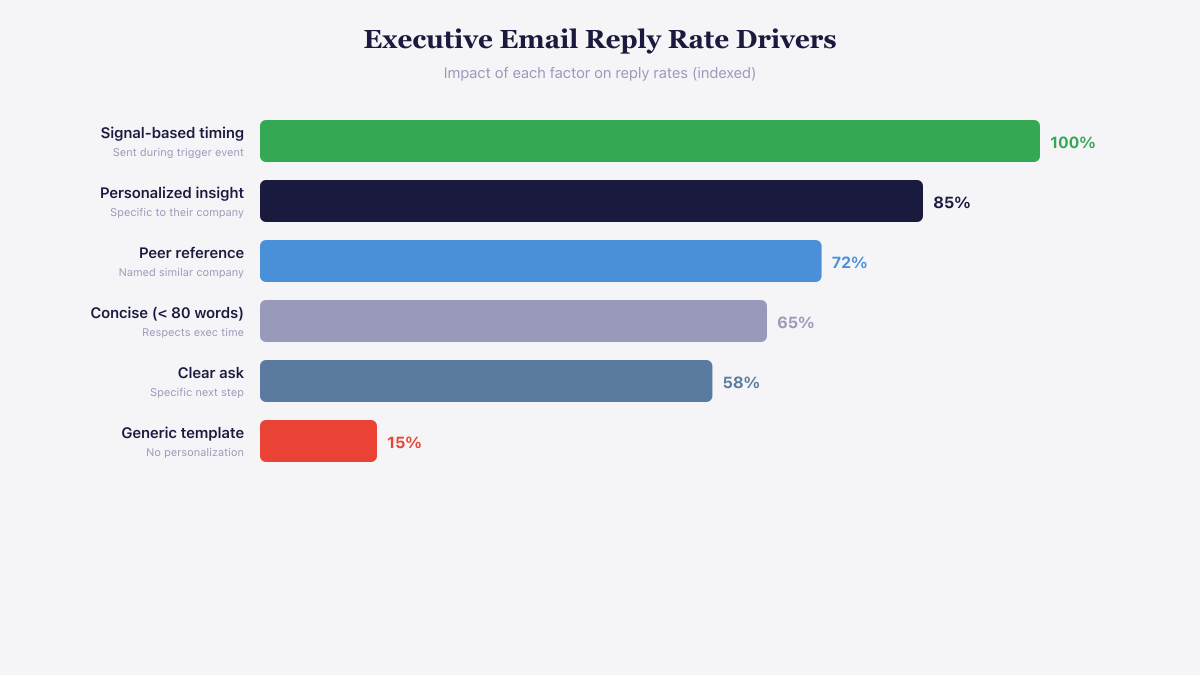 Signal-based timing has the single largest impact on executive email reply rates.
Most cold emails fail for three specific reasons that the data makes clear.
They are too long. Reply rates drop sharply past 100 words. The sweet spot is 50 to 100 words. Executives do not have time to read a 300-word email from someone they have never met. If you cannot communicate relevance in three sentences, you have not done enough research to know what relevance looks like for this specific person.
They lead with the seller's product. Most cold emails open with "We help companies do X" or "Our AI-powered platform enables Y." Executives call this the "we-we" problem: the entire email is about the sender. Terms like "AI," "platform," and feature-led positioning significantly lower reply rates because they signal a generic pitch, not a tailored conversation.
They ask for a meeting instead of offering value. "Do you have 15 minutes this week?" is a request that benefits only the seller. The executive gets nothing from that exchange except another meeting on an already packed calendar.
See Salesmotion on a real account
Book a 15-minute demo and see how your team saves hours on account research.
Subject Lines: Shorter Is Better
Executives decide whether to open your email based on the subject line, and they decide in under three seconds. The data shows that one to four word subject lines perform best. Open rates decline as subject line length increases.
Effective executive subject lines reference the prospect's world, not your product:
- "Student dropout risk" (for a higher education buyer)
- "Pipeline forecast accuracy" (for a CRO)
- "Q3 expansion gap" (for a VP of Sales)
Each of these subject lines creates curiosity about a topic the executive already cares about. They work because they sound like internal communications, not marketing.
Avoid subject lines that announce what you are selling: "Introducing [Product Name]" or "Revolutionize Your [Function]." These signal a mass email and get filtered before the executive ever sees them.
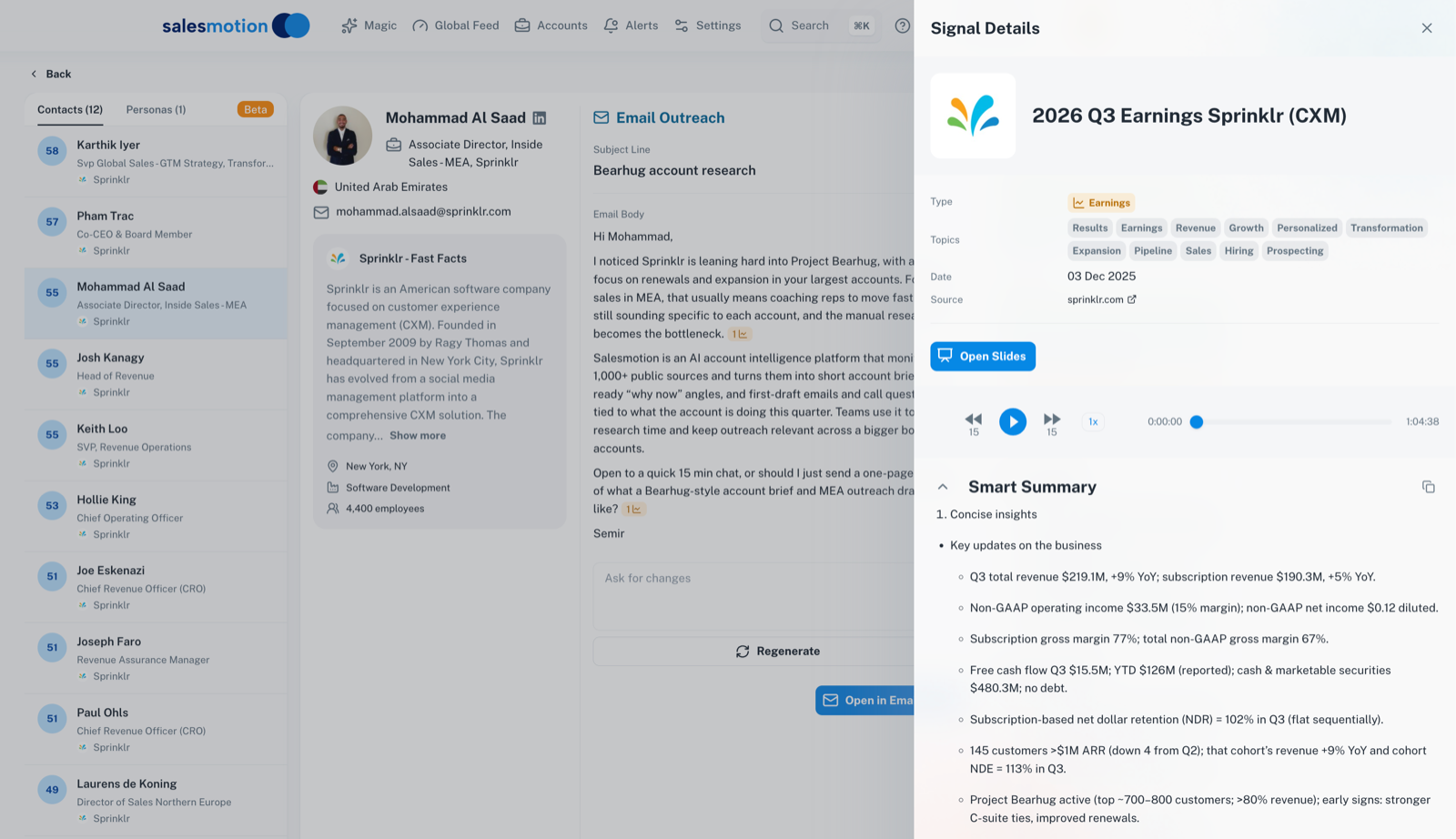 An AI-powered email draft anchored to a real earnings signal demonstrates the kind of specificity that earns executive replies — referencing their own stated priorities rather than generic product pitches.

“The talking points are gold. If they're in Salesmotion, I know they're being discussed inside that business. That makes it easy to spark a real conversation, which is 90 percent of the battle.”
Andrew Giordano
VP of Global Commercial Operations, Analytic Partners
The Body: Lead With Their Priority, Not Your Product
The first sentence determines whether the executive reads the rest. Start with something about their world, not yours.
Weak opener: "I'm reaching out because our platform helps revenue teams..."
Strong opener: "Saw that your team expanded by 12 AEs last quarter. CROs scaling that fast often find that pipeline quality drops as volume increases."
The strong opener demonstrates account research, references a specific event, and connects it to a challenge the executive likely faces. It earns the next sentence.
After the opener, anchor on how similar organizations handle the challenge. This provides social proof without making a product claim:
"We have been working with CROs at [similar companies] who faced the same dynamic. They found that [specific approach] maintained pipeline quality during rapid scaling."
Notice what this does not include: product names, feature descriptions, or ROI claims. The email positions you as someone who understands their problem and has seen how peers solve it. That is enough to earn a response.
Replace Meeting Requests With Value Offers
The call to action is where most cold emails to executives collapse. "Are you free for 15 minutes this week?" offers the executive nothing. Even if they are interested, the ask feels transactional.
Data shows that CTAs offering concrete value outperform meeting requests. The value offer gives the executive a reason to engage even if they never buy your product:
- "We put together a brief benchmark showing how your company compares to peers on [relevant metric]. Open to reviewing it?"
- "I can share how [similar company] handled this exact challenge in their last growth phase. Worth a 20-minute conversation?"
- "We published research on [specific topic] that is relevant to what your team is navigating. Happy to send it over."
Each offer provides something the executive values independent of a sales conversation. This lowers the barrier to reply because the executive is accepting value, not committing to a pitch.

“All of the vendors that I've worked with, all of the onboarding that I have had to deal with, I will say, hands down, Salesmotion was the easiest that I have had.”
Lyndsay Thomson
Head of Sales Operations, Cytel
A Framework That Fits in 100 Words
Combining these principles into a repeatable structure:
Line 1: Reference their priority. "Saw that [specific event or initiative]..." This proves you did research and connects to something they already care about.
Line 2: Name the challenge. "[Company] was up against [specific challenge]..." This shows you understand the problem behind the initiative, not just the initiative itself.
Line 3: Validate the current approach. "We have seen companies handle this by [current approach]..." This reduces resistance by acknowledging what they are already doing rather than implying they are doing it wrong.
Line 4: Offer a new perspective. "Open to hearing how [peer company] approached [specific outcome]?" This is the value offer. It positions the meeting as learning, not a sales pitch.
The hardest part of this framework is Line 1 — finding the specific event for each executive. That research used to take 30-60 minutes per account. Tools like Salesmotion's Research Agent surface these signals automatically, so reps can spend time writing, not researching.
Line 5: Low-pressure close. "Either way, [brief acknowledgment]." This removes the sense of obligation and keeps the tone human.
The entire email should fit within 50 to 100 words. If it does not, cut ruthlessly. Every word past 100 reduces the probability of a reply.
Timing and Persistence
Even well-crafted cold emails require follow-up. Most deals require five to twelve touchpoints before a prospect engages, but 48% of reps never send a second follow-up.
Combining cold email with a signal-based selling approach dramatically improves response rates. For executive cold email specifically:
- Follow up two to three times with new value in each message, not the same ask repeated
- Space follow-ups three to five days apart to stay visible without being irritating
- Add channels between emails: a LinkedIn connection request after email one, a phone call after email two. Multi-channel sequences produce 22% higher response rates than email alone
- Send on Tuesday or Wednesday mornings between 7 and 11 AM for the highest open and response rates
Key Takeaways
- C-suite executives are 30.2% less likely to reply to cold email, but concise, priority-led emails with value offers close that gap significantly.
- One to four word subject lines perform best. Executives decide to open in under three seconds.
- Keep body copy to 50-100 words. Reply rates drop sharply past 100 words.
- Lead with the executive's priority, not your product. The "we-we" problem kills reply rates.
- Replace "do you have 15 minutes?" with a concrete value offer: benchmarks, peer insights, or relevant research.
- Follow up two to three times with new value. Use multi-channel sequences for 22% higher response rates.
Frequently Asked Questions
What reply rate should you expect from cold emails to executives?
Expect 3-6% as a baseline. C-level executives reply at roughly 6.4% overall, but cold outreach to executives typically runs lower than warm or signal-triggered outreach. If your reply rate is below 3%, your messaging likely has a targeting or relevance problem. Above 8% means your approach is working well. The teams achieving 10%+ reply rates combine precise targeting (buying signals and trigger events) with the short, value-led email format that executives respond to.
How many follow-ups should you send to an executive?
Two to three follow-ups spaced three to five days apart. Each follow-up must add new value: a different insight, a relevant case study, or new information about their company. Never send "just checking in" or "bumping this to the top of your inbox" to an executive. If three follow-ups produce no response, shift channels (try phone or LinkedIn) or look for a different entry point at the account. Persistence is valuable. Repetition without new value is spam.
Should you personalize every cold email to executives or use templates?
Personalize the first two lines and the CTA. The middle section (the challenge and social proof) can be templatized by persona and industry since the problems facing CROs at similar-sized SaaS companies overlap significantly. The key is that the personalized elements reference specific, verifiable information about the executive's company: a recent hire, a funding round, an earnings call statement, or an account intelligence insight. The best signals for enterprise sales provide exactly this kind of verifiable context. Generic personalization ("I saw you are the CRO at Acme") is worse than no personalization because it signals automated outreach disguised as research.