No, AI cannot fully replace SDRs for outbound prospecting, and the latest data to plan 2027 against shows why attempting it costs more than it saves. In head-to-head tests, human SDRs generated 2.6x more revenue ($147K vs $56K) and achieved 71% meeting show rates vs 52% for AI. The real opportunity is not replacement but augmentation: AI handles the 70% of SDR time consumed by research and admin, while humans handle the conversations and relationships that actually close deals. 45% of sales teams are already running this hybrid model.
TL;DR: AI SDRs excel at high-volume outreach execution and can handle 10-50x the activity of a human rep. But they struggle with complex account research, multi-threaded relationship building, and the judgment calls that enterprise selling requires. The most effective model isn't AI vs. human. It's AI-augmented human SDRs who use intelligence tools for research and prioritization while bringing human judgment to high-value interactions.
What AI SDRs Actually Do (And Don't Do)
An AI SDR, in its current form, is an automated outreach agent that handles some or all of the prospecting workflow: identifying target contacts, personalizing messages, managing multi-step sequences, responding to replies, and scheduling meetings.
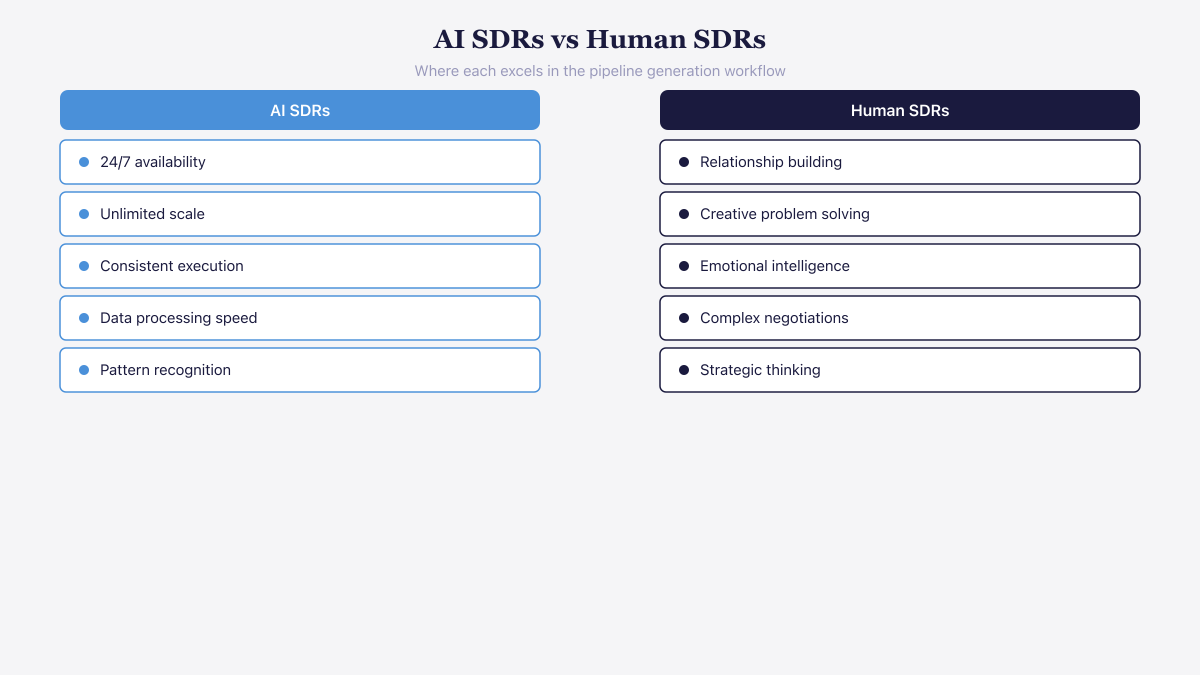 AI and human SDRs excel in complementary areas — the best teams combine both.
What AI SDRs do well:
- Volume. AI agents can send hundreds or thousands of personalized emails daily, far exceeding human capacity.
- Consistency. Every message follows the defined playbook. No missed follow-ups, no inconsistent timing, no Monday morning slowdowns.
- Speed. Initial response to inbound leads can happen in seconds rather than hours.
- Pattern matching. AI can identify which email templates, subject lines, and send times produce the highest engagement.
What AI SDRs struggle with:
- Deep account research. Most AI SDRs personalize from LinkedIn profiles and company descriptions. They miss the earnings call language, hiring patterns, competitive moves, and strategic signals that make outreach truly relevant.
- Relationship building. Enterprise selling requires trust, rapport, and multi-threaded relationships. AI can't build genuine connections with multiple stakeholders over time.
- Complex judgment calls. When a prospect responds with a nuanced objection or an unexpected question, AI agents often produce generic or awkward responses that damage credibility.
- Account-specific strategy. An AI SDR treats every account as an email to send. A human SDR can assess whether an account needs a warm introduction, a LinkedIn engagement strategy, a direct call, or a referral approach.
- Reading readiness. An enterprise SaaS rep framed it well: 20 to 60 percent of his accounts had unknown readiness, what he called teenagers rather than adults, and he burned four or five meetings educating prospects who were never going to buy that year. The bottleneck is timing, not send volume, and judging whether an account is ready now is human work an output-optimized AI SDR skips.
See Salesmotion on a real account
Book a 15-minute demo and see how your team saves hours on account research.
The Real ROI Comparison
Let's compare costs, output, and pipeline quality honestly.
Cost Comparison
| Factor | Human SDR | AI SDR Platform |
|---|---|---|
| Base compensation | $55,000-75,000/year (mid-market) | $0 |
| Platform/tool cost | $200-500/month (CRM, engagement, data) | $1,000-5,000/month |
| Commissions/bonuses | $15,000-30,000/year | $0 |
| Benefits and overhead | $15,000-25,000/year | $0 |
| Management cost | 1 manager per 6-10 SDRs | Minimal oversight |
| Training and ramp | 3-6 months to full productivity | Days to weeks |
| Total annual cost | $100,000-150,000 per rep | $12,000-60,000 per license |
On pure cost, AI SDRs win. A single AI SDR license costs 20-60% of a human SDR's fully loaded cost.
Activity Output
| Metric | Human SDR | AI SDR |
|---|---|---|
| Emails per day | 50-100 | 500-5,000 |
| LinkedIn touches per day | 20-40 | 100-500 |
| Calls per day | 40-80 | N/A (most AI SDRs don't call) |
| Accounts researched per day | 5-10 (thoroughly) | 50-200 (surface-level) |
| Follow-up consistency | Variable (60-80%) | 100% |
On raw activity, AI SDRs win decisively. The volume advantage is 10-50x depending on the channel.
Pipeline Quality
This is where the comparison gets complicated.
| Quality Metric | Human SDR | AI SDR |
|---|---|---|
| Meeting show rate | 70-85% | 40-60% |
| Meeting-to-opportunity conversion | 25-40% | 10-20% |
| Average deal size from meetings booked | Standard | Often smaller |
| Enterprise account penetration | Multi-threaded, strategic | Single-threaded, transactional |
| Relationship equity built | Significant | Minimal |
AI SDRs generate more meetings but lower-quality meetings. The show rates are lower because AI-booked meetings often lack the relationship context that creates commitment. The conversion rates are lower because the prospect's expectations were set by AI interaction, not human engagement. For SMB motions with shorter sales cycles and smaller deal sizes, this trade-off can work. For enterprise motions where relationships and preparation matter, the quality gap is significant.
The root cause is an optimization mismatch: an autonomous AI SDR optimizes for sends, like a machine gun, while the buyer optimizes for relevance, like a sniper, so reply rates collapse on mail no human touched. The checkpoint that separates a copilot from a spam cannon is a human deciding the draft sounds like the rep did the work before sending, which only holds when research is continuous (miss the feed for a week and the signal is gone).

“The Business Development team gets 80 to 90 percent of what they need in 15 minutes. That is a complete shift in how our reps work.”
Andrew Giordano
VP of Global Commercial Operations, Analytic Partners
Where Each Model Wins
AI SDRs Win for High-Volume SMB Outbound
If your motion involves reaching thousands of small and mid-market accounts with a standardized value proposition, AI SDRs deliver strong economics. The key conditions:
- Deal size under $25K ACV where the cost of human SDR outreach exceeds the margin benefit
- Standardized messaging that doesn't require deep customization per account
- Inbound follow-up where speed matters more than personalization depth
- List-based prospecting targeting known ICP-fit accounts with basic firmographic personalization
Human SDRs Win for Enterprise and Strategic Accounts
For accounts where deal sizes exceed $50K, buying committees include 5+ stakeholders, and the sales cycle spans months, human SDRs deliver significantly better outcomes:
- Multi-threaded relationship building that creates multiple pathways into the account
- Signal-informed outreach referencing specific events at the target company
- Phone-based engagement which remains the highest-converting channel for enterprise
- Adaptive strategy that adjusts approach based on real-time feedback and account dynamics
In life sciences and CRO selling, the timing economics are stark. Responding cold to a published RFP converts below 20 percent, while relationships shaped early convert above 60 percent, and the predictive signals sit 6 to 9 months ahead of the RFP. No volume of sends recovers a relationship that should have started two quarters earlier, which is judgment a human SDR brings.
The Hybrid Model: AI-Augmented Human SDRs
The most effective model combines the strengths of both:
AI handles: Research aggregation, signal monitoring, email personalization at scale, follow-up cadence management, data enrichment, and meeting scheduling.
Humans handle: High-value calls, complex email responses, relationship building, multi-threading strategy, and judgment calls about account approach.
A marketing operations director at a cybersecurity software firm told us: "there's some preference of having a human in the loop. So more like getting a dashboard of some ranking of key indicators that you should reach out to first and then letting the reps decide how to fire off." That is the hybrid model in one sentence: the system ranks, the rep decides.
In practice, this means equipping human SDRs with account intelligence that eliminates the research bottleneck. The routine a BD or CRO runs before sending one email is granular: pull a list, enrich it, filter by title, open each company site, read the About, Leadership, and Pipeline pages, infer the moment, then draft a message. One BD director in life sciences called it 10 to 15 minutes of back-and-forth per account. Instead, the SDR receives a pre-built account brief with leadership changes, strategic priorities, buying signals, and competitive context, then writes outreach that references specific, current events at the target company.
Teams like Analytic Partners achieved 40% pipeline growth not by replacing SDRs with AI, but by giving their team automated account research that cut preparation from 3 hours to 15 minutes per account. The reps still ran the conversations. The AI handled the research that made those conversations productive.
Decision Framework: When to Use AI vs Human SDRs
Use this matrix to determine the right model for your team. One dimension predicts copilot fit better than deal size: whether the rep owns a defined list of 50 to 200 named accounts. There the strongest differentiator is cross-account search, asking which of 1,000 accounts mentioned a given catalyst in the last three months.
| Criteria | Use AI SDR | Use Human SDR | Use Hybrid |
|---|---|---|---|
| Deal size | Under $25K ACV | Over $50K ACV | $25K-$50K ACV |
| Buying committee | 1-2 decision makers | 5+ stakeholders | 3-5 stakeholders |
| Sales cycle | Under 30 days | Over 90 days | 30-90 days |
| Outreach volume needed | 500+ emails/day | Under 100/day | 100-500/day |
| Brand sensitivity | Low (SMB/startup) | High (enterprise) | Medium |
| Channel mix | Email-only | Multi-channel (phone, email, LinkedIn) | Email + selective calls |
| Research depth needed | Basic firmographics | Earnings calls, signals, competitor intel | Signal monitoring + human judgment |
The pattern: Most teams that try full AI SDR replacement revert to hybrid within 6 months. Only 2% of AI SDR implementations stick long-term according to Topo.io research, while 50-70% churn within a year.

“Salesmotion has been a game-changer for me. I used to spend 12 hours a week on prospect research, now it's down to 4. Plus I'm finding stuff I was totally missing - podcasts, news mentions, the good bits.”
George Treschi
Account Executive, FY25 President's Club, Sigma
The Hidden Risks of Full AI SDR Replacement
Before replacing your SDR team with AI, consider these risks:
Brand Perception
Recipients are increasingly aware of AI-generated outreach. Obvious AI emails (over-personalized, generically specific, or tonally off) can damage your brand with enterprise prospects who expect human interaction. A Fortune 500 VP receiving clearly automated outreach may develop a negative impression that takes months to overcome.
I say the same thing to sales leaders: you don't want an AI SDR accidentally being not very good with a high-value prospect. These systems are not perfect.
Deliverability
AI SDRs sending thousands of emails per day face inbox placement challenges. Email providers are tightening spam detection, and high-volume sending patterns trigger deliverability penalties. This is an operational tax that grows with volume.
Loss of Market Intelligence
Human SDRs collect qualitative market intelligence on every call: objections, competitive mentions, buyer sentiment, and market shifts that don't show up in CRM data. Organizations that fully automate outbound lose this feedback loop.
Adoption and Shelfware
The number-one post-sale fear sales leaders raise is not cost or accuracy. It is that nobody will use the thing. One prospect described a prior tool with around 80 licensed seats and three daily active users; another estimated only about 10 percent of reps ever touch the tools they are given. A tool that hands a rep better drafts gets used. One that tries to do the rep's job gets switched off. If adoption is the risk that decides ROI, read why sales reps ignore intelligence tools before you buy.
Regulatory Risk
AI-generated outreach that mimics human interaction raises compliance questions in certain industries and regions. GDPR requirements around automated decision-making and the evolving US regulatory landscape create uncertainty for fully autonomous AI outreach.
How to Decide: A Framework for Sales Leaders
Ask these questions:
-
What's your average deal size? Under $25K: AI SDRs can work well. Over $50K: human SDRs with AI augmentation deliver better ROI.
-
How complex is your buying process? Single decision-maker: AI SDRs are sufficient. Multi-stakeholder committee: human judgment and relationship building are essential.
-
How important is brand perception? If your prospects are enterprise executives who expect premium engagement, AI-only outreach carries brand risk.
-
What's your current research bottleneck? If SDRs spend more time researching than selling, the answer isn't replacing them with AI. It's giving them the augment model. Platforms like Salesmotion pair a Signal Agent for buying signals with a Research Agent that builds the account research brief, so reps spend time selling instead of preparing.
-
What does your team need most: more activity or better activity? AI SDRs increase activity volume. AI-augmented human SDRs increase activity quality. Most enterprise teams need the latter.
Key Takeaways
- AI SDRs deliver 10-50x the outreach volume of human SDRs at 20-60% of the cost, but with significantly lower meeting quality metrics (40-60% show rates vs. 70-85% for human-booked meetings).
- For SMB motions with sub-$25K deal sizes and standardized messaging, AI SDRs can deliver strong economics.
- For enterprise motions with $50K+ deals and multi-stakeholder buying committees, human SDRs with AI augmentation produce better pipeline quality and higher conversion rates.
- The hybrid model works best: AI handles research, signal monitoring, and follow-up automation while humans handle calls, complex responses, and relationship building.
- Before going full AI SDR, consider brand perception risk, deliverability challenges, loss of market intelligence, and regulatory uncertainty.
- The most effective investment for most enterprise teams isn't AI SDRs. It's AI-powered account intelligence that eliminates the 2-3 hours of research per account that prevents human SDRs from spending more time selling.
Frequently Asked Questions
Can AI SDRs replace human SDRs entirely?
For high-volume SMB outbound with standardized messaging, AI SDRs can handle the majority of the prospecting workflow effectively. For enterprise sales with complex buying committees, multi-threaded relationship requirements, and high deal values, full replacement carries significant risks: lower meeting quality, brand perception damage, and loss of qualitative market intelligence. The most successful organizations use AI to augment human SDRs rather than replace them entirely.
What is the average cost of an AI SDR platform?
AI SDR platforms range from $1,000 to $5,000 per month per license, depending on capabilities, volume limits, and feature tiers. This compares to $100,000-150,000 in fully loaded annual cost for a human SDR (base salary, commissions, benefits, tools, management overhead). The cost advantage is clear on a per-unit basis, but the ROI depends on pipeline quality, not just pipeline volume.
How do AI SDRs personalize outreach?
Most AI SDRs personalize using LinkedIn profile data, company descriptions, recent news mentions, and firmographic data. Advanced platforms incorporate intent data and job posting analysis. However, the personalization depth varies significantly. Basic AI SDRs produce surface-level personalization that recipients recognize as automated. More sophisticated platforms generate outreach that references specific account events, but still lack the contextual judgment that makes human-crafted messages resonate with senior executives.
What is the best approach for enterprise sales teams?
Equip human SDRs with the augment model split across three agents: a Signal Agent that detects buying signals across 1,000-plus sources, a Research Agent that turns hours of tool-toggling into a brief in minutes, and an Outreach Agent that drafts a signal-anchored message and waits for the rep to review and send. The SDR keeps the calls, the relationship, and the send decision while the agents remove the busywork, which preserves the judgment enterprise selling requires.
Do AI SDRs actually work?
Yes, for specific use cases. AI SDRs deliver strong ROI for high-volume SMB outbound (deal sizes under $25K) where standardized messaging reaches thousands of accounts. They achieve 3-8% cold reply rates vs 5-12% for humans, but at 10-50x the volume. Where they fail is enterprise selling: lower meeting show rates (40-60% vs 70-85%), inability to multi-thread relationships, and recipients increasingly detecting and ignoring AI-generated messages. Teams that pair AI SDRs with human oversight report 2.8x more pipeline than teams using AI alone.
Should I hire AI SDRs or human SDRs?
It depends on your deal size and selling motion. For deals under $25K with short sales cycles: AI SDRs at $12,000-$60,000/year deliver better economics than a human SDR at $100,000-$150,000 fully loaded. For deals over $50K with multi-stakeholder buying committees: human SDRs with AI augmentation produce better pipeline quality and higher conversion. For the middle ground ($25K-$50K): start with a hybrid model where AI handles research, signal monitoring, and email drafting while humans handle calls and relationship-building.
What are the biggest limitations of AI SDRs in 2027?
Four limitations consistently emerge: (1) Shallow personalization — most AI SDRs personalize from LinkedIn and company descriptions, missing earnings calls, SEC filings, and hiring signals that make outreach genuinely relevant. (2) No phone capability — the highest-converting channel for enterprise remains the phone, and most AI SDRs are email-only. (3) Brand risk — enterprise prospects increasingly recognize and penalize AI-generated outreach. (4) Hallucination — AI agents can fabricate prospect details (wrong job title, non-existent news events) that destroy credibility when caught. These limitations explain why only 2% of full AI SDR implementations stick long-term.