Most sales leaders I talk to have the same story: they bought an AI tool, rolled it out to the team, and six months later, three reps use it regularly. The rest went back to their spreadsheets.
It's not the technology that fails. It's the rollout. And getting AI adoption in sales right is now the difference between hitting your number and watching your competitors pull ahead.
Gartner predicts that task-specific AI agent adoption will jump from under 5% in 2025 to 40% by the end of 2026. But here's the part most vendors leave out: over 40% of those AI projects will be canceled due to escalating costs and unclear business value. The difference between the teams that succeed and the ones that burn budget comes down to how they approach their AI adoption strategy, not which tool they pick.
TL;DR: Successful AI adoption in sales starts with automating the right tasks first (account research, not outreach), getting your data foundation right, and giving reps a phased rollout plan instead of a big-bang launch. Teams that nail the rollout see 40%+ pipeline growth and 2-4 hours saved per rep per week. Teams that skip the fundamentals join the 40% cancellation rate.
Why Most Sales Teams Struggle with AI Adoption
The failure pattern is predictable. A VP sees a demo, gets excited, buys the tool, sends a Slack message saying "we're using AI now," and expects adoption to happen organically. It doesn't.
A 2025 ZoomInfo survey found that over 40% of AI users are dissatisfied with the accuracy and reliability of their tools. Data privacy concerns (40%) and technical expertise gaps (38%) round out the top three barriers. These aren't technology problems. They're implementation problems.
The root causes fall into three buckets:
Wrong starting point. Teams try to automate outreach or prospecting first because it sounds exciting. But outreach quality depends on research quality. If reps don't trust the insights feeding their messages, they won't trust the messages. You're building on sand.
Data gaps. Your CRM has stale contacts, missing fields, and job titles from two years ago. AI amplifies whatever data you feed it. Feed it garbage, get garbage at scale. According to Gallup, only 6% of workers feel "very comfortable" using AI in their roles. When the outputs look wrong because the inputs are wrong, that number drops to zero.
No clear win. Reps need to see value in the first week, not the first quarter. If the AI tool requires three weeks of training before it does anything useful, you've already lost half the team. The best AI rollouts deliver an "aha moment" in the first session, not the first month.
Misaligned expectations. Leadership promises 10x productivity gains they saw in a vendor demo. Reality delivers 2x after proper setup and training. Gartner warns that by 2028, AI agents will outnumber sellers by 10x, yet fewer than 40% of sellers will report that AI actually improved their productivity. More tools does not equal more results.
See Salesmotion on a real account
Book a 15-minute demo and see how your team saves hours on account research.
Which Sales Tasks Should You Automate First?
Not all AI use cases deliver equal ROI. The mistake most teams make is automating whatever the vendor demo showed them, not what would actually improve outcomes for their specific workflow. Here's how to prioritize based on what we've seen work across hundreds of B2B teams:
High-ROI, low-risk (start here)
Account research is the single best first use case for AI in sales. Every rep does it, everyone hates it, and the before/after is dramatic. Reps spend 3-5 hours per week toggling between LinkedIn, company websites, SEC filings, news sites, and CRM notes to prepare for meetings. An account intelligence platform compresses that into minutes.
When Analytic Partners rolled out Salesmotion, their team went from spending 3 hours per account to getting 80-90% of what they needed in 15 minutes. The result: 40% growth in qualified pipeline within a year. That's the kind of win that makes the rest of the team ask "when do I get access?"
Here's what that looks like in practice. Instead of a rep opening seven tabs and spending an hour piecing together a pre-meeting brief, they get a comprehensive account summary with key insights, strategic initiatives, recent news, and competitive context in one view:
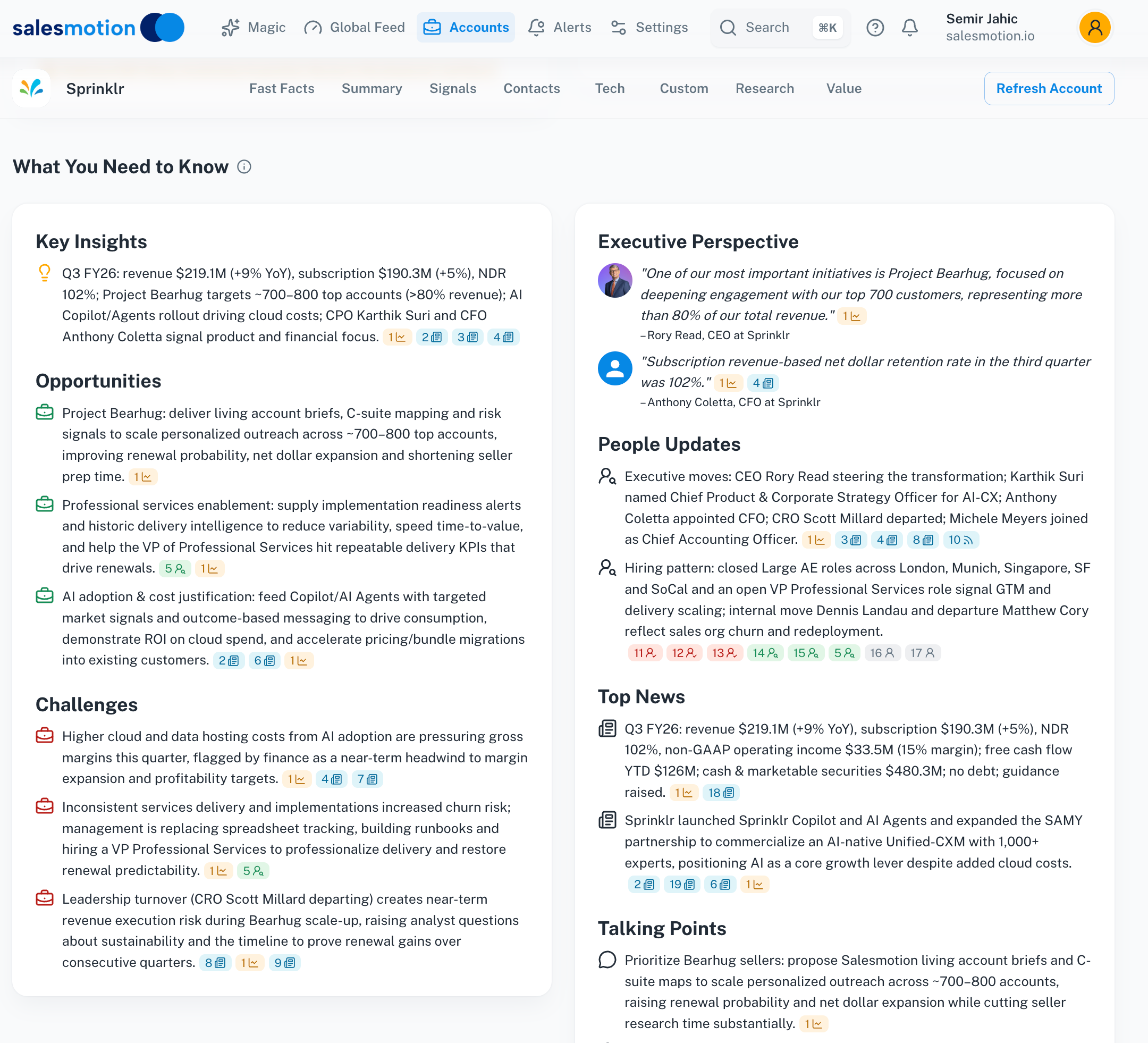 An AI-generated account summary consolidates insights from 1,000+ sources into a single view, replacing hours of manual research.
Signal monitoring is the natural second step. Instead of reps manually checking for leadership changes, funding rounds, earnings calls, and hiring patterns, AI surfaces these buying signals automatically. Reps stop wasting calls on accounts that aren't ready and focus on the ones showing active intent.
An account executive at a software firm told us he tried to build his own account-monitoring agent, gave up on the token cost, and really just wants a Monday email naming five accounts and why. That is the job signal monitoring has to do.
The difference between reactive and proactive selling becomes obvious when you see a signal feed in action. Instead of a rep discovering that their champion left three weeks ago (after the deal already stalled), the platform flags it the day it happens:
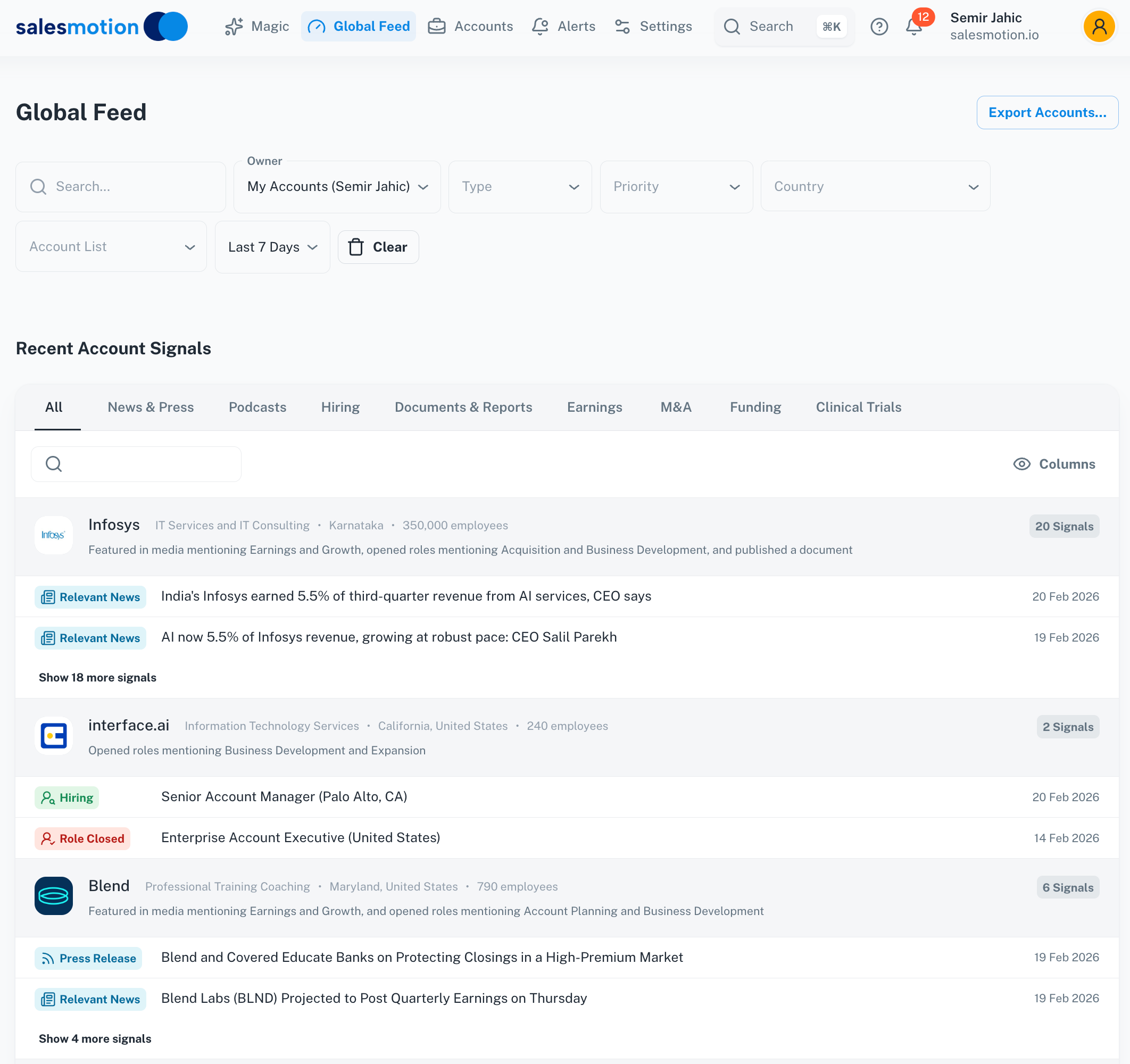 A real-time signal feed surfaces leadership changes, earnings insights, hiring patterns, and competitive moves across your entire territory.
Medium-ROI, medium-risk (phase two)
Meeting preparation and follow-up. AI can pull together pre-meeting briefs, suggest talking points based on recent signals, and draft follow-up emails. But reps need to review and personalize. This is a copilot use case, not autopilot. Meeting prep improves dramatically when built on top of the research and signal layers from phase one.
Lead scoring and prioritization. AI can rank accounts by likelihood to convert, but only after you've fed it enough data to calibrate. Start with transparent scoring you can verify before trusting it to route leads.
Lower-ROI until foundations are set (phase three)
Automated outreach. The vendor demos look impressive, but fully automated emails without strong research and signal data behind them produce the same generic messages your buyers already ignore. Get the research and signal layers right first, and AI-generated outreach becomes meaningfully better than templates.
A sales consultant at a sales consultancy told us where teams go wrong: "what they're focused on too much is the automation of just getting stuff out."
When the foundation is solid, AI-generated outreach references a prospect's recent earnings call, a new VP starting two weeks ago, and a strategic initiative from their latest 10-K. That's outreach that sounds like the rep did two hours of homework:
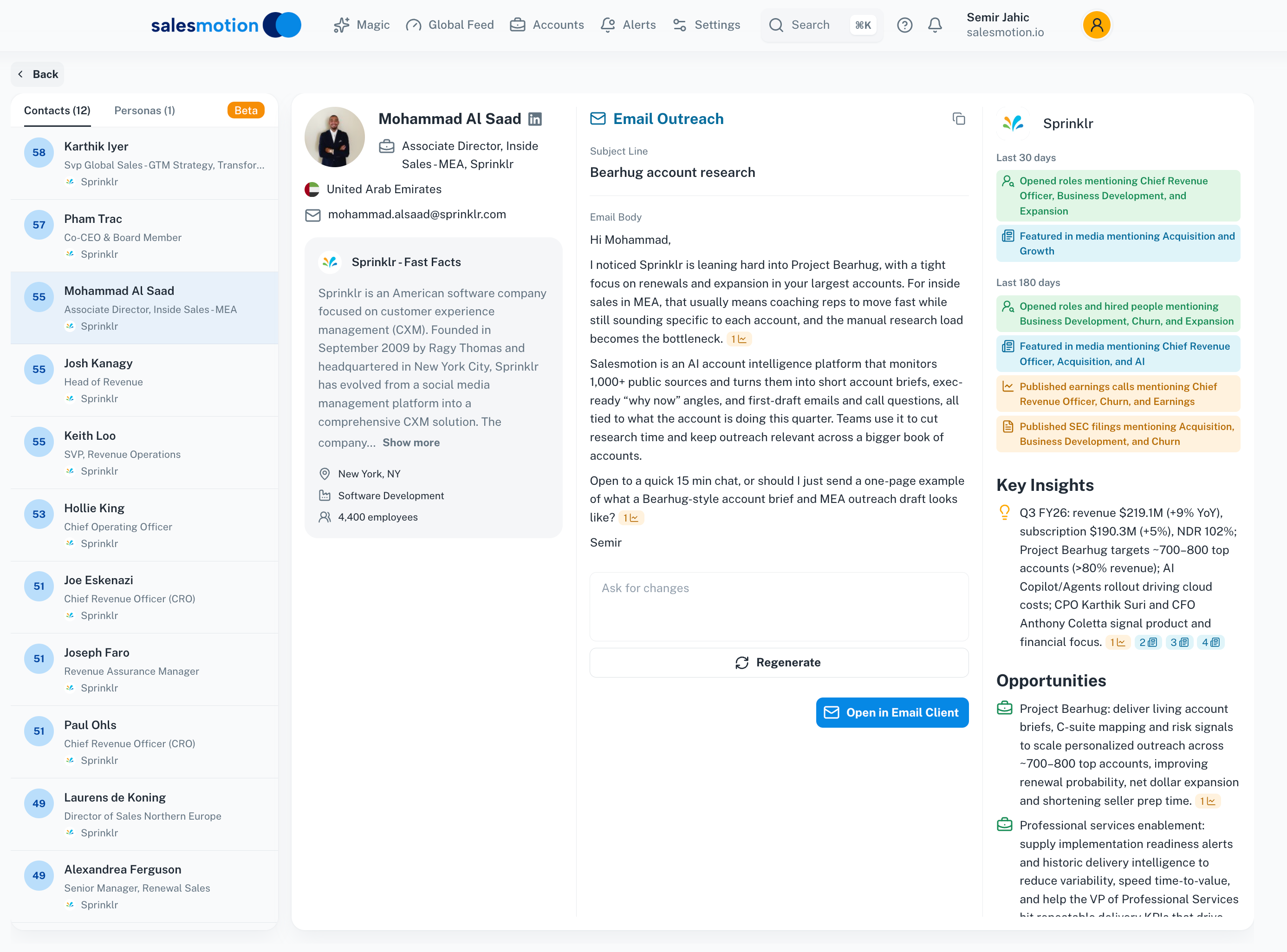 AI-generated outreach anchored to live signals and account research. The message references real events, not generic templates.

“The Business Development team gets 80 to 90 percent of what they need in 15 minutes. That is a complete shift in how our reps work.”
Andrew Giordano
VP of Global Commercial Operations, Analytic Partners
What AI Adoption Looks Like in Practice
Here's a concrete example of how signal-based intelligence changes a rep's day:
Trigger: On a Tuesday morning, the platform detects that a target account has posted a new VP of Revenue Operations role. Their latest earnings call transcript mentions "investing in sales productivity tools" as a strategic priority.
Platform action: The account brief auto-updates with the leadership change, earnings insight, and a hiring pattern showing 6 new sales roles in 30 days. The rep receives an alert.
Rep action: Instead of a cold call, the rep enters discovery knowing there's likely new budget, a new VP who'll want to make their mark, and a scaling sales team where research time is about to become a bottleneck.
Outcome: The first meeting is a consultative conversation, not a qualification call. The rep references the earnings commentary and asks how the hiring plan connects to the new VP's mandate. Deal velocity increases because discovery is half-done before the call starts.
This is the difference between AI sales agents that automate busywork and AI that changes how deals get worked.
How to Build a Phased AI Rollout Plan
The biggest mistake sales leaders make is treating AI like a light switch: off one day, on the next. A phased approach builds confidence, surfaces problems early, and creates internal champions who pull the rest of the team along.
Weeks 1-2: Foundation
- Audit your CRM data quality. Fix duplicate records, standardize fields, update stale contacts. If less than 60% of contacts have been updated in the last 90 days, you have a data problem to fix first.
- Identify your pilot group: 3-5 reps who are curious about new tools and respected by peers. You need credible voices who can tell the team "this actually works" and be believed.
- Define success metrics before anyone touches the tool. Pipeline generated, hours saved per week, and meeting prep quality are more meaningful than "logins per day."
- Document the current workflow. How long does account research take today? How many tools do reps toggle between? You need a baseline to prove improvement later.
Month 1: Pilot
- Deploy to the pilot group on one use case only (account research is the strongest start).
- Set a weekly feedback rhythm. What's working? What's confusing? What would make them use it more?
- Capture at least three concrete wins. "I found a signal that led to a meeting" or "I prepared for an executive briefing in 10 minutes instead of 90" are the stories that sell the rollout internally.
- Track the numbers. Compare the pilot group's pipeline activity and preparation time against their pre-pilot baseline.
Quarter 1: Expansion
- Share pilot results with the broader team. Let pilot reps present, not management.
- Expand to the full sales team on the proven use case.
- Add the second use case (signal monitoring or meeting prep) only after the first is consistently adopted.
- Assign an internal champion who owns adoption metrics and can troubleshoot issues. Someone needs to be accountable for whether the team is getting value from the tool.
Cacheflow's team saw the power of getting this right. When they adopted Salesmotion, the entire team was fully utilizing the platform within 24 hours. Why? Because the value was immediately obvious: meeting prep time dropped from 90 minutes to 30, and reps could see the difference in their first session.

“The moment we turned on Salesmotion, it became essential. No more hours on LinkedIn or Google to figure out who we're talking to. It's just there, served up to you, so it's always 'go time.'”
Adam Wainwright
Head of Revenue, Cacheflow
The Data Quality Problem Nobody Talks About
Every AI vendor promises intelligence. Few talk about what happens when the intelligence layer sits on top of broken data.
Here's the reality: your CRM decays at roughly 30% per year. Contacts change jobs, companies get acquired, phone numbers go stale, and org charts shuffle. If your AI tool pulls from CRM data alone, it's working with information that's partially wrong before it starts.
Before deploying any AI tool, audit your CRM: check contact freshness (what percentage updated in the last 6 months?), run a dedupe analysis (most CRMs have 10-25% duplicates), verify field completeness on critical fields, and standardize data entry formats. These issues seem manageable at small scale, but AI amplifies every gap across your workflow.
The fix isn't just "clean your CRM." It's choosing AI tools that bring their own verified data rather than only working with what you already have. There's a meaningful difference between:
- Enrichment tools that append data fields to existing records (still dependent on your base data being current)
- Intelligence platforms that monitor 1,000+ sources in real time and surface what's actually happening at target accounts right now
A signal-driven approach solves the staleness problem by design. Instead of relying on static data that was accurate when it was entered, you're working with live signals: a new VP just started, the company posted 12 sales roles this month, their CEO mentioned "digital transformation" on the last earnings call.
Revenue Velocity Lab's benchmark of 938 B2B companies found that AI-augmented reps generate $1.75M in revenue per rep compared to $1.24M for traditional reps. That 41% gap doesn't come from better tools alone. It comes from better information feeding those tools.
Human-in-the-Loop: When to Let AI Run vs. When to Review
Not every AI use case needs the same level of human oversight. The teams that get adoption right build clear boundaries around what AI handles independently and where humans stay in control.
Let AI run autonomously
- Account research compilation. AI pulling together publicly available information about a company, its leadership, recent news, and strategic initiatives. Low risk, high time savings.
- Signal detection and alerting. Monitoring for job changes, earnings calls, funding rounds, and hiring patterns. The AI is scanning, not deciding.
- Data enrichment and deduplication. Standardizing records, filling in missing fields, and flagging duplicates. This is the kind of grunt work AI was built for.
Use AI as a copilot (review before acting)
- Meeting prep summaries. AI generates the brief, but the rep reviews it before walking into the meeting. A rep who's been working the account for months might know something the AI doesn't.
- Email drafts and outreach. AI generates the first draft anchored to real signals. The rep adds personal touches and decides whether the timing is right. AI handles 80% of the work, the rep adds the 20% that makes it feel human.
- Lead scoring and prioritization. AI ranks the accounts, but reps validate whether the signal indicates buying intent for their specific product.
Keep humans fully in control
- Strategic account planning. AI provides inputs (signals, research, competitive landscape), but engaging a $500K+ opportunity requires human judgment about relationships, timing, and organizational politics.
- Negotiation and pricing decisions. Discount authority and deal structuring involve too many variables that live outside the data.
- Customer escalations. When something goes wrong, the customer needs a human who can empathize and take ownership.
The closer a task is to a customer conversation, the more human oversight it needs.
How to Get Your Sales Team to Actually Use AI
Change management advice usually sounds like it was written by someone who's never carried a quota. Reps don't care about "digital transformation journeys." They care about whether this thing helps them hit their number.
Here's what actually works:
Show, don't tell. Skip the all-hands presentation about "our AI strategy." Instead, have a pilot rep demo how they used the tool to win a deal or save three hours in a week. Peer proof beats executive mandates every time.
Remove the old workflow. If reps can still do things the old way, they will. When Frontify's team adopted Salesmotion, they saw a 42% increase in sales velocity year over year. That happened because the team replaced their patchwork of research tools, not added another tab alongside them. Consolidation drives adoption faster than addition.
Make it about their career, not the company's efficiency. The unspoken fear behind AI resistance is job replacement. Address it directly: "This tool handles the research grunt work so you can spend more time in conversations with buyers. The reps who learn this first will have a material edge." That framing turns resistance into urgency.
Celebrate specific wins publicly. Not "the team saved 200 hours this quarter." That's abstract. Instead: "Sarah used a signal about a leadership change at [account] to get a meeting with the new CRO in her first week. That deal is now in stage 2." Concrete stories create FOMO that no training session can match.
Invest in workflow-specific training, not feature tours. 48% of workers say they would use AI more with formal training, according to Gallup research. But train reps on three specific workflows they'll use tomorrow, not a 45-minute walkthrough of every feature:
- Pre-meeting prep: Pull an account brief before every meeting (takes 2 minutes, saves 60)
- Signal response: Spot and act on a buying signal within 24 hours
- Outreach drafting: Generate a first-draft email anchored to real research and personalize it in under 5 minutes
If a rep can do those three things on day one, they'll keep using the tool on day two.
Measuring AI ROI Beyond Time Saved
"We saved X hours per week" is a start, but it's not what your CFO wants to hear. Time saved only matters if that time converts into revenue. The real question is: are reps doing more valuable work with the time they got back?
Here are the metrics that actually prove AI adoption is working:
Pipeline generated. The ultimate metric. Are reps creating more qualified pipeline since adoption? Analytic Partners saw 40% more qualified pipeline within a year of rolling out an account intelligence platform. That's a number a CFO can work with.
Deal velocity. How fast are deals moving through the pipeline? Better preparation means faster discovery calls, tighter proposals, and fewer stalled deals. Frontify's US team saw a 31% reduction in sales cycle length. Faster cycles mean more revenue per quarter with the same team.
Win rates on signal-qualified opportunities. Track win rates separately for deals where AI surfaced a buying signal versus deals from traditional prospecting. The gap is typically 10-25% in favor of signal-qualified opportunities. This metric isolates the impact of intelligence from the impact of general sales effort.
Rep confidence and preparation quality. Harder to quantify but easy to observe. Are reps walking into meetings with better context? Are discovery calls advancing faster? Are prospects commenting on how well-prepared the rep seems? Guild Education's team went from spending hours on account research to having comprehensive briefs ready in minutes, freeing 6+ hours per rep per week for actual selling.
Revenue per rep. A benchmark of 938 B2B companies found AI-augmented reps generate $1.75M per rep compared to $1.24M for traditional reps, a 41% lift, while performing 18% fewer activities. They weren't doing more. They were doing the right things.
The wrong metrics to track: Daily active users or number of AI-generated emails sent. These measure activity, not outcomes.
Set a 90-day baseline before launch across pipeline, velocity, win rates, and activity metrics. Then compare at 90 and 180 days post-rollout. AI adoption compounds over time as reps build new habits and the platform learns from your data. Share the numbers with the team monthly. When reps see qualified pipeline growing 20-40% and research time dropping 70-90%, adoption becomes self-reinforcing.
Key Takeaways
- Automate account research first. It's the highest-ROI, lowest-risk starting point for AI in sales. Every rep does it, everyone hates it, and the before/after is immediately visible.
- Phase your rollout in three stages. Foundation (weeks 1-2), pilot (month 1), expansion (quarter 1). Each phase builds on the last. Big-bang launches create big-bang failures.
- Fix your data foundation. AI amplifies data quality problems. Choose tools that bring their own verified intelligence rather than relying solely on your CRM.
- Build human-in-the-loop workflows. Let AI run autonomously for research and signal detection. Use copilot mode for outreach and meeting prep. Keep humans in full control of strategy and negotiations.
- Measure pipeline and velocity, not logins. Time saved only matters if it converts into revenue. Track qualified pipeline, deal velocity, and win rates on signal-qualified opportunities.
- Make adoption about the rep's career, not the company's efficiency. Reps who master AI sales tools first will outperform their peers. Frame it as competitive advantage, not compliance.
Frequently Asked Questions
How long does it take for a sales team to fully adopt AI tools?
Most teams see initial value within the first two weeks if they start with a high-impact use case like account research. Full team adoption typically takes 60-90 days with a phased rollout. Cacheflow's team was fully utilizing the platform within 24 hours because the value was immediately obvious. The key is starting with a use case where reps see personal benefit fast, not rolling out everything at once.
What is the biggest mistake teams make when adopting AI for sales?
Automating the wrong things first. Most teams jump to outreach automation because it sounds exciting, but AI-generated messages are only as good as the research behind them. Start with account research and signal monitoring to build a foundation of accurate, timely intelligence. Once that layer is solid, AI-generated outreach becomes meaningfully better because it's anchored to real insights about the buyer's situation.
Should sales teams build custom AI solutions or buy existing tools?
Buy, almost always. a roundup of Gartner, Forrester and IDC predictions that 3 out of 4 firms attempting to build advanced AI architectures independently will fail. Purpose-built AI sales tools come with trained models, CRM integrations, and verified data layers that would cost millions to replicate internally.
There is also a consistency cost, and this part is my own view: if every seller builds their own automations you create a Frankenstein. You get levels of inconsistency.
How do you measure the ROI of AI adoption in B2B sales?
Focus on revenue-linked metrics: qualified pipeline generated, deal velocity, win rates on signal-qualified opportunities, and rep preparation quality. Avoid vanity metrics like daily active users. Set a 90-day baseline before launch, then compare at 90 and 180 days post-rollout. AI-augmented reps generate 41% more revenue per rep on average, but only when adoption is done right.
What is the best AI use case for sales teams starting out?
Account research. It's universal (every rep does it), time-intensive (3-5 hours per week), and the improvement is immediate. When a rep goes from 60 minutes assembling a pre-meeting brief to getting a comprehensive summary in under 5 minutes, the value is undeniable. Start there, prove the ROI, then expand to signal monitoring and AI-assisted outreach.