Most B2B purchases begin with a trigger event, not a marketing campaign. The data backs this up: according to Champify's value report, opportunities with former advocates win at an average of 39%, versus under 19% for the SaaS average. Yet most teams still prospect on static ICP criteria, reaching accounts that look right on paper but have no reason to buy right now.
TL;DR: The gap between "interesting signal" and "booked meeting" is 48 hours. After that, the trigger goes cold and competitors have already reached out. This guide covers 24 buying triggers organized by priority score — the highest-priority ones (executive hires, M&A, fiscal year-end) demand response within 48 hours. Each trigger includes where to find the signal and a ready-to-use outreach template. See real-time trigger monitoring.
First-party data: how often do these events happen? In Salesmotion's B2B buying signals benchmark, 18.7% of 8,518 tracked companies had an M&A, funding, partnership, expansion or product-launch event in Q3 2026, and 30.8% counting relevant hiring.
Research shows a simple truth: companies don't look for solutions until something happens that forces them to act. Understanding these compelling events, whether you call them buying triggers or sales trigger events, can transform how you build pipeline.
The difference between prospects actively seeking solutions and those just browsing is clear. The best sales teams don't just cast wide nets - they adopt a signal-based selling approach and fish where the fish are biting.
Sales Trigger Events vs. Purchase Signals
Sales trigger events, buying triggers, purchase signals: the names vary, but they describe the same thing, company events, changes, or challenges that show a business is ready to buy. For a deeper breakdown of 40 signal types with prioritization frameworks and outreach examples, see our complete buying signals guide. These signals reveal the perfect moment when a prospect moves from passive awareness to active interest.
A true buying trigger meets three criteria: it's recent (within the last 30-90 days), it changes the account's status quo, and it creates a window where your solution becomes more relevant than it was before. Generic industry trends don't qualify. Specific events at specific companies do.
When you get good at spotting purchase signals, you gain three big advantages:
- Better timing: Reaching prospects exactly when they're ready to make decisions
- More relevance: Creating messages that speak to immediate concerns
- Smarter resource use: Focusing your efforts on the best opportunities
This approach fills your pipeline with ready-to-buy prospects while boosting your conversion rates at every stage. To see how real-time signal monitoring works in practice, book a 30-minute demo.
The Buying Signal Framework
Instead of an overwhelming list, we've organized the most powerful B2B purchase signals into logical groups and assigned each a Priority Score (1-5) based on how likely they are to lead to a sale.
Priority Score Key:
5 = Immediate opportunity (respond within 24-48 hours)
4 = High potential (respond within 1 week)
3 = Strong indicator (respond within 2 weeks)
2 = Supporting signal (monitor and combine with other signals)
1 = Contextual information (use to personalize outreach)
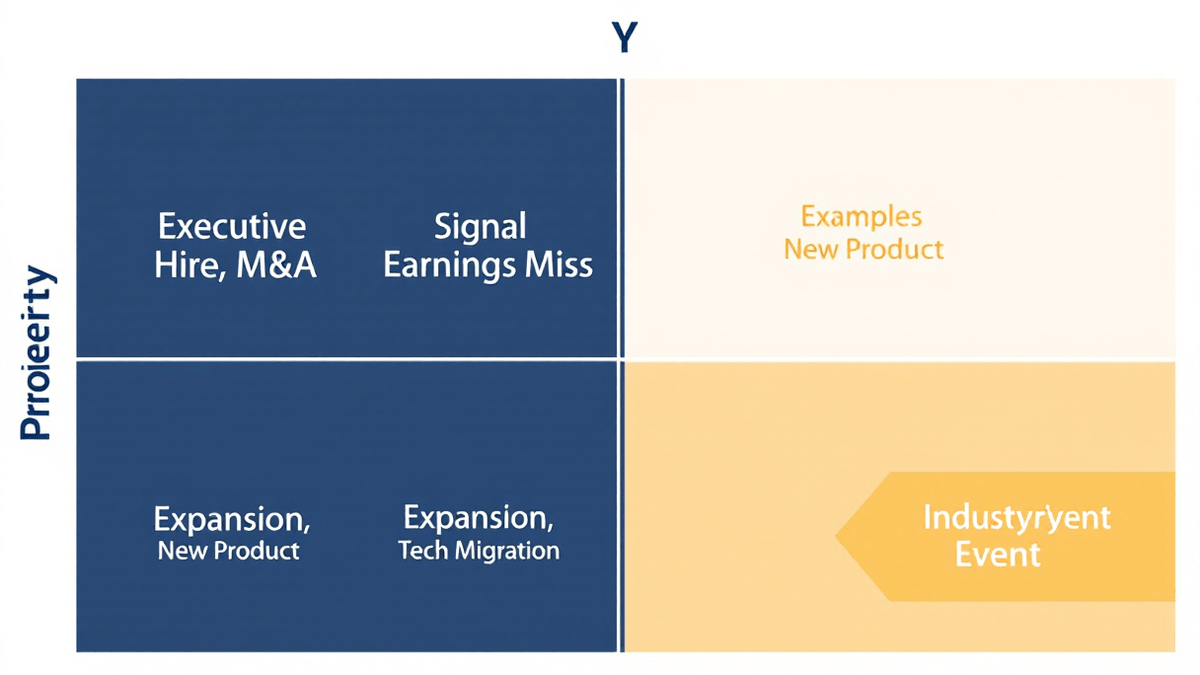 Prioritize triggers by urgency and signal strength. Top-right quadrant demands response within 48 hours.
Let's explore these signal categories and how to use them effectively.
Financial Signals: Following the Money
1. Fiscal Cycle
Companies follow predictable budget cycles, creating windows when they're most likely to buy. New budgets at the start of quarters and years create opportunities, while year-end often sees companies rushing to spend unused funds.
How to Find It:
Look up your target company's fiscal year on their investor relations page or annual report. For public companies, check SEC filings on EDGAR or earnings call schedules on sites like Earnings Whispers. Set calendar reminders 60-90 days before their fiscal year-end.
Outreach Example:
"Hi [Name],
I noticed [Company] typically finalizes annual budgets in March. Many of our clients find this the ideal time to look at [solution category] to ensure new fiscal year investments deliver maximum impact.
Would it be helpful to discuss how similar companies are prioritizing their [solution area] investments this year?
Best
[Your Name]"
2. New Funding
When companies secure new funding, they're ready to spend. Whether it's venture capital, private equity, or a public offering, fresh funding means companies are looking to grow quickly and solve problems that might slow them down. Especially in VC-backed companies time is of the essence to capture the growth potential. Many projects might have been on hold pre-funding and will be unlocked as soon as the round is closed.
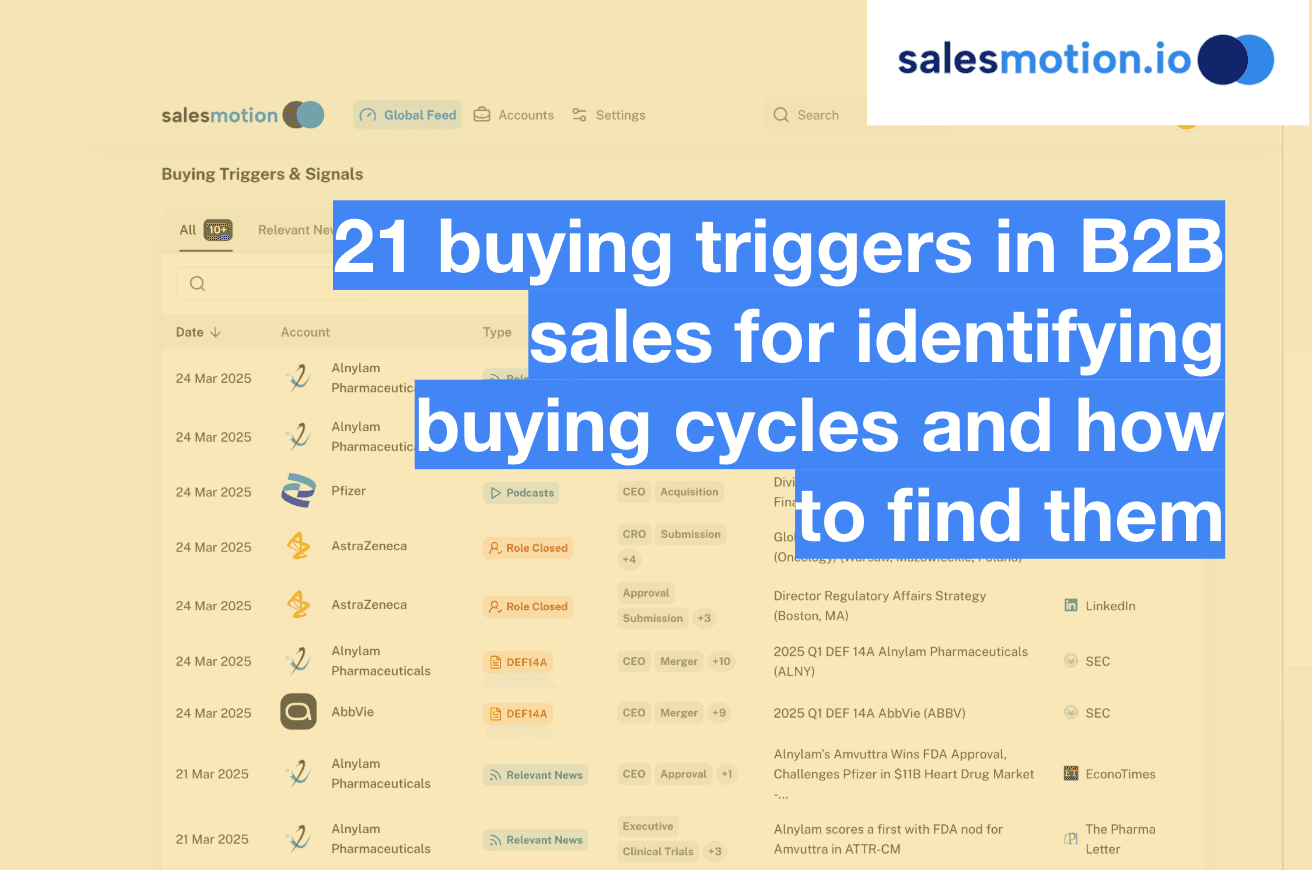
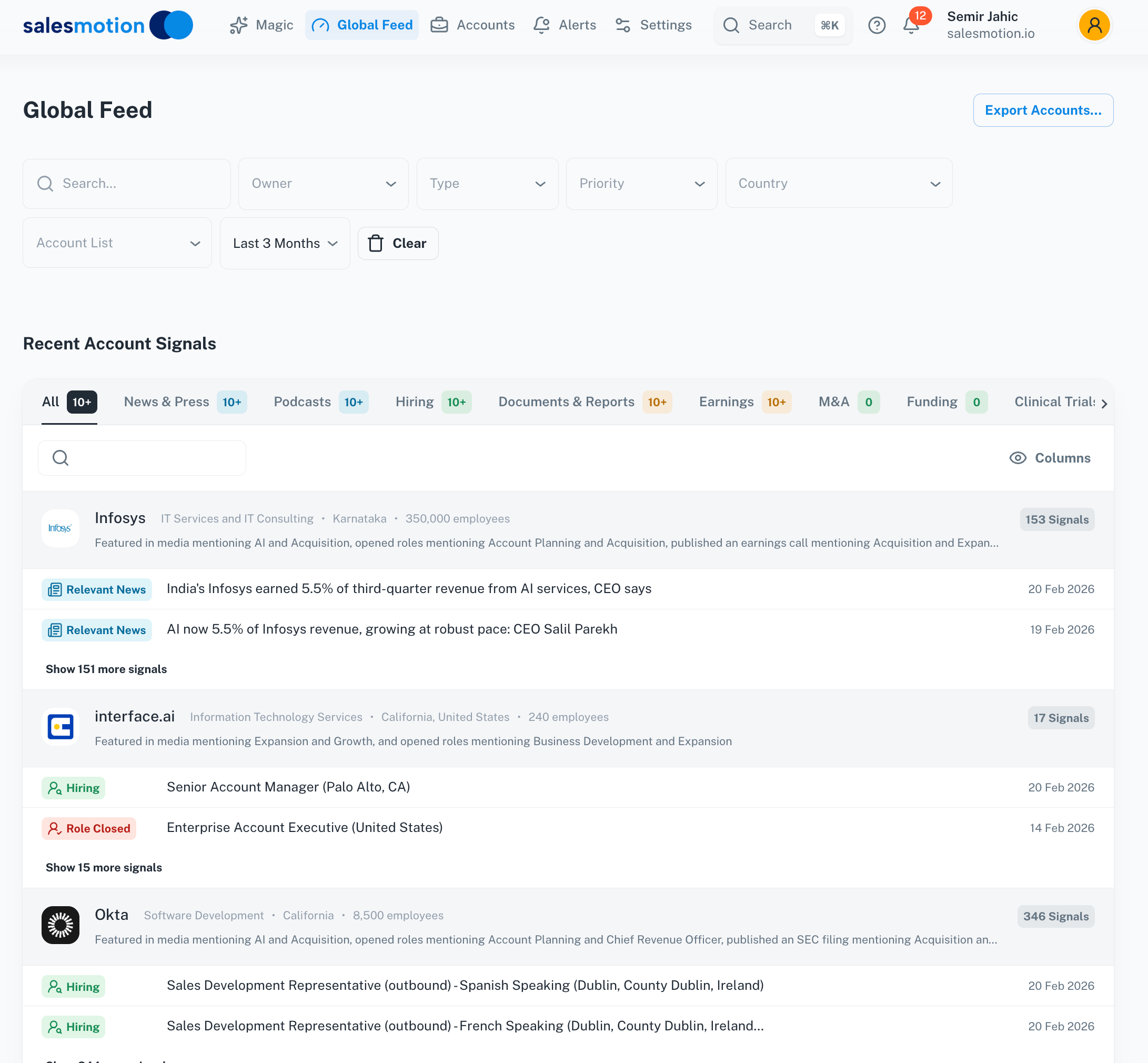 Monitor buying triggers across your target accounts with Salesmotion's signal feed, filterable by time range and signal type.
How to Find It:
Create daily funding alerts through Crunchbase, PitchBook, CB Insights or Salesmotion filtered by industry and funding stage. For UK private companies, compare the Beauhurst alternatives. Monitor investment news on specialized platforms like TechCrunch's funding section or VC firm announcement pages.
Set Google Alerts combining target company names with terms like "announces funding," "secures investment," or "closes round."
Outreach Example:
"Congratulations on your Series C funding round!
As you scale operations to meet your growth targets, many companies at this stage find that [specific challenge] becomes a roadblock.
I'd like to share how other [industry] leaders addressed this after their funding rounds, helping them grow faster while saving resources.
Open to me sending over an example?
Best
[Name]"
3. Performance Milestone Achievement
Companies that hit big growth milestones often need new tools to maintain momentum. When a business announces record growth or exceeds targets, they become more open to solutions that will help them keep succeeding.
In May 2026, Gong announced ARR above $500 million to mark a great milestone. This is momentum sales teams should capitalize on.
How to Find It:
Watch earnings calls, investor presentations, and annual reports for terms like "record quarter," "milestone achievement," or "exceeded targets." Set up alerts on Yahoo Finance, Seeking Alpha or Salesmotion for earnings surprises. Review annual reports for year-over-year performance trends.
Outreach Example:
"I noticed [Company] just announced its third consecutive quarter of double-digit growth - congratulations!
In our experience, this growth inflection point often creates new challenges in [functional area].
I'd like to share our assessment tool that helps identify gaps before they slow down your growth momentum.
Open to me sending it over?
Best
[Name]"
Organizational Transformation Signals
4. Leadership Transitions
New executives typically make changes within their first 100 days. They review vendors, launch new initiatives, and look for quick wins. This creates perfect opportunities to introduce solutions that align with their fresh vision.
How to Find It:
Create saved LinkedIn searches for executive title changes at target accounts. Use alerts from sources like Boardroom Insiders. Monitor press releases with search terms like "[company name] AND (appoints OR names OR welcomes) AND (CEO OR CTO OR CIO)."
Outreach Example:
"Congratulations on your recent appointment as [Title] at [Company]. During your first 90 days, you're likely assessing systems and looking for strategic improvements.
I've prepared a brief overview of how other incoming [Title]s in [industry] achieved early wins by addressing [specific challenge].
Would this be helpful as you develop your priorities?
Best
[Name]"
5. Structural Reorganization
When companies reorganize, they signal changing priorities and often need new solutions. Restructuring creates gaps in capabilities and processes that need to be filled quickly to maintain business momentum.
How to Find It:
Watch LinkedIn for patterns of title changes or department shifts. Set alerts for press releases with terms like "reorganization," "restructuring," or "new division." Track company announcements about strategic shifts or new market approaches.
Perfect Outreach Example:
"I noticed [Company] recently reorganized to create a dedicated [functional area] team.
This transition period often creates a good opportunity to reassess tools and processes.
I'd like to share how similar companies have succeeded after reorganization by implementing [specific approach] that fits perfectly with this new structure.
Mind if I send over a quick video of how we helped [Case Study Company]?
Best
[Name]"
6. Merger or Acquisition (M&A) Activity
M&A events trigger system consolidations, process standardization, and vendor reviews. For a real-world example, see how Google's $32B Wiz acquisition created selling opportunities across cybersecurity. Companies going through mergers or acquisitions need solutions that help combine operations smoothly while maintaining business continuity.
How to Find It:
Subscribe to M&A databases like MergerMarket or Refinitiv. Set up Google Alerts with patterns like "[company name] AND (acquires OR buys OR merges)." Check SEC Form 8-K filings for public companies, which disclose major events including acquisitions.
Perfect Outreach Example:
"Regarding your recent acquisition of [Target Company], we've helped many companies in [industry] navigate post-merger integration challenges, particularly around [specific function].
Would it be useful to discuss our integration framework that helps reduce system consolidation time while keeping operations running smoothly?
Mind if I send over a quick 1-pager of how we can help?
Best
[Name]"

“The talking points are gold. If they're in Salesmotion, I know they're being discussed inside that business. That makes it easy to spark a real conversation, which is 90 percent of the battle.”
Andrew Giordano
VP of Global Commercial Operations, Analytic Partners
Market Position Signals
7. Competitive Pressure Events
When competitors adopt new technologies or strategies, companies often respond quickly to keep up. This competitive pressure creates urgency to find and implement similar or better solutions to avoid losing market position.
How to Find It:
Use dedicated competitive intelligence tools like Klue or Crayon or multi-purpose account intelligence tool like Salesmotion also allows you track competitors. Check competitor case studies and new testimonials for what products they're using. Set alerts for competitor press releases about innovations or new partnerships. Follow industry analysts for competitive landscape updates.
Outreach Example:
"I noticed that several of your key competitors have recently implemented [technology/approach].
This could impact [specific metrics] in your market segment.
I'd like to share our competitive response framework that has helped similar companies not just catch up but move ahead through strategic implementation.
Best
[Name]"
8. Industry Recognition
When companies win awards or receive industry recognition, they often look to build on that success. This recognition creates momentum and openness to solutions that can help maintain their leadership position.
How to Find It: Follow industry award programs, review sites that give out badges like G2 and their announcement schedules. Check social media for company celebration posts with hashtags like #proud, #honored, or #recognition. Set Google Alerts for "[company name] AND (wins OR awarded OR recognized)."
Outreach Example:
"Congratulations on [Company]'s recent recognition as [award name]! This well-deserved achievement highlights your excellence in [relevant area].
As you build on this success to drive growth, I'd like to share how other award-winning organizations have strengthened their [solution area] capabilities to maintain their competitive edge.
Best
[Name]"
9. Product or Service Releases
When companies launch new products or services, they often discover they need supporting technologies and tools. These launches create opportunities to offer complementary solutions that enhance their new offerings.
How to Find It:
Monitor product pages and company blogs for announcements. Set up alerts for terms like "introduces," "launches," or "enhances" in company communications. Check industry publications and review sites like G2 that announce product updates. Join user communities where roadmap discussions happen.
Outreach Example:
"I noticed [Company] just launched your new [product/feature]. Companies implementing similar capabilities typically find that [related challenge] becomes increasingly important to maximize ROI.
I'd like to share our complementary approach that has helped other [product] adopters improve their results significantly."
Operational Indicators
10. Technology Stack Changes
When companies adopt new platforms or migrate to new systems, they need complementary tools and services. These technology changes create opportunities to offer integration solutions and supporting products that make their primary investment more valuable.
How to Find It:
Use tools like BuiltWith or Datanyze to spot platform changes. Look for job postings in tools like Salesmotion to spot roles that require specific technology expertise. Join developer communities where migration discussions happen. Watch for integration partner announcements from major platforms.
Outreach Example:
"I noticed your team is implementing [technology platform] based on a recent job posting for the role of [insert role title].
Having supported similar implementations, we've identified key factors that impact success. I'd like to share our implementation framework that helps reduce deployment time and improve user adoption."
11. New Offices / Locations
Office moves, expansions, or consolidations create natural moments to update systems and processes. Companies use these physical changes as opportunities to improve their technology infrastructure rather than just moving old systems to new locations.
How to Find It:
Check commercial real estate listings on services like CoStar. Read business journals' real estate sections for leasing announcements. Look for address updates on company websites or Google Business profiles. Set alerts for terms like "relocates headquarters" or "opens new office."
Outreach Example:
"Congratulations on your upcoming move to [location]. This transition creates a perfect opportunity to upgrade [relevant systems] without disrupting operations.
I'd like to share our relocation roadmap that has helped similar companies use their move to implement better capabilities rather than just relocating outdated systems."
12. Workforce Changes
Significant hiring or staff reductions signal changing operational needs. Companies experiencing workforce shifts need to adapt their systems to support their new organizational structure and size.
How to Find It:
Monitor company career pages for hiring surges. Check LinkedIn for patterns of new employees or "open to work" indicators. Also follow companies in the news for new hiring, layoffs and more. Lastly, look for WARN (Worker Adjustment and Retraining Notification) filings for downsizing information. Set alerts for terms like "expanding team" or "restructuring workforce."
Outreach Example:
"I noticed [Company] is rapidly growing your [department] team based on recent job postings. This growth typically creates challenges around [specific function].
I'd like to share how similar companies implemented [solution approach] during growth phases to maintain quality while supporting their expanding teams."
Regulatory and Environmental Signals
13. Compliance Requirement Changes
New regulations force companies to adapt quickly. When compliance requirements change, businesses need specialized tools and expertise to meet deadlines and avoid penalties.
How to Find It:
Subscribe to industry regulatory updates from governing bodies. Follow compliance blogs in your target industries. Track regulatory deadlines and implementation timelines. Join industry associations that send compliance alerts to members.
Outreach Example:
"With the [specific regulation] compliance deadline just 90 days away, many companies in [industry] are finding gaps in their preparation.
We've developed a quick compliance assessment that identifies high-risk areas needing immediate attention.
Would it be helpful to see how similar companies have successfully navigated this regulatory change?"
14. Market Disruption Events
Industry disruptions - whether technological, competitive, or economic - force companies to adapt rapidly. These disruptions create urgent needs for new approaches and solutions that address emerging challenges.
How to Find It:
Follow industry analysts and thought leaders for disruption predictions. A good example today is the impact of AI or tariffs.
Read trade publications for emerging trend coverage. Track venture capital investments in your sector to spot innovation hotspots. Set up news alerts for industry-specific disruption terms.
Outreach Example:
"The recent [industry disruption] is forcing companies to rethink their [functional area] approach. We've analyzed how market leaders are responding and identified key strategies emerging.
I'd like to share our analysis and discuss which approach best fits your strategic position."
15. Economic Climate Shifts
Economic changes - both downturns and growth periods - create opportunities for solution providers. During economic transitions, companies reassess their investments and look for tools that align with their new priorities.
How to Find It:
Track economic indicators relevant to your target industries. Listen to earnings calls for mentions of economic impacts or responses. Follow industry economic forecasts and sentiment indexes. Watch for budget adjustment announcements or spending priority shifts.
Outreach Example:
"In response to the current economic [downturn/growth period], we're seeing [industry] leaders adjust their [functional area] investments.
I'd like to share our framework for finding high-ROI initiatives during this economic phase that deliver quick impact while positioning you for future success."
15a. AI Adoption and Automation Signals
Companies investing in AI and automation often need complementary tools to operationalize their strategy. When a business announces an AI initiative, hires a Head of AI, or adopts a major automation platform, adjacent needs surface quickly -- from data infrastructure to workflow integration to change management.
How to Find It:
Monitor job postings for AI/ML engineering roles or "Head of AI" titles at target accounts. Track press releases mentioning "AI strategy," "machine learning initiative," or "automation transformation." Tools like Salesmotion surface these signals automatically by tracking hiring patterns, leadership announcements, and technology adoption across your target accounts.
Outreach Example:
"I noticed [Company] recently posted several AI engineering roles and announced an automation initiative. Companies at this stage of AI adoption often find that [specific challenge] becomes a bottleneck.
I'd like to share how similar organizations addressed this during their AI rollout.
Best [Your Name]"
15b. Regulatory and Compliance Deadline Triggers
Beyond general compliance changes (#13), specific regulatory deadlines create predictable windows of urgency. Think GDPR enforcement actions, SOC 2 audit cycles, industry-specific mandates like DORA for financial services, or new SEC disclosure rules. Companies facing these hard deadlines are actively buying solutions months before the due date.
How to Find It:
Track regulatory calendars for your target industries. Subscribe to compliance news from bodies like the SEC, FCA, or relevant sector regulators. Monitor for companies disclosing compliance gaps in earnings calls or risk factor updates. Set alerts for "[regulation name] AND (deadline OR compliance OR preparation)."
Outreach Example:
"With the [specific regulation] enforcement date approaching in Q3, companies in [industry] are accelerating their compliance preparations. We've helped several organizations in your space close critical gaps ahead of schedule.
Would it be useful to compare your current approach against what's working for similar companies?"
15c. M&A Pipeline and Strategic Partnership Signals
Beyond announced mergers (#6), pre-M&A activity and new strategic partnerships are equally powerful triggers. Companies evaluating acquisitions or forming major partnerships often need solutions to support due diligence, integration planning, or joint go-to-market execution.
How to Find It:
Watch for "strategic review" language in earnings calls and SEC filings. Track new partnership announcements that signal expansion into adjacent markets. Monitor advisor and investment banker hiring patterns. Tools like Salesmotion can detect these signals by analyzing earnings transcripts and press releases across your account list.
Outreach Example:
"I noticed [Company] recently announced a strategic partnership with [Partner]. These partnerships often accelerate the need for [specific capability] to capture the joint opportunity quickly.
I'd like to share how we helped a similar company operationalize a new partnership within 60 days.
Best [Your Name]"
Digital Body Language Signals
16. Research Intensity Patterns
When companies research specific topics intensely, they're showing buying interest. These research spikes indicate they're moving from casually learning about solutions to actively considering purchases.
How to Find It:
Use intent data tools like Bombora or 6sense. Track content consumption patterns on your website using tools like HubSpot or Pardot. Monitor engagement with industry research from Gartner or Forrester. Analyze search trends for buying intent keywords.
Outreach Example:
"We've noticed your team has been researching [specific topic] extensively recently.
This pattern typically means [specific challenge] has become a priority.
I'd like to share our diagnostic tool that helps quantify this challenge's impact and find the best approach for your situation."
17. Event Participation
Conference or webinar attendance shows active interest in solution areas. When companies send team members to events, they're typically seeking knowledge about current priorities, making them more receptive to related solutions.
How to Find It:
Check event registration lists when available. Watch social media for event participation mentions and hashtags. Especially things like major industry conferences can be a great insight. Use geo-targeting during major industry events. Follow speakers and look for attendee interactions. Spot the speaking topics to tailor your approach. Create post-event follow-up campaigns.
Outreach Example:
"I noticed several members of your team attended the [Event Name] session on [topic]. This topic has evolved significantly this year.
've prepared a short comparison of the approaches discussed at the session, plus some practical implementation tips not covered in the presentation.
Would this additional perspective be helpful?"
18. Digital Engagement Escalation
When prospects move from reading basic information to downloading detailed guides or case studies, they're showing increased buying intent. This progression through content types signals they're getting closer to making a decision.
How to Find It:
Track content engagement across channels. Monitor downloads of late-stage content like case studies or implementation guides. Track repeat visits to pricing or comparison pages. Analyze email engagement with decision-stage messaging.
Perfect Outreach Example:
"I noticed your team has been exploring our resources on [specific topic], especially around implementation approaches and ROI measurement.
These areas typically become important when companies are moving from consideration to decision phases. I'd like to offer our ROI calculator that helps you input your specific variables to see potential impact."
Human-Centered Signals
19. Champion Movement (Priority: 5)
When advocates from existing customers move to new organizations, they often bring preferred solutions with them.
How to find it:
Track job changes among customer contacts using LinkedIn alerts or contact management tools. Implement alumni programs that maintain relationships with former customer champions. Create Google Alerts for press releases announcing key contact role changes. Develop systematic processes for fast outreach when champions change organizations. For the full playbook, including manual methods, tool pricing, and the alert-to-outreach workflow, see our guide on how to track job changes.
Outreach Example:
"Congratulations on your new role at [Company]! Having worked together at [Previous Company], I know how much you value [specific capability/approach]. I'd love to reconnect and share how we might help you achieve similar success in your new organization, especially given the different [industry/scale/challenges] you're now addressing."
20. Relationship Network Changes (Priority: 3)
New connections between your team and prospect organizations create warm pathways for introduction and engagement.
How to find it:
Implement relationship intelligence tools like LinkedIn Sales Navigator or Nudge.ai. Create alerts for new connections between your team and target accounts. Track former colleagues who move to prospect organizations. Monitor customer referral opportunities systematically.
Outreach Example:
"I noticed you recently connected with my colleague [Name] who mentioned your interest in addressing [specific challenge].
Having helped several organizations similar to yours overcome this same challenge, I wanted to offer a few initial thoughts based on what's worked well in comparable situations."
21. Support or Service Escalations (Priority: 4)
Customer experience challenges often trigger urgent evaluation of alternative solutions.
How to find it:
Monitor review sites like G2, Capterra, or industry-specific platforms for negative sentiment trends. Implement social listening for support-related complaints. Track support forum activity for competitors' products. Set alerts for terms like "looking for alternatives to [competitor]" in industry communities.
Outreach Example:
"I noticed some recent discussions about challenges with [Competitor's product], particularly around [specific issue].
We've developed a migration framework specifically for organizations experiencing these challenges that minimizes transition risks while immediately addressing the [specific issue].
Would it be valuable to explore whether this approach might be relevant to your situation?"
The Purchase Signal Multiplier Effect
Individual signals are helpful, but combinations of signals are powerful. When multiple signals happen together, they strongly indicate a company is ready to buy.
Signal Combination Examples:
- New CTO + Technology Stack Change: Higher conversion rate
- New Funding + Hiring Surge: Higher conversion rate
- Compliance Deadline + Research Intensity: Higher conversion rate
The Purchase Signal Detection System
To systematically track these signals, build a comprehensive detection system:
1. Signal Monitoring Infrastructure
- Multi-channel alert dashboard: Gather alerts from all sources in one place
- Automated signal scoring: Rank signals based on how likely they lead to sales
- Signal combination detection: Spot when multiple signals happen at the same account
- Time-based signal tracking: Monitor how signals change over time
2. Response Protocol Development
- Signal-specific playbooks: Create response templates for each signal type
- Cross-functional notification flows: Make sure the right team members know about relevant signals
- Tiered response timelines: Prioritize outreach based on signal importance
- Success measurement tracking: Record which signals and responses work best
3. Continuous Improvement Process
- Signal effectiveness analysis: Regularly check which signals actually predict purchases
- New signal identification: Keep adding to your signal library based on results
- Response optimization: Test different approaches to similar signals
- Industry-specific customization: Adjust signal priorities based on what works in different industries
To make that improvement loop concrete, track four metrics for every trigger type:
- Signal-to-response rate: What percentage of trigger-based outreach gets a reply?
- Signal-to-meeting rate: What percentage converts to a booked meeting?
- Signal-qualified deal velocity: How fast do trigger-sourced opportunities move through pipeline compared to cold pipeline?
- Signal type ranking: Which triggers produce the highest-quality conversations?
Teams that track these numbers can continuously optimize which triggers they prioritize and which playbooks they run.
Implementation Self-Assessment
How ready is your company to capitalize on purchase signals? Rate your readiness in these key areas:
- Signal Awareness: Do you have a documented list of purchase signals relevant to your solution?
- □ Comprehensive □ Partial □ Limited □ None
- Detection Capabilities: Have you set up systematic monitoring for these signals?
- □ Automated systems □ Manual processes □ Ad hoc monitoring □ No monitoring
- Response Protocols: Do you have signal-specific response playbooks?
- □ Comprehensive playbooks □ Basic templates □ Generic responses □ No standardization
- Cross-functional Alignment: Are sales, marketing and customer success aligned on signals?
- □ Fully aligned □ Partially aligned □ Limited alignment □ Siloed approaches
- Measurement Systems: Do you track signal-to-opportunity conversion rates?
- □ Comprehensive analytics □ Basic tracking □ Anecdotal evidence □ No measurement
If you scored less than "comprehensive" in any category, you have significant room to improve your purchase signal effectiveness.
Key Takeaways
- B2B purchases begin with trigger events, not marketing campaigns -- the best sales teams focus on identifying these specific buying signals rather than casting wide nets.
- Organize buying triggers into clear categories: financial signals (funding, fiscal cycles, milestones), organizational signals (leadership changes, M&A, restructuring), market signals (competitive pressure, product launches), operational signals (tech stack changes, hiring surges, AI adoption), regulatory signals (compliance deadlines, new mandates), and digital signals (research intensity, event attendance).
- Use a Priority Score system (1-5) to rank signals by urgency and likelihood of conversion, ensuring your team responds to the highest-value triggers within 24-48 hours.
- Signal combinations are far more powerful than individual triggers -- a new CTO hire paired with a technology stack change, or new funding paired with a hiring surge, dramatically increases conversion rates.
- Build a systematic detection infrastructure with multi-channel monitoring, automated scoring, signal-specific playbooks, and continuous improvement processes to scale your trigger-based outreach.
From Signal Detection to Revenue Generation
Tracking buying signal and triggers can transform your approach and elevate outreach. With perfectly-timed engagement reply rates will go up and more real opportunities can be created by your outbound efforts. By systematically identifying when prospects are ready to buy, you can:
- Engage at the perfect moment when they're most receptive
- Tailor your message to address their immediate needs
- Focus resources on high-probability opportunities
- Speed up sales cycles by skipping early-stage nurturing
- Increase win rates by positioning yourself as a timely solution provider
The companies that master purchase signal detection don't just respond to demand - they catch it right when it emerges, positioning themselves as the natural solution to emerging needs.
Put Buying Trigger Tracking on Auto-Pilot with Salesmotion
Salesmotion puts signal and buying trigger tracking on auto-pilot by having account intelligence agents monitor all your target accounts 24/7. The platform will find the relevant stakeholder changes, job openings that reveal insights, earnings calls nuggets you can leverage and a lot more from start to finish. Anything a sales rep would have to setup in a suite of tools and widget can be done in one place. This will help you do great work not just on 2 or 3 accounts but scale those efforts to 10-20 and more.
Rather than stitching together alerts from Crunchbase, Google Alerts, LinkedIn, and SEC filings, Salesmotion consolidates every trigger type covered in this guide -- financial, organizational, regulatory, M&A, AI adoption, and more -- into a single signal feed scored by relevance to your accounts. AI-powered signal detection means you catch triggers like earnings call language shifts, compliance deadline pressure, and leadership changes the moment they happen, not days later when your competitors have already reached out.
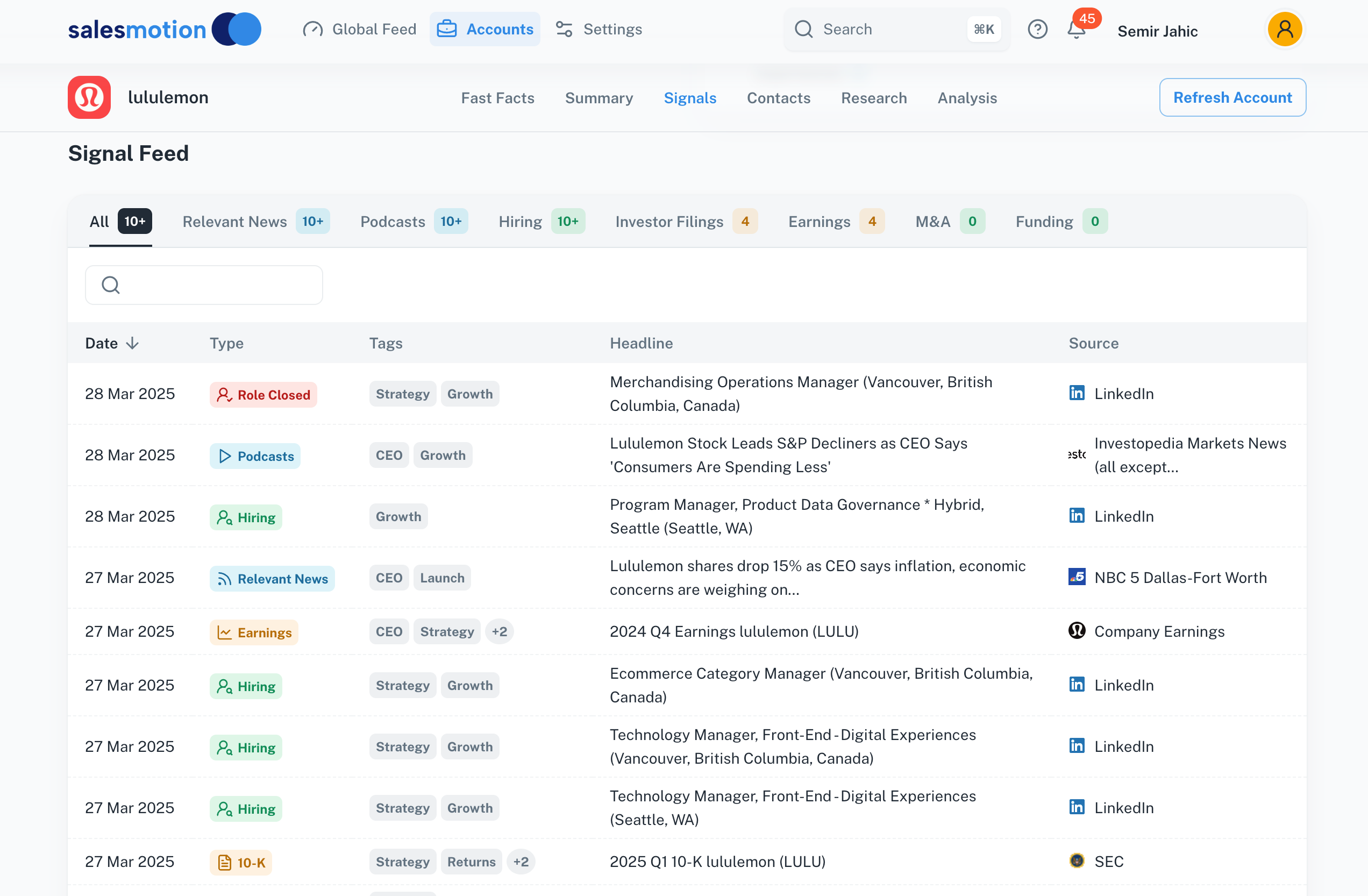 Salesmotion automates buying trigger detection by monitoring all your target accounts around the clock.
The payoff shows up in rep workflows: teams like Cacheflow reduced meeting prep from 90 minutes to 30 minutes while tripling average deal sizes, because reps entered every conversation with the trigger context that made their outreach relevant.
Frequently Asked Questions
What are sales trigger events?
Sales trigger events are specific, time-bound occurrences at a company that create a window of buying readiness, such as a funding round, an executive hire, an M&A announcement, or a champion changing jobs. They are the same concept as buying triggers: discrete events you can monitor and respond to, as opposed to gradual indicators like website visits. The 24 triggers in this guide are all sales trigger events, organized by category and priority score.
What is the difference between a buying trigger and a buying signal?
A buying trigger is a specific event that creates a new need or urgency within a company, such as a funding round, an executive hire, or a regulatory change. A buying signal is the broader category of observable indicators that suggest a company is ready to purchase. In practice, triggers are the discrete events you monitor, while signals encompass all evidence of purchase intent, including digital behavior like website visits and content downloads.
How quickly should I respond to a buying trigger?
Response time depends on the trigger's priority score. For high-priority triggers rated 4-5, such as new funding or a champion moving to a new company, respond within 24 to 48 hours. Mid-priority triggers rated 3 should be addressed within two weeks. Lower-priority signals should be monitored and combined with other indicators before outreach.
What tools can I use to monitor buying triggers automatically?
Platforms like Salesmotion, Crunchbase, PitchBook, and LinkedIn Sales Navigator help automate trigger detection. You can also set up Google Alerts for specific company events, use BuiltWith or Datanyze for tech stack changes, and monitor review sites like G2 for competitor dissatisfaction signals. The key is consolidating these alerts into a single dashboard or CRM workflow.
What is signal-driven selling?
Signal-driven selling is a prospecting approach where outreach timing and messaging are determined by real-time buying triggers rather than static sequences or scheduled cadences. Instead of emailing every account in your territory on a predetermined schedule, you prioritize accounts showing active triggers and tailor your message to reference the specific event that suggests they're entering a buying window. This approach consistently produces higher response rates, faster deal velocity, and better win rates than cadence-based outreach.
How do I prioritize which buying triggers matter most for my business?
Start by mapping each trigger type to a specific pain point your solution solves. The triggers that draw the most direct line between the event and your value proposition should receive the highest priority. Test different signal types over several quarters, track which ones lead to the highest meeting and conversion rates, and adjust your scoring model based on actual results.