
The Challenger Sale was published in 2011, when B2B sales reps still controlled the information asymmetry. Buyers relied on vendors to educate them about their own problems. Fifteen years later, buyers complete nearly 80% of their research before engaging sales, buying committees have expanded to 13+ stakeholders, and AI tools are reshaping every step of the sales process. The question isn't whether the Challenger methodology still works. It's how to adapt its core principles for a world where buyers are pre-educated and reps need real-time intelligence to deliver insights that buyers can't find on their own.
TL;DR: The Challenger Sale's core insight remains powerful: reps who teach buyers something new about their business outperform relationship builders. But the original playbook assumed reps would develop insights through experience and tribal knowledge. In 2026, the best Challenger reps use AI-powered account intelligence to surface the data-backed insights that make teaching moments specific, timely, and impossible to ignore.
What the Challenger Sale Gets Right (Still)
The Challenger Sale identified five rep profiles: Relationship Builders, Hard Workers, Lone Wolves, Reactive Problem Solvers, and Challengers. The research found that Challengers outperformed all other profiles in complex sales, accounting for 40% of high-performing reps.
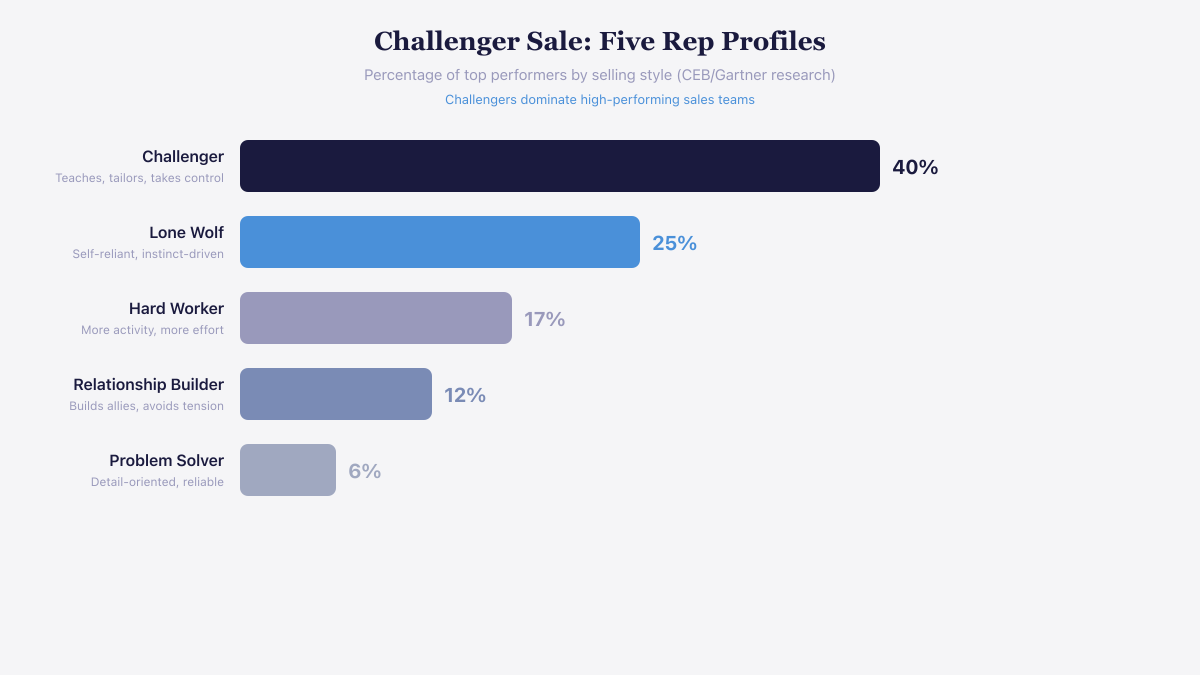 CEB/Gartner research found Challengers make up 40% of high-performing B2B sales reps.
Challengers succeed because they do three things:
Teach: They bring unique perspectives that reframe how the buyer thinks about their problem. Not product features. Business insights.
Tailor: They adapt their message to the specific stakeholder's priorities, speaking differently to a CFO than to a VP of Operations.
Take control: They're comfortable with constructive tension and can push back on buyer assumptions when the data supports a different conclusion.
These principles haven't expired. In a world of endless generic outreach, the ability to teach a buyer something new about their own business is more valuable than ever. The execution model needs updating.
See Salesmotion on a real account
Book a 15-minute demo and see how your team saves hours on account research.
Where the Original Challenger Playbook Breaks in 2026
The 2011 Challenger model assumed reps would develop commercial insights through industry knowledge, product expertise, and accumulated experience. That works when you're selling into a handful of well-known accounts. It collapses when:
Buyers are already educated. When buyers have done 80% of their research before talking to sales, showing up with generic industry insights doesn't differentiate. The buyer has already read those reports. The teaching moment has to be account-specific, not industry-generic.
Buying committees are massive. Tailoring for a single decision-maker was hard enough. Tailoring for 13 stakeholders across procurement, finance, IT, and the business unit requires deep understanding of each person's priorities, which manual research can't provide at scale.
Market conditions change faster than experience accumulates. By the time a rep learns from a lost deal that a competitor has changed their pricing model, that intelligence is weeks old. The Challenger approach requires current, account-specific intelligence that reflects what's happening right now, not what happened last quarter.
Reps manage more accounts with less time. Sales teams are leaner in 2026. Each rep covers more territory with higher quotas. The 3+ hours per account that thorough Challenger preparation requires simply doesn't scale across 50+ named accounts.

“Salesmotion empowers me to cultivate a great buyer experience. I'm able to challenge prospects' thinking and be a trusted consultative seller. A major part of this is Salesmotion insights.”
Austin Friesen
Account Executive, FY25 #1 President's Club, Clari
How to Be a Challenger Rep in 2026
The evolution isn't about abandoning the methodology. It's about upgrading the intelligence layer that powers it.
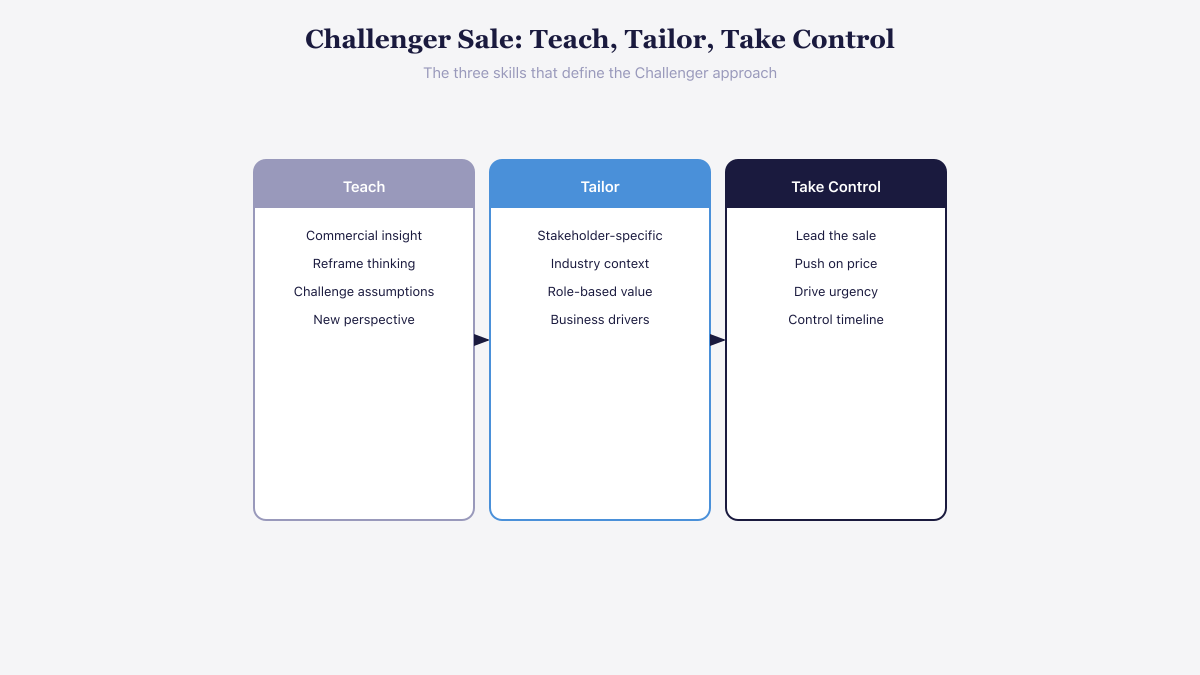 The Challenger approach rests on three complementary skills that build on each other.
Teaching With Data, Not Just Experience
The original Challenger teaching model relied on commercial insights: packaged perspectives about how the buyer's industry is changing and why the status quo is risky. These insights were developed by marketing, trained in enablement sessions, and deployed by reps.
In 2026, the most effective teaching moments are account-specific, not industry-generic. They reference something happening at the buyer's company right now:
-
"Your CEO mentioned 'sales technology modernization' on last quarter's earnings call, and your team has posted 4 new SDR roles in the past 6 weeks. Companies going through that exact transition typically hit a research bottleneck around month 3 when new reps can't prepare for meetings fast enough."
-
"Your top competitor launched a product that directly addresses your core market. Based on how similar companies have responded, you have about a 90-day window before their sales team starts targeting your existing accounts."
These teaching moments require real-time intelligence that no amount of experience or marketing content can replace. They require knowing what's happening at each specific account right now.
Tailoring at Scale With Account Intelligence
Tailoring was always the hardest part of the Challenger model. It's one thing to tailor a message for a single executive. It's another to tailor messaging for 13 stakeholders across different functions, each with different priorities, different buying criteria, and different definitions of success.
AI-powered account intelligence makes this possible by surfacing stakeholder-specific context:
- The CRO cares about pipeline velocity and win rates. Reference the company's hiring signals and competitive pressure.
- The CFO cares about ROI and cost consolidation. Reference the company's vendor stack and potential tool consolidation.
- The VP of RevOps cares about data quality and process efficiency. Reference the company's technology adoption signals and internal job postings.
Same account, three different teaching moments, each grounded in specific intelligence about what that stakeholder likely cares about.
Taking Control With Evidence, Not Opinion
The original Challenger model encouraged constructive tension: pushing back on buyer assumptions to reframe the problem. This only works when the rep has stronger evidence than the buyer.
In 2026, that evidence comes from three sources:
Account-specific signals. "Based on your earnings commentary and hiring patterns, your team is scaling faster than your current tools can support. Companies at your stage typically see a 30-40% drop in rep productivity within 6 months without infrastructure changes."
Customer evidence. "Teams like Frontify saw a 42% increase in sales velocity after addressing this exact bottleneck. They were in a similar growth stage with a similar scaling challenge."
Market data. Citing recent research and benchmarks specific to the buyer's industry and segment gives the rep authority that goes beyond product knowledge.
The Challenger rep in 2026 doesn't push back with opinions. They push back with data the buyer hasn't seen yet.
The Challenger + Signals Workflow
Here's how the updated Challenger methodology works in practice with AI-powered intelligence:
Before the call: The intelligence platform flags a target account with converging signals: new VP of Sales hired 6 weeks ago, earnings call mentioned "go-to-market transformation," and the company posted 8 new sales roles this month. The account brief auto-updates with this context plus the new VP's background, previous companies, and likely priorities.
The teaching moment: Instead of opening with a generic industry insight, the rep leads with: "Your new VP of Sales came from a company that went through a similar GTM transformation two years ago. Based on what we've seen with similar teams, the biggest risk isn't hiring fast enough. It's that your existing reps will lose 2-4 hours daily on manual research as the team scales, which cuts effective selling time by 30%."
The tailored follow-up: The rep sends the VP of Sales a case study from a company at the same growth stage. They send the CFO a one-page ROI analysis based on the current team size and estimated research time savings. They send the RevOps leader a comparison of how other companies handled the tool consolidation during a similar scaling phase.
The constructive tension: When the buyer says "we're planning to solve this with ChatGPT and some custom prompts," the rep can respond: "We see a lot of teams try that. It works for the first 10 accounts, but at your scale of 50+ named accounts per rep, the manual prompting and verification process takes longer than the research it replaces. Here's the data from teams that started with ChatGPT and eventually moved to automated intelligence."
This is the Challenger Sale adapted for an era where the best insights aren't packaged by marketing. They're surfaced by AI from real-time account data.

“The talking points are gold. If they're in Salesmotion, I know they're being discussed inside that business. That makes it easy to spark a real conversation, which is 90 percent of the battle.”
Andrew Giordano
VP of Global Commercial Operations, Analytic Partners
Why Challenger Methodology Breaks at Scale Without Automation
Sales leaders have tried to operationalize the Challenger approach in CRM fields, coaching sessions, and playbook documents. These efforts consistently fail at scale for predictable reasons:
- Insight development is too slow. By the time marketing develops a new commercial insight, packages it, trains reps, and deploys it, the market has moved.
- Tailoring requires account-specific research that reps don't have time for. With 50+ accounts, thorough preparation for every interaction is impossible without automation.
- Account intelligence goes stale between coaching sessions. The insight that was relevant during last month's QBR may not reflect what's happening at the account today.
- New reps can't Challenger-sell without deep account knowledge. The Challenger model historically required years of experience to develop the account understanding necessary for effective teaching moments.
Automated account research solves these problems by providing every rep, including new hires, with the account-specific intelligence they need to teach, tailor, and take control. Salesmotion surfaces the signals and context that make Challenger selling possible at scale: leadership changes, strategic priorities, hiring patterns, competitive moves, and market dynamics for every account in the territory, updated continuously.
Teams like Analytic Partners grew qualified pipeline 40% YoY not by training better Challengers, but by giving every rep the intelligence that makes Challenger-quality conversations the default rather than the exception.
Key Takeaways
- The Challenger Sale's core principles (teach, tailor, take control) remain powerful in 2026. What's changed is the intelligence layer that makes them executable.
- Generic industry insights no longer differentiate. Account-specific teaching moments grounded in real-time signals (earnings language, leadership changes, hiring patterns) are what separate Challengers from everyone else.
- Tailoring at scale requires AI-powered account intelligence that surfaces stakeholder-specific context across 13+ person buying committees.
- Taking control with constructive tension only works when reps have evidence stronger than the buyer's assumptions. Real-time signals and customer case studies provide that evidence.
- The Challenger model breaks at scale when insight development, account research, and intelligence maintenance are manual processes.
- Automate the research layer first. Every rep becomes a more effective Challenger when they enter every conversation with current, specific, data-backed intelligence about the account.
Frequently Asked Questions
Is the Challenger Sale methodology still relevant in 2026?
Yes. The core insight that reps who teach buyers something new outperform relationship builders has been validated repeatedly. What's changed is the execution model. In 2011, teaching moments came from packaged industry insights. In 2026, the most effective teaching moments are account-specific, drawn from real-time signals about what's happening at each buyer's company right now. The methodology is more relevant than ever; the intelligence powering it needs to be current.
How do you teach buyers who have already done their research?
The key is specificity. Buyers have access to general industry research, analyst reports, and competitor marketing. What they don't have is a synthesized view of how multiple signals at their own company (earnings language, hiring patterns, competitive moves, leadership changes) converge to suggest a specific timing window or strategic priority. Account-specific insights drawn from real-time intelligence teach buyers something they can't learn from general research.
Can junior reps use the Challenger approach effectively?
Traditionally, no. The Challenger model required years of experience to develop the account knowledge and confidence needed for teaching and constructive tension. With AI-powered account intelligence, junior reps can access the same quality of account-specific insights that experienced reps develop over years. The teaching moments are data-backed rather than experience-driven, which makes them accessible to any rep who has the intelligence at their fingertips.
What is the relationship between the Challenger Sale and signal-based selling?
Signal-based selling provides the intelligence layer that makes the Challenger approach operational at scale. The Challenger methodology tells you what to do (teach, tailor, take control). Signal-based selling tells you when to do it (when buying triggers fire) and what to say (based on specific account signals). Combined, they create a system where reps engage accounts at the right time with insights that demonstrate genuine understanding of the buyer's current situation.