Most pipeline programs still overinvest in net-new cold outreach and underinvest in the warmest trigger in B2B sales: a proven internal advocate changing companies. When someone who already bought from you, defended you internally, and saw value in your product lands in a new role, you're not starting from zero. You're entering a new account with trust already built.
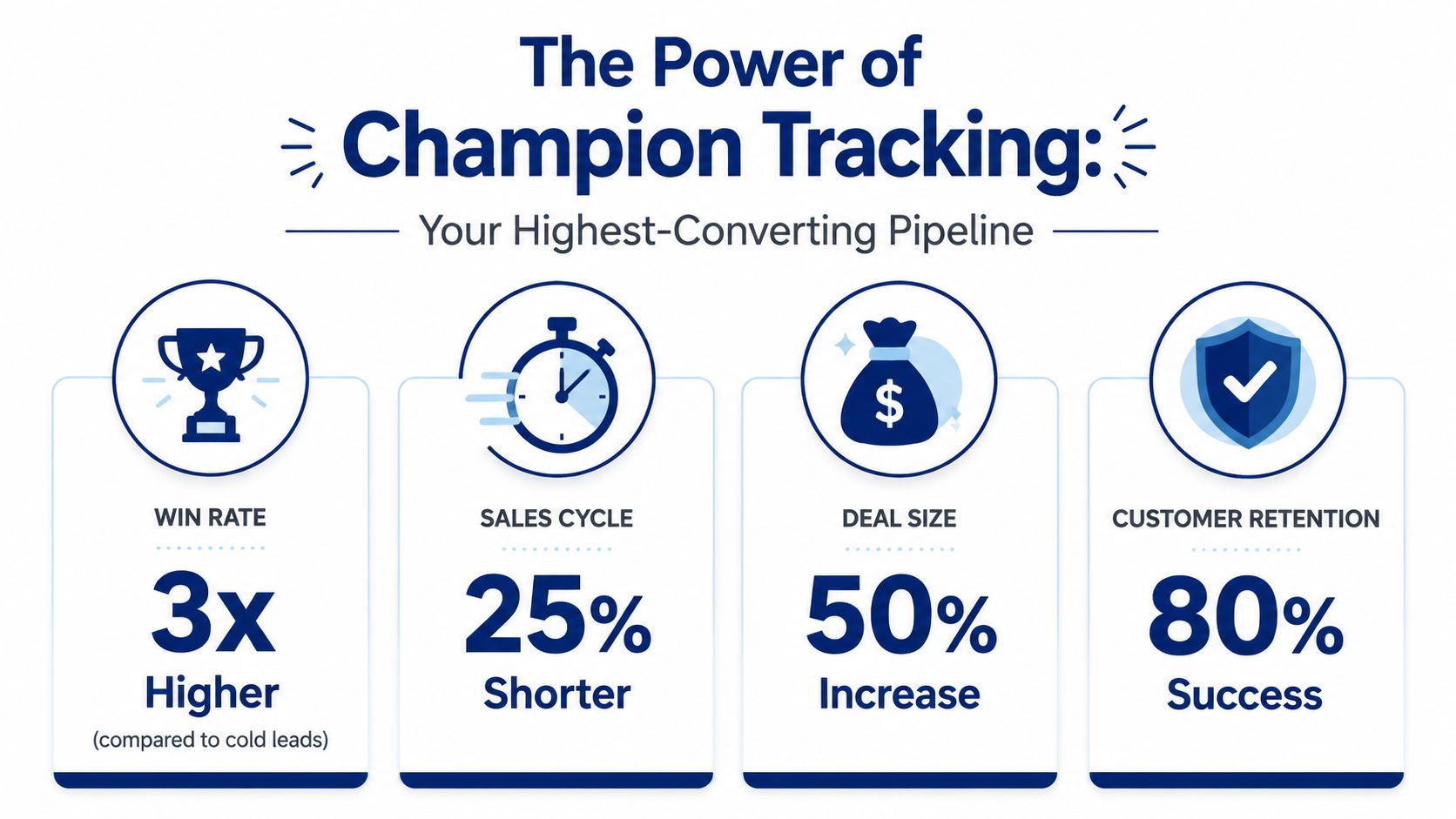
That matters because champion-driven opportunities perform differently from ordinary prospecting. UserGems reports that champion-driven deals close with 114% higher win rates, 12% shorter sales cycles, and 54% larger average deal sizes than comparable opportunities, and Launch Leads notes that mature champion-tracking programs can contribute 15% to 25% of total pipeline in practice, as outlined in this champion tracking data roundup.
Most articles stop at “track champions.” That's not enough. Champion tracking in sales only works when you treat it like an operating system: define who counts, capture the right people in CRM, route alerts fast, and give reps a simple playbook for turning a job change into a meeting.
Why Champion Tracking Is Your Highest-Converting Pipeline
A champion job change is one of the few sales signals that can create pipeline fast. The reason is simple. You are starting with prior proof, not just prior awareness.
Why the economics are different
Cold outbound has to earn attention, credibility, and urgency from scratch. Champion tracking skips a large part of that work because the contact already knows your product, remembers the rollout, and understands the trade-offs behind the purchase.
That changes the math for the first meeting. The conversation can start with a real business outcome, a past deployment, or a lesson from the last buying process. Reps do not need to spend the entire call proving they are worth listening to.
For revenue teams, that difference matters operationally. Champion-sourced opportunities deserve named ownership, response-time expectations, and CRM rules. If the team handles these moves like casual networking, good signals die in inboxes and LinkedIn notifications.
Practical rule: If a former buyer, admin, evaluator, or internal advocate joins a target account, open an opportunity review, not just a contact task.
What makes it convert
Champion moves work because they combine trust with a live business event. New hires often reassess tools, reset vendor preferences, and look for quick wins in their first months. A contact who has already used your product has a credible reason to take that conversation.
The strongest cases usually share three traits:
- Shared operating history: You can point to a project, implementation, renewal, expansion, or business result you worked through together.
- Internal credibility: The contact has enough standing to introduce your team, frame the problem, and shape early consensus.
- Relevant timing: Their new role gives them a reason to review the category now, not six months from now.
That timing piece gets missed. Teams often treat champion tracking as a relationship play. In practice, it is a trigger play. The value comes from contacting the right former advocate during a narrow window when they are evaluating priorities, building their team, and deciding which vendors get considered.
Leadership-change monitoring supports the same motion. Teams building a broader trigger program should pair champion alerts with a process for tracking leadership changes for sales teams, because both signals help reps reach accounts when internal priorities are still forming.
Where teams get it wrong
The common failure is inconsistency.
A rep remembers a few former customers, follows them on LinkedIn, and reaches out when a move happens to show up in the feed. That can produce occasional wins, but it does not create dependable coverage across the book.
A working program needs discipline. Tag the right contacts while deals are active. Keep those records tied to the account and the opportunity they influenced. Route job-change alerts to the correct owner within days, not weeks. Without that structure, champion tracking stays a rep habit instead of becoming a repeatable pipeline source.
See Salesmotion in action
Take a self-guided interactive tour — no signup required.
How to Identify Your True Sales Champions
Closed-won deals rarely hinge on one enthusiastic contact. They move because a small group of people carries your case internally. Reviews of complex deal coverage often point to keeping 3 to 5 active champions on important opportunities, not a single “main contact,” as noted in this guide to champion qualification and coverage.

That matters because sales teams usually over-label. A responsive user gets marked as a champion. A senior signer gets marked as a champion. A friendly evaluator gets marked as a champion. Then the CRM says the account has support, while the deal has no real internal operator pushing it forward.
Use a stricter standard. A true champion has three things at once: organizational influence, personal credibility, and a reason to act. If one is missing, track the contact by role, but do not treat them as a reusable pipeline source after they change jobs.
A practical test works better than title filters. Ask what this person does when your team is not present.
- Advocates for your solution internally: They explain the problem, defend the recommendation, and answer objections.
- Expands the buying group: They introduce peers, bring in approvers, and help your team reach the right stakeholders.
- Spends political capital: They are willing to be associated with the decision if scrutiny shows up later.
That last point is the separator. Plenty of contacts are helpful. Fewer will put their reputation on the line.
Start identification with closed-won business from the past 2 to 3 years. Do not pull a list of “people who liked us.” Reconstruct the true mover of the deal. In practice, that means reviewing call notes, email threads, mutual action plans, and stakeholder maps to answer four operational questions: who opened doors, who kept momentum alive during procurement, who resolved internal doubt, and who influenced the final shape of the buying group.
Your output should be a usable champion map, not a memory exercise.
| Contact type | Keep them in champion tracking | Why |
|---|---|---|
| Economic buyer who advocated internally | Yes | Can recreate urgency and sponsor evaluation in a new account |
| Functional leader who drove evaluation | Yes | Often shapes requirements and internal consensus |
| End user who loved the tool but lacked influence | Maybe | Useful for context, weak as a primary reentry point |
| Final signer with little day-to-day involvement | Maybe | Important for deal control, but often not the internal driver |
Behavior is the next filter, and it is usually more reliable than title. Gong's team highlights signals such as response speed, internal forwarding, and multi-thread participation when identifying real champions in active deals, in this analysis of AI-based champion identification. Those signals matter because they show work happening inside the account, not just politeness toward your rep.
Use that idea directly in your audit. Look for contacts who consistently did the following:
- Replied quickly when the deal stalled
- Added new stakeholders without being asked
- Kept email threads active across functions
- Confirmed internal next steps after your call ended
- Shared context your team would not have learned otherwise
Many teams misclassify coaches as champions. A coach gives intel. A champion creates movement. Both are valuable, but only one is likely to produce pipeline after a job change.
One hard question keeps the list clean: if this person joined a target account tomorrow, would your team spend real selling time there because of them? If the answer is uncertain, tag them as a supporter, not a champion.
Champion identification also improves when reps can distinguish influence from authority across the wider buying group. This companion guide on how to find decision-makers in a company helps teams map who can approve, who can block, and who can carry your message between those groups.
The goal is operational, not academic. Sales teams need a shortlist of former advocates who can reopen doors, compress trust-building, and create qualified pipeline when they land somewhere new. That only works if the label “champion” means the same thing across every rep, deal, and CRM record.

“Consolidation of prospect company information that I can use frequently to be way better informed when I'm doing my outbound, preparing for a meeting, or building relationships. Ease of use and Customer Support is excellent.”
Werner Schmidt
CEO & Co-Founder, Lative
The Manual Approach and Why It Fails to Scale
Teams commonly start manually because it feels sensible. Set a LinkedIn alert. Keep a spreadsheet of strong contacts. Send a quarterly “how are things going?” note. Ask CSMs and AEs to flag notable moves when they hear about them.
That works for a handful of strategic relationships. It breaks as soon as you try to operationalize it.
Manual tracking is better than nothing
A rep with ten former champions can manage this by hand. They'll notice a promotion, congratulate someone on a new role, and occasionally reopen a conversation at the right moment. For high-value accounts, that effort is worth it.
The problem is coverage. The moment your company has hundreds or thousands of past buyers, admins, evaluators, and internal advocates across CRM, memory stops being a system.
Where the manual process collapses
The failures are predictable:
- Signals arrive late: By the time a rep notices a move, the contact may already be buried in a new role or working with another vendor.
- Ownership is unclear: Sales, customer success, and marketing all assume someone else followed up.
- Good contacts disappear: People change email addresses, update titles, or move on and never get re-linked to the original account history.
- Reps cherry-pick: They track the people they remember, not the full set of real champions.
Manual champion tracking in sales also creates bad CRM habits. Reps often log one “main contact” and leave the rest of the influence map in call notes or inbox threads. That makes job-change follow-up fragile because the company only retains the relationship if the original rep remembers it.
The hidden cost is decision quality
The biggest issue isn't labor. It's prioritization.
When teams rely on ad hoc checking, they overreact to visible moves and underreact to meaningful ones. A familiar name at a new company can look exciting even when the account isn't a fit, the person lost authority, or there's no active initiative. The opposite also happens: a subtle move into a highly relevant account gets missed because nobody sees it in time.
That's why the manual approach is a reasonable pilot, not a durable program. It shows the motion works. It doesn't give leaders a reliable channel they can forecast against.
Building a Systematic Champion Tracking Program
A real program starts when champion tracking stops living in a rep's memory and starts living in your revenue infrastructure.
Build the data foundation first
The first job is simple. Identify the right people and tag them consistently in CRM.
At minimum, each champion record should include:
- Champion status: Verified champion, possible champion, supporter, or former evaluator
- Source account: Where the relationship was built
- Use-case context: What problem they cared about and what team they represented
- Owner: Which rep, CSM, or leader owns follow-up
- Last meaningful interaction: Not just any activity. A real conversation, project, or business discussion
Alerts are only as good as the records underneath them. If your CRM doesn't distinguish a real champion from a casual contact, your team will get noise.
Add monitoring and routing
Once the contacts are tagged, you need a monitoring layer that watches for job changes and routes the signal to the right person with context attached.
That's where technology closes the manual gaps. UserGems notes that effective programs need SLAs between teams, transparent dashboards, and shared metrics, and points to AI-assisted analysis of multi-touch behavior and real-time alerts across calls and emails to reduce guesswork and surface changes in advocacy, as covered in this operational guide to champion tracking programs.
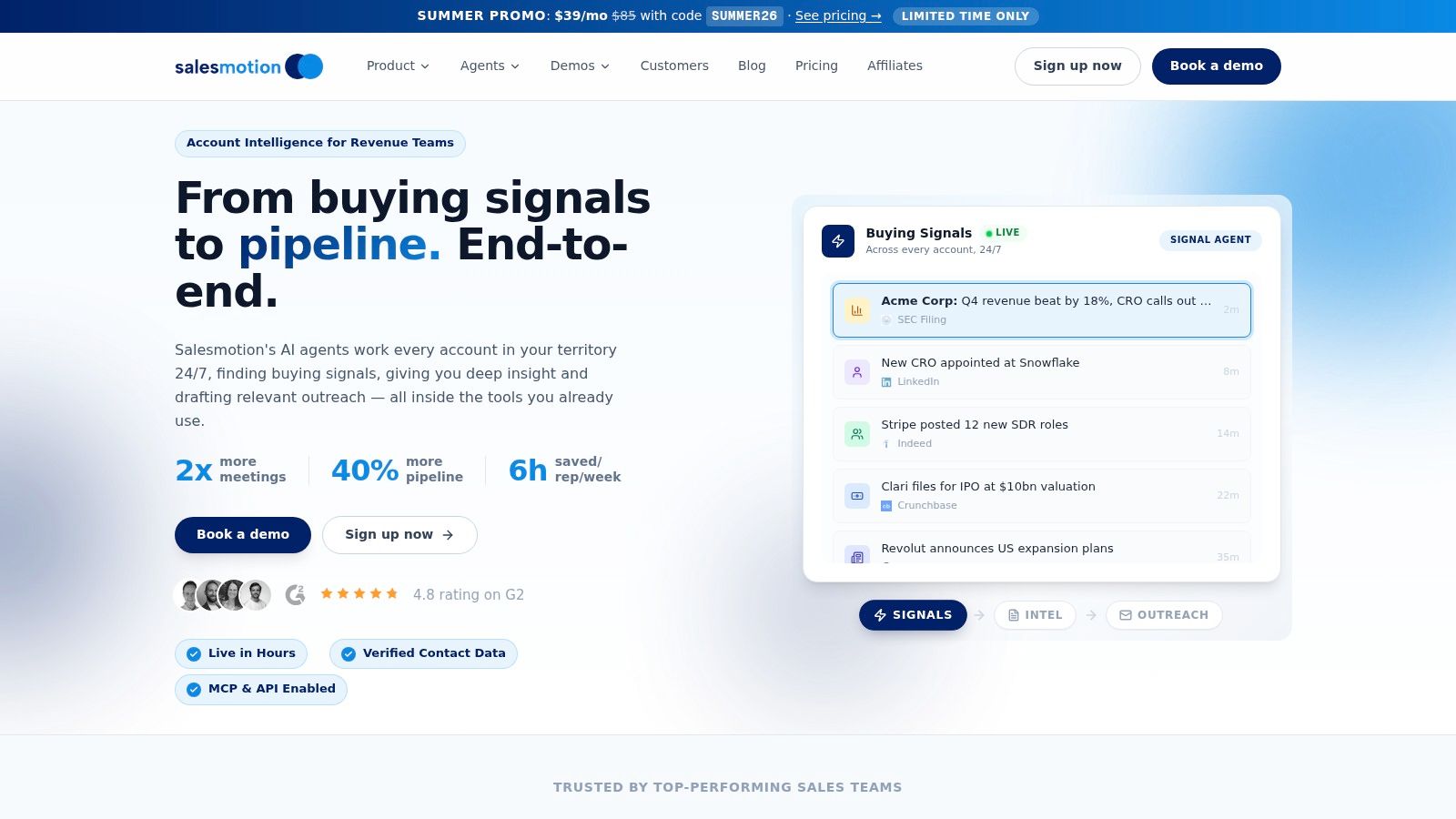
One example is Salesmotion's Signal Agent, which tracks champion movements and executive changes across target accounts and alerts teams when someone moves. Used well, that kind of workflow doesn't just tell a rep “Jane changed jobs.” It should tell them why Jane matters, what the prior relationship was, whether the new company is in territory, and what action belongs with the account owner.
Put governance around the motion
Often, teams underbuild. They buy alerts and skip the operating model.
A clean setup usually includes:
| Workflow area | What good looks like |
|---|---|
| Ownership | One named person owns outreach per alert |
| SLA | Follow-up expectations are defined across sales, marketing, and customer success |
| Dashboards | Leaders can see alerts, response times, meetings created, and sourced opportunities |
| Suppression rules | Low-fit accounts and low-confidence contacts don't trigger rep noise |
More alerts don't create more pipeline. Better decisions do.
A few implementation rules keep the system useful:
- Route by account ownership first. Don't let multiple reps chase the same mover.
- Include account fit in the alert. A champion move into a weak-fit company shouldn't outrank a strong-fit account with clear relevance.
- Separate expansion from new-logo plays. A former champion moving inside an existing customer base needs a different follow-up motion than one joining a net-new target account.
If you're evaluating automation, this overview of AI agents for sales teams is useful because champion tracking works best when account research, signal monitoring, and outreach support sit in one workflow instead of three disconnected tools.

“This is my singular place that very simply summarizes a company's top initiatives, strategies and connects them to my solution. Something I would spend hours researching manually, now it's automated.”
Derek Rosen
Director, Strategic Accounts, Guild Education
Your Outreach Playbook for Champion Job Changes
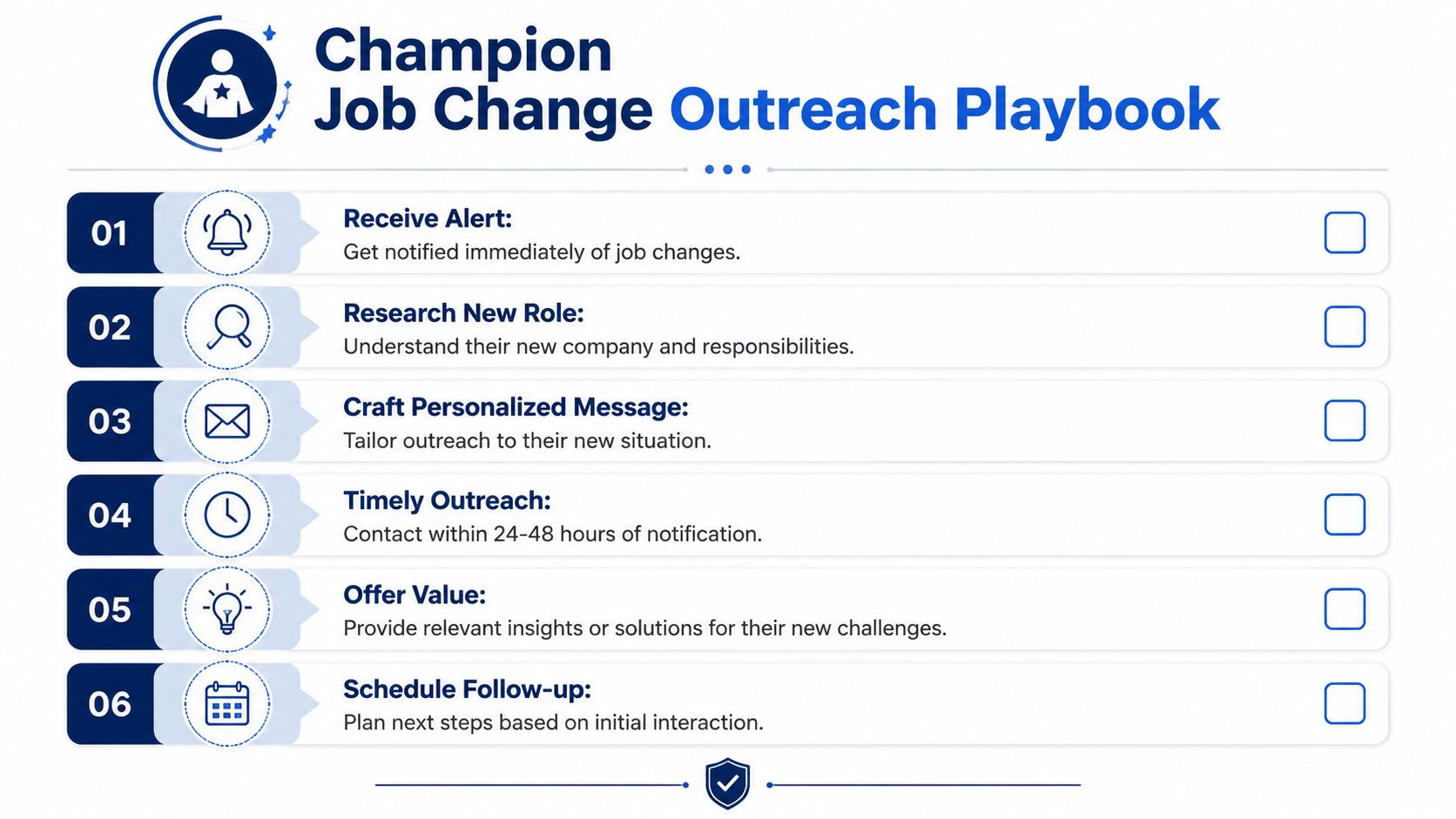
An alert is only useful if the rep knows what to do next. Most don't need a long sequence. They need a tight playbook that respects timing, context, and tone.
Move early, but don't sell too hard
The best window is usually early in the new role, ideally within the first two weeks. That's when the contact is learning the business, forming views on gaps, and deciding where familiar vendors might help.
The wrong message is “Saw you changed jobs. Want a demo?” That treats the alert like a list signal.
The right message does three things:
- Acknowledges the move
- References shared history
- Offers a useful next step tied to their new context
A simple working cadence
Here's a practical sequence that sales teams can run without overthinking it.
Day 1 or 2: Personal email
Subject: Congrats on the new role at [Company]
Hi [First Name], Congrats on the move to [Company]. Great to see you in the [New Title] role.
I enjoyed working with you at [Previous Company], especially around [specific initiative or project]. You had a clear view of what needed to change, and that made the rollout straightforward.
If it's useful, I'm happy to share a quick perspective on where teams in similar roles usually look first when they join a new environment. No pitch. Just happy to compare notes once you're settled in.
Day 3 or 4: LinkedIn follow-up
Keep this short. Congratulate them, reference your email, and avoid forcing a meeting ask.
Day 6 or 7: Value-add message
Send something relevant to the new role. That might be a short note about a likely operational challenge, a point of view on the team they now manage, or a quick assessment offer.
Example:
Hi [First Name], One thing we often see in a transition like yours is that teams inherit fragmented processes they don't fully trust yet. If helpful, I can outline how companies typically assess that in the first phase without turning it into a big internal project.
What to say in the meeting ask
When the contact engages, don't jump straight into product. Anchor the conversation around their early priorities.
A good talk track sounds like this:
You already know how we worked together before. What I'd want to understand first is whether the same problem exists in this environment, how visible it is internally, and whether it's something you'd want to tackle early or later.
That framing works because it respects the fact that a job move is a relationship signal, not automatic buying intent.
Avoid the common outreach mistakes
Teams usually blow this motion in one of four ways:
- They send generic congratulations: That gets ignored because everyone else sends the same note.
- They over-reference the old deal: Your shared history matters, but the new company has its own priorities.
- They ask for too much too soon: A “30-minute intro with your team next week” is often too aggressive.
- They skip account research: If you don't understand the new company's setup, your message reads like automation.
A strong first message should feel like a smart former partner reconnecting, not a seller cashing in on a trigger.
Measuring the Pipeline Impact of Your Program
Programs like this earn budget by producing pipeline, not by generating replies.
Start by measuring coverage with the same discipline you use for territory planning. How many verified champions sit in CRM today? How many map to closed-won customers, active target accounts, or former customers with a realistic path back into cycle? If that number is fuzzy, the team is still running a contact list, not a program.
Then split reporting into two layers. The first tells you whether the workflow is operating. The second tells you whether it is worth continuing.
Track the right metrics
The operational layer should answer four questions fast:
- Tracked champions: How many verified champions are under active monitoring
- Job-change alerts: How many relevant move signals reach the team
- Response time: How quickly an owner follows up after an alert
- Meetings booked: How many conversations come directly from mover outreach
Those numbers expose execution gaps quickly. Slow follow-up usually points to routing problems or unclear ownership. High alert volume with low meeting creation usually means qualification is too loose or outreach quality is weak.
The business layer is where this motion stands or falls:
| Metric | Why it matters |
|---|---|
| Sourced pipeline | Shows whether champion moves create net-new opportunity value |
| Influenced pipeline | Captures reopen or acceleration impact on deals already in motion |
| Win rate by source | Compares champion-sourced deals against outbound, inbound, and partner channels |
| Deal velocity | Shows whether these opportunities move through stages faster than other sourced deals |
This is also where discipline matters. If the account was already in an active sales cycle before the job change, don't count the full opportunity as sourced pipeline. Count influence only. Teams that blur that line make the program look better in QBRs and worse in forecasting.
Watch for false positives
Three issues usually distort reporting:
- Weak champion criteria: Reps tag friendly contacts as champions, and coverage looks stronger than it is
- Alert fatigue: Reps receive too many low-value notifications and stop acting on any of them
- Bad attribution: Pipeline gets credited to the mover program even when another motion created the opportunity
A useful dashboard makes those problems visible. Rising alerts with flat meetings point to poor filtering. Strong meeting rates with low opportunity creation usually point to weak account selection. Good opportunity creation with low win rates often means the team is overestimating the carryover value of the prior relationship.
For teams building that reporting model, these sales pipeline metrics help put champion tracking in the right context. Measure it against opportunity creation, conversion, and speed to revenue, not just contact activity.
Salesmotion helps revenue teams operationalize this motion by monitoring job changes, leadership moves, and other account signals, then routing actionable context into rep workflows. If you want champion tracking to become a repeatable pipeline channel instead of a manual side project, you can see how the platform works at Salesmotion.