
Most sales teams overvalue intent data and undervalue org change. That's backward.
A leadership change is often the clearest signal that a target account is about to revisit priorities, reset budget owners, and question the status quo. If you're selling into enterprise accounts, that's the moment when a dormant account can wake up fast. Strong sales leadership also changes outcomes inside the business. a compilation of sales-leadership statistics, indicates that strong sales leaders can increase average deal sizes by approximately 14% through strategic targeting and value-based selling. If leadership quality can move deal size that much, tracking leadership moves isn't a nice-to-have. It's pipeline strategy.
The problem is execution. Many teams still rely on scattered alerts, rep memory, and occasional LinkedIn checks. That breaks down quickly once you're covering a real territory instead of a shortlist. If you're managing 200+ enterprise accounts, missing one new CFO, CRO, or VP-level operator can mean learning about an evaluation process after your competitor is already in the deal. That's why teams that care about timing increasingly build around signals like job change signals for pipeline generation, not just static account lists.
The Single Most Valuable Buying Signal in Enterprise Sales
Leadership changes sit above most other signals because they change who decides, what gets measured, and which vendors get another look.
A new executive rarely joins to preserve the exact current state. They show up with a mandate. Sometimes it's growth. Sometimes it's efficiency. Sometimes it's cleanup after a rough quarter. In every case, they need to make decisions quickly enough that the organization sees movement.
That creates a window most sellers miss.
What makes this signal different
A product launch might create demand. A funding event might create budget. But a leadership change can reshape both demand and budget at the same time.
When a company hires a new CRO, sales process, pipeline inspection, tooling, and team design can all move. When a new CFO arrives, finance systems, planning rigor, vendor consolidation, and cost controls often come under review. A new CMO may reassess attribution, agency spend, and marketing tech before the quarter is over.
Practical rule: Track leadership changes because they answer the hardest outbound question. Why now?
Many teams get trapped in generic prospecting. They know the account fits. They know the persona is relevant. They just don't know why the buyer should care today. Executive movement gives you that trigger.
The cost of missing the change
The miss usually doesn't look dramatic at first. No one gets an alert saying, "You just lost this deal by not paying attention."
Instead, a rep notices months later that the account has a new buyer map, a new initiative, and an incumbent competitor already attached to it. By then, your outreach sounds late because it is late. You're no longer helping shape the evaluation. You're responding to it.
For teams covering a handful of named accounts, manual tracking can limp along for a while. For a manager running a broad enterprise book, it can't. The signal matters too much, and the coverage problem gets too big, too fast.
See Salesmotion in action
Take a self-guided interactive tour — no signup required.
Why New Leaders Create New Opportunities

New leaders create a short window where change is expected, budget debates reopen, and incumbent vendors have to defend their position.
That window is what sales teams should care about.
The title change itself is only the trigger. The revenue opportunity sits in the first 30 to 90 days after the hire, when the new executive is forming opinions, testing assumptions, and deciding which problems deserve attention first. If your team shows up during that period with a point of view tied to the executive's mandate, you can get into deals before requirements harden and before an incumbent frames the problem for them.
This is also where weak prospecting and strong prospecting separate fast. Weak outreach treats the hire as news. Strong outreach treats the hire as an operating event.
A new CRO usually inherits a forecast they do not fully trust, a pipeline they need to inspect, and a team they need to assess. A new CFO often reviews planning cadence, spend categories, reporting quality, and vendor overlap. A new COO looks for bottlenecks, missed handoffs, and inconsistent execution across teams. Those reviews create projects, and projects create buying motion.
The practical implication is simple. Do not contact a new executive just to acknowledge the move. Contact them with a hypothesis about what they are likely trying to fix.
That takes more work up front, but it pays off in reply rates and meeting quality. Teams that skip that step send the usual "congrats on the new role" message and get ignored. Teams that connect the hire to a likely business decision get a chance to shape the conversation early. For a manager building this motion across a broad account list, the main bottleneck is the research time required to do it well. The real cost of manual account research across an enterprise book shows up fast once reps are juggling dozens of accounts.
One more point matters here. New executives are often more open to outside perspectives than long-tenured leaders, but only if the input is useful and specific. They need fast credibility. They need a clean read on where friction sits. They need options they can explain internally.
That is why leadership-change selling works best as an operational playbook, not a monitoring exercise. The signal gets your timing right. The monetization comes from matching the executive change to a likely initiative, a clear message, and a measurable business case.

“Salesmotion helps you spot signals from prospect accounts, news items / job hiring alerts etc that indicate that now is a good time to reach out with a well-crafted message.”
Rob Douglas
Director of Sales, icit business intelligence
The Limits of Manual Tracking at Scale
Manual tracking fails long before teams admit it.
A rep can keep tabs on a handful of strategic accounts with discipline. A manager trying to run this motion across 200 enterprise accounts gets a very different result. Signals show up late, context lives in five different places, and follow-up quality drops because the rep spends the first 20 minutes figuring out whether the change matters.
What manual tracking looks like in the field
The standard setup is familiar. Saved searches in Sales Navigator. Google Alerts. Company news pages. Leadership bios. SEC filings for public accounts. Maybe a Slack channel where reps dump interesting updates.
None of those sources are bad on their own. The problem is the workflow. Someone has to monitor them, verify that the executive move is real, decide whether it affects an active priority, map the change to the account plan, and then write outreach that sounds informed instead of generic.
That sequence breaks under normal sales pressure.
Here is where the cracks show up fastest:
- LinkedIn alerts: Good for job changes and promotions, but inconsistent on timing and light on business context.
- Google Alerts and news feeds: Broad coverage, high noise, and often too late to catch the first window.
- Sales Navigator saved searches: Useful for watching named accounts, but they still leave interpretation to the rep.
- Company leadership pages and press releases: High-signal when updated, but many companies post changes after the move is already old news.
- Investor relations and SEC filings: Strong source for public companies, but slow to review account by account.
The issue is not detection alone. It is operational follow-through. If a rep needs 30 minutes to turn one leadership move into a usable point of view, the team will only work the cleanest alerts and ignore the rest.
Where manual methods break
Scale is the first problem. Coverage is the second. Consistency is the third.
At 20 accounts, a strong AE can stay on top of leadership moves. At 50, the process depends on rep habits. Past that, managers lose visibility into what got checked, what got missed, and which alerts turned into real opportunities. That makes it hard to coach, hard to forecast, and hard to prove ROI later.
Analysts at Visualping note in their guidance on monitoring executive leadership changes that automated systems achieve 92% coverage of executive moves versus 37% for manual methods, reduce miss rates by 78%, and boost pipeline velocity by 22% in major markets.
That gap matters because late information has a direct revenue cost. The cost of manual account research is not just rep time. It is slower timing, weaker hypotheses, and missed entry points that never make it into pipeline. The real cost of manual account research across an enterprise book shows how fast that drag adds up.
Manual tracking also creates a handoff problem. Reps may spot the move, but they still need enough context to brief an SDR, update the account plan, or shape the next meeting. If that context is missing, the signal dies in a note field.
Leadership tracking methods at scale
| Capability | Manual Methods (LinkedIn, Google Alerts) | Automated Platform (Salesmotion) |
|---|---|---|
| Coverage across 200+ accounts | Inconsistent. Depends on rep discipline and bandwidth. | Continuous monitoring across a large account set. |
| Signal speed | Usually reactive. Reps see changes after they surface publicly and after someone checks. | Near real-time alerting when a meaningful change is detected. |
| Context on why it matters | Minimal. Reps have to research the company and executive manually. | Signal paired with account context and likely implications. |
| Workflow fit | Lives across tabs, inboxes, saved searches, and notes. | Routed into existing workflows like Slack, email, or CRM. |
| Scalability for managers | Hard to audit and impossible to standardize cleanly. | Easier to operationalize across teams and territories. |
Automated does not mean more noise
Many managers hear "automation" and assume more alerts, more tabs, and more junk for reps to ignore. That concern is fair. Bad automation just floods the team with updates nobody can use.
A workable system does something different. It monitors executive moves, filters for accounts and roles that matter, adds enough account context to explain why the change deserves attention, and gives the rep a starting point for outreach. That matters later, too, because the same research thread often feeds downstream work like business cases and how to structure winning proposals.
One option in that category is Salesmotion. It tracks executive changes and champion movement across target accounts, monitors public sources continuously, and pairs alerts with account research so reps do not have to assemble the story by hand.
Your Playbook for Monetizing Leadership Changes
The hard part isn't finding one useful signal. The hard part is building a repeatable system so your team can turn signals into meetings and opportunities every week.
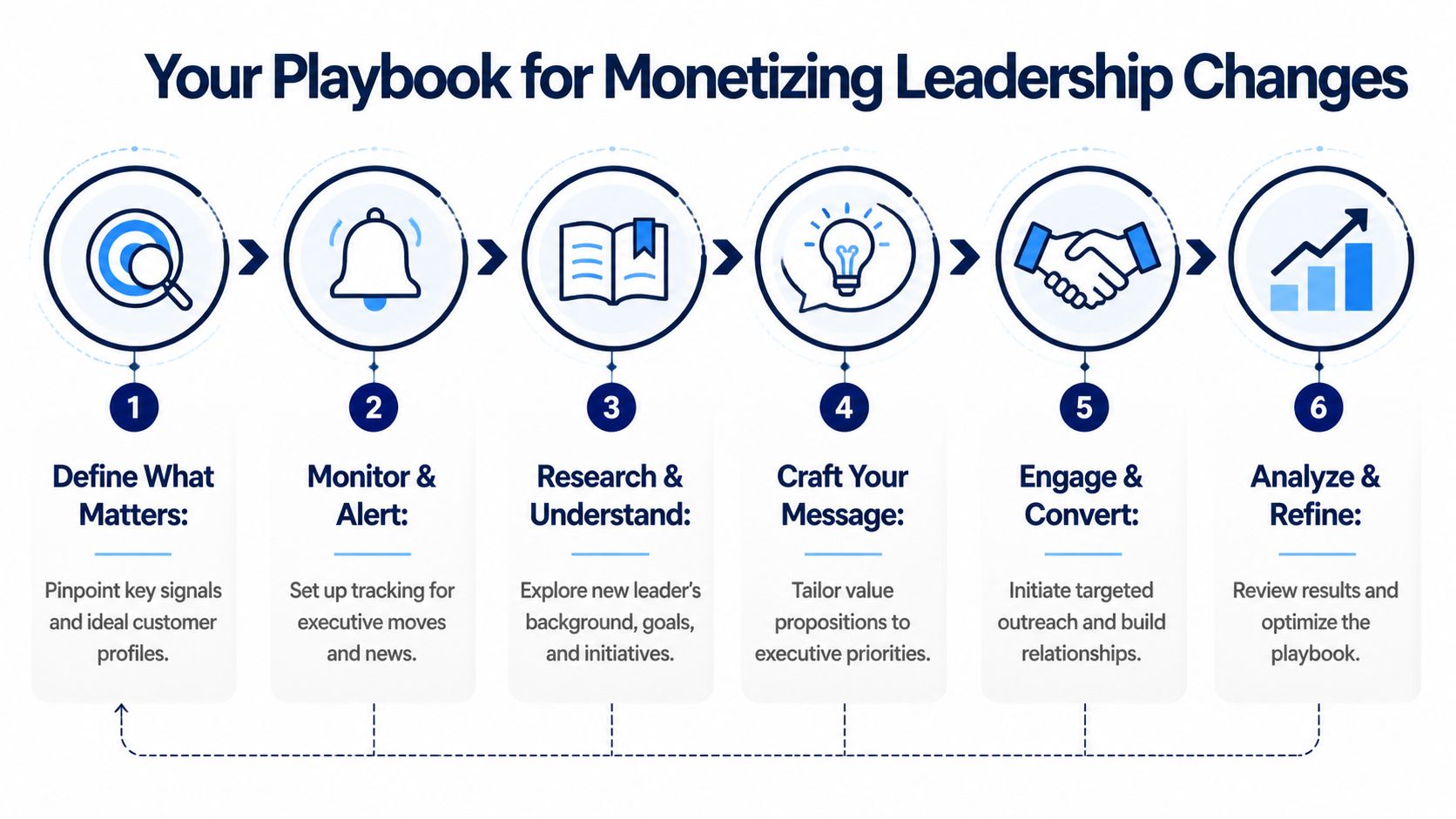
Define what matters
Don't track every title change. Track the roles that can realistically trigger evaluation in your category.
For most enterprise teams, that includes C-suite roles tied to budget, systems, or go-to-market execution. It often also includes VP-level operators who own rollout, process, or transformation work. If you sell into finance, the CFO, CAO, VP Finance, and controller layer matters. If you sell into revenue, start with CRO, VP Sales, RevOps leadership, and enablement.
Also track champion movement. When a prior buyer or internal supporter lands at a target account, that's often more actionable than a press release. As a result, champion tracking in sales becomes part of the same operating model, not a separate project.
Choose sources that give you signal, not clutter
You need breadth, but you also need source quality.
A practical stack usually includes LinkedIn, company leadership pages, press releases, investor relations pages, earnings transcripts, and job postings. Job postings matter because they often reveal the operational agenda behind the hire. If a company brings in a new CRO and starts hiring aggressively for RevOps, enablement, and regional sales leadership, that's a stronger signal than the title change alone.
Use Google Alerts sparingly. It's fine as a lightweight backstop. It isn't enough as the main system. Sales Navigator saved searches are better for role changes, but still limited if they don't tell the rep what to do next.
Prioritize before reps touch the account
Not every leadership change deserves outreach. Some are low relevance. Others are urgent.
Score for fit and momentum. Fit means role relevance, account tier, territory ownership, and alignment to your ICP. Momentum means what else is happening around the account. Has the company discussed efficiency, expansion, restructuring, hiring, or system changes? Has the new executive posted publicly about their priorities? Is there a related budget owner already engaged?
A simple prioritization lens works well:
- High priority: Executive move tightly connected to your category, plus recent company activity that supports a likely initiative.
- Medium priority: Relevant hire, but limited supporting context so far.
- Low priority: Leadership change with weak category relevance or unclear timing.
Operator's note: Reps don't need more account updates. They need fewer, sharper ones.
Map signals to actual sales motion
Most guides stop too early. Detection alone doesn't create pipeline.
Every signal should trigger a predefined motion. For example:
- Research the leader. Review their prior roles, public posts, and likely mandate.
- Research the company. Pull earnings commentary, strategic language, and recent org activity.
- Draft the angle. Tie your message to a business priority, not the title change itself.
- Select the path. Decide whether this should be AE outreach, SDR sequencing, exec-to-exec email, or a customer expansion motion.
- Tag the opportunity. Mark signal-sourced outreach in CRM so you can measure downstream outcomes.
When the outreach progresses to a business case or proposal, a clear structure matters. If your team needs a good reference on that step, GenPPT's guide on how to structure winning proposals is a useful resource because it focuses on turning a problem statement into a document buyers can evaluate.
Write messages that reflect actual homework
Generic "congrats on the new role" emails underperform because they ask the buyer to do the thinking. Good signal-based outreach does the opposite.
That difference shows up in response data. A/B testing summarized here found that insight-led emails referencing a new leader's prior focus produced reply rates of 35% versus 12% for generic messages.
Use that as the standard. Your message should sound like this account, this executive, this moment.

“Automatic account profile detail I can use to manage my territory. Using Salesmotion AI to generate value statements per persona, account, etc. Using Salesmotion to give me a starting point based on new hires, or news alerts is critical.”
Adam Wainwright
Head of Revenue, Cacheflow
Turning a Signal Into a Winning Conversation
A signal becomes valuable when it changes the quality of the conversation.
Take a common scenario. One of your target accounts hires a new CFO. A lot of reps will send a fast congratulations note and pitch their product as a finance improvement tool. That usually goes nowhere because it treats the title change as the message.
The stronger move is to combine the executive change with what the business has already said.
The CFO example done properly
Let's say the company's latest earnings commentary emphasized cost optimization and operating discipline. Then you notice the new CFO's LinkedIn activity centers on finance transformation, tighter planning, and cleaner reporting. Now you have a credible reason to reach out.
Your outreach isn't "saw you hired a CFO."
It's closer to this:
Subject: Cost optimization priorities after the CFO transition
Hi [Name], I noticed the recent CFO appointment and spent some time reviewing the company's recent commentary around cost optimization and operating discipline. I also saw that your new CFO has consistently focused on finance transformation and reporting rigor in prior roles.
In companies going through that combination of leadership change and cost focus, teams usually review where planning, reporting, or vendor sprawl is slowing down decision-making.
If that's on the agenda, I can share how similar teams frame the evaluation and where they usually find friction first. Worth a conversation next week?
That works because it does three things well.
- It connects the hire to a business issue.
- It reflects public context, not guessed intent.
- It offers a useful discussion, not a product brochure.
Why timing matters
Leadership signals decay fast. The longer you wait, the more likely another vendor has already framed the conversation.
Internal benchmarks summarized here show that teams acting on executive move signals within 7 days achieve 2.5x higher response rates, with 15% response versus 6% baseline compared with delayed outreach.
That doesn't mean you should rush low-quality messaging. It means your workflow needs to make fast, informed action possible.
A simple outreach framework reps can use
Use this when training the team:
- Start with the event: Mention the leadership change briefly.
- Anchor to business context: Tie it to earnings language, hiring patterns, or strategic commentary.
- Bring in the leader's lens: Reference the executive's background or public priorities.
- State the likely challenge: Name the operational problem they may be reviewing.
- Offer a narrow next step: Suggest a short conversation or a relevant point of view.
The bad version sounds like a sequence. The good version sounds like a prepared peer.
What good tooling changes
In a manual workflow, a rep has to find the hire, look up the company, read the relevant commentary, scan the executive's profile, and draft the email from scratch. That's why so many "signal-based" programs collapse into shallow personalization.
A more operational setup pairs signal detection with research and message drafting. The alert should include the event, the account context, and a suggested angle so the rep starts with a thesis instead of a blank page.
Measuring the Pipeline Impact of Your Program
If this motion does not create measurable pipeline, it gets cut at budget time.
The cleanest way to measure the impact of tracking leadership changes is to tag the source of motion in CRM from the first touch. Do it at outreach creation, not when an opportunity finally appears. That gives you a clean chain from signal to meeting, meeting to pipeline, and pipeline to closed-won revenue.
This is an operating discipline, not a reporting exercise. If reps log the signal inconsistently, managers lose the ability to see which executive changes produce deals.
Track the metrics that matter
A useful dashboard answers four questions:
- Signal-to-meeting conversion: Are leadership-triggered touches producing more meetings than your standard outbound motion?
- Pipeline created from leadership-triggered opportunities: How much qualified pipeline came from this program?
- Speed to first touch: Did the rep act while the leadership change still had urgency?
- Progression quality: Do these opportunities advance through stages at a healthy rate, or die after the first meeting?
Reply rate and meeting rate are helpful diagnostic metrics. They are not the main score. The main score is revenue impact.
A simple way to keep the team honest is to compare leadership-sourced opportunities against a control group from your standard outbound program. Same segment, same quarter, same stage definitions. That is how you separate a real signal from a good story.
Measure signal quality, not just volume
More alerts rarely mean more pipeline. Managers need to know which combinations of signals deserve rep time and which ones just create activity.
OpenView's analysis of executive-change tracking notes that AI fusion, combining org changes, LinkedIn activity, and job postings, can predict buying intent 45 days earlier than traditional methods and boost account priority scores by 40%. The practical lesson is to score bundles of evidence, not isolated events.
A new executive by itself can be noise. A new executive plus role-specific hiring, budget language in earnings commentary, and a recent team restructuring is a selling window.
Score the cluster, not the headline. Composite signals usually produce better meetings, better qualification, and better forecast accuracy.
Keep the reporting operational
Managers should see this data where they already inspect execution. CRM fields, account views, and weekly pipeline reviews matter more than a standalone dashboard nobody opens.
Review signal-sourced outreach, meetings, stage progression, and win rates in the same cadence you use for normal pipeline inspection. If your team already knows how to track webinar ROI, apply that same logic here. Tie the initiating activity to conversion, then to pipeline, then to revenue.
For leadership, this scorecard should sit beside your broader sales pipeline metrics that actually matter. That keeps executive-change tracking tied to resource allocation, coaching, and forecast quality instead of letting it drift into a side project.
Sales teams do not need more alerts. They need proof that this program creates meetings, pipeline, and closed-won deals. Salesmotion helps revenue teams monitor target accounts, detect executive changes and other real-world triggers, pair them with account research, and turn them into actionable outreach in the tools reps already use.