Marketing teams are under pressure to run precision ABM programs, yet most B2B data providers deliver only 50% accuracy on average. That gap between what marketing account intelligence software promises and what it actually delivers has real consequences: wasted ad spend, misrouted leads, and campaigns that target companies nowhere near your ICP.
The marketing account intelligence software market is projected to grow from $3.4 billion in 2024 to $10.5 billion by 2033, reflecting how fast B2B marketing teams are shifting from spray-and-pray to signal-driven targeting. But not every platform delivers the same value. Some excel at intent data, others at firmographic enrichment, and a few try to do everything.
This guide compares the 10 best marketing account intelligence platforms based on data quality, intent accuracy, integration depth, and real pricing information that most comparison articles leave out.
Looking at ABM platforms?
ABM platforms are built for marketing teams and sold on annual quotes. Salesmotion works for reps from day one, from $85/mo.
Account intelligence, signals, and rep-ready outreach for $85/mo. Live in an hour, no annual contract.
TL;DR: Marketing account intelligence software helps marketing teams identify which accounts match your ICP, which are actively researching solutions, and who to target within the buying committee. The best platforms to shortlist for 2027 combine firmographic, technographic, contact, and intent data into unified account profiles. ABM programs using account intelligence deliver 87% higher ROI than traditional marketing. This guide covers 10 platforms with honest pricing, screenshots, and trade-offs.
What Is Marketing Account Intelligence Software?
Marketing account intelligence software aggregates firmographic, technographic, contact, and intent data into a unified platform that identifies which companies match your ICP and shows which are actively researching solutions. It eliminates manual prospecting research and surfaces buying committees ready for outreach.
These platforms combine multiple data types to build complete account profiles:
- Firmographic data: Company size, revenue, industry, location, employee count, growth trajectory, and funding status
- Technographic data: Installed technology stack, software vendors, IT spend, and tech refresh cycles
- Contact data: Decision-maker names, titles, verified emails, direct dials, and organizational structure
- Intent signals: Content consumption, keyword research activity, website visits, and buying committee engagement
The key difference from generic marketing analytics tools: account intelligence tells you which specific companies are in-market, not just aggregate traffic trends. And unlike pure sales intelligence platforms, marketing account intelligence is designed for campaign targeting, ad audience building, and lead-to-account matching at scale.
According to Demandbase's 2026 State of ABM report, teams with mature ABM frameworks see a 22.33% median MQA conversion rate vs. 14.19% for less mature programs. That maturity gap almost always traces back to the quality of account intelligence feeding the program.
See Salesmotion on a real account
Book a 15-minute demo and see how your team saves hours on account research.
Best Marketing Account Intelligence Software
Here is how the top marketing account intelligence platforms compare:
| Platform | Primary Strength | Best For | Pricing |
|---|---|---|---|
| Salesmotion | Signal-driven account research + AI briefs | Enterprise marketing-to-sales handoff | From $85/mo |
| ZoomInfo Marketing | Large B2B contact + intent database | Mid-market to enterprise ABM | Custom, consumption-based |
| 6sense | Predictive analytics + anonymous buyer ID | Enterprise ABM programs | Custom, quote-only |
| Demandbase One | ABX orchestration + advertising | ABX-focused marketing teams | Custom (platform fee + per-user fee) |
| Bombora | Co-op intent data network | Teams layering intent onto existing data | Custom, quote-only |
| Apollo | Contact data + engagement sequences | SMB/mid-market outbound | Free; $49–$119/user/mo (annual) |
| Cognism | Phone-verified mobiles + EMEA coverage | EMEA-focused teams | Custom, quote-only |
| HG Insights | Technology intelligence + IT spend data | Tech companies targeting IT buyers | Custom |
| Clearbit (HubSpot data enrichment) | Real-time enrichment + HubSpot native | HubSpot-first marketing teams | Included in paid HubSpot plans |
| AdRoll ABM (formerly RollWorks) | Account-based advertising orchestration | Teams running paid ABM campaigns | Does not publish ABM pricing |
1. Salesmotion
This platform takes a different approach to account intelligence. Instead of building another massive contact database, it monitors over 1,000 public and proprietary sources to surface what is actually happening at your target accounts right now: leadership changes, earnings signals, hiring patterns, competitive moves, and strategic initiatives.
What it does best: Turns raw signals into AI-generated account briefs that marketing teams use to trigger targeted campaigns and prioritize handoffs to sales. When a target account's CFO mentions "operational efficiency" on an earnings call, that signal flows directly into your campaign workflows.
Who it's for: B2B marketing and sales teams at mid-market and enterprise companies running account-based programs where context matters more than contact volume.
Key differentiator: The platform does not just tell you a company matches your ICP. It tells you why this week matters for that account. The AI Research Agent generates account summaries covering financials, competitive landscape, and strategic priorities, giving marketing teams the context to personalize campaigns at scale.
Pricing: Individual plans start at $85/month. Team plans use custom pricing and include unlimited users.
Limitation: Not a contact database. If your primary need is bulk email lists or phone numbers, you will need to pair it with a contact data provider.
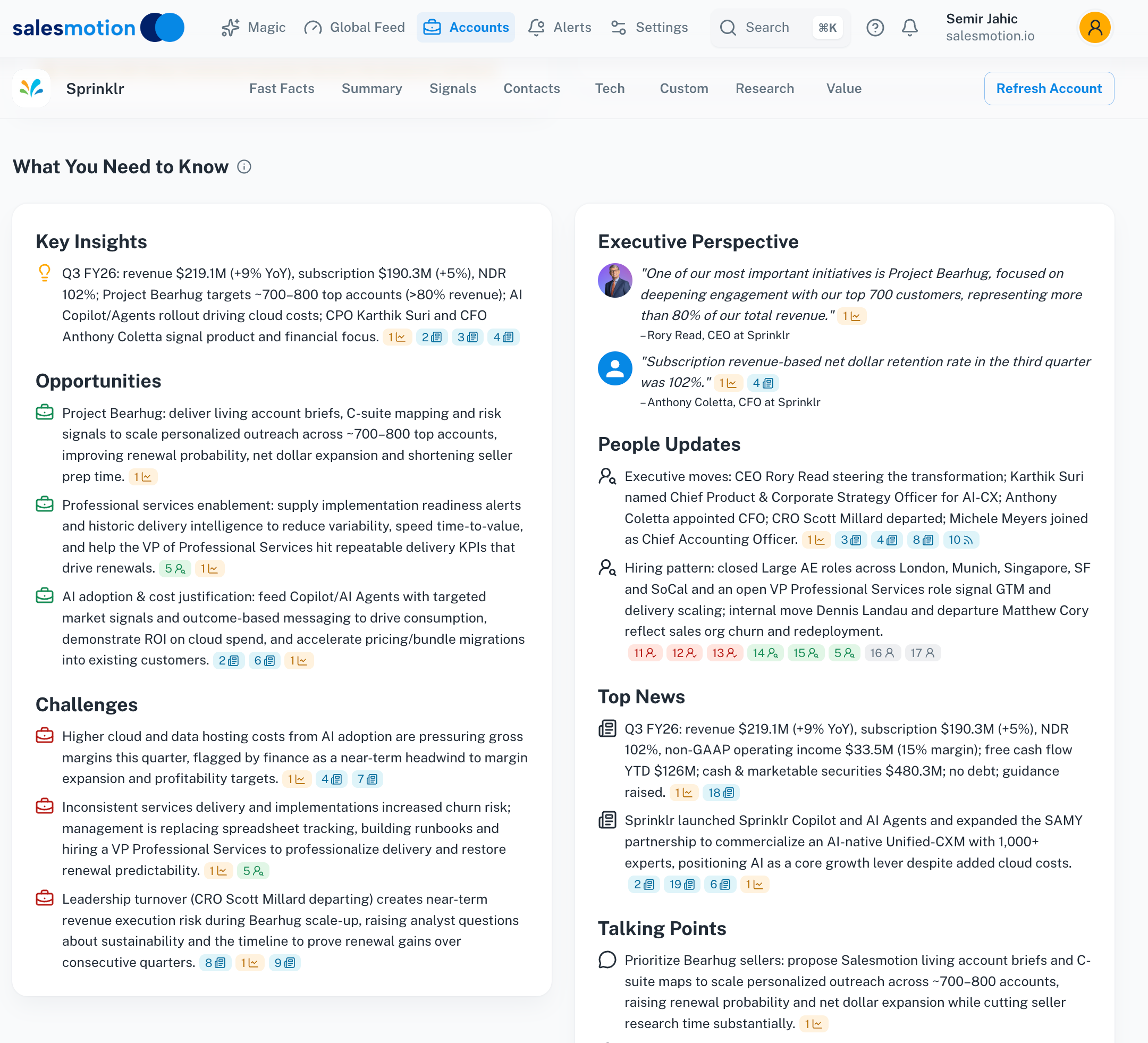 Salesmotion's AI Research Agent generates account summaries pulling from earnings calls, hiring data, news, and competitive intelligence.
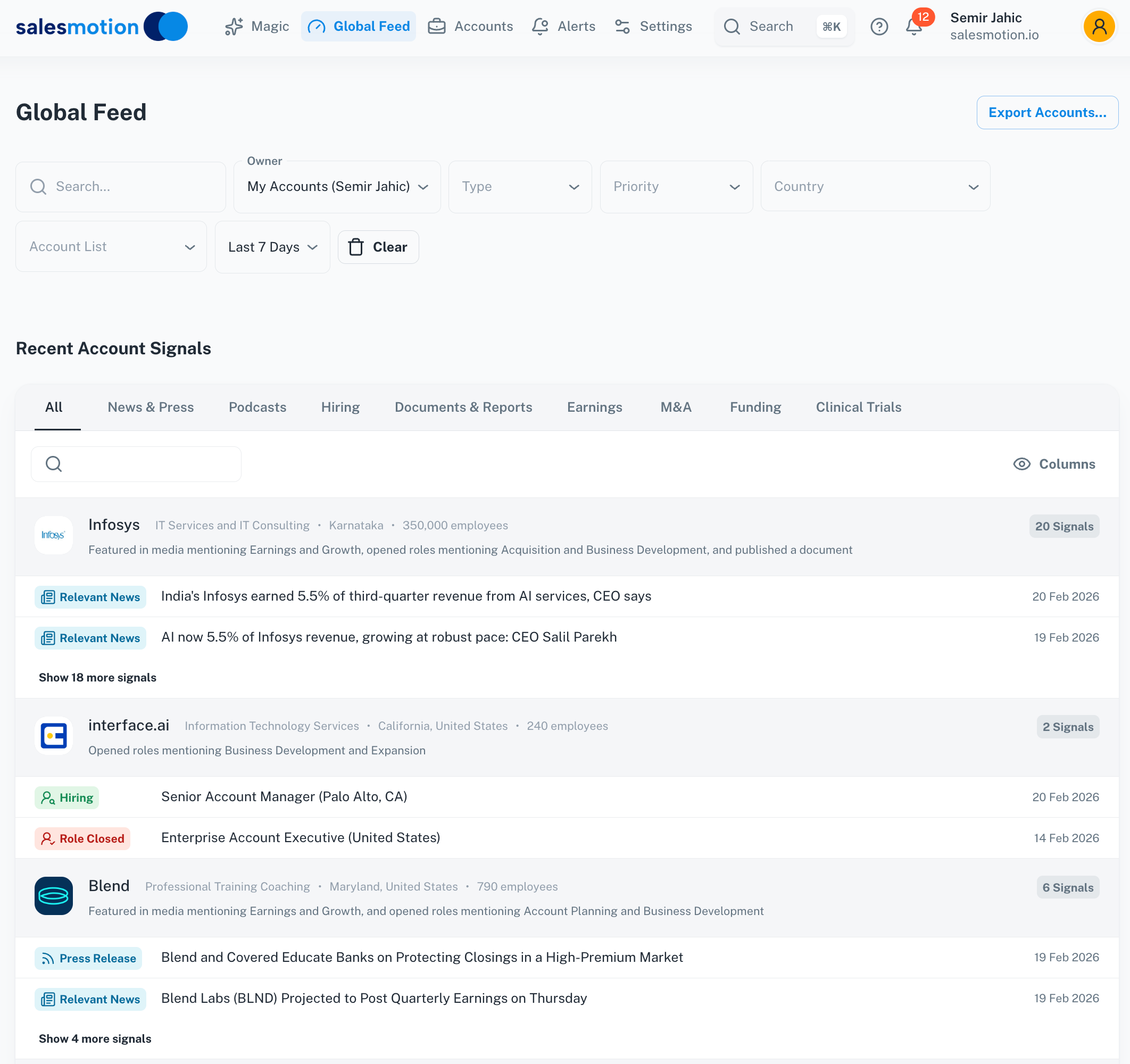 The global signal feed surfaces real-time buying signals across your entire target account list.
Workflow example:
Trigger: Target account posts 8 new sales roles and mentions "pipeline acceleration" in earnings call → Platform: Flags account with hiring + strategic initiative signals, generates AI brief → Marketing: Launches personalized ABM campaign referencing their growth initiative → Outcome: Sales receives warm, contextualized handoff with talking points
Customers like Analytic Partners grew qualified pipeline 40% YoY while cutting research time from 3 hours to 15 minutes per account. Frontify saw a 42% increase in sales velocity after implementing signal-driven account prioritization.
Salesmotion's Take
Quality has never mattered more in account intelligence. The market is flooded with platforms offering millions of contacts and billions of "intent signals," but the teams winning right now are the ones that deeply understand their customers before making contact. I started this company because I saw the same pattern at Salesforce and Clari: reps and marketers had access to more data than ever, yet walked into conversations knowing less about their accounts than ever. Real intelligence is not about data volume. It is about knowing what a company cares about this quarter, what is changing in their leadership, and why your solution matters to them specifically. That depth of understanding is what converts pipeline into revenue.

Semir Jahic
CEO & Co-Founder, Salesmotion
2. ZoomInfo Marketing
ZoomInfo Marketing delivers account intelligence through a platform that combines over 100 million company profiles, 500 million contact profiles, and 1 billion buying signals processed monthly. The platform was named a Leader in the 2025 Gartner Magic Quadrant for ABM Platforms.
What it does best: Combines one of the industry's largest B2B databases with intent signals, website visitor identification, and native campaign automation through ZoomInfo Copilot.
Who it's for: Mid-market to enterprise B2B marketing teams that need both contact data and account intelligence in a single platform.
Key differentiator: Database scale. Few platforms match ZoomInfo's breadth of firmographic, technographic, and contact data coverage, which makes it particularly strong for teams building large target account lists from scratch.
Pricing: ZoomInfo does not publish list pricing; its pricing page says pricing is consumption-based. Vendr reports a median contract of $33,500 a year based on 1,576 purchases. Marketing plans are Marketing Demand, ABM Lite and ABM Enterprise.
Limitation: ZoomInfo is built for breadth, so smaller teams should plan time to configure filters and workflows around their ICP, and pricing comes from a quote. For teams evaluating the Copilot AI layer specifically, see our ZoomInfo Copilot alternatives guide.
 ZoomInfo Marketing combines contact data, intent signals, and campaign automation in a single platform.
3. 6sense
6sense Revenue Marketing uses AI and machine learning to capture anonymous buying signals and predict which accounts are in-market for specific solutions. Named a Leader in the 2025 Gartner Magic Quadrant for ABM Platforms for the fifth consecutive year.
What it does best: Reveals "Dark Funnel" activity, identifying accounts researching your category before they ever fill out a form or visit your website.
Who it's for: Enterprise marketing teams with the budget and resources to operationalize predictive intelligence across their ABM programs.
Key differentiator: Predictive account scoring that combines anonymous intent signals with firmographic fit to rank accounts by buying stage. The platform's ability to identify accounts before they self-identify is its strongest advantage.
Pricing: 6sense does not publish pricing. Vendr reports a median annual contract value of $62,220 across 386 purchases, with a range of $11,234 to $176,511. See our 6sense pricing breakdown for details.
Limitation: A significant investment by Vendr's figures. 6sense is built for enterprise ABM programs, so it fits best where a mature ABM operation can act on the intelligence.
 6sense uses predictive analytics to identify anonymous accounts researching your category.
4. Demandbase One
Demandbase One is an Account-Based Experience (ABX) platform that combines account intelligence, advertising, and sales intelligence. Forrester rated Demandbase the top performer in their ABM Platforms evaluation, with the highest score in the "current offering" category.
What it does best: Orchestrates the full ABX journey from account identification through advertising, web personalization, and sales handoff in a single platform.
Who it's for: Marketing teams that want to run coordinated ABM campaigns across advertising, email, and web channels without stitching together point solutions.
Key differentiator: Combined advertising and intelligence platform. Demandbase is one of the few vendors that lets you identify target accounts, serve them personalized ads, and measure engagement all within one system.
Pricing: Demandbase does not publish pricing; its pricing page describes a platform fee plus a flat fee per user. Vendr reports a median annual contract value of $68,591 across 187 purchases, with a range of $24,000 to $164,037. See our Demandbase pricing breakdown.
Limitation: Demandbase is sold as one platform rather than as separate marketing and sales solutions. Advertising can be a starting place and its data can be bought on its own, so teams with a narrow need should scope accordingly.
 Demandbase One orchestrates the full ABX journey from account identification through advertising and sales handoff.
5. Bombora
Bombora provides Company Surge intent data sourced from a cooperative of thousands of B2B sites that contribute anonymous browsing activity. Bombora is best known for its intent signals.
What it does best: Delivers high-quality, consent-based intent data that layers onto your existing marketing stack.
Who it's for: Marketing teams that already have an ABM platform or MAP but need stronger intent signals to improve account prioritization and campaign timing.
Key differentiator: The cooperative data model. Because hundreds of publishers and brands contribute data across thousands of B2B sites, Bombora captures research behavior across a wider content ecosystem than platforms relying solely on their own web properties.
Pricing: Bombora does not publish pricing. Vendr reports a median annual contract value of $25,000 across 35 purchases, with a range of $13,000 to $80,450.
Limitation: Company Surge reports intent at the company level. Bombora also sells identity and enrichment, digital audiences and campaign measurement, and teams running outbound typically add a contact data source.
 Bombora surfaces intent signals from a cooperative of thousands of B2B sites tracking content consumption.
6. Apollo
Apollo combines a database of 240M contacts and 30M companies with built-in engagement workflows for prospecting and outbound campaigns. While primarily a sales tool, its data and list-building capabilities make it useful for marketing account intelligence at lower price points.
What it does best: Delivers strong contact data with built-in email sequencing at a price point accessible to SMBs and startups. The platform's Chrome extension enables prospecting directly from LinkedIn.
Who it's for: SMB and mid-market marketing teams that need contact-level data and outbound engagement in a single affordable platform.
Key differentiator: Price-to-value ratio. Apollo's free plan includes 900 credits per seat a year and two sequences, making it one of the most accessible entry points into account intelligence for smaller teams.
Pricing: Free tier available. Paid plans start at $49 per seat per month (Basic), with Professional at $79 and Organization at $119, all on annual billing (3-seat minimum on Organization). See our Apollo pricing breakdown.
Limitation: Buying intent is capped by plan (1 intent topic on Free, 6 on Basic and Professional, 12 on Organization). Phone numbers cost 8 credits each against 1 for an email, so calling-heavy teams draw down credits faster.
 Apollo combines a 240M contact database with built-in email sequencing and prospecting workflows.
7. Cognism
Cognism is a B2B data platform that specializes in phone-verified mobile numbers (previously marketed as Diamond Data). The platform provides strong EMEA coverage with GDPR-compliant data collection.
What it does best: Delivers phone-verified mobile numbers, for which Cognism claims up to 3x higher connect rates.
Who it's for: Marketing and sales teams targeting European markets or any team where phone outreach is a primary channel.
Key differentiator: Phone-verified mobile numbers and Europe-first data coverage with a compliance-first posture, making it a strong choice for reaching prospects by phone in Europe.
Pricing: Cognism does not publish pricing; it sells Standard and Pro packages, each listed with 5 seats included, on a credit system where one credit reveals one contact. See our Cognism pricing review.
Limitation: Cognism is built for prospecting into Europe; teams selling mainly into North America usually compare it with ZoomInfo or Apollo. Intent data comes from Bombora's Company Surge and sits in the Pro package.
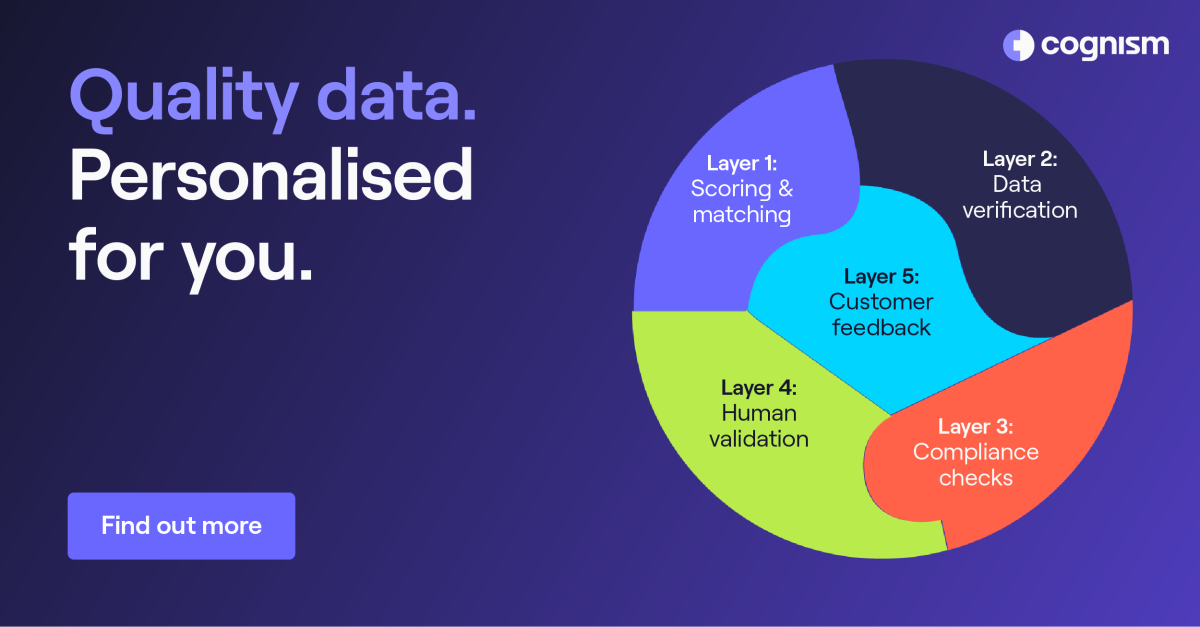 Cognism delivers phone-verified mobile numbers with strong EMEA coverage.
8. HG Insights
HG Insights provides technology intelligence data covering IT installations, technology spend, contracts, and adoption patterns across millions of companies.
What it does best: Delivers the deepest technographic data in the market. If your product replaces or integrates with specific technologies, HG Insights can identify every company running that tech stack.
Who it's for: B2B technology companies selling to IT teams, or any company whose ICP includes specific technology requirements.
Key differentiator: Depth of technology intelligence. HG Insights tracks not just which technologies a company uses but estimated spend, contract renewal timing, and adoption maturity, enabling highly targeted campaigns timed to buying windows.
Pricing: HG Insights does not publish pricing. Its plans are Starter, Growth and Enterprise.
Limitation: Narrow focus. HG Insights is built around technology intelligence, so it is most useful when your ICP is defined by technology stack.
 HG Insights tracks technology installations, estimated spend, and contract renewal timing across millions of companies.
9. Clearbit (HubSpot Data Enrichment)
Clearbit is now part of HubSpot, and its enrichment ships as HubSpot's data enrichment (introduced as Breeze Intelligence in 2024). It provides real-time firmographic and technographic enrichment for marketing databases. The acquisition by HubSpot in 2023 made it the native intelligence layer for HubSpot's marketing platform.
What it does best: Enriches inbound leads and existing CRM records with firmographic data in real time. The HubSpot integration is seamless, making it the easiest intelligence layer to activate for HubSpot-first teams.
Who it's for: Marketing teams already running HubSpot that need enrichment and lead scoring without adding another platform to their stack.
Key differentiator: Native HubSpot integration. Data flows directly into HubSpot properties, list segmentation, and workflow triggers without any middleware or manual mapping.
Pricing: Included with HubSpot Starter, Professional and Enterprise subscriptions; HubSpot's documentation says data enrichment does not consume HubSpot Credits.
Limitation: HubSpot's data enrichment works on records inside HubSpot. Teams whose system of record is Salesforce or another CRM need a separate enrichment source.
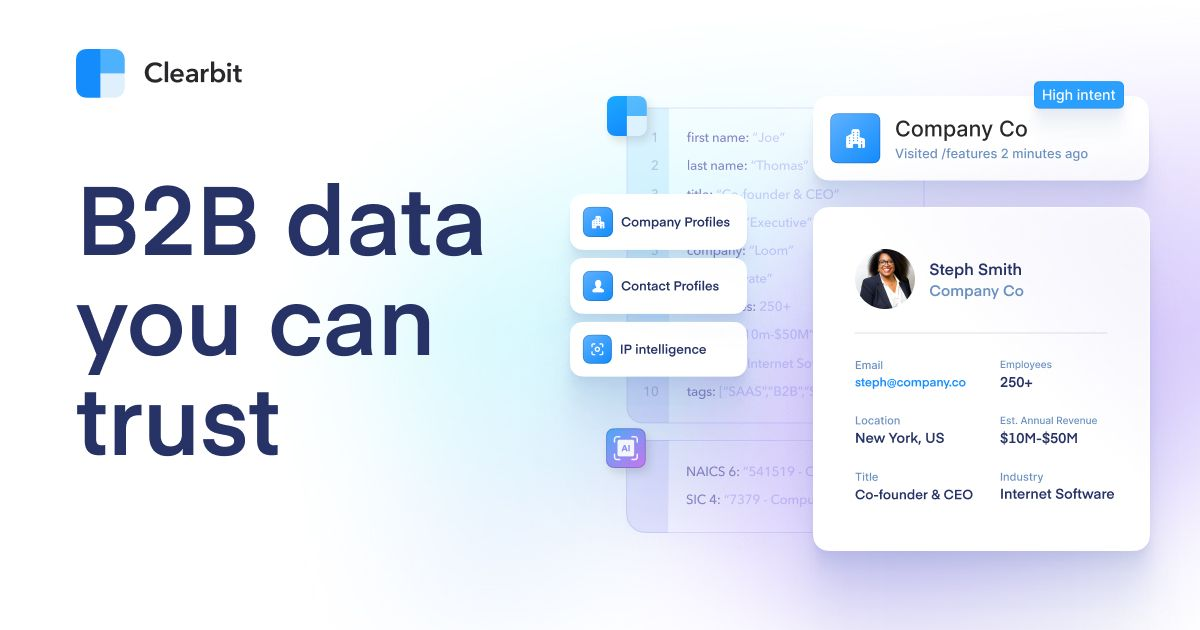 Clearbit, now part of HubSpot, provides native HubSpot enrichment with real-time firmographic data.
10. AdRoll ABM (formerly RollWorks)
RollWorks provides account-based advertising orchestration, using AI and machine learning to transform buyer data into targeting insights for display, social, and email campaigns.
What it does best: Bridges account intelligence and paid media execution. Build target account lists and immediately activate them as ad audiences across programmatic and social channels.
Who it's for: Marketing teams running paid ABM campaigns that want account targeting and advertising execution in one platform.
Key differentiator: Programmatic reach to both known and unknown contacts at target accounts, extending ABM beyond owned channels into paid media.
Pricing: AdRoll does not publish prices for its ABM packages. Account-Based Retargeting has no fee to get started and you pay only for media.
Limitation: Built around advertising execution. Teams that want deep account research and sales signals usually pair AdRoll ABM with an intelligence source.
 RollWorks bridges account intelligence and paid media, activating target account lists as ad audiences.

“We're no longer fishing. We know who the right customers are, and we can qualify them quickly. Salesmotion has had a direct impact on pipeline quality.”
Andrew Giordano
VP of Global Commercial Operations, Analytic Partners
Marketing Account Intelligence vs. Sales Intelligence: What Is the Difference?
These two categories overlap, but they serve different workflows and different buyers within the organization.
Marketing account intelligence is optimized for:
- Building and refining target account lists at scale
- Segmenting audiences for personalized campaigns
- Lead-to-account matching and routing
- Ad audience creation and activation
- Measuring account engagement across marketing channels
Sales intelligence is optimized for:
- Individual rep prospecting and outreach
- Contact-level data (direct dials, verified emails)
- Real-time alerts for sales triggers (job changes, funding rounds)
- Deal-level account research and call prep
- CRM enrichment and pipeline management
The best programs use both. Marketing account intelligence feeds the top and middle of the funnel with the right accounts and signals. Sales intelligence helps reps convert those accounts into pipeline. Some platforms span both categories, while others like Bombora (marketing-focused intent) and Cognism (sales-focused contact data) specialize in one side.
According to AdRoll's 2026 ABM research, companies that align ABM with account-based advertising see 60% higher win rates. That alignment only works when marketing and sales are looking at the same account intelligence.
How to Evaluate Marketing Account Intelligence Platforms
The comparison table helps you narrow the field, but the real evaluation happens when you test platforms against your specific data and workflows. Here is what to prioritize, and what to watch out for.
Data Quality Over Data Volume
Database size is the most commonly cited metric and the least useful one. A platform with 100 million contacts means nothing if its match rate against your ICP is 30%. Request a match test: upload your target account list and measure how many accounts the platform can enrich with accurate, current data.
Red flag: Any vendor that leads with database size but will not run a match test on your actual ICP list.
Intent Signal Source and Methodology
Not all intent data is created equal. First-party intent (from your own website and content) is the most reliable but limited in scope. Third-party intent varies enormously by source and methodology.
Key questions to ask:
- Where do the intent signals come from? (Cooperative data, bidstream, web scraping, proprietary panels?)
- How are intent topics defined and how often are they updated?
- What signal threshold triggers an alert or score change?
- Can you test against accounts you know are in-market to validate accuracy?
Red flag: Vendors that cannot explain their intent data methodology or that define "intent" as nothing more than website visits.
Integration Depth With Your Stack
Native CRM and MAP integration is non-negotiable. But "integration" ranges from basic CSV export to real-time bidirectional sync with workflow triggers.
Validate:
- Bidirectional sync that updates records in both directions automatically
- Workflow triggers that launch campaigns based on account activity or score changes
- Custom field mapping to your specific data model
- Deduplication logic that prevents duplicate records from polluting your database
Red flag: Integrations that require middleware (Zapier, Workato) for basic data sync.
Reporting and Attribution
ABM metrics are notoriously hard to measure. Your account intelligence platform should track account progression through buying stages and attribute pipeline to specific campaigns, channels, and signals.
Red flag: Platforms that only measure impressions and clicks but cannot connect account engagement to pipeline outcomes.
“The Business Development team gets 80 to 90 percent of what they need in 15 minutes. That is a complete shift in how our reps work.”
Andrew Giordano
VP of Global Commercial Operations, Analytic Partners
Key Takeaways
- Marketing account intelligence software aggregates firmographic, technographic, contact, and intent data to identify which accounts match your ICP and which are actively in-market. The market is projected to reach $10.5 billion by 2033.
- ABM programs powered by account intelligence deliver 87% higher ROI than traditional marketing, with mature programs converting MQAs at 22.33% vs. 14.19% for less mature teams.
- The biggest differentiator between platforms is not database size but data quality and signal accuracy. Most B2B data providers deliver only 50% accuracy on average, so match-testing against your ICP is essential before buying.
- Marketing account intelligence and sales intelligence serve different workflows. Marketing focuses on account lists, campaign segmentation, and ad targeting. Sales focuses on contact-level prospecting and deal research. The best programs layer both.
- Pricing ranges from free tiers (Apollo) to quote-only enterprise contracts (Vendr reports a median of $62,220 a year for 6sense) depending on whether you need contact data, intent signals, advertising execution, or all three. Start by identifying your primary gap rather than buying an all-in-one platform you will only use 30% of.
Frequently Asked Questions
What is the difference between marketing account intelligence and sales intelligence?
Marketing account intelligence focuses on account-level data for campaign targeting, audience building, lead-to-account matching, and measuring engagement across marketing channels. Sales intelligence focuses on contact-level data for individual rep prospecting, outreach, call prep, and CRM enrichment. Marketing account intelligence feeds the funnel with the right accounts; sales intelligence helps reps convert those accounts into pipeline.
How much does marketing account intelligence software cost?
Pricing ranges dramatically. Apollo offers a free tier with paid plans from $49 per seat per month on annual billing. Clearbit's enrichment is included in paid HubSpot plans. Enterprise platforms like ZoomInfo, 6sense and Demandbase do not publish pricing; Vendr reports median contracts of $33,500 a year for ZoomInfo, $62,220 for 6sense and $68,591 for Demandbase. The right budget depends on whether you need contact data, intent signals, advertising capabilities, or a combination.
Can marketing account intelligence replace my ABM platform?
In some cases, yes. Platforms like 6sense and Demandbase One combine intelligence with ABM execution (advertising, orchestration, personalization). But many account intelligence tools, such as Bombora, Clearbit, and HG Insights, focus primarily on data and signals rather than campaign execution. If your ABM strategy relies heavily on paid advertising and multi-channel orchestration, you likely need both intelligence and execution capabilities.
How do marketing teams measure ROI from account intelligence?
Track account-to-opportunity conversion rates, pipeline velocity, and cost per qualified account before and after implementation. Mature teams also measure account engagement lift and the percentage of marketing-sourced pipeline that originated from intelligence-flagged accounts. According to industry data, 63% of companies with mature ABM programs see at least 25% ROI from their account intelligence investments.
What data sources do marketing account intelligence tools use?
Primary sources include: firmographic databases (company registrations, financial filings, job postings), technographic crawls (website technology detection, job description analysis), intent data (content consumption from cooperative networks, bidstream data, or proprietary panels), contact data (email verification, phone validation, LinkedIn enrichment), and first-party signals (website visitor identification, form fills, content engagement). B2B contact data decays at approximately 2.1% per month, which is why continuous enrichment matters more than one-time database purchases.