Most sales reps still spend 40% of their time searching for the right prospects to call. That's not a productivity problem. That's a strategy problem disguised as a workflow.
The company research tools market has split into two distinct categories, and most buyers don't realize it yet. On one side: contact databases that tell you WHO works at a company. On the other: account intelligence platforms that tell you WHY and WHEN to reach out. The difference between those two categories is the difference between cold-calling from a spreadsheet and walking into a meeting already knowing the prospect's strategic priorities.
Here are 12 company research tools worth evaluating for 2027, what each does best, where each falls short, and how to pick the right one for your team. Several double as prospect research tools, covering the individual buyer as well as the account, and we flag which ones do.
TL;DR: Company research tools fall into two camps: contact databases (ZoomInfo, Apollo, LinkedIn Sales Navigator) and account intelligence platforms (6sense, Demandbase, Salesmotion). Contact databases answer "who works there?" Intelligence platforms answer "why should I care right now?" The best teams use both, but lead with intelligence. According to Gartner, AI agents will outnumber sellers 10x by 2028, and it predicted that 40% of enterprise apps would feature task-specific AI agents by end of 2026, up from under 5% in 2025.
What Separates Good Company Research Tools from Great Ones
Before comparing individual platforms, you need an evaluation framework. Most listicles skip this part, which is why sales leaders end up buying tools that look great in demos but don't change how reps actually prepare for meetings.
Here's what matters:
Data freshness. B2B data decays at 2.1% per month. A contact database that's refreshed quarterly is already 6% stale by the time you use it. Look for tools that pull real-time or near-real-time data from public filings, job postings, news, and social activity.
Intelligence depth. There's a difference between knowing a company has 500 employees and knowing they just hired a VP of Revenue Operations, posted their first-ever AI Engineer role, and had their CEO mention "sales transformation" on the last earnings call. The first is firmographic data. The second is actionable intelligence.
Signal coverage. The best company research tools monitor more than one signal type. A tool built around a single trigger type will miss the rest. Look for tools that also track earnings commentary, funding rounds, product launches, competitive moves, and hiring patterns.
CRM integration. According to an Everstage analysis of seller time allocation, reps spend 28% of their week actually selling. If your research tool doesn't push insights into Salesforce or HubSpot automatically, you're just adding another tab to alt-tab between.
Pricing model. Credit-based pricing punishes high-volume prospecting teams. Per-seat pricing with unlimited access works better for teams that do heavy research. Know what model works for your team size and research volume before you evaluate.
See Salesmotion on a real account
Book a 15-minute demo and see how your team saves hours on account research.
12 Best Company Research Tools (2027)
1. ZoomInfo
ZoomInfo is a B2B contact and company database covering 500M+ contacts and 100M+ companies, serving enterprise sales, marketing, and recruiting teams. Its core strength is the sheer volume of contact records and company profiles available.
What it does best: Contact data coverage, especially in North America. ZoomInfo's database includes verified phone numbers, email addresses, org charts, and technographic data. Its Streaming Intent add-on and Copilot signal alerts add a layer of buying signal detection.
Who it's for: Large sales and marketing teams that need high-volume contact data with advanced filtering and segmentation.
Key differentiator: Database size and breadth of integrations. ZoomInfo connects to virtually every major CRM, marketing automation, and sales engagement platform.
Pricing: Custom only — ZoomInfo's own pricing page states that it publishes no dollar amounts, because pricing is consumption-based. Vendr reports a median contract of $33,500 a year based on 1,576 purchases, with a range of $7,233 to $156,053. ZoomInfo Lite is a permanent free tier with 10 credits a month.
Limitation: ZoomInfo is built around contact and company data, with Copilot adding signal alerts and account summaries on top. Teams that want cited account research from earnings calls and filings usually pair it with an account intelligence platform.
 ZoomInfo's contact database lets reps filter by company size, industry, revenue, and technographics.
2. LinkedIn Sales Navigator
LinkedIn Sales Navigator leverages LinkedIn's 1 billion+ member network to help sales teams identify and connect with decision-makers. Its Account IQ feature, powered by AI, delivers instant insights on target accounts.
What it does best: Relationship mapping and warm introductions. No other tool matches LinkedIn's ability to show you who in your network can connect you to a prospect. The Lead and Account recommendations use AI to surface prospects matching your ideal customer profile.
Who it's for: Any sales team, but especially those that rely on social selling and warm outreach rather than cold calling.
Key differentiator: The network graph. You can see second and third-degree connections, shared group memberships, and recent activity, all of which help warm up cold outreach.
Pricing: Core at $119.99/month or $1,079.88/year, Advanced at $159.99/month or $1,799.88/year, and Advanced Plus on request.
Limitation: No phone numbers or email addresses without a third-party tool. LinkedIn shut down Sales Insights in 2025, leaving gaps in firmographic data that many teams relied on.
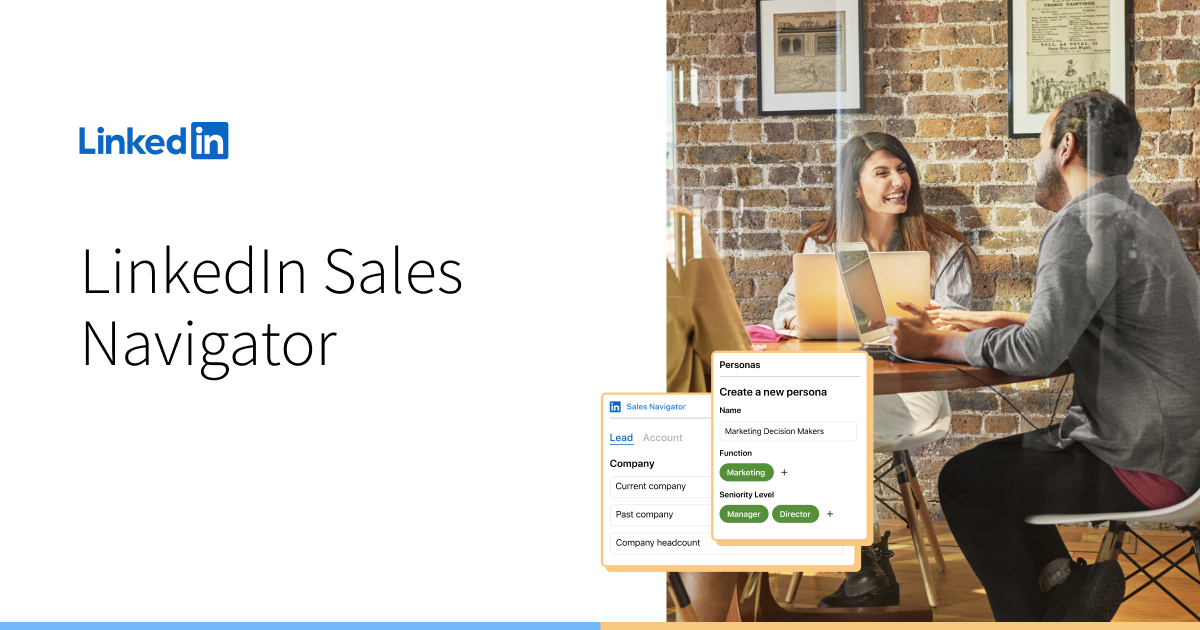 LinkedIn Sales Navigator uses AI-powered lead recommendations and Account IQ to surface target accounts.
3. Salesmotion
Salesmotion is an account intelligence platform that combines deep account research, real-time signal monitoring, and AI-driven prospecting in a single workspace. Rather than giving you a contact database to search, it continuously monitors your target accounts across 50+ signal types, from leadership changes and earnings commentary to funding events, hiring surges, and product launches.
What it does best: Compresses multi-hour account research into minutes. The Research Agent builds a full account brief covering strategic initiatives, executive changes, competitive moves, and talking points, all sourced from 1,000+ public and private data sources. Teams using Salesmotion report cutting research time by 85% at Analytic Partners and 50% at Cytel.
Who it's for: Mid-market and enterprise sales teams that sell complex, multi-stakeholder deals and need deep account context, not just contact data.
Key differentiator: Signal-based selling. The platform monitors your entire territory 24/7 and proactively alerts you when accounts enter a buying window. Most tools require you to go looking for information. Salesmotion brings the information to you.
Pricing: $85/month for the individual plan, self-serve monthly with no annual commitment. Custom team pricing with unlimited users on team plans. Uncapped research; 200 contact credits/month for verified emails and phone numbers.
Limitation: Not a contact database. If your primary need is bulk email lists or phone numbers, pair it with a contact data provider.
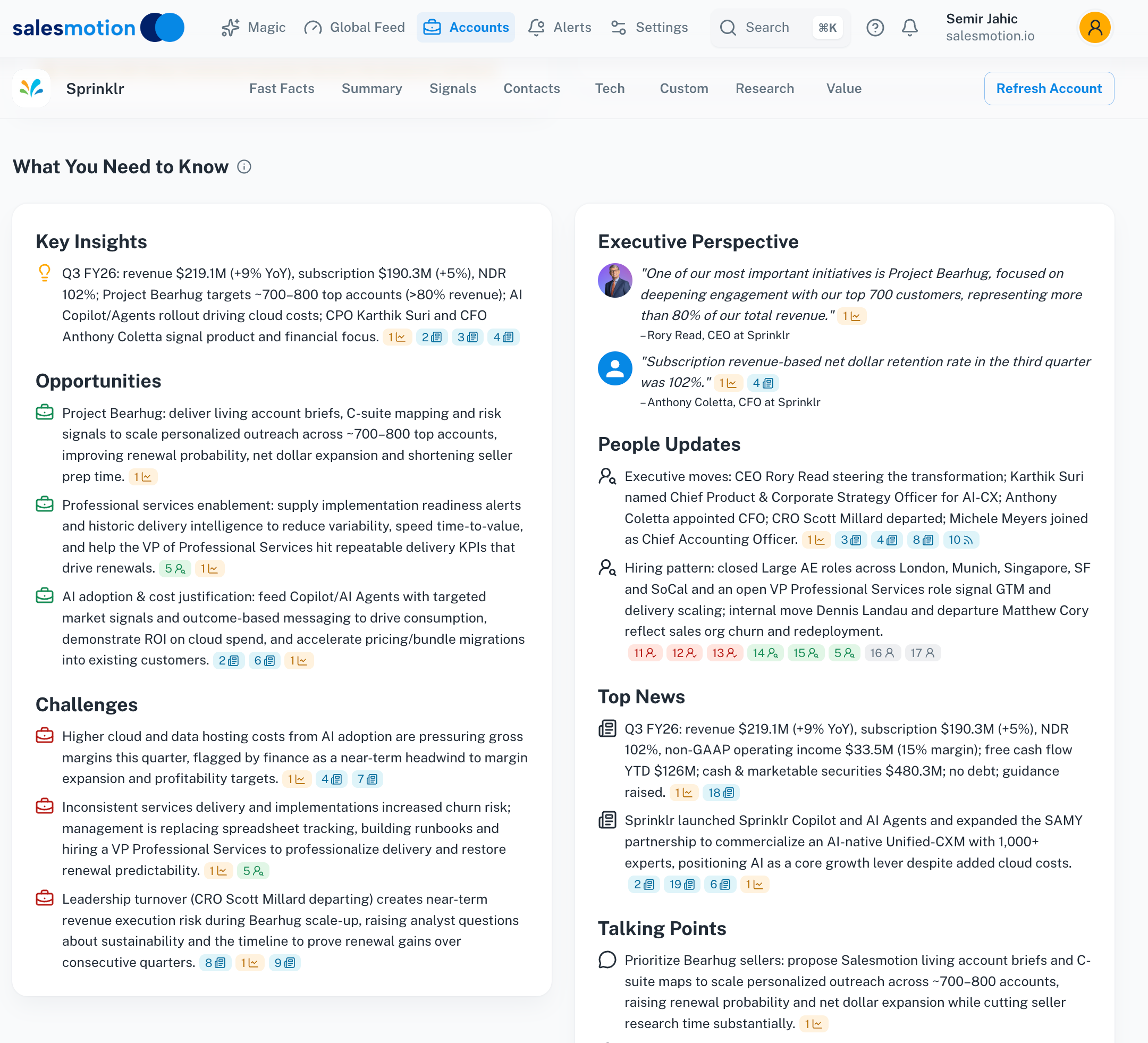 Salesmotion's account summary compresses hours of research into a single brief with strategic initiatives, signals, and talking points.
4. Apollo.io
Apollo.io is an all-in-one sales intelligence and engagement platform with a database of 240M contacts and 30M companies. It's popular with startups and SMBs because of its free tier and affordable published pricing.
What it does best: Combining prospecting, enrichment, and email sequencing in one platform. Apollo's workflow reduces the need to switch between separate research and outreach tools.
Who it's for: Startups, SMBs, and individual sellers who need an affordable all-in-one solution. Also popular with growth-stage teams scaling outbound for the first time.
Key differentiator: Price-to-feature ratio. Apollo publishes a self-serve rate card that starts with a free plan and covers data, sequencing, and a dialer in one product. The AI writing assistant helps generate personalized emails from prospect data.
Pricing: Free plan available. Basic at $49/user/month, Professional at $79/user/month, and Organization at $119/user/month on annual billing. Watch the credit system: it, not the seat price, is the real cost driver at scale.
Limitation: Apollo is built for high-volume prospecting: contact data, sequencing, and AI research inside the outbound workflow. Teams selling large, complex deals often add an account intelligence layer for account-level research and signal monitoring.
 Apollo.io combines prospecting, enrichment, and email sequencing in a single platform.
5. Crunchbase
Crunchbase is the go-to database for company funding, investor relationships, and startup data. It's essential for anyone selling to venture-backed companies or tracking the funding landscape.
What it does best: Funding round data and investor intelligence. No other tool provides the depth of funding history, lead investor details, and M&A activity that Crunchbase offers.
Who it's for: Sales teams targeting startups and growth-stage companies, VCs doing deal sourcing, and business development teams tracking M&A activity.
Key differentiator: The funding and investment data is unmatched. You can track when a company raises a round, who invested, and the implied valuation, which are strong buying signals for sellers.
Pricing: Free trial of Pro. Pro at $49/month billed annually for the first year ($79 list price) or $99/month billed monthly. Business starts at $199/month billed annually. API access and data licensing use custom pricing.
Limitation: Built around funding and private-market data. Teams that need direct dials and verified emails at volume usually pair it with a dedicated contact database.
 Crunchbase provides detailed funding history, investor relationships, and M&A data for startup research.
6. 6sense
6sense is an account-based marketing (ABM) and predictive analytics platform that uses AI to identify accounts showing anonymous buying intent. It's designed for marketing and sales alignment around high-intent accounts.
What it does best: Anonymous intent detection. 6sense's AI analyzes billions of intent signals across the web to predict which accounts are in-market for your solution, even before they visit your website or fill out a form.
Who it's for: Enterprise marketing and sales teams running coordinated ABM programs. Best suited for organizations with $50K+ deal sizes where targeting precision justifies the investment.
Key differentiator: The predictive buying stage model. 6sense categorizes accounts into stages (Awareness, Consideration, Decision, Purchase) based on intent signals, so sellers can prioritize outreach timing.
Pricing: 6sense does not publish pricing. Vendr reports a median annual contract of $62,220 across 386 purchases, ranging from $11,234 to $176,511. See our 6sense pricing breakdown for the packaging detail.
Limitation: No published pricing, and the value depends heavily on how well your marketing team configures the intent models. It fits teams with dedicated marketing operations.
 6sense uses AI to categorize accounts into buying stages based on anonymous intent signals.
7. Demandbase
Demandbase is a B2B go-to-market platform that combines advertising, ABM, sales intelligence, and intent data in one ecosystem. It acquired InsideView in 2021, adding company data and sales intelligence to its ABM core.
What it does best: Connecting advertising spend to pipeline. Demandbase lets marketing teams target in-market accounts with programmatic ads and then hand warm leads to sales with full account context.
Who it's for: Enterprise organizations with both marketing and sales teams that want a unified GTM platform. Best for teams already running or planning ABM programs.
Key differentiator: The advertising-to-pipeline connection. Most research tools stop at identifying accounts. Demandbase can also warm those accounts with targeted ads before a rep ever reaches out.
Pricing: Demandbase does not publish pricing; it describes its model as a platform fee plus a flat fee per user. Vendr reports a median annual contract of $68,591 across 187 purchases, ranging from $24,000 to $164,037.
Limitation: Overlap with other tools in your stack. If you're already running a separate ABM platform and a separate contact database, adding Demandbase can create redundancy rather than consolidation.
 Demandbase connects advertising, ABM, and sales intelligence to warm accounts before outreach.
8. Clearbit (now part of HubSpot)
Clearbit was acquired by HubSpot in late 2023, and its enrichment now ships as HubSpot's data enrichment (introduced as Breeze Intelligence in 2024). It specializes in real-time data enrichment, turning a company domain or email address into a complete firmographic and technographic profile.
What it does best: Instant enrichment. Drop in an email address or domain and get back company size, revenue, industry, tech stack, and employee count in milliseconds. It's built for automation and works seamlessly inside HubSpot.
Who it's for: HubSpot customers who want native enrichment without a third-party integration. Also used by product-led growth (PLG) companies that need to qualify leads in real-time from signup forms.
Key differentiator: API-first design. Clearbit is built for developers and RevOps teams who want to embed enrichment directly into their workflows, forms, and routing rules.
Pricing: Included with HubSpot Starter, Professional and Enterprise subscriptions; HubSpot's documentation says data enrichment does not consume HubSpot Credits.
Limitation: New Clearbit sign-ups have required a HubSpot account since December 2023, and HubSpot's data enrichment works on records inside HubSpot. Teams whose system of record is Salesforce or another CRM need a separate enrichment source.
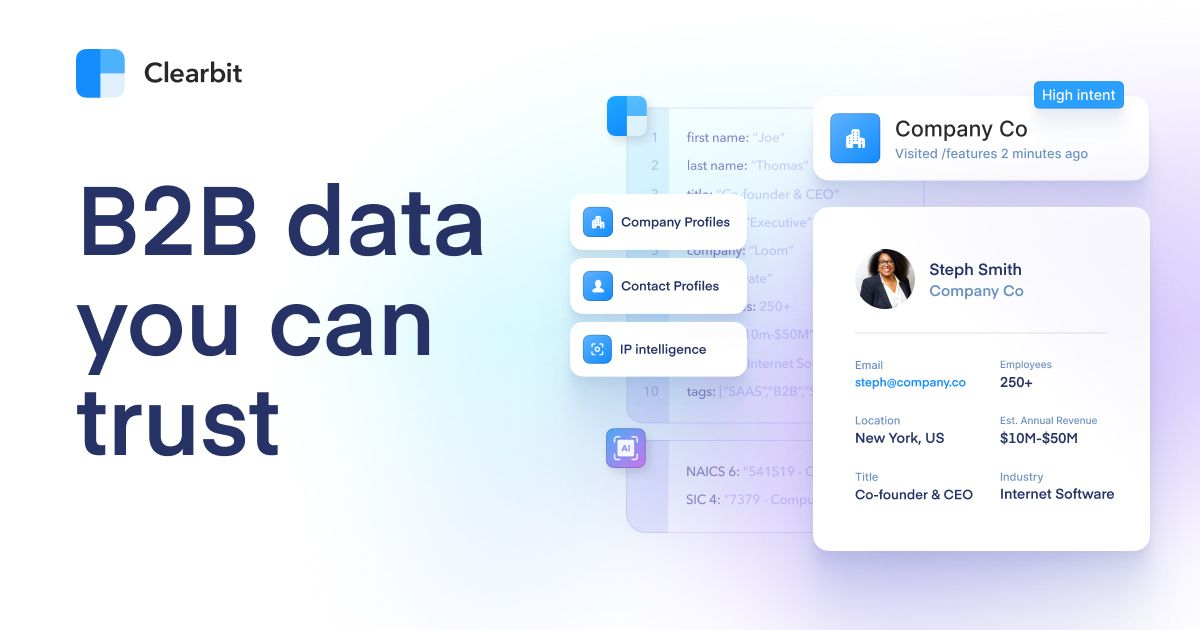 Clearbit (now part of HubSpot) enriches company domains into full firmographic and technographic profiles in real time.
9. SalesIntel
SalesIntel differentiates itself with human-verified contact data. Its research team manually verifies contact information every 90 days, which produces higher connect rates than machine-verified alternatives.
What it does best: Contact data accuracy, particularly for direct dials and mobile numbers. The human verification process catches errors that automated systems miss.
Who it's for: Sales teams where phone outreach is a primary channel and connect rates directly impact pipeline. Best for US-focused teams.
Key differentiator: The 95% data accuracy claim, backed by human verification rather than algorithmic validation. Also offers a Research on Demand service where you can request contacts that aren't in the database.
Pricing: SalesIntel does not publish pricing. Its pricing page describes unlimited data and enrichment at a single price, available on request.
Limitation: Records refresh on a 90-day cycle, so a contact can change between refreshes.
 SalesIntel's research team manually verifies contact data every 90 days for higher connect rates.
10. UpLead
UpLead is a budget-friendly contact database with real-time email verification. It's positioned as a ZoomInfo alternative for smaller teams that don't need enterprise-scale features.
What it does best: Affordable access to verified contact data. UpLead verifies emails in real-time before you export them, reducing bounce rates. The interface is clean and straightforward.
Who it's for: Individual sellers, small teams, and startups that need basic contact data without enterprise pricing.
Key differentiator: Price point. At $99/month for the Essentials plan, UpLead is significantly cheaper than ZoomInfo while covering the basics well.
Pricing: Free 7-day trial. Essentials at $99/month ($74/month billed annually), Plus at $199/month ($149/month annually). Both are single-user plans; teams of two or more need the Professional tier.
Limitation: Essentials and Plus are single-user plans. Buyer intent data, full API access and team management are on the quoted Professional tier.
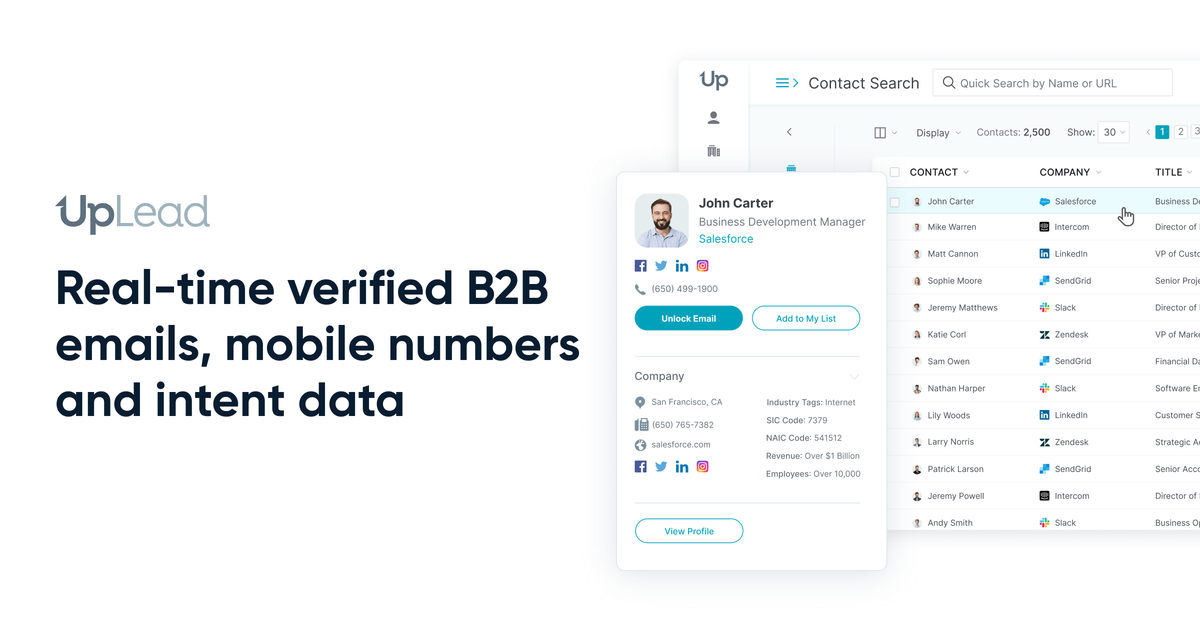 UpLead verifies emails in real time before export, reducing bounce rates for budget-conscious teams.
11. Seamless.AI
Seamless.AI positions itself as a "real-time search engine" for B2B contacts rather than a static database. It crawls the web to find and verify contact information on demand.
What it does best: Real-time contact discovery. Rather than searching a pre-built database, Seamless.AI searches the web when you query, which theoretically means fresher data.
Who it's for: Budget-conscious teams that want AI-driven prospecting without the enterprise price tag. Popular with individual sellers and small outbound teams.
Key differentiator: The real-time search model. Instead of pre-building and maintaining a massive database, Seamless.AI builds the record when you need it.
Pricing: Seamless.AI does not publish list pricing; its pricing page is a demo request form. Its site says Seamless.AI is free for up to 50 credits.
Limitation: Paid pricing comes from a sales conversation, so cost is harder to compare up front. Test match rates on your own account list before committing.
 Seamless.AI crawls the web in real time to find and verify contact information on demand.
12. LeadIQ
LeadIQ focuses on prospecting workflow efficiency. Its Chrome extension lets sales reps capture contact data from LinkedIn, enrich it, and push it directly to their CRM and sequencing tool in one click.
What it does best: Speed of capture. LeadIQ is built for the prospecting motion of browse LinkedIn, find a contact, capture, enrich, and sequence. The workflow is faster than most competitors.
Who it's for: SDR teams that live in LinkedIn Sales Navigator and need a fast way to move contacts into their outbound sequences.
Key differentiator: The one-click capture-to-sequence workflow. LeadIQ also generates personalized message drafts based on the contact's profile and recent activity.
Pricing: Free plan with 50 credits for one user. Pro is listed at $200/month for 200 credits, shared by up to 5 users, with 25% off on annual billing. Enterprise is custom-priced and annual only.
Limitation: LeadIQ is built for capturing and enriching contacts. Teams that need deep company context and buying signals for enterprise sales pair it with an account research tool.
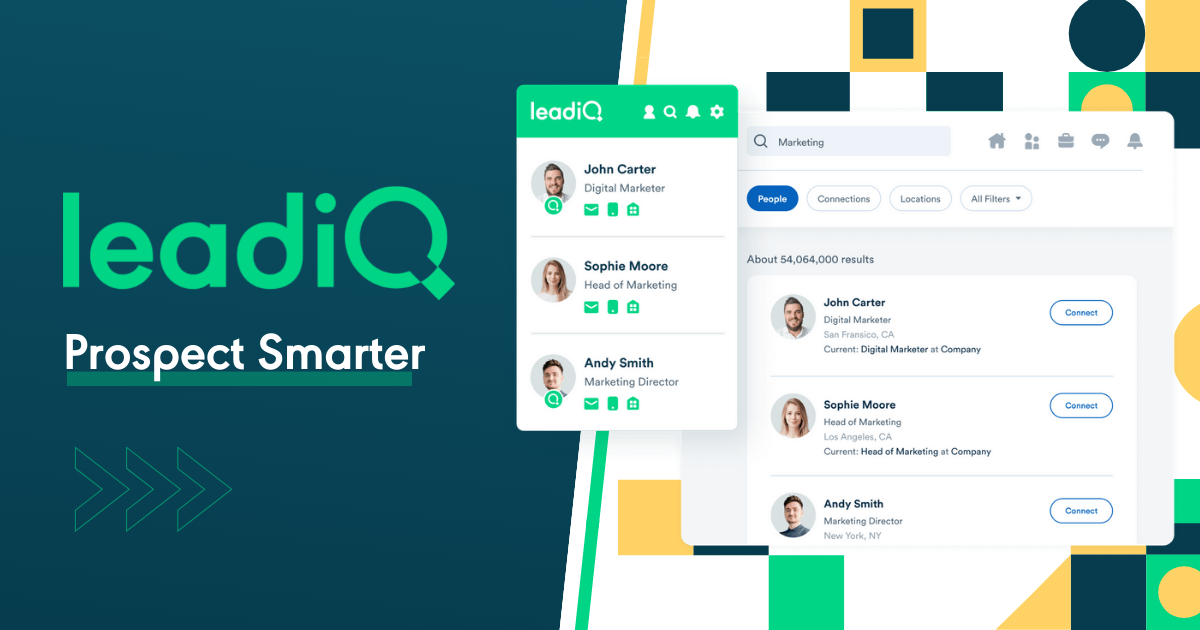 LeadIQ's Chrome extension captures contacts from LinkedIn and pushes them to CRM and sequencing tools in one click.

“The Business Development team gets 80 to 90 percent of what they need in 15 minutes. That is a complete shift in how our reps work.”
Andrew Giordano
VP of Global Commercial Operations, Analytic Partners
Contact Databases vs Account Intelligence: Why the Distinction Matters
Most company research tool lists treat every platform the same. They shouldn't.
Contact databases (ZoomInfo, Apollo, SalesIntel, UpLead, Seamless.AI, LeadIQ) answer a simple question: who works at this company, and how do I reach them? They're essential for building prospecting lists. But a contact record alone doesn't tell you whether the company is actually ready to buy.
Account intelligence platforms (Salesmotion, 6sense, Demandbase) answer a harder question: which of my target accounts are showing buying signals right now, and what should I say to them?
Here's how that plays out in practice:
Without intelligence: A rep searches ZoomInfo for "VP of Sales" at companies with 500-1,000 employees in SaaS. They get 2,000 contacts. They blast a generic email sequence. Maybe 2% respond.
With intelligence: An account intelligence platform flags that a target account just posted three new sales leadership roles, their CEO mentioned "sales transformation" on the last earnings call, and a former champion from a closed-won deal just joined as CRO. The rep writes a specific email referencing the hiring surge and the CEO's stated priorities. The response rate is 5-10x higher because the timing and context are right.
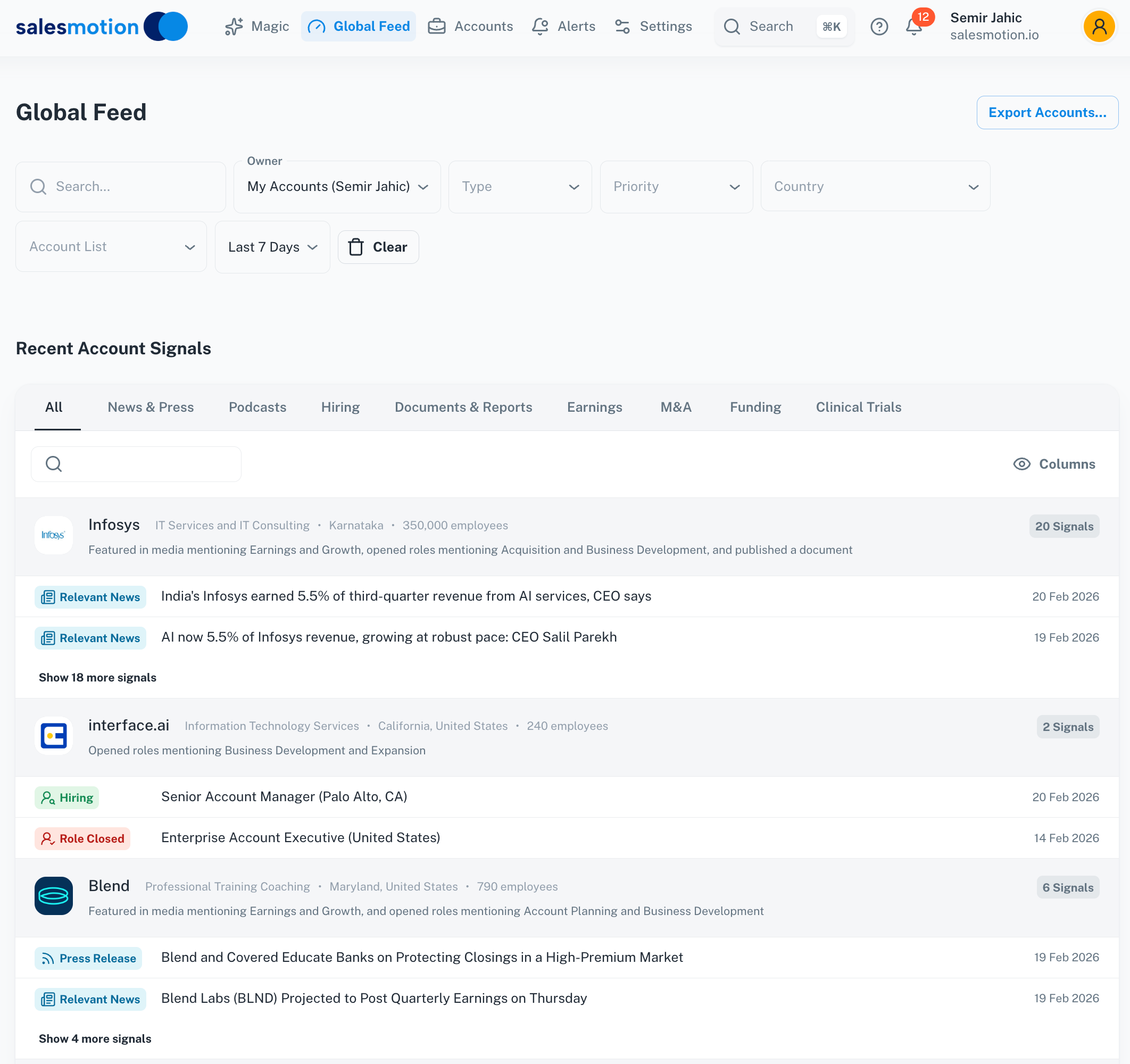 A signal feed across a full territory. Salesmotion tracks 50+ signal types, from earnings and hiring to M&A, funding, and podcasts, so reps see buying windows without manually checking each account.
Gartner predicted that 40% of enterprise applications would feature task-specific AI agents by end of 2026, up from under 5% in 2025. The research tools that embed AI agents for automated research, signal detection, and outreach drafting will define the next generation of this category.
The bottom line: sales reps spend only 28% of their week selling. The right company research tool should increase that number, not just give you more data to sift through.
Company Research Tools vs Prospect Research Tools
Company research tools work at the account level: strategy, financials, hiring trends, leadership moves, competitive position. Prospect research tools work at the person level: a buyer's role, tenure, priorities, and recent activity. The categories overlap heavily, and most platforms on this list cover both to some degree.
In practice, the split looks like this. LinkedIn Sales Navigator, LeadIQ, and Apollo.io lean toward prospect research: they help you understand and reach individual people. Crunchbase, 6sense, and Demandbase lean toward company research. Salesmotion connects the two: its account briefs include people updates (executive moves, champion changes, hiring patterns) alongside company-level signals, so reps research the account and the buyer in one pass.
If your evaluation is centered on deep pre-meeting preparation rather than list building, see our ranked guide to the best account research tools, which scores ten platforms on research depth specifically. And if you're mapping the full workflow from research to outreach, the account research solution overview shows how the pieces fit together.

“All of the vendors that I've worked with, all of the onboarding that I have had to deal with, I will say, hands down, Salesmotion was the easiest that I have had.”
Lyndsay Thomson
Head of Sales Operations, Cytel
How to Choose the Right Company Research Tool
The right tool depends on your team size, deal complexity, and where you spend the most time today.
If you're a solo seller or small team (1-5 reps): Start with Apollo.io or UpLead for affordable contact data, paired with Crunchbase for company context. LinkedIn Sales Navigator is worth the investment if social selling is part of your motion. Total cost: $150-300/month.
If you're a mid-market team (5-25 reps): You need both contact data AND intelligence. Pair a contact database (ZoomInfo or Apollo) with an account intelligence platform like Salesmotion. The intelligence layer is what separates average teams from top performers. Look for tools that integrate with your CRM to reduce data entry.
If you're an enterprise team (25+ reps): Evaluate the full-stack options (Demandbase, 6sense) alongside specialized intelligence tools. Enterprise teams benefit from continuous signal monitoring across large territories where no rep can manually track hundreds of accounts. The average enterprise research team has consolidated from 8-12 tools down to 2-4, so consolidation should be a priority.
If you sell into regulated industries (pharma, finance, healthcare): Account context matters more than contact volume. Tools that surface earnings commentary, regulatory filings, and strategic initiatives give your reps the context they need to speak the buyer's language.
Key Takeaways
- Company research tools split into two categories: contact databases (who works there) and account intelligence platforms (why and when to engage). The best teams use both.
- Sales reps spend only 28% of their week selling. The right research tool should compress prep time, not add another tab to manage.
- AI is reshaping this category fast. Gartner predicted 40% of enterprise apps would feature AI agents by end of 2026. Tools that automate research and surface signals proactively will outperform static databases.
- Don't over-index on database size. A million contacts mean nothing if you can't identify which accounts are actually in a buying window right now.
- Match the tool to your deal complexity. Solo sellers need affordable contact data. Enterprise teams need signal-driven intelligence across large territories.
- Teams using account intelligence report 50-85% reductions in research time and measurable pipeline improvements, including 40% more qualified pipeline at Analytic Partners and 42% higher sales velocity at Frontify.
Frequently Asked Questions
What are the best company research tools?
The best company research tools going into 2027 are ZoomInfo and Apollo.io for contact data at scale, LinkedIn Sales Navigator for relationship mapping, Crunchbase for funding intelligence, and Salesmotion for signal-based account intelligence. The right pick depends on whether your bottleneck is finding people to contact or knowing why and when to contact them.
How do I research a company before a sales call?
Start with what changed recently: leadership moves, earnings commentary, funding events, job postings, and product launches. Then connect those changes to the problems you solve and prepare 2-3 specific talking points. Done manually across LinkedIn, news sites, and SEC filings, this takes 1-3 hours per account. An automated Research Agent compresses it into minutes by monitoring 1,000+ sources and generating the brief for you.
What free company research tools exist?
Google Alerts, Crunchbase's free profiles, LinkedIn's free search, company investor relations pages, Glassdoor, and ChatGPT all support basic company research at no cost. They work for low account volumes but require manual effort per account. Our guide to free account research tools covers ten free options and where each one breaks down.
What is the difference between a contact database and an account intelligence platform?
A contact database stores information about people and companies: names, titles, emails, phone numbers, firmographics. You search it to build prospecting lists. An account intelligence platform goes further by monitoring your target accounts for buying signals (leadership changes, funding, earnings commentary, hiring patterns) and synthesizing that data into actionable research briefs. Contact databases tell you WHO to call. Intelligence platforms tell you WHY and WHEN.
How much do company research tools cost going into 2027?
Pricing ranges dramatically, and the enterprise end mostly does not publish. Budget tools like UpLead start at $99/month ($74/month billed annually) for a single user. Mid-range platforms like Apollo.io and LinkedIn Sales Navigator run $49-160/month. ZoomInfo, 6sense and Demandbase all quote per organization; Vendr's contract data puts them at a $33,500 median, a $62,220 median and a $68,591 median respectively. Account intelligence platforms start at $85/month (individual, self-serve monthly), with custom pricing for team plans (unlimited users on team plans).
Can AI replace manual company research entirely?
Not yet, but it's getting close. AI tools can now automate 80-90% of the research that reps used to do manually, compressing hours of work into minutes. According to recent data, sales professionals save an average of 2 hours and 15 minutes per day using AI tools, with 78% reporting that AI lets them focus on higher-value work. The remaining 10-20% still requires human judgment: reading between the lines on an earnings call, interpreting a strategic hire, or assessing competitive positioning within a specific deal context.
What company research tools integrate with Salesforce and HubSpot?
Most major platforms offer CRM integrations. ZoomInfo, Apollo.io, 6sense, Demandbase, and SalesIntel all offer Salesforce integrations. Clearbit's enrichment is built into HubSpot as data enrichment. LinkedIn Sales Navigator offers CRM sync for Salesforce and Microsoft Dynamics. When evaluating integrations, look beyond "connects to Salesforce" and ask: does it push insights automatically, or does the rep have to copy-paste? The best integrations surface account signals directly inside CRM records.
How do you measure ROI on a company research tool?
Track three metrics: time saved per rep per week on research (benchmark: 2-4 hours saved), increase in qualified meetings booked (benchmark: 20-50% improvement), and change in win rate on researched vs. non-researched accounts. The math is straightforward. If a rep earns $100K+ OTE and you give them back 4 hours per week of selling time, that's a 10% productivity increase. For a team of 10 reps, that's the equivalent of hiring another full-time seller without the headcount cost.