Cognism has a pricing page, but it lists packages without prices. To get a number, you need to talk to sales for a personalised quote, and that quote is what you will pay against over the life of the contract. Cognism sells two packages, Standard and Pro, each listed with 5 seats included, on a credit system where one credit reveals one contact. For teams evaluating Cognism pricing against alternatives, that is the point: there is no list price to anchor on, so what you pay comes down to the credit volume and package written into your quote.
TL;DR: Cognism sells two packages, Standard and Pro, on a credit system where one credit reveals one contact. It publishes no rates; every buyer gets a personalised quote from sales. Its pricing page does not state contract length or billing terms, and Cognism offers a free data sample so you can check quality first.
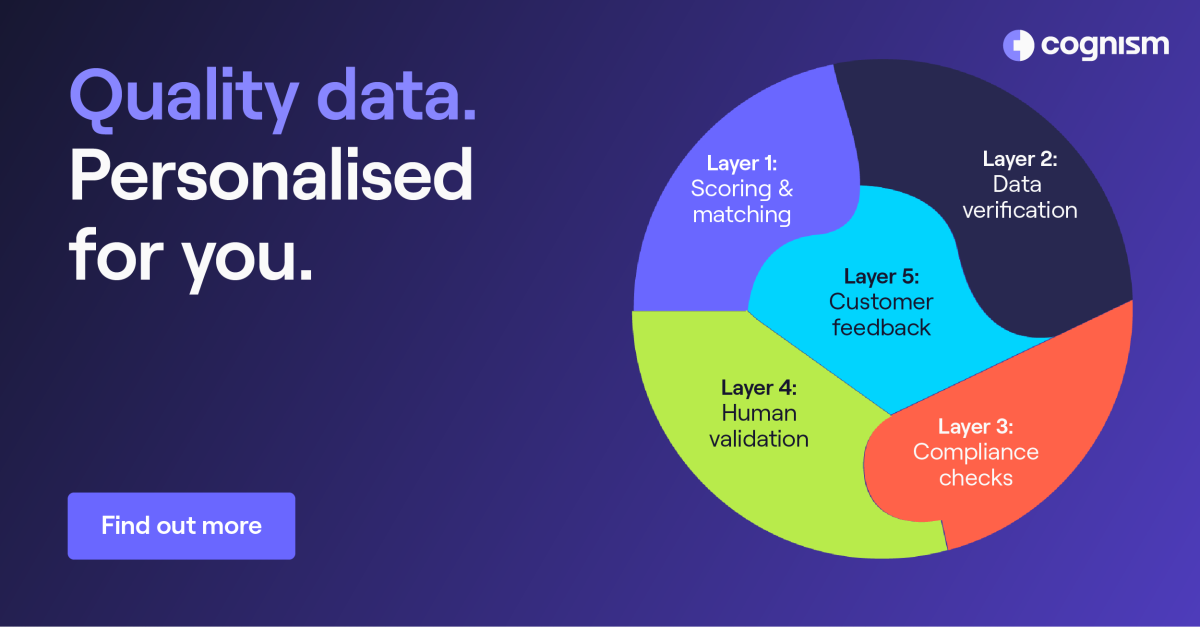 Cognism leads with verified data quality — pricing is quote-only, with no published rate card.
Cognism
Custom, quote-only
no published price · Standard and Pro packages
Salesmotion
From $85/mo
monthly contract · verified contacts included
Cognism is compliance-first contact data. Salesmotion adds account research, signals and AI-drafted outreach, with published pricing from $85/mo.
- 3 AI agents on every account: signals, research briefs, drafted outreach
- Live in an hour, monthly billing, no annual contract
- Verified contacts included; CRM integration on custom team & enterprise plans
Cognism vs Salesmotion at a Glance
Before unpacking the quote structure, here is how Cognism's contact-data pricing compares to an account intelligence platform:
| Cognism | Salesmotion | |
|---|---|---|
| Starting price | Quote-only; Cognism does not publish pricing | $85/month individual plan |
| Pricing transparency | No public prices; personalised quote from sales | Published on the pricing page |
| Contract | Not stated on the pricing page; terms come with the quote | Self-serve monthly individual plan, no annual commitment; custom pricing with unlimited users on team plans |
| What you get | Contact data with phone-verified mobiles, built for prospecting into Europe, plus hiring, funding and job-change signals | Account intelligence: buying signals across 1,000+ sources, AI research briefs, and AI agents |
Want this running on your accounts?
Book a demo and we'll walk through your real territory: signals, research briefs, and AI-drafted outreach on the accounts you actually sell to.
Key Takeaways
- Cognism pricing is entirely quote-based. Its pricing page lists packages without prices.
- Cognism sells two packages, Standard and Pro, on a credit system: one credit reveals one contact. Each package is listed with 5 seats included.
- Each seat includes an allocation of credits, and additional credits can be purchased at any point. Viewing a contact you have already revealed costs nothing.
- Pro adds higher-quality mobile data, on-demand verification and Bombora intent data to Standard.
- The pricing page ties the offer to package and credits, so pin both down in the quote.
- Account-based pricing models, where your entire team gets access for a flat annual fee, can deliver better cost predictability than a credit-metered contract as teams scale.

“The moment we turned on Salesmotion, it became essential. No more hours on LinkedIn or Google to figure out who we're talking to. It's just there, served up to you, so it's always 'go time.'”
Adam Wainwright
Head of Revenue, Cacheflow
Cognism Plans Overview: Platinum vs Diamond (Now Standard vs Pro)
Cognism's pricing page sells two sales prospecting packages, Standard and Pro, each listed with 5 seats included and a credit system where 1 credit equals 1 revealed contact. Many buyers and reviewers still reference older names (Platinum and Diamond, later Grow and Elevate), none of which appears on Cognism's pricing page today, so older quotes and reviews may use any of them.
Standard covers contact search, firmographic, technographic and signal-based list filters, AI account research, CSV export and enrichment, and MCP and API access.
Pro adds higher-quality mobile data, on-demand verification, and Bombora-powered intent data. Cognism describes its mobiles as phone-verified and claims up to 3x higher connect rates.
Cognism's pricing page does not state contract length or billing terms; these come with the quote. Cognism does offer a free data sample so you can check quality before committing.
What the Public Data Actually Shows
Cognism publishes no rates, and its pricing page gives no figures in any currency. What it does state is the structure: two packages with 5 seats included, an allocation of credits with each seat, one credit per revealed contact, no charge for viewing a contact you have already revealed, and additional credits available to buy at any point.
That tells you there is no list price to anchor on. The quote, not the website, is where credit volume and package get a price, so a comparison only works once both are written down.
How Cognism Packages Are Built
Cognism sells Standard and Pro as packaged plans rather than a per-seat rate card. Its pricing page lists 5 seats included with each package and describes a credit system where one credit reveals one contact. The page ties each package to included seats and a credit allocation rather than publishing a per-user rate.
That matters for comparison shopping. A per-seat competitor gives you a number you can multiply. Cognism gives you a package, which means the only way to compare like for like is to model your team's expected reveal volume and get that written into the quote.
How the Model Compares
Most competitors either publish their pricing (Apollo, Lusha) or, like ZoomInfo, use consumption-based contracts quoted per organization. Cognism sits closer to the second group. The practical consequence is the same in both cases: you cannot budget from a website, and you will not know your effective cost per contact until you know your credit consumption.

“The Business Development team gets 80 to 90 percent of what they need in 15 minutes. That is a complete shift in how our reps work.”
Andrew Giordano
VP of Global Commercial Operations, Analytic Partners
What to Pin Down Before You Sign
The quote is the starting point, not the contract. Get these in writing:
Credit allotment and overage terms. Credits are the meter, so the number of credits per year and what happens when you exhaust them are the two most consequential lines in the agreement.
Which package includes what. Higher-quality mobile data, on-demand verification, and Bombora-powered intent sit on the Pro side. Confirm which of them your quote actually covers rather than assuming the tier name carries them.
Renewal terms. Ask for the renewal increase to be capped, or for a multi-year rate lock, before you sign rather than at renewal when you have no leverage.
Notice period. Confirm the exact cancellation notice window in the contract itself.
Is Cognism Worth the Investment?
Cognism's core value proposition is phone-verified mobile numbers (previously marketed as Diamond Data). For outbound-heavy teams that rely on cold calling, this is genuinely valuable. Cognism claims up to 3x higher connect rates, says its decision-maker data is refreshed every 30 days, and holds a 4.6/5 rating on G2.
Cognism is built for prospecting into Europe; teams selling mainly into North America usually compare it with ZoomInfo or Apollo. It is built around verified contact data, with hiring, funding, job-change and intent signals and AI company research layered on. Salesmotion is built around source-cited account research and monitoring: why an account is worth calling right now, what strategic initiatives it is pursuing, and which public events suggest a buying window.
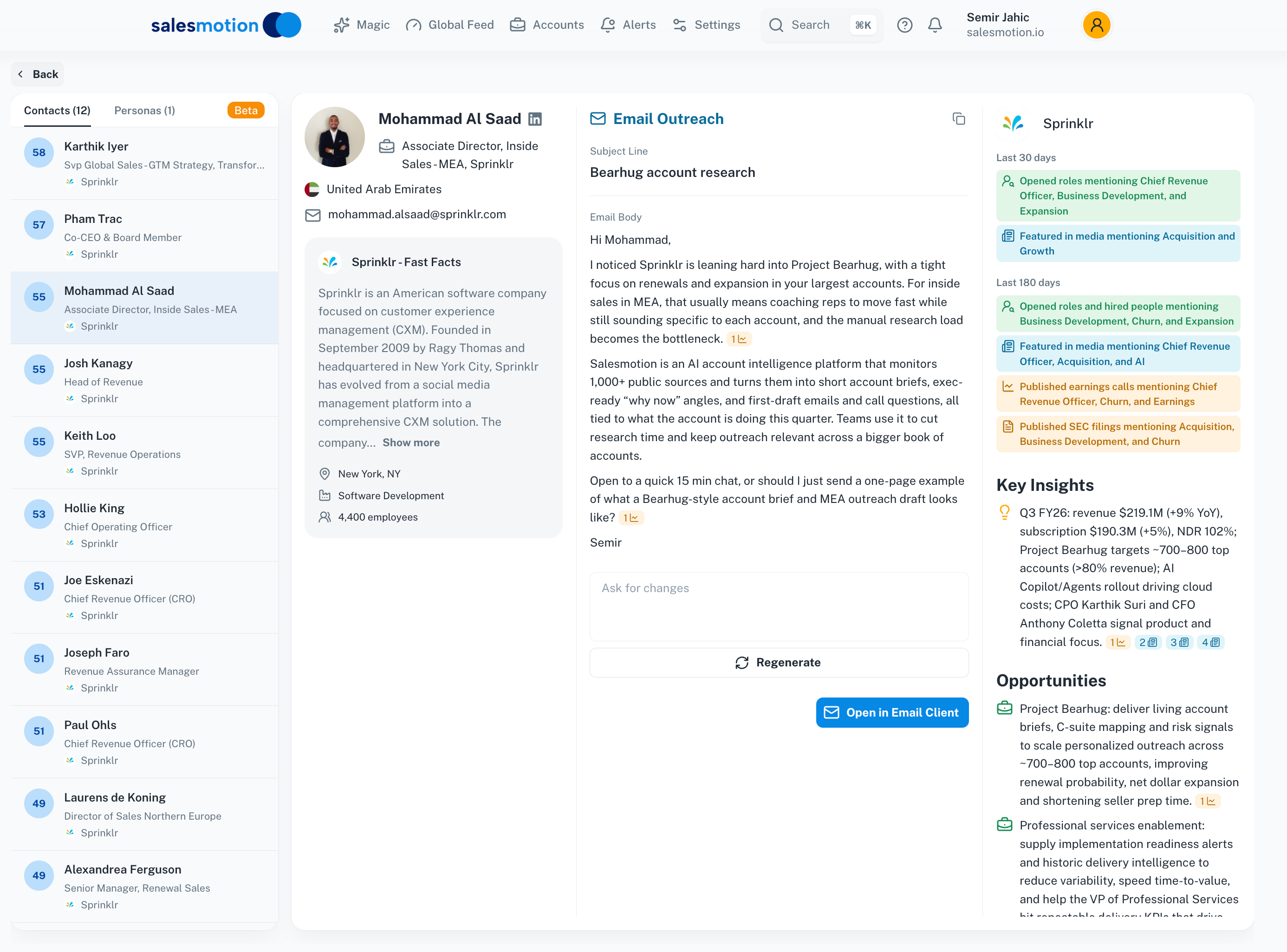 Outreach drafted from a named account initiative, with the supporting signals and insights in view — the "why call now" layer that contact data alone does not cover.
For teams that need contact data for prospecting into Europe, Cognism delivers. For teams whose main need is source-cited account research and monitoring, a quote-only contact data contract is harder to justify as the primary tool. If you are weighing other options before committing, our guide to Cognism alternatives compares the leading contenders on data coverage, pricing model, and scope.
Where the ROI Math Gets Tough
Consider a mid-market team. A Cognism contract buys verified contact data, with signals and AI company research layered on. If your reps still build account context by hand, toggling between LinkedIn, news sites, SEC filings, and CRM notes, that research time is a cost to count next to the quote.
With Salesmotion, the same 10-rep team gets flat, account-based pricing that covers unlimited users on team plans — and gets deep account intelligence across 1,000+ sources, real-time buying signals, and AI-generated account briefs. Teams like Analytic Partners cut research time by 85% with Salesmotion.
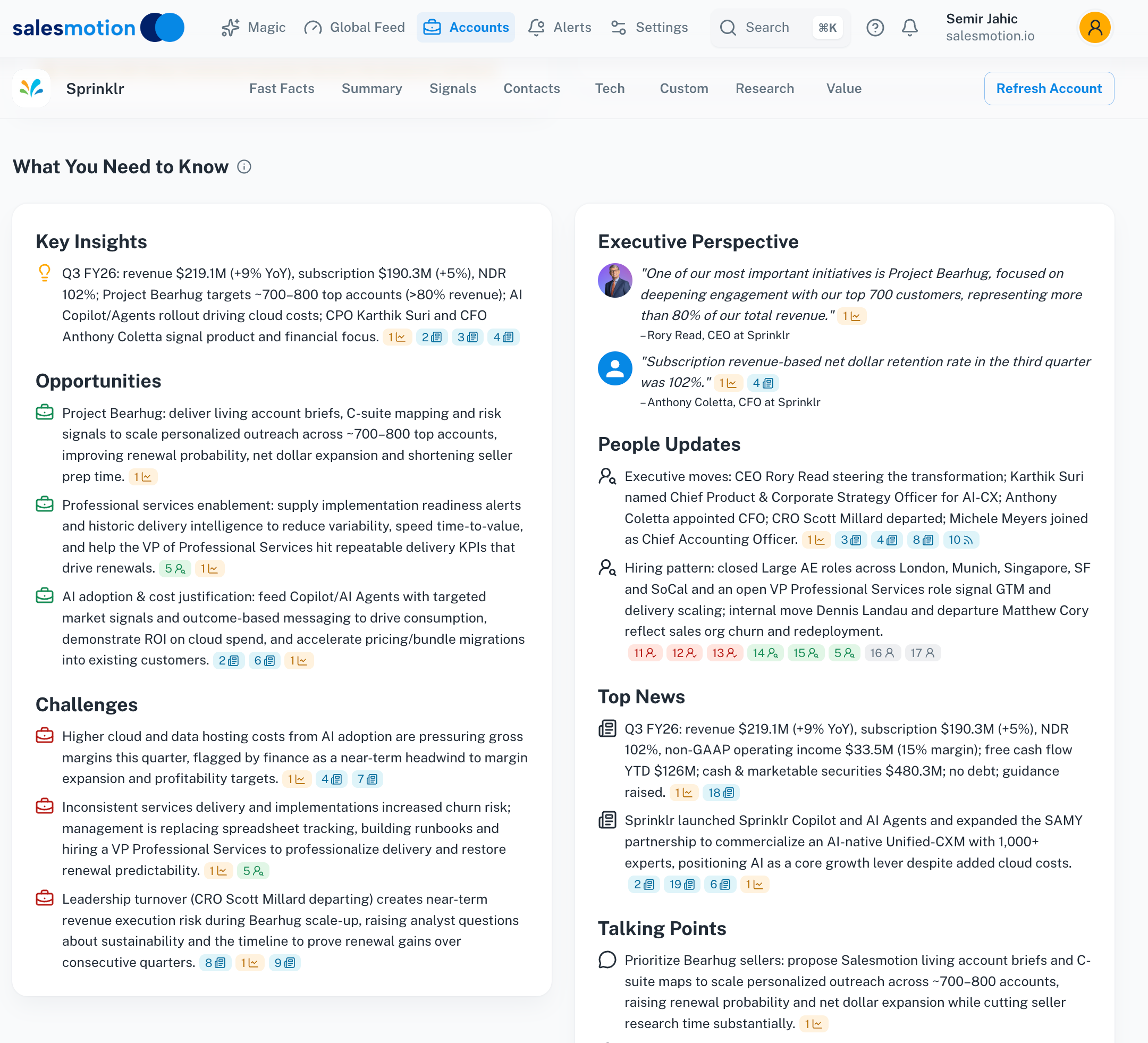 An AI-generated account brief — key insights, executive quotes, people moves, and talking points — replaces the manual research reps would otherwise do before each call.
The question is not whether Cognism's data is good. It is whether verified phone numbers alone justify the cost when your reps still spend hours on manual research that could be automated.
Salesmotion's Take
Credit where it's due — Cognism's EU and compliant contact data is some of the best out there, and if your motion is cold calling into EMEA, the phone-verified mobiles are real. But two objections come up constantly with teams evaluating it. First, the credit-metered, quote-only model is increasingly out of step with how teams want to buy; buyers now expect to read a price off a page and know what a year costs. Second, and bigger: it's built around contact data first, not account context. A verified mobile gets you the dial, but it doesn't tell the rep why this account is worth the call today. Most teams I talk to don't need a better phone number — they need to know which accounts to call and what's happening inside them. That's the layer we focus on.

Semir Jahic
CEO & Co-Founder, Salesmotion
How Cognism Compares: Side-by-Side Pricing
| Cognism (Pro) | Account-Based Alternative | |
|---|---|---|
| Pricing model | Packaged plans metered by credits | Account-based (unlimited users on team plans) |
| Published rates | None | Published from $85/month |
| Typical annual cost | Not published; quoted per organization | Custom (flat, unlimited users) |
| What scales the bill | Credits consumed | Accounts monitored |
| Free trial | Free data sample | Interactive demo available |
| Contract | Not stated on the pricing page | Monthly individual plan; flexible team terms |
| Core value | Verified phone numbers + contact data | Account intelligence + buying signals |
| Data scope | Contact and company data, with firmographic, technographic and signal filters | 1,000+ sources (news, earnings, hiring, leadership, tech, competitive) |
| Buying signals | Hiring, funding and job-change signals; Bombora intent on Pro | Built-in, 24/7 monitoring |
| Best for | Cold calling teams focused on EMEA | Teams needing account context + signal-based selling |
| G2 rating | 4.6/5 | 4.8/5 |
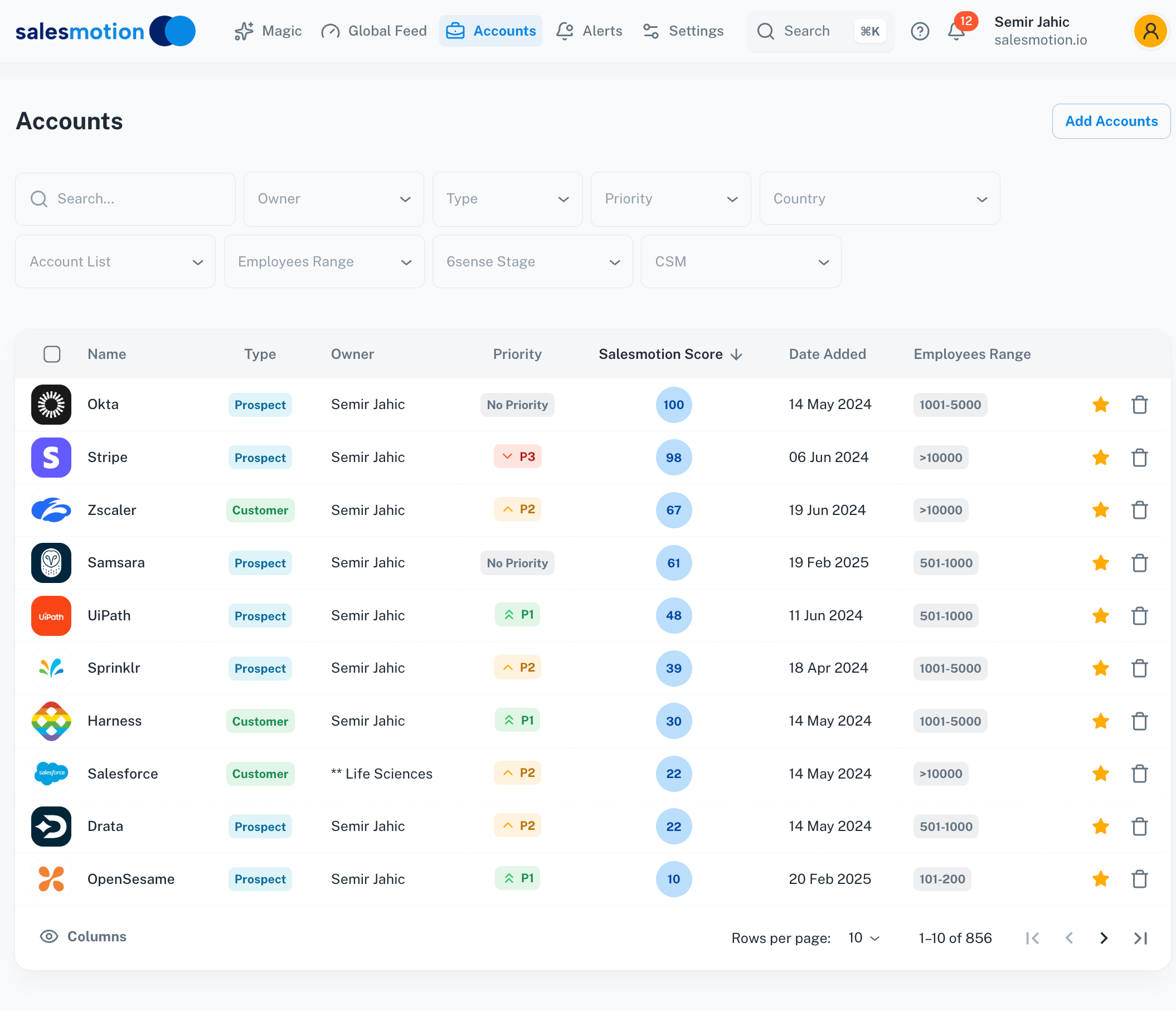 Accounts ranked by a signal-driven score so the whole team works from the same priority list — the account-context side of the comparison above.
Negotiating Your Cognism Contract
If you decide Cognism is the right fit, negotiation is not optional. Here is what works:
-
Treat the first quote as a starting point. Cognism publishes no list price, so there is no public number the quote has to match.
-
Anchor on your credit volume, not the quote. Model how many contacts your team will reveal in a year and ask for the price at that volume and one step either side.
-
Time your purchase. End-of-quarter deals tend to come with deeper discounts. Cognism's fiscal quarters are worth tracking.
-
Use competing quotes. Bring pricing from ZoomInfo, Apollo, or Lusha to the table. Apollo and Lusha both publish rates, which makes them easy comparators to put on the desk.
-
Lock in renewal pricing. Negotiate a cap on annual increases or push for a multi-year rate lock while you still have leverage.
-
Get the credit maths in writing. Confirm the annual credit allotment, what a reveal costs against it, and what happens on overage before you sign.
Frequently Asked Questions
How much does Cognism cost?
Cognism does not publish prices; its pricing page sends buyers to sales for a personalised quote. Cognism sells Standard and Pro as packaged plans with 5 seats included and a credit system where one credit reveals one contact, with a credit allocation per seat and additional credits available to buy. Ask for the price at your expected annual reveal volume.
Is Cognism worth it?
Cognism is worth it if your sales motion depends on cold calling into Europe: the phone-verified mobile numbers (previously marketed as Diamond Data) are its headline strength, and its compliance posture is built for Europe. It is a less obvious fit if you sell primarily into North America, where teams usually compare it with ZoomInfo or Apollo, or if your real bottleneck is source-cited account research rather than getting a number that connects.
What do Cognism reviews say?
Cognism holds a 4.6/5 rating on G2, and its newsroom notes that it ranked highest in G2's Europe Sales Intelligence Grid. When you read reviews, filter for teams prospecting into the same regions you do, and look at how reviewers describe credit consumption against their plan.
What are the best Cognism alternatives?
The most commonly evaluated alternatives are ZoomInfo (500M+ contacts, consumption-based pricing), Apollo (published per-seat pricing with a free tier), and Lusha (published self-serve plans from $37.45/month on annual billing). Teams whose bottleneck is account research and prioritization rather than phone numbers also evaluate account intelligence platforms like Salesmotion, which pairs buying signals with AI research briefs at flat, account-based pricing. See our full Cognism alternatives comparison for a side-by-side breakdown.
Does Cognism offer a free trial?
Cognism's pricing page does not mention a free trial or a free plan. What it offers is a free data sample, which lets you evaluate data quality before committing. The page does not state contract length or billing terms; these come with the quote.
Is Cognism better for US or European markets?
Cognism is built for prospecting into Europe: it describes itself as Europe's most trusted B2B data and screens against do-not-call lists across Europe. Teams selling mainly into North America usually compare it with ZoomInfo or Apollo.
What is the difference between Cognism Platinum and Diamond?
Platinum and Diamond are older names that buyers and reviewers still use; Cognism's pricing page today lists Standard and Pro. Standard covers contact search, signal-based list filters, AI account research, and MCP and API access. Pro adds higher-quality mobile data, on-demand verification, and Bombora-powered intent data. Cognism does not publish what the step up between the two costs, so the gap has to come out of your quote.
How does Cognism's pricing compare to other sales intelligence tools?
Cognism and ZoomInfo both quote per organization rather than publishing prices; ZoomInfo's own pricing page says its pricing is consumption-based, and Vendr reports a median ZoomInfo contract of $33,500 a year based on 1,576 purchases. Apollo offers a free plan and published per-seat pricing starting at $49/user/month on annual billing. Platforms with account-based pricing take a fundamentally different approach (from $85/month) that scales with accounts monitored, not credits consumed, making them more cost-predictable as teams grow.