Cybersecurity buying signals are the events that force a security purchase: a breach disclosure, a compliance deadline, an audit finding, a new CISO or a board-level mandate. The budget is there. Gartner forecast worldwide end-user spending on information security to grow 12.5% in 2026 to $240 billion (Gartner, July 2025). But individual CISOs spend it in response to specific events. For B2B sales teams selling cybersecurity products and services, tracking these events is the difference between reaching a CISO during an active buying window and landing in a crowded inbox with no urgency.
TL;DR: Cybersecurity buying signals include breach disclosures, compliance deadlines (SOC 2, ISO 27001, GDPR), CISO hires, vendor consolidation initiatives, audit findings, regulatory changes, and board-level security mandates. Tracking these signals helps sales teams engage security leaders when purchase urgency is highest.
Why Selling to CISOs Requires Signal Intelligence
CISOs and security leaders are among the hardest personas to reach in B2B sales. Every security vendor targets the same small group of buyers, so CISOs ignore outbound unless it is directly relevant to a current priority. Generic outreach rarely gets a reply from this buyer; the guide on how to sell to CISOs covers why.
What works is timing. A CISO who just disclosed a breach is evaluating incident response and detection tools. A CISO facing a SOC 2 audit deadline is buying compliance automation. A CISO who just joined a company is building their security stack and open to new vendor relationships. Signals create the timing. Research creates the relevance.
The cybersecurity buying committee is also complex. Large organizations involve the CISO, VP of Security Operations, compliance officers, IT infrastructure leads, and procurement. Budget authority varies: some CISOs control their budget directly, while others require CIO or CFO approval for purchases above a threshold. Understanding the organization's governance model helps you route outreach to the right person at the right time.
Breach and Incident Signals
Public Breach Disclosures
A publicly disclosed breach is the strongest cybersecurity buying signal. The organization is under regulatory scrutiny, board pressure, and media attention. They will evaluate and purchase detection, response, and prevention tools on an accelerated timeline. Track breach disclosures from the HHS breach portal (for healthcare), SEC Form 8-K Item 1.05 filings (US-listed companies must disclose material cybersecurity incidents there), and state attorney general breach notification sites.
Ransomware and Incident Response Events
Even when an incident does not result in a public disclosure, organizations that experience ransomware or significant incidents increase their security spending. Watch for indicators: a company that suddenly posts multiple security roles, engages incident response firms, or announces a "security review" is likely responding to an incident.
Industry Peer Breaches
When a company's direct competitor or industry peer suffers a breach, boards and executives ask "Could this happen to us?" This creates a secondary buying signal. After a major healthcare breach, other health systems increase security spending. After a financial services breach, other financial institutions evaluate their posture. Track peer breaches within your target accounts' industries.

“The account and contact signals are key for reaching out at important times, and the value-add messaging it creates unique to every contact helps save time and efficiency.”
Daniel Pitman
Mid-Market Account Executive, Black Swan Data
Compliance and Regulatory Signals
SOC 2, ISO 27001, and Certification Deadlines
Compliance certifications have fixed timelines. A company pursuing SOC 2 Type II for the first time needs continuous monitoring tools, access management, and policy automation. An ISO 27001 audit requires documented controls and evidence collection. These deadlines are often discoverable through job postings (hiring compliance roles), vendor announcements, and customer trust page updates.
GDPR, CCPA, and Privacy Regulation Changes
When new privacy regulations take effect or existing ones expand in scope, organizations need data discovery tools, consent management platforms, and privacy impact assessment solutions. Track regulatory changes from the IAPP and government legislative databases.
Regulatory Enforcement Actions
SEC enforcement of cybersecurity disclosure rules, HIPAA fines, and GDPR penalties all send ripple effects through organizations. When a regulator fines a company for insufficient security controls, similar companies in the same industry accelerate their security investments. Track enforcement actions as both direct and indirect buying signals.
Organizational and Strategic Signals
CISO Hires and Security Leadership Changes
A new CISO is the most actionable organizational signal in cybersecurity sales. New CISOs usually review the security stack early in their tenure. They bring preferred vendors, new security philosophies, and fresh budget requests. Salesmotion flags new executive hires at your accounts and shows them next to the same company's security incidents, compliance hiring and 10-K risk factors, so the rep sees what the new CISO inherited.
Board-Level Security Initiatives
When a company adds a cybersecurity expert to its board, creates a board-level security committee, or announces a "security transformation initiative," it signals top-down commitment and budget. Board-level attention means security spending increases and decision timelines shorten. Track board announcements in proxy statements and press releases.
Vendor Consolidation and Platform Initiatives
Many organizations are consolidating point security tools onto integrated platforms. When a company announces a "vendor consolidation" or "platform rationalization" initiative, it is simultaneously evaluating replacements for multiple tools. This creates a large buying window, but also competitive pressure. Track vendor consolidation signals in earnings calls and security trade publications.
Security Team Hiring Surges
A sudden increase in security job postings signals either a response to an incident or a strategic expansion. Either way, growing security teams need new tools, and the guide to hiring surges as a buying signal shows how to read them. Track security role postings (SOC analysts, security engineers, compliance specialists) as leading indicators of technology purchases.

“Salesmotion helps you spot signals from prospect accounts, news items / job hiring alerts etc that indicate that now is a good time to reach out with a well-crafted message.”
Rob Douglas
Director of Sales, icit business intelligence
How to Work Cybersecurity Buying Signals
Cybersecurity signals come from breach databases, 8-K filings, compliance calendars, trust pages, job boards, proxy statements and earnings transcripts. Breach and incident signals go stale fastest, so they need daily attention; certification and audit cycles can be planned a quarter ahead.
Build a compliance calendar. Map the major compliance deadlines for your target accounts' industries: SOC 2 audit cycles, HIPAA assessment periods, PCI DSS validation dates, and regulatory filing deadlines. This calendar tells you when compliance-driven buying pressure peaks.
Track breach activity by industry. When a breach hits an industry, run a campaign to the other accounts in that vertical while boards are still asking "could this happen to us?" Lead with the control that failed, not the victim's name.
Monitor leadership changes closely. CISO turnover is high, so new CISOs appear in every territory each quarter. Salesmotion's account intelligence puts the new leader next to the organization's incidents, security hiring and stated priorities; if the new CISO was a past user or buyer of your product, the Past Champion signal flags it.
Segment by maturity. A startup pursuing its first SOC 2 certification has different needs than a Fortune 500 company consolidating its security platform. Segment your signals by the account's security maturity to match messaging and solution positioning. Expect very different signal volume too: in Salesmotion's B2B buying signals benchmark, 40% of companies with more than 10,000 employees had a hard trigger event in a quarter, against 8% of companies with 200 or fewer.
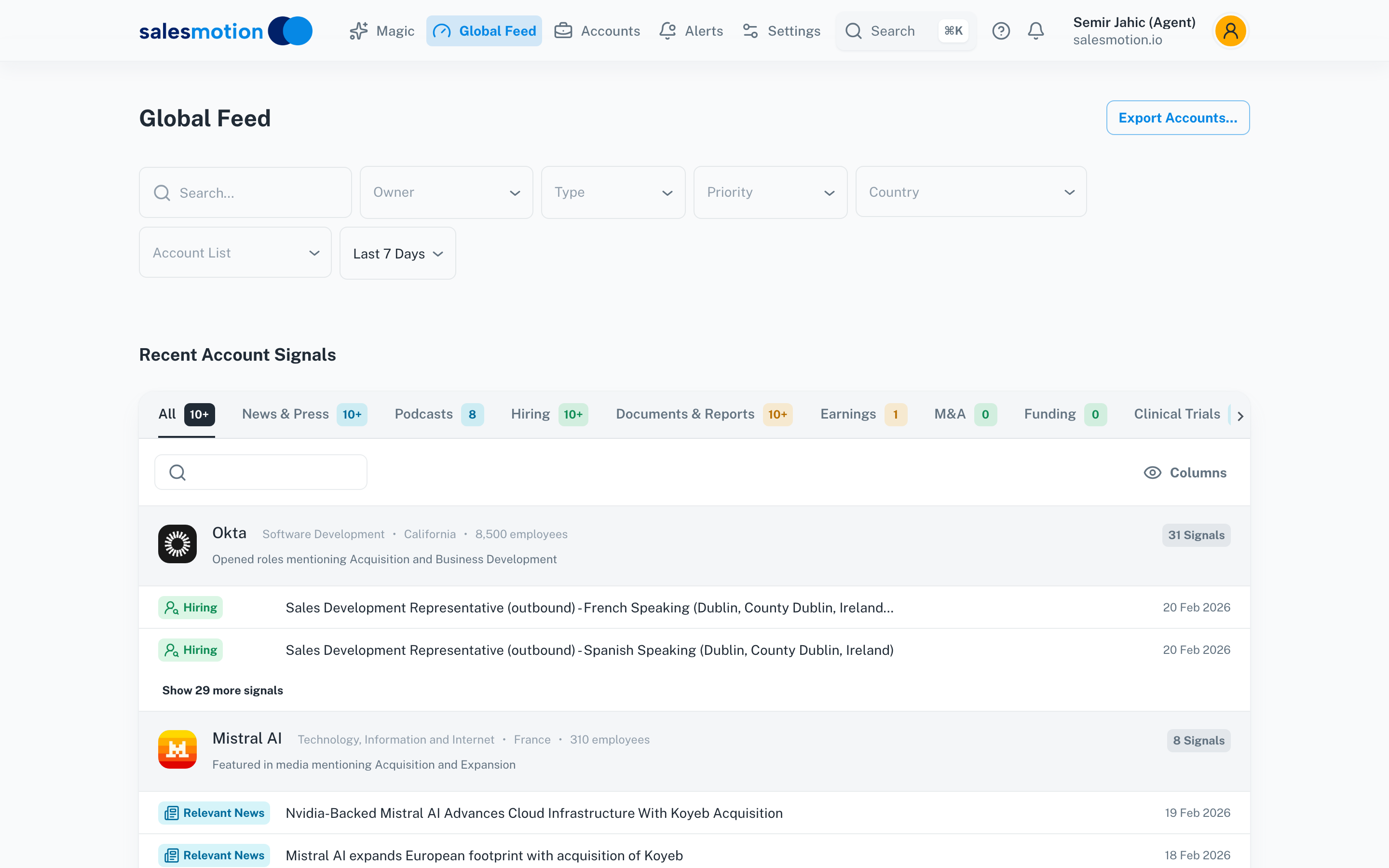 The Global Feed sorts signals by type and filters by owner, priority and account list. For a security book, the Hiring tab surfaces SOC analyst and compliance roles, and News and Press catches incident and breach coverage.
Illustrative Scenario: Cybersecurity
A hypothetical example: a SaaS company's first CISO.
Signals: A mid-market SaaS company hires its first CISO. In the same month it posts several security engineering roles, and its trust page still shows no SOC 2 report.
What the rep sees: The account brief lists the new executive hire, the security job postings (with the frameworks each description names) and recent customer-win news, each linked to its source. The rep checks the trust page by hand and confirms the SOC 2 gap.
Rep action: The rep writes to the new CISO about reaching SOC 2 while the security team is still being hired, names the open roles and the enterprise customers the company now sells to, and asks one question about the audit timeline.
Why it works: The message describes the CISO's first-year problem in the company's own evidence. That is the security version of signal-based selling: the hire says who, the gap says why now.
Before the first call, the cybersecurity account research guide lists what to check. For territory-level coverage, see sales intelligence for cybersecurity, or book a 30-minute demo to see the signals on your own accounts.
Key Takeaways
- Breach disclosures are the strongest cybersecurity buying signal, but industry peer breaches also create secondary buying urgency. Track breach activity across your target accounts' industries, not just individual accounts.
- CISO hires open a window early in the new leader's tenure, when they review and replace vendor relationships. This is the most actionable organizational signal in cybersecurity sales.
- Compliance deadlines (SOC 2, ISO 27001, GDPR) create predictable, recurring buying cycles. Build a compliance calendar for your territory to anticipate these windows.
- Vendor consolidation initiatives represent large-scale buying opportunities where organizations replace multiple point solutions simultaneously.
- Segment signals by security maturity. First-time SOC 2 buyers and Fortune 500 platform consolidators need completely different solutions and messaging.
Frequently Asked Questions
What are the most important buying signals for selling cybersecurity solutions?
The strongest cybersecurity buying signals are public breach disclosures (creating immediate urgency), CISO and security leadership hires (triggering vendor evaluations), compliance certification deadlines (SOC 2, ISO 27001, PCI DSS), regulatory enforcement actions (driving industry-wide spending increases), and vendor consolidation initiatives (creating large platform deals). Each of these signals indicates active budget and purchase urgency.
How do breach disclosures create cybersecurity buying opportunities?
A breach puts the organization under regulatory scrutiny, board pressure, and public attention. The company will evaluate and purchase detection, response, and prevention tools on an accelerated timeline, often bypassing normal procurement cycles. Additionally, the breached company's industry peers increase their own security spending in response, creating secondary buying opportunities across the vertical.
Why is a new CISO hire such a strong buying signal?
New CISOs review the existing security stack early in their tenure and often change vendors in their first year. They bring preferred tools and vendors from previous roles, fresh budget requests from the board, and a mandate to improve the security posture. CISO turnover is high, so these windows recur in every territory, which makes CISO hires a reliable, recurring signal.
How should sales teams track cybersecurity buying signals at scale?
Sort them by how fast they go stale. Breach disclosures, 8-K Item 1.05 filings and CISO hires need daily monitoring per account. Compliance calendars (SOC 2 audit cycles, PCI DSS validation, HIPAA assessments) and enforcement actions can be reviewed monthly for the whole territory. A sales intelligence tool that reads news, job boards and filings for each account covers the daily list, so reps spend their time on the outreach.