Last year I audited the data enrichment tools across three mid-market sales teams. Every single one had spent $30K+ annually on contact data providers. And every single one still had reps spending 45+ minutes researching accounts before calls. The tools were working exactly as designed. The problem was the definition of "enrichment."
Most B2B data enrichment tools solve the wrong problem. They fill in email addresses and phone numbers. That is useful. But it is not what separates a cold call from a warm, contextualized conversation that leads to pipeline. The real gap is not contact data. It is account intelligence.
TL;DR: Data enrichment tools range from basic contact append to full account intelligence platforms. Contact enrichment (emails, phones, titles) is table stakes. The real competitive advantage comes from account-level enrichment: strategic initiatives, buying signals, financial context, and competitive landscape. Choose tools based on what your sellers actually need to have better conversations, not just bigger contact lists.
What Data Enrichment Actually Means in B2B (and Why Most Teams Get It Wrong)
Data enrichment is the process of enhancing your existing CRM records with additional data from external sources. Simple concept. But the execution varies wildly.
Most teams equate enrichment with contact data: verified email addresses, direct phone numbers, job titles, company size. That is the starting line, not the finish.
Here is why this matters: B2B contact data decays at roughly 22% per year. Job titles change even faster, at nearly 66% annually. So you are constantly refilling a leaky bucket. The data enrichment market has grown to over $2.5 billion precisely because this problem never goes away.
But here is the disconnect: even with perfect contact data, your reps still need to understand why they should call a specific account right now. That requires a different layer of enrichment entirely.
The hierarchy looks like this:
- Contact enrichment (emails, phones, titles, LinkedIn URLs)
- Firmographic enrichment (company size, revenue, industry, HQ location)
- Technographic enrichment (tech stack, tools they use, recent implementations)
- Intent enrichment (content consumption, product research signals)
- Account intelligence (strategic initiatives, earnings insights, leadership changes, competitive landscape, SWOT context)
Most data enrichment platforms stop at the first two or three layers. That leaves a massive gap between having data and having insight.
Enrichment beyond contact data
Salesmotion enriches accounts with what actually starts conversations — strategic initiatives, buying signals, and financial context — not just emails and phone numbers.
The Enrichment Stack: Tools by Category
The B2B data enrichment landscape has dozens of players. Rather than ranking them all, here is how they break down by what they actually do.
Contact Enrichment Tools
These tools focus on finding and verifying contact details:
- ZoomInfo is the largest database at 420M+ contacts across 145M+ companies, with strong coverage across enterprise and mid-market. It publishes no list pricing because the model is consumption-based; Vendr reports an average contract value of $33,500 across 1,012 anonymized deals. Best for large SDR teams that need volume.
- Apollo.io publishes its rate card — a free plan, then $49, $79 and $119 per user per month on annual billing — which makes it popular with startups and SMBs. The contact database is comparable in size to Lusha's but thinner on enterprise coverage than ZoomInfo.
- Lusha focuses on quick contact lookups with a Chrome extension across a 280M+ contact database, priced per plan with seats included from $49.90/month. Good for individual reps who need a phone number fast. Less useful as a platform-level enrichment layer.
- Cognism has strong European data coverage across 400M+ contacts, plus GDPR compliance, making it a better fit for teams selling into EMEA. It quotes rather than publishes; Vendr's median is $36,000 across 108 purchases.
Firmographic and Technographic Enrichment
- Clearbit (now HubSpot Breeze Intelligence) pioneered API-first enrichment with over 100 B2B attributes from 250+ sources. Since HubSpot acquired it in 2023, it is increasingly tied to the HubSpot ecosystem. Strong on company data, thinner on individual contacts.
- BuiltWith and Wappalyzer specialize in technographic data, showing what tools and technologies a company uses. Useful for tech vendors who sell based on a prospect's existing stack.
Enrichment Orchestration
- Clay has carved out a unique position as an enrichment orchestration platform. Instead of maintaining its own database, it connects to 150+ data providers and runs "waterfall" queries that check multiple sources sequentially. If Source A misses, Source B picks it up. This routinely delivers 30-40% more data coverage than any single provider. The tradeoff: it requires more setup and a higher technical comfort level.
Account Intelligence
This is the layer above contact and firmographic data. Account intelligence platforms aggregate strategic context: what a company is focused on, what challenges they face, what their leadership is saying publicly, and what signals suggest they are ready to buy.
Salesmotion operates in this category. Rather than enriching contact fields, we enrich the strategic context around target accounts, including earnings analysis, leadership changes, hiring patterns, competitive moves, and initiative-level insights. The goal is not to give reps more data points. It is to give them the preparation that turns a generic outreach into a relevant conversation.
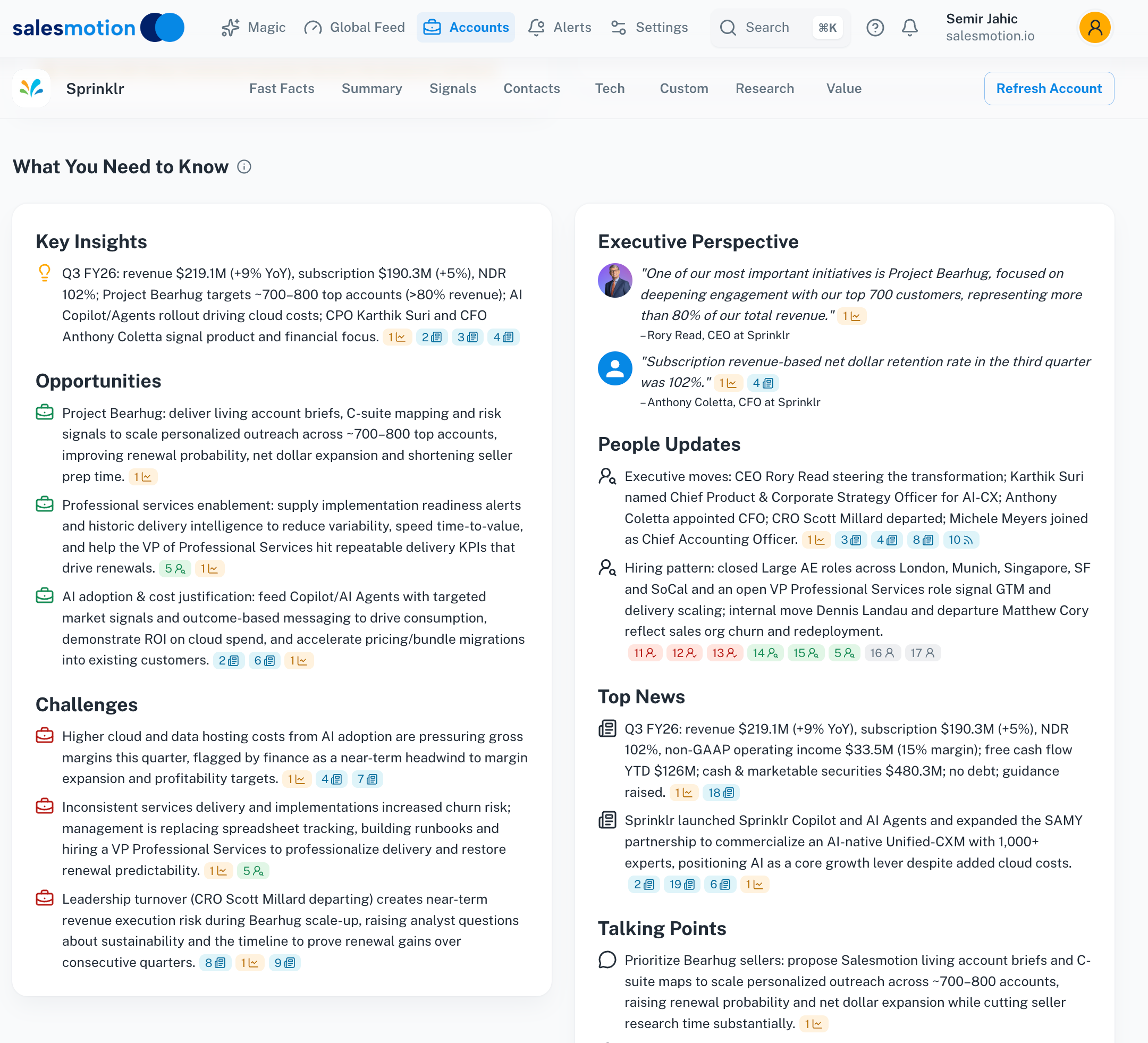 An account intelligence summary surfaces strategic initiatives, key insights, and talking points, well beyond what contact enrichment provides.

“We had a variety of tools, and that was the pain — the variety. We had to go to multiple places to get streamlined data.”
Lyndsay Thomson
Head of Sales Operations, Cytel
Contact Enrichment vs. Account Enrichment: The Critical Distinction
This is the most important concept in this entire post. Most buying decisions around enrichment tools conflate two fundamentally different problems.
Contact enrichment answers: Who should I call, and how do I reach them?
Account enrichment answers: Why should I call this account now, and what should I say when I get them on the phone?
Both matter. But they require different tools, different data sources, and different evaluation criteria.
Here is a practical example. A rep gets assigned a new enterprise account. Contact enrichment gives them the CTO's email and direct line. Account enrichment tells them the company just reported earnings that flagged a digital transformation initiative, their CEO mentioned AI adoption on the last earnings call, and they recently posted three job openings for data engineers.
One gives you a way in. The other gives you something worth saying.
The best-performing teams I have worked with, at Clari and before that at Salesforce, always had both layers. The reps who crushed quota were not the ones with the most phone numbers. They were the ones who walked into every call knowing something the prospect did not expect them to know.
For a deeper look at how account intelligence fits into the broader sales toolkit, see our breakdown of the modern B2B sales tools stack.
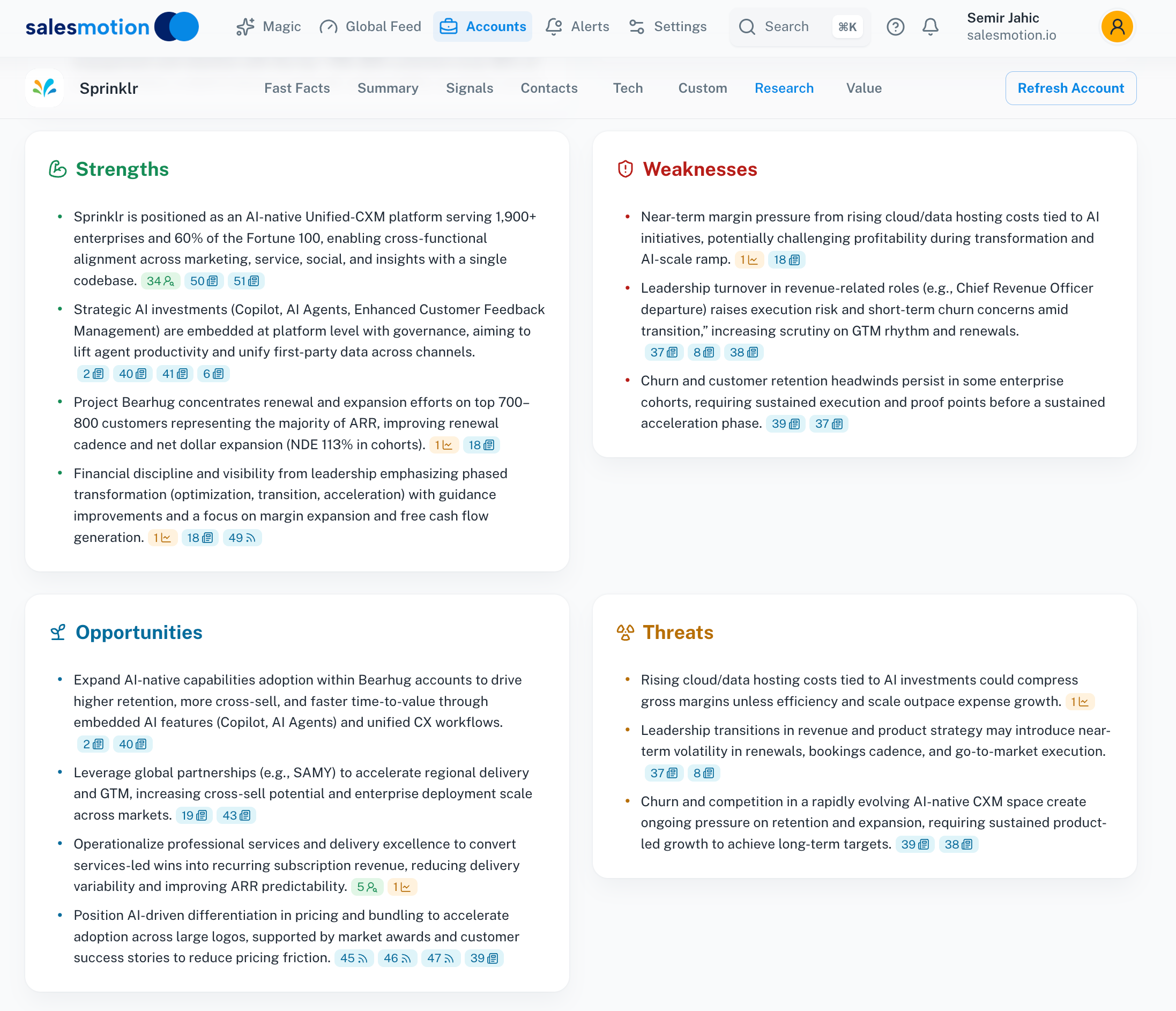 Account-level enrichment includes strategic analysis like SWOT, giving reps genuine insight before conversations.
How to Evaluate Data Enrichment Tools
Not all enrichment is created equal. Here is the framework I use when evaluating data enrichment platforms for a sales team:
1. Accuracy and Verification
The single most important metric. An 80% accurate email database means one in five outreach attempts bounces. That damages sender reputation, wastes rep time, and skews your pipeline metrics.
Ask vendors: What is your verification methodology? How often is data re-verified? What is your average bounce rate?
Waterfall enrichment approaches are gaining traction precisely because they can achieve 95%+ accuracy by cross-referencing multiple sources, compared to 80-85% from single-database providers.
2. Freshness and Decay Management
Static enrichment is a losing game. If a tool enriches your records once and never updates them, you are back to 22% data decay within a year. The best platforms continuously monitor and re-enrich records.
Ask: Do you re-enrich records automatically? What triggers a refresh? How quickly do you capture job changes?
3. Coverage and Depth
Coverage matters differently depending on your ICP. A tool with 200 million contacts sounds impressive, but if your target market is mid-market SaaS companies in North America, what matters is depth within that segment.
Ask: What is your coverage for [my specific ICP segment]? Can I test accuracy against my existing verified contacts before committing?
4. Integration with Your Workflow
Enrichment data that lives in a separate tab is enrichment data that does not get used. The tools that drive the most ROI are the ones embedded directly where reps work, whether that is inside Salesforce, HubSpot, or their daily research workflow.
Ask: How does this integrate with our CRM? Is it a native integration or a CSV export? Can reps access enriched data without leaving their workflow?
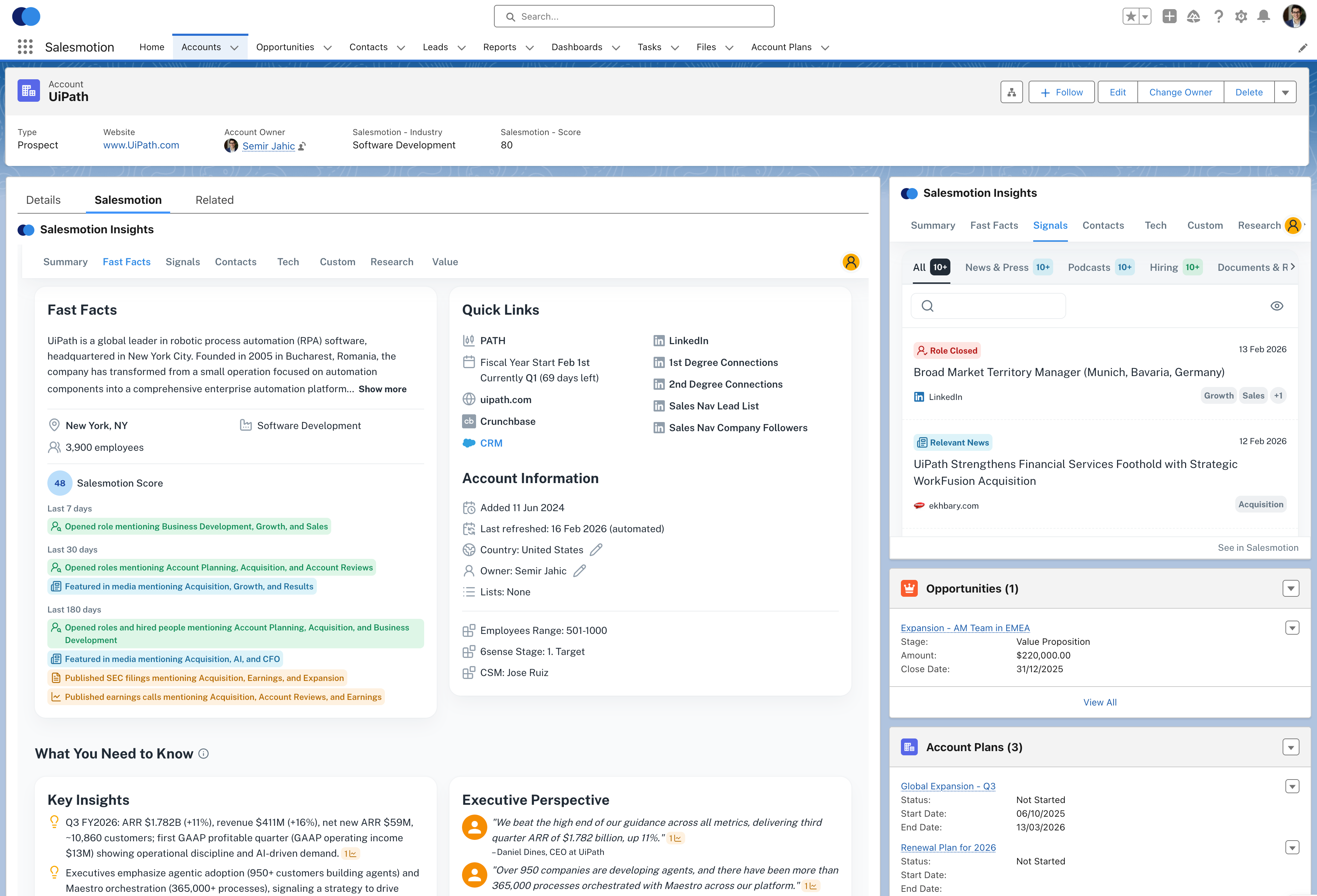 Enrichment tools that embed directly in the CRM drive significantly higher adoption than standalone platforms.
5. Total Cost of Ownership
On Vendr's marketplace data, ZoomInfo averages $33,500 a year and Cognism's median is $36,000; Apollo publishes $79 per user per month, or $9,480 a year for ten seats. But the sticker price is not the full picture. Factor in:
- Per-seat costs as your team grows
- Credit overages and usage caps
- Implementation and onboarding time
- Ongoing maintenance and data hygiene
A tool that requires three other tools to fill its gaps may cost more than a single platform that covers multiple enrichment layers, whatever the per-seat line item says.

“This is massive and saves me hours of searching Google and reading annual reports. Using Salesmotion as my very first place to go when I'm doing anything account-related now.”
Derek Rosen
Director, Strategic Accounts, Guild Education
The Real ROI of Data Enrichment
Let me cut through the vendor hype with numbers that actually matter.
The data on enrichment ROI is compelling when implemented well. Companies using B2B data enrichment see an average 25% increase in sales productivity and 25% shorter sales cycles. Conversion rates improve by an average of 12% when firmographic enrichment is applied to lead scoring. And customer acquisition costs drop by roughly 12% as reps waste less time on poorly qualified accounts.
But here is what the vendors will not tell you: these gains come from using the data, not just having it. I have seen teams spend the better part of six figures on ZoomInfo licences and never change their outbound workflow. The data sat in the CRM, untouched, while reps continued doing manual Google searches.
The real ROI framework is:
- Time saved per rep per week on manual research
- Improvement in connect/conversion rates from better targeting
- Increase in average deal size from more informed conversations
- Reduction in tools consolidated into fewer platforms
That last point matters more than people realize. Tool consolidation alone can save 20-30% on your tech stack budget while actually improving rep adoption because there are fewer platforms to learn.
For an in-depth look at how AI-powered account intelligence tools specifically drive these outcomes, check out our comparison guide.
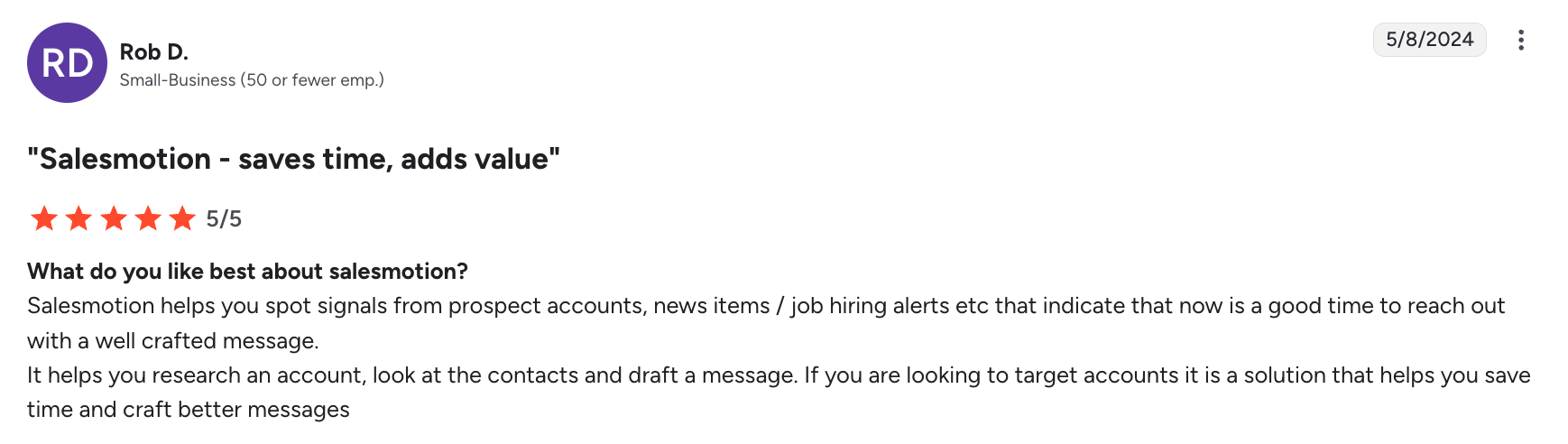 Real user feedback on G2 about the ROI of account intelligence vs. traditional enrichment tools.
A Practical Enrichment Workflow
Here is how a well-structured data enrichment stack works in practice:
Step 1: Firmographic foundation. Use a tool like Clearbit/Breeze or ZoomInfo to enrich new accounts with company size, revenue, industry, and tech stack. This powers your lead scoring and ICP matching.
Step 2: Contact discovery. Layer in Apollo, Cognism, or Lusha (depending on your geography and budget) to find verified contacts at target accounts. Use waterfall enrichment via Clay if a single source is not hitting your coverage targets.
Step 3: Account intelligence. Add a platform like Salesmotion to surface what is actually happening at each account: earnings insights, strategic initiatives, leadership changes, and competitive signals. This is what turns a name on a list into a qualified, timely opportunity.
Step 4: Signal-based prioritization. Use the intelligence layer to prioritize which accounts to work today based on buying signals, not just static fit scores.
Step 5: CRM sync and automation. Make sure every enrichment layer flows back into your CRM automatically. Manual data entry is where enrichment goes to die.
The entire point is to move from "we have a lot of data" to "our reps know exactly which accounts to work and what to say." That is the difference between a data enrichment platform and a data enrichment strategy.
Key Takeaways
- Contact enrichment is necessary but not sufficient. Emails and phone numbers get your foot in the door. Account intelligence tells you what to say when you get there.
- Data decays at 22%+ per year. Any enrichment tool that does not continuously refresh records is creating a false sense of data quality.
- Evaluate tools on accuracy, freshness, coverage, integration, and total cost, not just database size or feature count.
- Waterfall enrichment (querying multiple providers sequentially) consistently outperforms single-database providers on coverage and accuracy.
- The real ROI comes from using enriched data, not just storing it. Embed enrichment in your reps' daily workflow or the investment is wasted.
- Account intelligence is the competitive edge. Strategic context about what a company is doing, why, and when, is what separates average pipeline from high-converting pipeline.
Frequently Asked Questions
What is the difference between data enrichment and data cleansing?
Data cleansing fixes existing records: correcting typos, standardizing formats, removing duplicates, and flagging invalid entries. Data enrichment adds new information to existing records: appending missing fields, layering in external data, and enhancing records with additional context. Most teams need both. Cleansing ensures your foundation is solid. Enrichment builds on that foundation with the additional data your sales team needs. Run cleansing first, then enrich, or you end up enriching records that should have been merged or deleted.
How much do B2B data enrichment tools cost?
Pricing varies dramatically by category. Contact enrichment tools range from free plans (Apollo, Lusha) and published per-seat rate cards ($49-$119/user/month at Apollo) up to quote-only contracts where Vendr's averages are $33,500 for ZoomInfo and $36,000 for Cognism. Firmographic enrichment through Clearbit/Breeze is often bundled with HubSpot licenses. Orchestration tools like Clay run $185-$495/month on the published tiers. Account intelligence platforms like Salesmotion start at $85/month for individual users. The real cost consideration is total stack spend. Many teams end up paying for three or four overlapping tools when a more strategic combination of two could cover the same ground at lower cost.
How often should CRM data be re-enriched?
At minimum, quarterly. Job titles change at nearly 66% per year, and phone numbers go stale at over 40% annually. For your highest-priority accounts, continuous enrichment is ideal. Set up automated re-enrichment triggers based on time-based schedules (every 90 days minimum), event-based signals (job changes, funding rounds, earnings), and engagement-based triggers (before any scheduled meeting or active deal progression). The cost of re-enrichment is almost always less than the cost of a bounced email or a wasted call to a departed contact.
Can I use multiple data enrichment tools together?
Yes, and most high-performing teams do. The waterfall approach, using multiple providers in sequence, is becoming the standard for contact data. For account intelligence, the strategy is additive: use a contact enrichment tool for the "who," a firmographic tool for the "what," and an account intelligence platform for the "why" and "when." The key is making sure they all sync to your CRM so reps have a single source of truth rather than tabbing between five different platforms.