Only 28% of sales reps hit quota last year — the lowest figure in six years, according to Salesforce's State of Sales report. Meanwhile, Sam McKenna's "Show Me You Know Me" methodology achieves a 43% open rate and 20% reply rate on cold outreach, compared to industry averages of 6% and 0.9%. The gap between the 28% and the 20% reply rate isn't better tools — it's better research going into every touchpoint.
The B2B prospecting tool market hit $4.49 billion in 2026 and is growing at over 16% annually. That growth has flooded the market with options, making it harder than ever to pick the right B2B prospecting tools for your team. This guide cuts through the noise. I'll cover the categories that matter, review the tools worth evaluating, and show you how to build a stack that makes reps better — not just busier.
Comparing AI prospecting tools?
Most AI prospecting tools spit out generic emails. Salesmotion drafts outreach anchored to real signals.
Verified contacts + 24/7 signal monitoring + AI-drafted emails grounded in actual account research. $85/mo.
TL;DR: The best B2B prospecting tools fall into five categories: contact databases, engagement platforms, intelligence layers, workflow automation, and AI agent prospecting. Most teams need three tools, not ten. The biggest gap in most stacks is the research and intelligence layer, the difference between sending 200 generic emails and having 20 meaningful conversations.
| Tool | Category | Best For | Starting Price |
|---|---|---|---|
| Apollo.io | Contact Database + Engagement | Startups, all-in-one on a budget | Free / $49/user/mo |
| ZoomInfo | Contact Database + Intent | Enterprise data coverage | Custom, consumption-based |
| Cognism | Contact Database (GDPR) | European markets, phone-verified | Custom, quote-only |
| Outreach | Engagement + Sequencing | Enterprise multi-channel outbound | Custom, quote-only |
| Salesloft | Engagement + Sequencing | Mid-market, analytics + coaching | Custom, quote-only |
| LinkedIn Sales Nav | Intelligence + Social Selling | Account-based, relationship-driven | $119.99/user/mo |
| Salesmotion | Intelligence + AI Agent | Deep account context + signal-based outreach | From $85/mo |
| Clay | Workflow Automation | RevOps custom data pipelines | Free / $185/mo |
| Instantly | Email Engagement | High-volume cold email | $30/mo |
| Lusha | Contact Database | Quick contact lookups | Free / $49.90/mo |
Why Most Prospecting Stacks Are Broken
Here's the uncomfortable truth: it now takes 18 touches to book a single meeting, up from 5-7 just a few years ago. Response rates are declining. Inboxes are noisier. And most teams respond by adding more tools and sending more volume.
That approach is failing. As Jason Bay, founder of Outbound Squad, puts it: "82% of B2B buyers accepted meetings from salespeople who reached out to them in the last 12 months." Cold outreach works — but quality matters more than ever. His advice: "Don't take 'cold calling is dead' advice from someone who helps companies with inbound marketing."
The average sales rep uses at least six different tools daily, toggling between CRM, contact databases, email sequencers, LinkedIn, and research tabs. Companies with well-connected tech stacks are 42% more likely to increase sales productivity. The problem isn't the number of tools. It's that most stacks are built for volume, not quality.
According to HubSpot's 2025 outreach data, social outreach now outranks email for response rates: 42% vs. 26%. Multi-channel consistently beats single-channel. But even multi-channel fails without research behind it.
If your reps have a full contact database but still spend 30 minutes Googling a prospect before a call, your stack has a research gap. And that gap is where deals are won or lost.

“There's been a big focus on hyper personalization and relevance in our outbounding efforts. Salesmotion has been a key partner in hitting our significantly increased meeting targets. What stands out is how simple it is. Reps can log in and get valuable account insights within 30 seconds to a minute.”
Joe DeFrance
VP of Sales, Incredible Health
The Four Categories of B2B Prospecting Tools
Before comparing individual tools, it helps to understand the landscape. Every b2b prospecting tool falls into one of four categories, and each solves a different problem.
1. Contact Databases
These tools answer the question: "Who should I reach out to?" They provide emails, phone numbers, firmographic data, and org charts. Examples include Apollo, ZoomInfo, Cognism, and Lusha. If you don't have accurate contact data, nothing else matters.
2. Engagement and Sequencing Platforms
These tools answer the question: "How do I reach them at scale?" They automate multi-step email sequences, call tasks, and LinkedIn touchpoints. Outreach and Salesloft are the two dominant players, with newer tools like Instantly gaining traction for email-only workflows.
3. Intelligence and Research Platforms
These tools answer the question: "What should I actually say?" They surface account-level insights, buying signals, news events, and competitive intelligence that help reps personalize outreach and prepare for conversations. LinkedIn Sales Navigator and dedicated account research platforms fall here, though they work very differently.
As prospecting coach Josh Braun explains: "When prospects see the first sentence of your cold email, they're secretly asking 'Why are you emailing ME as opposed to anyone?'" That's why good cold emails start with an observation or trigger — and intelligence tools are what surface those triggers.
4. Workflow Automation
These tools connect everything together. Clay is the standout example, pulling data from 150+ providers and piping it into your CRM or sequencer. Zapier handles simpler point-to-point integrations. These tools reduce manual data entry and keep your stack in sync.
5. AI Agent Prospecting
This is the newest category, and the one changing fastest. AI agent prospecting tools don't just assist reps with suggestions or templates. They work autonomously: monitoring territories for buying signals, generating signal-based outreach grounded in real account activity, and pushing relevant intelligence to reps proactively.
The difference from traditional automation is that agents operate continuously without being prompted. A rep doesn't need to remember to check an account. The agent surfaces it when a signal fires, whether that's an earnings call mentioning a relevant initiative, a leadership change, or a hiring surge in the rep's territory. According to Gartner, 40% of enterprise applications will embed task-specific AI agents by the end of 2026, up from less than 5% in 2025. In prospecting, this means the research-to-outreach cycle compresses from hours to minutes, and reps focus on conversations rather than data gathering.
The most effective prospecting stacks combine tools from multiple categories. But most teams over-invest in categories 1 and 2 (contacts and sequencing) and underinvest in categories 3 and 5 (intelligence and AI agents). That's the gap worth closing. For a deeper look at building a balanced stack, see our guide to building a B2B sales tools stack.
See Salesmotion on a real account
Book a 15-minute demo and see how your team saves hours on account research.
Top Sales Prospecting Tools: 2026 Comparison
Here's a breakdown of the best tools in each category. I've focused on tools I've personally evaluated or heard consistently strong feedback about from revenue leaders.
Apollo.io
Category: Contact Database + Engagement
Best for: Startups and mid-market teams that want an all-in-one platform
Apollo combines a 230M+ person database with built-in email sequencing, making it the most popular all-in-one prospecting tool on the market. Its free tier gives you 900 credits a year, and paid plans run $49 (Basic), $79 (Professional) and $119 (Organization) per user per month on annual billing. The trade-off is data accuracy: Fundraise Insider's provider comparison puts Apollo in the 65-80% range, which means you'll see more bounces than with premium providers. For teams that need both contacts and sequencing on a budget, Apollo is hard to beat.
ZoomInfo
Category: Contact Database + Intent Data
Best for: Enterprise teams that need the most comprehensive B2B dataset
ZoomInfo offers 420M+ contacts, 145M+ companies, and 120M+ direct dials. It's the gold standard for data coverage, especially in North America. ZoomInfo's own sales blog reports email bounce rates dropping from 15% to under 3% after switching. The catch is cost. ZoomInfo does not publish list pricing — its pricing page explains that amounts vary because pricing is consumption-based — and Vendr's marketplace data shows an average contract value of $33,500 across 1,012 anonymized deals. If your average deal size justifies it, ZoomInfo's data quality is hard to match.
Cognism
Category: Contact Database (GDPR-focused)
Best for: Teams selling into European markets or with strict compliance requirements
Cognism's differentiator is its Diamond Data, phone-verified mobile numbers that Cognism claims deliver a 22% call connect rate against 14% for competitors. Its GDPR-first approach makes it the default choice for teams operating in the EU. Cognism's own research also reports that signal-personalized emails achieve 18% response rates — a 5.2x improvement over generic outreach. Coverage across its 400M+ profiles is strongest in EMEA, though North American data has improved significantly. Cognism does not publish list pricing; it sells Standard and Pro packages on a credit system where one credit reveals one contact, and Vendr reports a median annual contract value of $36,000 across 108 purchases.
Outreach
Category: Engagement and Sequencing
Best for: Enterprise sales teams running multi-channel outbound at scale
Outreach is the market leader in sales engagement, offering advanced sequencing, call recording, and AI-driven optimization. It excels at orchestrating email, phone, and LinkedIn touchpoints in structured cadences. Outreach does not publish dollar figures; it sells four tiers — Amplify Essentials, Core, Plus, and Pro — separated by AI credit allotments, on per-user pricing with no platform fees. Outreach makes the most sense for teams with 20+ reps who need rigorous workflow enforcement.
Salesloft
Category: Engagement and Sequencing
Best for: Mid-market teams that want strong analytics alongside engagement
Following its merger with Clari, which completed in December 2025, Salesloft now combines sales engagement with pipeline forecasting and deal inspection. Like Outreach, it publishes packages without dollar figures, contract terms, or seat minimums, so every number comes from a quote. It is often the preferred choice for teams that value coaching insights alongside outreach execution.
LinkedIn Sales Navigator
Category: Intelligence and Social Selling
Best for: Any B2B team doing account-based or relationship-driven selling
Sales Navigator is almost table stakes for B2B prospecting. Advanced search filters, lead recommendations, and 50 monthly InMail credits make it the primary tool for identifying and connecting with decision-makers. Core runs $119.99/month ($1,079.88/year) and Advanced $159.99/month ($1,799.88/year), with Advanced Plus quoted on request — still one of the more affordable tools on this list. The limitation is that intelligence is mostly LinkedIn-native. You won't find earnings calls, news events, or competitive intel here. For teams evaluating alternatives, see our LinkedIn Sales Navigator alternatives guide.
Salesmotion
Category: Intelligence and Account Research
Best for: Teams that need deep account context before conversations
Salesmotion sits in a different part of the stack than most tools on this list. Instead of finding contacts or automating sequences, it synthesizes account intelligence from earnings calls, news, hiring signals, tech stack changes, and more into a single view. Reps use it to prepare for calls in minutes instead of hours, and the prospect module generates signal-based outreach grounded in real account activity. It complements contact databases like Apollo or ZoomInfo and engagement tools like Outreach.
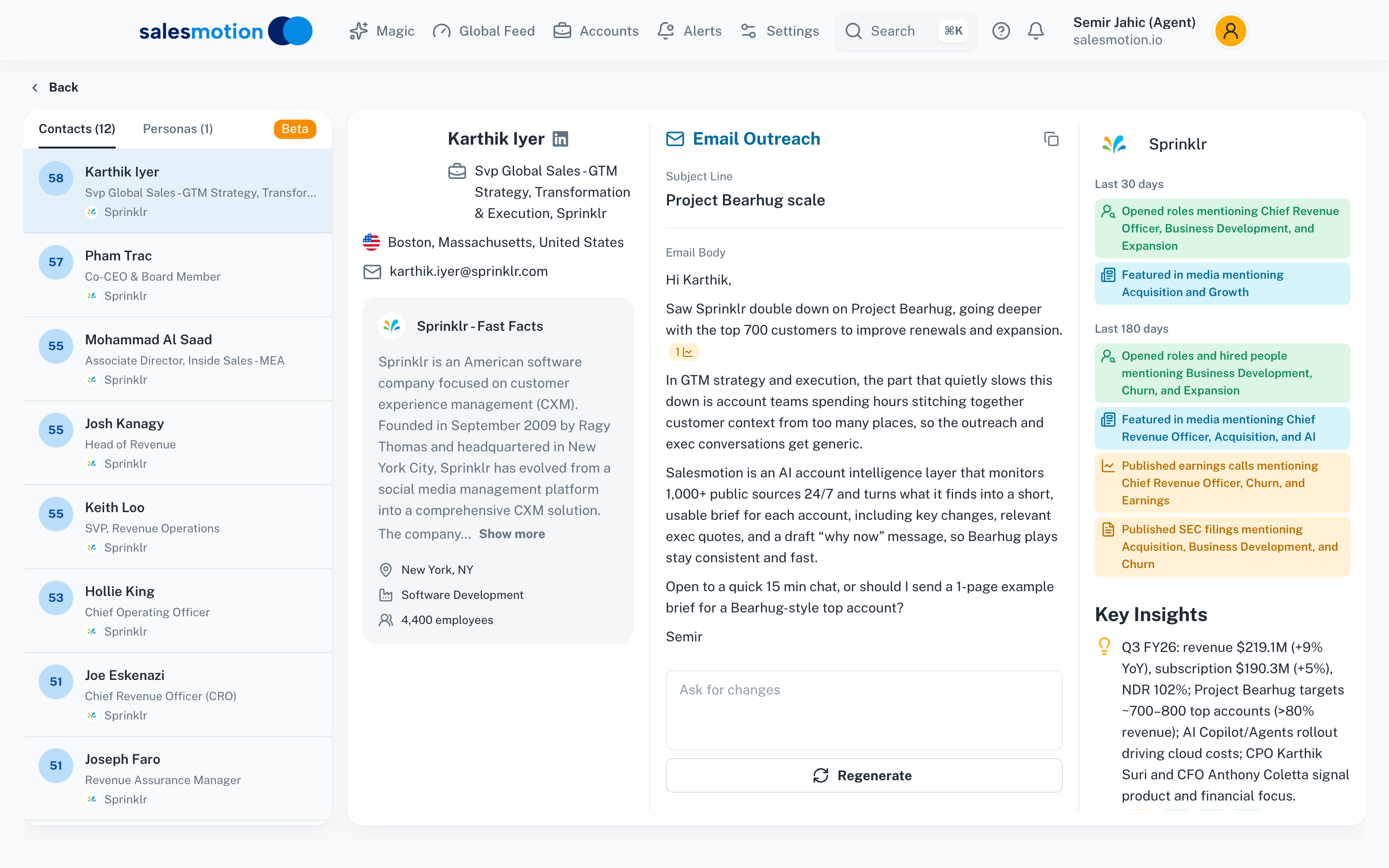 The prospect module surfaces contacts, generates signal-based outreach, and shows key account insights — so reps can move from research to relevant email in under a minute.
Clay
Category: Workflow Automation and Data Enrichment
Best for: RevOps teams building custom prospecting workflows
Clay has quickly become the go-to tool for teams that want to build custom data pipelines. Its "waterfall enrichment" feature chains multiple data providers together (checking Apollo first, then Hunter, then Cognism) to maximize coverage. With 150+ data integrations, Clay is incredibly flexible. There is a free tier, then Launch at $185/month and Growth at $495/month (roughly $167 and $446 on annual billing), though costs scale with usage. It's best suited for technical teams with RevOps resources to build and maintain workflows.
Instantly
Category: Email Engagement
Best for: Teams focused purely on cold email outreach at volume
Instantly has carved out a niche as the simplest, most affordable way to send cold emails at scale. It handles email warmup, inbox rotation, and deliverability optimization. Pricing starts around $30/month. It lacks the multi-channel capabilities of Outreach or Salesloft, but for teams whose primary motion is email-first outbound, it does that one thing well.
Lusha
Category: Contact Database
Best for: Individual reps and small teams who need quick contact lookups
Lusha is the simplest entry point into B2B contact data. Its browser extension surfaces emails and phone numbers directly from LinkedIn profiles. The free plan includes 40 credits per month on one seat, and paid plans start at $49.90/month on annual billing — priced per plan with seats included, not per user. Data accuracy is solid for its price point, though its 280M+ contact database is smaller than Apollo's or ZoomInfo's. For reps who just need a Chrome extension to find email addresses fast, Lusha is the most frictionless option.
How to Build an Effective Prospecting Stack
You don't need ten tools. You need the right three.
Salesmotion's Take
The industry has spent a decade optimizing the wrong metric. We built faster email senders, better dialers, smarter sequences. But the reps who consistently hit President's Club don't prospect more — they prospect smarter. They know which 20 accounts to focus on and why those accounts would buy right now. The tool that matters most isn't the one that sends the email — it's the one that tells you which email is worth sending.

Semir Jahic
CEO & Co-Founder, Salesmotion
Here's the framework I recommend to every revenue leader: pick one tool for contacts, one for engagement, and one for intelligence. Then connect them.
For startups and SMBs (sub-$50K budget):
- Apollo (contacts + basic sequencing) + LinkedIn Sales Navigator (social selling) + an intelligence layer for account research
- Total: roughly $200-350/user/month
For mid-market teams ($50K-150K budget):
- Cognism or ZoomInfo (contacts) + Salesloft (engagement) + LinkedIn Sales Navigator + an intelligence layer
- Add Clay if you have RevOps capacity to build custom enrichment workflows
For enterprise teams ($150K+ budget):
- ZoomInfo (contacts + intent) + Outreach (engagement) + LinkedIn Sales Navigator + dedicated research tools
- The scale justifies separate, specialized tools in each category
The key principle: 75% of B2B businesses report strong ROI from prospecting when they combine channels, not when they stack up more tools in the same category. Having both Apollo AND ZoomInfo doesn't help. Having a contact database AND an intelligence platform does.
Nick Cegelski and Armand Farrokh of 30 Minutes to President's Club put it plainly: "In a world where everyone avoids cold calls, that's your advantage." Their analysis of 300M+ cold calls found that the top 10% of reps book 1 meeting for every 3 cold calls that connect. The difference isn't talent — it's preparation.

“Consolidation of prospect company information that I can use frequently to be way better informed when I'm doing my outbound, preparing for a meeting, or building relationships. Ease of use and Customer Support is excellent.”
Werner Schmidt
CEO & Co-Founder, Lative
The Research Gap That Most Teams Miss
Contact databases tell you who to call. Sequencing tools help you reach them consistently. But neither tells you what to say or why now.
That's the research gap, and it's the biggest missed opportunity in most B2B prospecting strategies.
Consider two approaches to the same prospect:
Approach A (volume-first): Rep finds the VP of Sales at a target account in ZoomInfo. Drops them into a 5-step email sequence with a generic pitch. Response rate: 2-3%.
Approach B (intelligence-first): Rep sees that the same company just reported declining revenue in their latest earnings call, is hiring 15 new account executives, and their CTO mentioned a "digital transformation initiative" on a recent podcast. Rep writes one email referencing the growth initiative and offering a relevant perspective. Response rate: 15-25%.
The tools are the same in both approaches. The difference is the 10 minutes spent understanding the account before hitting send. As Sam McKenna says: "Personalization in sales must go beyond surface-level AI-generated efforts." The "Show Me You Know Me" approach works precisely because it proves you did the work.
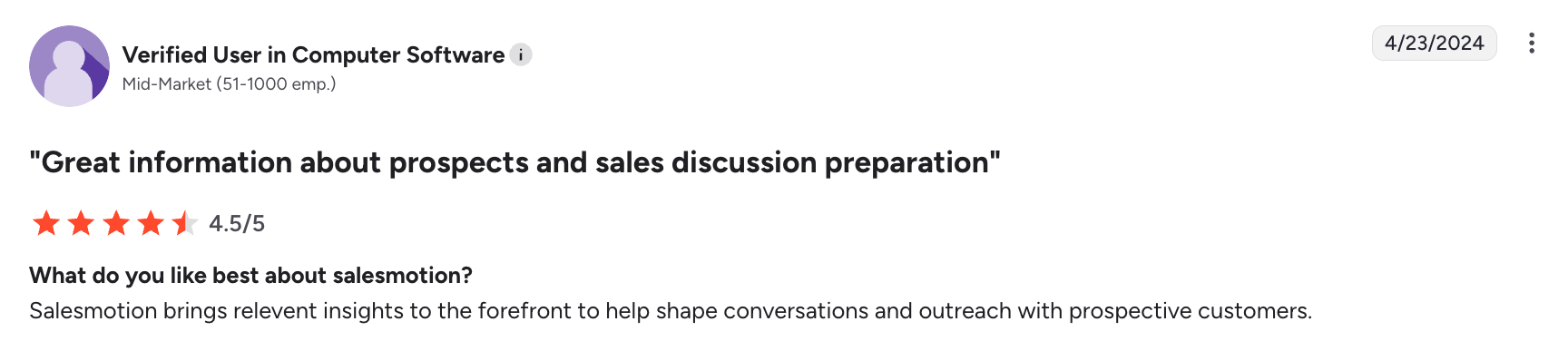 G2 reviewers consistently highlight the time savings and relevance improvements from adding an intelligence layer to their prospecting workflow.
One of the strongest signals that a company needs prospecting tools? They are hiring SDRs and BDRs at scale. This is exactly why AI prospecting tools are gaining traction. According to SPOTIO's 2026 sales statistics report, sales intelligence, engagement, and prospecting tools each deliver 25-27% ROI, the highest of any sales technology category. The ROI doesn't come from sending more. It comes from sending smarter.
For reps who want to put intelligence into practice immediately, our prospecting templates include signal-based outreach frameworks that work with any tool stack.
Key Takeaways
- The B2B prospecting tool market has five categories: contact databases, engagement platforms, intelligence layers, workflow automation, and AI agent prospecting. Most teams over-invest in the first two and underinvest in intelligence and AI agents.
- You need three tools, not ten. Pick one for contacts, one for engagement, and one for intelligence. Then connect them through your CRM or a workflow tool like Clay.
- The research gap is where deals are won. It now takes 18 touches to book a meeting. The reps who break through are the ones who lead with relevance, not volume.
- Data accuracy varies dramatically. ZoomInfo leads in coverage, Cognism leads in European data and phone-verified numbers, and Apollo offers the best value for smaller teams.
- Signal-personalized outreach delivers 5x better response rates compared to generic outreach — turning fewer sends into more meaningful conversations.
- Multi-channel beats single-channel. Social outreach now outranks email for response rates (42% vs. 26%), and 75% of B2B businesses report strong ROI when they combine prospecting channels.
Frequently Asked Questions
What are the best free sales prospecting tools?
Apollo.io offers the most generous free tier, with 900 credits a year, two sequences, and basic sequencing capabilities. Lusha provides 40 free monthly credits for quick contact lookups. LinkedIn's free version still allows basic prospecting, though Sales Navigator's advanced filters make a significant difference. Hunter.io is useful for domain-level email lookups at no cost. For teams starting out, Apollo's free plan paired with LinkedIn is a solid foundation before investing in paid tools.
How many prospecting tools does a sales team actually need?
Most effective teams use three to four core tools: one for contact data, one for engagement/sequencing, and one for intelligence or research. According to Highspot's research on modern sales stacks, the average rep uses six tools daily, but the teams that perform best are those with well-integrated stacks rather than the largest number of tools. Adding a fourth tool for workflow automation (like Clay or Zapier) makes sense once your team has RevOps capacity to maintain it.
What's the difference between a contact database and a sales intelligence platform?
Contact databases (Apollo, ZoomInfo, Cognism, Lusha) provide contact information: emails, phone numbers, job titles, and company firmographics. Sales intelligence platforms provide context: what's happening at an account, what signals indicate buying intent, and what talking points will resonate in a conversation. The best prospecting stacks include both. A contact database tells you who to reach. An intelligence platform tells you what to say and when to say it. That distinction is critical because 69% of buyers still answer cold calls, but only when the rep demonstrates they've done their homework.
Is it worth paying for ZoomInfo over cheaper alternatives like Apollo?
It depends on your deal size and market. ZoomInfo's data quality is measurably better, with 120M+ direct dials and the most comprehensive dial coverage in the market. But ZoomInfo does not publish a price, and Vendr's marketplace data puts the average contract at $33,500, so it only makes sense if your average contract value justifies the investment. For teams with ACVs under $25K, Apollo's 230M+ person database at a fraction of the price often delivers enough accuracy. For enterprise teams where a single missed contact could cost a six-figure deal, ZoomInfo's premium data pays for itself quickly.
How do I measure the ROI of my prospecting tools?
Track three metrics: cost per meeting booked, response rate by channel, and time spent on research per account. According to Sopro's 2024 sales statistics report, 75% of B2B companies see strong ROI from email prospecting alone, and that number climbs when you layer in additional channels. The most telling metric is time-to-first-meeting for new accounts. If adding a tool reduces that by even a few days, the compounding effect on pipeline generation is substantial.