Enterprise account planning has a consistency problem. Nearly every B2B sales organization invests in annual or quarterly planning exercises, yet the plans themselves go stale within weeks. Reps fill out templates during QBR season, leadership reviews them once, and then the documents sit untouched while the accounts they describe keep changing. New executives join, strategic priorities shift, competitors make moves, and budgets get reallocated. The plan that was accurate in January is fiction by March.
TL;DR: Effective enterprise account planning in 2026 requires three shifts: from static documents to living intelligence, from annual exercises to continuous monitoring, and from template compliance to strategic decision-making. The best account plans combine relationship mapping, whitespace analysis, and real-time signal tracking to keep reps focused on the right actions at the right time.
What Enterprise Account Planning Actually Requires
Account planning is the process of analyzing a target account's business, stakeholders, priorities, and competitive landscape to develop a strategic engagement approach. A SWOT analysis for each deal helps expose risks before they kill pipeline. For enterprise deals with 8-12 stakeholders, 6-24 month sales cycles, and deal sizes exceeding $100K, planning isn't optional. It's the difference between coordinated strategic selling and chaotic opportunistic chasing.
A complete enterprise account plan covers five dimensions:
1. Account Intelligence: Company financials, strategic initiatives, recent leadership changes, competitive pressures, technology stack, and market position. This is the foundation everything else builds on.
2. Stakeholder Mapping: Who has budget authority, who influences the decision, who champions your solution, and who blocks it. For enterprise deals, this means mapping 8-12+ people across multiple business units.
3. Whitespace Analysis: Where you have existing footprint, where expansion opportunities exist, and which adjacent pain points could drive cross-sell or upsell.
4. Competitive Positioning: Who else the account is evaluating or already using, what those competitors do well, and where your differentiation is strongest.
5. Action Plan: Specific next steps, assigned owners, timelines, and success metrics that translate strategy into execution.
The 80/20 rule is intensifying in enterprise sales: 80% of revenue comes from 20% of accounts. Getting account planning right for your top accounts isn't a nice-to-have. It's the highest-leverage activity your sales team can invest in.
See Salesmotion on a real account
Book a 15-minute demo and see how your team saves hours on account research.
Account Tiering: How Much Planning Each Account Deserves
Not every account needs the same planning depth. Spreading planning effort evenly across all accounts is one of the fastest ways to burn out a sales team. Use a tiering model to match planning investment to account potential:
| Tier | Criteria | Planning Investment | Review Cadence |
|---|---|---|---|
| Tier 1 (Top 10-15 accounts) | $200K+ potential, 5+ stakeholders, strategic reference value | Full account plan: all 5 dimensions, dedicated owner, executive sponsor | Weekly internal review, monthly customer touchpoint |
| Tier 2 (Next 20-30 accounts) | $50-200K potential, 3-5 stakeholders, expansion opportunity | Focused plan: stakeholder map + whitespace + 90-day actions | Bi-weekly internal review, quarterly customer check-in |
| Tier 3 (Remaining named accounts) | <$50K potential or early-stage relationships | Lightweight plan: key contacts + signals to watch + next 3 actions | Monthly review, signal-triggered engagement |
The critical mistake: treating every account like Tier 1. When a rep manages 50 accounts and tries to build comprehensive plans for each, the result is 50 shallow plans instead of 15 deep plans and 35 lightweight ones. Tier explicitly, communicate the tiering criteria to reps, and give them permission to spend less time on Tier 3 accounts.
How to tier objectively: Score each account on four dimensions (revenue potential, expansion opportunity, strategic value, competitive risk) weighted by your business priorities. Automate the scoring using CRM data where possible. Re-tier quarterly as accounts grow or shrink.

“All of the vendors that I've worked with, all of the onboarding that I have had to deal with, I will say, hands down, Salesmotion was the easiest that I have had.”
Lyndsay Thomson
Head of Sales Operations, Cytel
The Account Planning Framework That Actually Works
Most account planning frameworks fail because they're designed for documentation, not decision-making. Here's a framework built for execution.
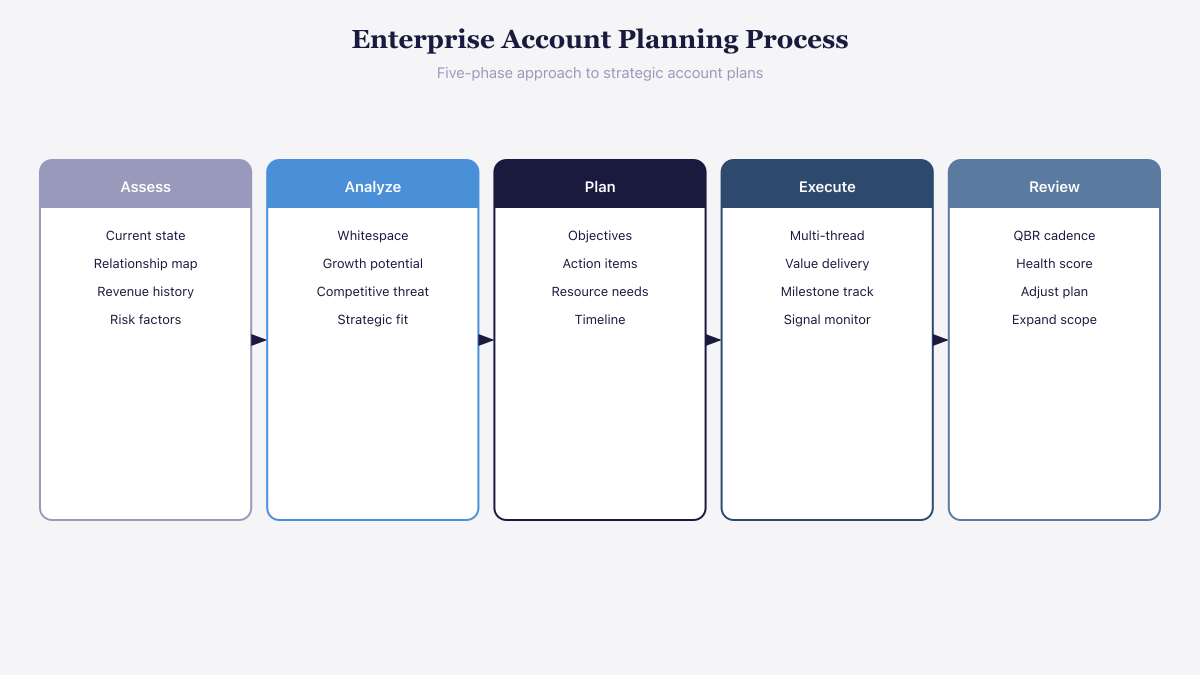 Enterprise account planning follows a continuous five-phase cycle from assessment to review.
Phase 1: Research and Discovery (Week 1)
Gather comprehensive intelligence about the account before any planning session. This includes:
- Financial picture: Recent earnings, revenue trends, strategic investments, cost-cutting signals
- Leadership landscape: New executives, recent departures, reporting structure changes
- Strategic priorities: What the company has publicly committed to (earnings calls, press releases, annual reports, job postings)
- Technology environment: Current vendor relationships, recent purchases, contract renewal timelines
- Competitive context: Which of your competitors have existing relationships, recent RFP activity
The traditional approach requires reps to manually research each account across 5+ sources, spending 2-3 hours per account. This is where most plans fail before they start. The research burden is too high for reps to maintain across a portfolio of 20-50 named accounts.
Cytel's sales team consolidated from five separate research tools to one platform, cutting research time by 50% and reducing account planning preparation by 30%. The consolidation mattered as much as the capability: fewer tools meant less context-switching, cleaner data, and higher adoption.
Phase 2: Stakeholder and Relationship Mapping (Week 2)
Map every relevant stakeholder using the MEDDIC framework's Economic Buyer and Champion criteria:
| Stakeholder Role | What to Map | Why It Matters |
|---|---|---|
| Economic Buyer | Budget authority, approval thresholds | They can say yes when everyone else says no |
| Champion | Internal advocate with political capital | They sell for you when you're not in the room |
| Technical Evaluator | Product requirements, integration needs | They can block deals on technical grounds |
| Coach | Insider who shares intelligence | They tell you what's really happening |
| Blocker | Person resistant to change or your solution | They can kill deals through passive resistance |
For each stakeholder, document: their specific priorities, their relationship strength with your team (1-5), their influence level, and the last meaningful interaction.
Phase 3: Whitespace and Opportunity Identification (Week 3)
Use a heatmap approach to visualize your account penetration:
- Green zones: Business units where you have active relationships and usage
- Yellow zones: Adjacent teams that could benefit from your solution but haven't been engaged
- Red zones: Departments where competitors are entrenched or where you have no presence
The biggest missed revenue in enterprise accounts comes from yellow zones. Your existing champions can introduce you to adjacent teams, but only if you've identified those opportunities and built a specific engagement plan for each.
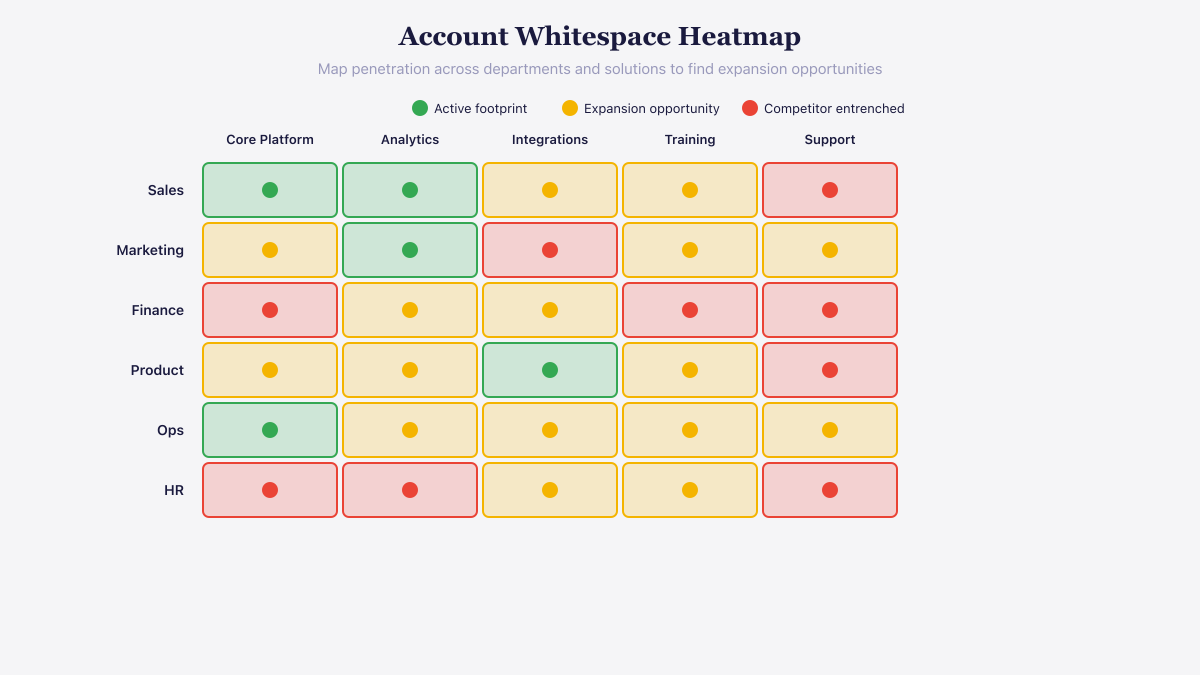 A whitespace heatmap visualizes where you have active footprint (green), expansion opportunities (yellow), and competitor-entrenched zones (red) across departments.
Phase 4: Strategy and Action Planning (Week 4)
Translate your research into specific, time-bound actions:
- 30-day actions: Immediate outreach, meeting requests, relationship-building touchpoints
- 90-day objectives: Qualified opportunities, executive engagement, proof-of-concept milestones
- Annual targets: Revenue goals, expansion metrics, relationship depth milestones
Every action should have an owner, a deadline, and a clear success metric.
Why Static Account Plans Break at Scale
The framework above works brilliantly for a planning exercise. It breaks within 60 days because the accounts keep changing while the plans don't.
Here's what goes stale fastest:
- Stakeholder maps decay. Enterprise accounts experience 20-30% annual turnover in key roles. Your champion from last quarter may have left, been promoted, or shifted priorities. If you're not monitoring leadership changes, you find out when your emails stop getting responses.
- Strategic priorities shift. A new CEO announces a different direction. An acquisition changes the competitive landscape. A budget freeze resets all vendor evaluations. These signals are public but require active monitoring to catch.
- Competitive dynamics evolve. A competitor wins a department you had targeted. A vendor the account was evaluating gets acquired. Contract renewal dates pass without your knowledge.
- Buying signals fire between QBRs. The account posts three VP-level roles in revenue operations (a hiring signal). Their CFO mentions "sales transformation" on the earnings call. A former champion who knows your product joins the company. These signals don't wait for quarterly review cycles.
The spreadsheet approach to account planning works for 10 accounts. It collapses at 50+. The plans themselves are sound. The intelligence maintenance layer is what fails.

“The Business Development team gets 80 to 90 percent of what they need in 15 minutes. That is a complete shift in how our reps work.”
Andrew Giordano
VP of Global Commercial Operations, Analytic Partners
"We Don't Have Time for Account Planning"
This is the most common objection from sales teams, and it's partially valid. Traditional account planning takes 2-3 hours per account just for the initial research phase. Multiply that by 30 named accounts and you're asking reps to spend 60-90 hours on planning instead of selling. No wonder plans get abandoned after QBR season.
The objection breaks down when you separate planning from research. The research phase (gathering intelligence about financials, stakeholders, priorities, competitive landscape) is what consumes 80% of the time. The strategic thinking (what's our angle, who should we engage, what's the next play) takes 20%. Most reps skip planning entirely because they can't get past the research bottleneck.
Salesmotion eliminates the research bottleneck. One-click account briefs compile intelligence from 1,000+ sources: earnings call transcripts, leadership changes, hiring patterns, competitive moves, and strategic initiative language. What used to take 2-3 hours per account now takes 5-15 minutes. Analytic Partners' team gets 80-90% of what they need for prospecting and meetings in 15 minutes, compared to 3 hours of manual research.
When research takes 15 minutes instead of 3 hours, the "no time" objection disappears. A rep can build a Tier 1 account plan in 45 minutes (15 minutes intelligence + 30 minutes strategy) instead of 4 hours. For 15 Tier 1 accounts, that's 11 hours per quarter, not 60. The ROI on planning becomes obvious when the research barrier is removed.
Making Account Plans Living Documents
The shift from static plans to living intelligence requires three capabilities:
Continuous Signal Monitoring
Instead of periodic manual research, monitor accounts for changes that affect your strategy. The signals that matter most for account planning:
- Leadership changes: New executives bring new priorities, new vendors, and new budget decisions
- Strategic initiatives: Earnings call language, press releases, and annual report commitments reveal what the account is investing in
- Hiring patterns: The roles an account is hiring for indicate what capabilities they're building internally vs. buying externally
- Competitive moves: Vendor announcements, partnership changes, and technology adoption signals
Salesmotion monitors these signals across 1,000+ sources for every account in your territory. When a target account's CRO mentions "modernizing our sales tech stack" on an earnings call while simultaneously hiring a VP of Revenue Operations, the platform flags the converging signals and updates the account brief automatically. Reps don't need to search for this intelligence. It surfaces proactively.
Automated Account Briefs
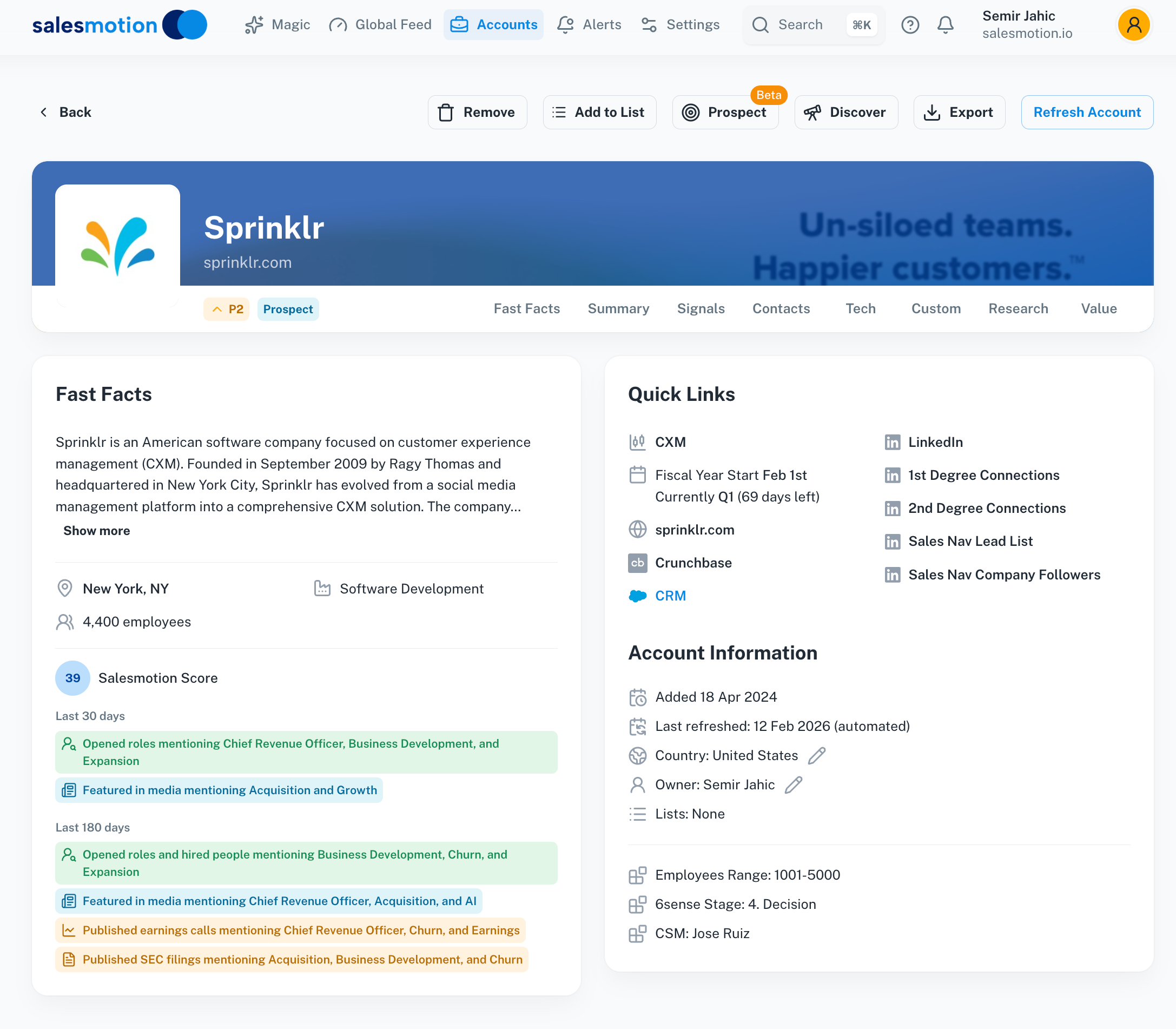 An automated account brief pulls together company overview, financials, strategic initiatives, and stakeholder data, replacing static documents with a living intelligence view.
Replace static Word documents and Salesforce fields with dynamically generated account briefs that pull from live data. A good brief includes:
- Company overview with recent financial performance
- Key stakeholders with current roles and tenure
- Recent signals and what they mean for your engagement strategy
- Competitive landscape and positioning recommendations
- Recommended next actions based on current account state
Teams like Analytic Partners get 80-90% of the insight they need for prospecting and meetings in 15 minutes, compared to 3 hours of manual research. That efficiency doesn't just save time. It means reps actually do the research instead of skipping it.
Quarterly Review Rhythm
Living intelligence doesn't replace strategic review. It enhances it. Use quarterly reviews to:
- Validate that your account strategy still aligns with the account's current priorities
- Review signal history from the past quarter to identify trends
- Update stakeholder maps based on relationship changes
- Adjust whitespace targets based on competitive movement
- Set specific 90-day action plans with measurable milestones
The review becomes a strategic conversation rather than a data-gathering exercise when the intelligence is already current.
Account Planning Template: The Essential Sections
For teams building or refreshing their account planning template, here are the sections that drive the most value:
Account Snapshot: Company overview, revenue, industry, employee count, strategic priorities, recent news. Updated automatically, not manually.
Stakeholder Map: Grid of key contacts with role, influence level, relationship strength, last interaction, and engagement strategy per person.
Opportunity Whitespace: Visual heatmap of business units showing current penetration, expansion opportunities, and competitive presence.
Signal Timeline: Chronological log of relevant signals (leadership changes, earnings mentions, hiring activity, competitive moves) with strategic implications noted.
Competitive Landscape: Who else has relationships in the account, what they offer, where your differentiation is strongest, and where you're at a disadvantage.
Action Plan: 30/60/90-day actions with owners, deadlines, and success metrics.
Success Metrics: Revenue target, meetings booked, stakeholders engaged, pipeline created, and deal progression milestones.
Key Takeaways
- Enterprise account planning fails when plans are treated as static documents rather than living strategies. Accounts change faster than quarterly review cycles.
- The five essential dimensions are: account intelligence, stakeholder mapping, whitespace analysis, competitive positioning, and action planning.
- Research is the bottleneck. Reps spending 2-3 hours per account on manual research limits how many accounts get meaningful plans.
- Automate the intelligence layer. Continuous signal monitoring keeps account plans current between QBRs without requiring manual research. Tools that track buying signals and leadership changes proactively prevent plans from going stale.
- Focus whitespace analysis on "yellow zones" where existing champions can make introductions. This is where most missed enterprise revenue lives.
- Use quarterly reviews for strategy, not data gathering. When the intelligence is already current, review meetings become decision-making sessions.
Frequently Asked Questions
What should be included in an enterprise account plan?
An enterprise account plan should cover five core dimensions: account intelligence (financials, strategic priorities, recent news), stakeholder mapping (8-12+ contacts with roles, influence levels, and relationship strength), whitespace analysis (current penetration and expansion opportunities), competitive positioning (who else is in the account and where your differentiation is strongest), and a time-bound action plan with assigned owners and success metrics.
How often should account plans be updated?
Formally, account plans should be reviewed quarterly. But the intelligence feeding them should be updated continuously. Leadership changes, strategic initiative announcements, and buying signals happen between quarters, and plans that don't reflect these changes lead to misaligned engagement strategies. The most effective teams use automated monitoring to keep account intelligence current between formal reviews.
What is the biggest mistake in enterprise account planning?
The biggest mistake is treating account planning as a documentation exercise rather than a strategic process. Teams that focus on filling out templates produce plans that look complete but drive no behavior change. The second most common mistake is failing to maintain the plan after the initial creation. Plans that aren't updated with new intelligence become fiction within 60-90 days as stakeholders change, priorities shift, and competitive dynamics evolve.
How do you scale account planning across a large sales team?
Scaling account planning requires automating the research phase, standardizing the template and review cadence, and using technology to keep intelligence current. Without automation, the research burden per account (2-3 hours manually) limits how many accounts get meaningful plans. Teams that automate account research and signal monitoring can maintain living plans across 50+ accounts per rep, compared to 10-15 accounts with manual methods.