SWOT analysis is one of the most recognized strategic planning frameworks in business -- and when paired with external macro-environmental analysis it becomes even more powerful (see our guide on SWOT vs PESTLE analysis) -- yet most sales teams either skip it entirely or apply it so generically that it produces no actionable insight. The typical SWOT exercise generates four quadrants of vague bullet points: "strong brand" under strengths, "economic uncertainty" under threats, and nothing that helps a rep win a specific deal or penetrate a specific account. When applied correctly to sales, SWOT analysis becomes a competitive weapon that sharpens positioning, exposes deal risks before they kill pipeline, and aligns team resources against the opportunities most likely to convert.
TL;DR: A SWOT analysis for sales evaluates your strengths, weaknesses, opportunities, and threats at three levels: team-wide (your overall competitive position), territory-level (market and segment dynamics), and deal-level (specific opportunity risks and advantages). The framework is most valuable when it drives specific actions: doubling down on strengths that differentiate, addressing weaknesses before competitors exploit them, pursuing opportunities with time-sensitive signals, and building contingency plans for realistic threats.
What SWOT Analysis Means for Sales Teams
SWOT stands for Strengths, Weaknesses, Opportunities, and Threats. In a sales context:
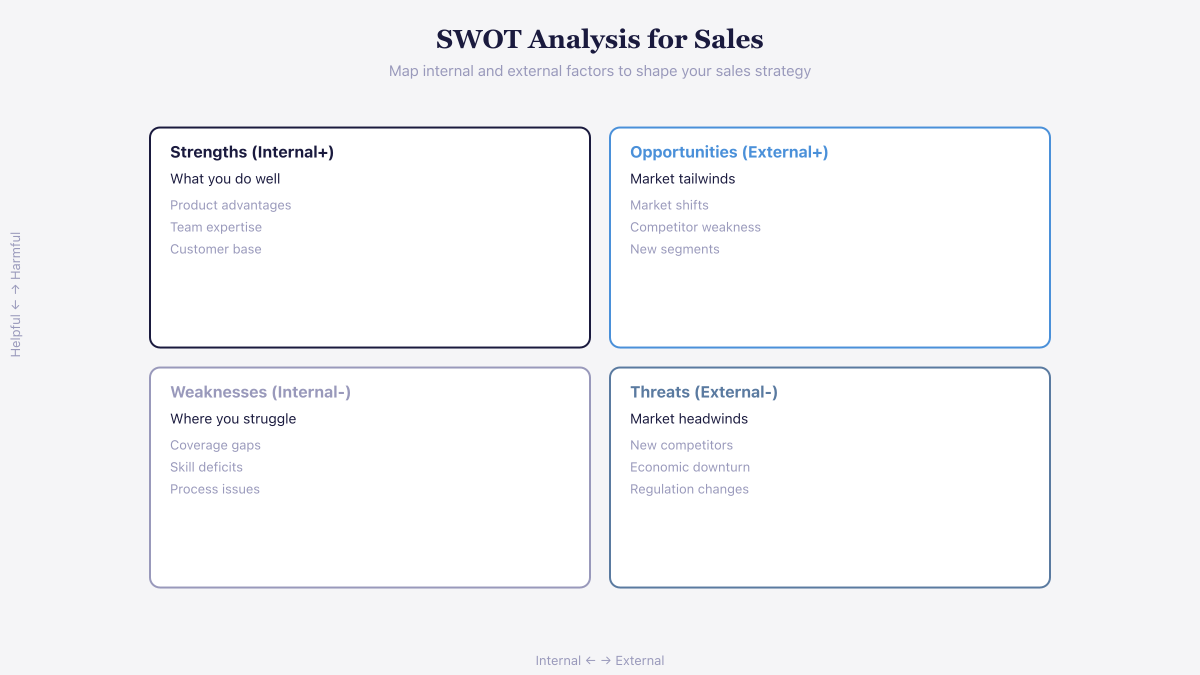 Map internal capabilities against external dynamics to shape your sales strategy.
Strengths are internal advantages that help you win deals. These include product capabilities that competitors can't match, customer relationships that provide referrals and case studies, team expertise in specific industries, and sales processes that consistently produce results.
Weaknesses are internal limitations that cost you deals. Missing product features that competitors highlight, gaps in industry expertise, slow response times, limited customer proof points in key verticals, or inadequate sales enablement materials.
Opportunities are external conditions that create favorable selling conditions. Market shifts driving demand for your solution category, regulatory changes requiring new capabilities, competitor missteps or pricing increases, and technology trends that align with your roadmap.
Threats are external factors that could reduce your win rate. New competitors entering your space, economic conditions that freeze budgets, customer consolidation that reduces your addressable market, or technology shifts that make your approach less relevant.
The difference between a useful SWOT and a useless one is specificity. "Good product" is not a strength. "42% faster implementation time than the nearest competitor, validated by 15 customer deployments" is a strength that changes how reps position against competition.
See Salesmotion on a real account
Book a 15-minute demo and see how your team saves hours on account research.
SWOT Analysis Template for Sales Teams
Use this template at three levels for maximum impact.
Level 1: Team-Wide SWOT
This analysis evaluates your overall competitive position and guides strategic decisions about messaging, hiring, and resource allocation.
| Category | Questions to Answer | Example |
|---|---|---|
| Strengths | What do we consistently win on? Where do customers say we outperform? | "Integration with Salesforce takes 2 days vs. 2 weeks for competitors" |
| Weaknesses | Where do we lose most often? What do churned customers cite? | "No native mobile app — field reps can't access insights on the go" |
| Opportunities | What market shifts favor us? Which segments are underserved? | "New data privacy regulations require the compliance features we already have" |
| Threats | Who's gaining market share? What could reduce demand? | "Competitor X raised $50M and is hiring 30 enterprise reps targeting our segment" |
Action mapping:
- Strength + Opportunity: Where your strengths align with market opportunities — invest aggressively. This is your highest-ROI focus area.
- Weakness + Threat: Where your limitations meet competitive pressure — mitigate immediately. This is your highest-risk area.
- Strength + Threat: Where your advantages can neutralize competitive threats — defend and position.
- Weakness + Opportunity: Where market opportunities exist but you're not equipped to capture them — develop or partner.
Level 2: Territory and Segment SWOT
Apply SWOT to specific territories, industries, or customer segments to guide account prioritization and resource allocation.
Example: Healthcare vertical SWOT
| Internal | External | |
|---|---|---|
| Positive | Strengths: 8 healthcare case studies, HIPAA-compliant infrastructure, dedicated healthcare SE | Opportunities: Hospital systems investing in operational efficiency post-pandemic, 3 major competitor healthcare customers churning |
| Negative | Weaknesses: No integration with Epic EHR, limited understanding of clinical workflows | Threats: Niche healthcare-specific competitor with deep clinical expertise gaining traction |
This segment-level analysis tells the team: pursue the churning competitor accounts (strength + opportunity), but avoid deals where Epic integration is a requirement (weakness) until the product team addresses it.
Level 3: Deal-Level SWOT
Apply SWOT to individual high-value opportunities during deal review. This is where SWOT becomes directly actionable for reps.
| Category | Deal-Specific Questions |
|---|---|
| Strengths | Which stakeholders are we strongest with? What product capabilities align perfectly with their requirements? What proof points (case studies, references) match their industry? |
| Weaknesses | Which stakeholders haven't we reached? What requirements can't we fully meet? Where is our pricing position weak? |
| Opportunities | What recent events at the account (leadership changes, funding, strategic shifts) create urgency? Which stakeholders are dissatisfied with the incumbent? |
| Threats | Which competitors are in the deal? What's the risk of "no decision"? Are there internal politics or organizational changes that could delay or kill the deal? |
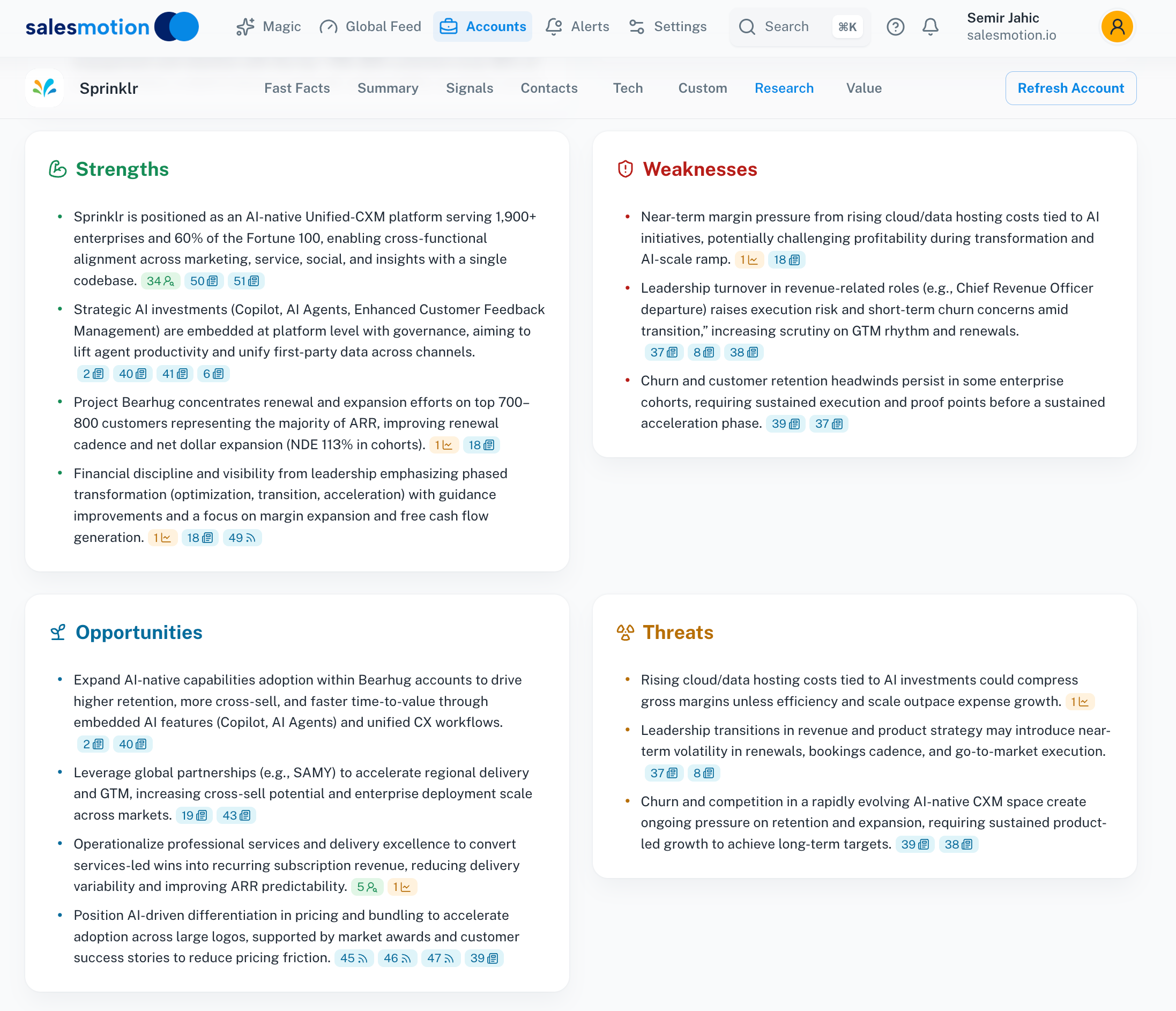 An AI-generated SWOT analysis populates each quadrant with real account data — competitive positioning, market threats, expansion opportunities — sourced from live signals rather than assumptions.
Deal-level SWOT connects directly to account intelligence. The "Opportunities" quadrant should be populated with real-time signals: a new CRO who previously championed your solution, an earnings call mentioning the exact problem you solve, or a hiring surge in the department your tool serves. The "Threats" quadrant should include competitive moves you've detected, not just the competitors you assume are involved.

“We're no longer fishing. We know who the right customers are, and we can qualify them quickly. Salesmotion has had a direct impact on pipeline quality.”
Andrew Giordano
VP of Global Commercial Operations, Analytic Partners
Real SWOT Analysis Examples for Sales
Example 1: SaaS Sales Team Competing Against an Established Incumbent
Strengths:
- 3x faster implementation time (average 14 days vs. 6 weeks for incumbent)
- 40% lower total cost of ownership over 3 years
- Modern API architecture enabling integrations the incumbent can't match
- NPS of 72 vs. incumbent's publicly reported NPS of 34
Weaknesses:
- Brand recognition is 80% lower in enterprise segment
- Only 12 enterprise case studies vs. incumbent's 200+
- No dedicated field sales team for on-site presentations
- Missing 3 features that appear in 60% of enterprise RFPs
Opportunities:
- Incumbent raised prices 25% at last renewal cycle, creating budget pressure
- Market shift toward composable architecture favors our API-first approach
- 40+ accounts on incumbent's platform showing dissatisfaction signals on review sites
- New data residency regulations in EU require capabilities we have and incumbent lacks
Threats:
- Incumbent has 8x our marketing budget and dominates search rankings
- Two well-funded startups entering the market with similar positioning
- Economic slowdown may freeze "rip and replace" projects in favor of incremental improvements
- Incumbent launching a "modern" tier that mimics our core differentiators
Actions from this SWOT:
- Build a competitive displacement playbook targeting the 40+ dissatisfied accounts (Strength + Opportunity)
- Develop an ROI calculator highlighting the 40% TCO advantage for budget-constrained buyers (Strength + Threat)
- Invest in 5 new enterprise case studies this quarter to close the proof point gap (Weakness mitigation)
- Create EU data residency positioning before incumbent adds the capability (Opportunity, time-sensitive)
Example 2: Account-Level SWOT for a $200K Enterprise Deal
Strengths:
- Strong relationship with VP of Sales (Coach-level buying influence)
- Product demo received highest scores in technical evaluation
- Two references in the same industry available for peer conversation
Weaknesses:
- No relationship with the CFO (Economic Buyer) who has final approval
- Missing custom reporting feature requested in RFP
- Pricing is 15% above budget communicated by procurement
Opportunities:
- New CRO joined 60 days ago and is evaluating all sales technology
- Company just closed Series D funding with stated goal of "scaling revenue operations"
- Current vendor's contract expires in 90 days
Threats:
- Incumbent vendor is offering 30% discount to retain the account
- CFO is known to favor incumbent based on existing relationship
- Internal champion (VP of Sales) has been in role only 4 months and may lack political capital
Actions from this SWOT:
- Get VP of Sales to introduce us to the CFO with an ROI-focused executive briefing (address Weakness)
- Present product roadmap showing custom reporting in next quarter's release (mitigate Weakness)
- Reference the CRO's previous company where our solution was implemented (leverage Opportunity)
- Prepare a competitive counter to the incumbent's discount with a 3-year TCO comparison (neutralize Threat)
Common Mistakes in Sales SWOT Analysis
Being too generic. "Strong team" is not a strength. "Average rep ramp time of 45 days vs. industry average of 90 days" is. Every SWOT item should be specific enough to drive a decision.
Ignoring internal weaknesses. Sales teams consistently overweight strengths and underweight weaknesses in self-assessment. Counter this by asking: "What do we hear from lost deals?" and "What do competitors say about us?"
Treating it as a one-time exercise. Market conditions, competitive dynamics, and account situations change continuously. A SWOT from Q1 may be obsolete by Q3. Review team-level SWOT quarterly, territory SWOT monthly, and deal-level SWOT at every stage gate.
Not connecting SWOT to action. The analysis has zero value without action items. Every SWOT should produce a prioritized list of actions with owners and deadlines. The Strength + Opportunity combination defines where to invest. The Weakness + Threat combination defines where to protect.
Using stale data. A SWOT built on assumptions rather than current market intelligence produces false confidence. Buying signals and real-time account data should populate the Opportunities and Threats quadrants. Teams like Analytic Partners grew qualified pipeline 40% year-over-year by replacing assumption-based account analysis with automated intelligence that kept their competitive positioning current.

“Automatic account profile detail I can use to manage my territory. Using Salesmotion AI to generate value statements per persona, account, etc. Using Salesmotion to give me a starting point based on new hires, or news alerts is critical.”
Adam Wainwright
Head of Revenue, Cacheflow
Key Takeaways
- SWOT analysis for sales works at three levels: team-wide (competitive positioning), territory/segment (resource allocation), and deal-level (opportunity strategy). Each level requires different specificity and update frequency.
- The value of SWOT is in the action mapping: Strength + Opportunity = invest, Weakness + Threat = mitigate, Strength + Threat = defend, Weakness + Opportunity = develop.
- Specificity is the difference between a useful SWOT and a wall decoration. Every item should be measurable or verifiable, not a generic platitude.
- Review team-level SWOT quarterly, territory SWOT monthly, and deal-level SWOT at every pipeline stage gate.
- Populate the Opportunities and Threats quadrants with real-time data (account signals, competitive intelligence, market shifts) rather than assumptions. Stale SWOT analysis creates false confidence.
- Always end the exercise with prioritized action items. A SWOT without actions is a list without a purpose.
Frequently Asked Questions
How do you do a SWOT analysis for a sales team?
Start by gathering input from reps, managers, and leadership across four categories: Strengths (where you consistently win), Weaknesses (where you consistently lose or struggle), Opportunities (external market conditions favoring you), and Threats (external risks to your pipeline and win rates). Use specific, measurable items rather than generic statements. Map each combination to an action: invest where strengths meet opportunities, mitigate where weaknesses meet threats. Review and update quarterly.
What is the difference between SWOT and competitive analysis?
Competitive analysis focuses specifically on evaluating competitors: their products, pricing, positioning, and market share. SWOT is broader, examining internal factors (strengths and weaknesses) alongside external factors (opportunities and threats, which include but aren't limited to competition). A thorough SWOT analysis incorporates competitive intelligence in the Threats quadrant and competitive advantages in the Strengths quadrant, making it a superset of competitive analysis.
How often should a sales team update their SWOT analysis?
Team-wide SWOT should be reviewed quarterly as part of strategic planning. Territory and segment SWOT should be reviewed monthly to reflect changing market dynamics. Deal-level SWOT should be updated at every pipeline stage transition during deal reviews. The key is matching update frequency to the rate of change: enterprise deals evolve weekly, markets evolve monthly, and competitive positioning shifts quarterly.
Can SWOT analysis help with sales forecasting?
Yes. Deal-level SWOT analysis improves forecast accuracy by forcing honest assessment of risks (Weaknesses and Threats) alongside positive indicators (Strengths and Opportunities). Deals with unaddressed items in the Weakness + Threat quadrant should be downweighted in the forecast. The sales methodology scoring from MEDDIC or similar frameworks complements SWOT by providing structured qualification criteria alongside the strategic analysis.