Enterprise software companies spent over $1.1 trillion on R&D in 2024, according to IDC, making them among the most active technology buyers in the B2B landscape. For sales teams selling into enterprise software companies, every product launch, platform migration, funding event, and leadership change creates a buying window. The challenge is that enterprise software companies are also the most sophisticated buyers. They evaluate rigorously, compare alternatives exhaustively, and move fast once a decision is made. Tracking enterprise software buying signals gives you the timing advantage that separates winning deals from missed opportunities.
TL;DR: Enterprise software buying signals include product launches, platform migrations, funding and IPO events, engineering hiring surges, leadership changes, earnings R&D commentary, partnership announcements, and competitive responses. Sellers building 2027 territory plans can track these signals to engage enterprise software accounts during active investment cycles.
Why Enterprise Software Buyers Move Fast and Evaluate Hard
Enterprise software companies understand technology purchasing because it is their core business. They know how to run vendor evaluations, build comparison matrices, and negotiate contracts. This makes them simultaneously attractive (large budgets, fast decisions) and challenging (high bars, competitive processes) as target accounts.
The buying committee in enterprise software varies by what you sell. Developer tools are bought by engineering leadership. Sales tools are bought by revenue leadership. Security tools involve the CISO and CTO. Analytics platforms may involve the CDO or VP of Data. Understanding which signal maps to which buyer is critical for routing outreach correctly.
Enterprise software companies also have a unique dynamic: they compete with each other for the same platform dollars. When Salesforce launches a new AI feature, ServiceNow, Microsoft, and Oracle respond. These competitive moves drive technology investment across the ecosystem. Tracking competitive responses is a signal category unique to this industry.
See Salesmotion on a real account
Book a 15-minute demo and see how your team saves hours on account research.
Product and Technology Signals
Product Launches and Feature Expansions
When an enterprise software company launches a new product line, expands into a new market segment, or releases a major platform update, it creates buying windows across multiple categories. A new AI product line requires data infrastructure, model management tools, and compliance capabilities. A new enterprise tier requires security certifications, SSO providers, and enterprise support platforms.
Platform Migrations and Architecture Changes
Enterprise software companies periodically re-architect their platforms: migrating from monolith to microservices, moving from on-premises to cloud-native, or adopting new data infrastructure. These migrations create multi-year buying cycles for observability tools, CI/CD platforms, data pipelines, and security solutions. Track platform migration announcements in engineering blog posts and conference talks.
Competitive Responses and Market Moves
When a competitor launches a competing product or enters an adjacent market, enterprise software companies respond with accelerated development, acquisitions, or partnerships. These responses drive technology and services purchases. When Microsoft entered the security analytics space, every competing vendor increased their R&D and tooling investment. Track competitive announcements and anticipate the response.

“The moment we turned on Salesmotion, it became essential. No more hours on LinkedIn or Google to figure out who we're talking to. It's just there, served up to you, so it's always 'go time.'”
Adam Wainwright
Head of Revenue, Cacheflow
Financial and Growth Signals
Funding Rounds and IPO Events
Late-stage funding rounds and IPO filings are strong buying signals for enterprise software companies. Pre-IPO companies professionalize their infrastructure: compliance tools, financial reporting, security audits, and vendor management. Growth-stage funding creates budget for scaling engineering, sales, and operations. Track funding on Crunchbase and IPO filings with the SEC.
Earnings R&D and Investment Commentary
Public enterprise software companies discuss R&D investment priorities during quarterly earnings calls. Mentions of "building our AI platform," "investing in developer experience," "scaling our data infrastructure," or "expanding our sales capacity" are direct statements of where the company will spend. These transcripts are publicly available and searchable.
Partnership Announcements
When an enterprise software company announces a major partnership (AWS marketplace listing, Salesforce ISV partnership, integration with a platform ecosystem), it signals investment in the partnership infrastructure: integration development, co-marketing, sales enablement, and technical support. Partnership announcements are a leading indicator of technology and services purchases.
Organizational Signals
Engineering Hiring Surges
A surge in engineering job postings is one of the most reliable leading indicators of technology investment. A company hiring 50 engineers needs developer tools, observability platforms, collaboration tools, and infrastructure. Track engineering hiring trends across your target accounts to identify companies in active investment cycles.
Leadership Changes
A new CTO signals technology direction changes. A new CRO signals go-to-market transformation. A new CPO indicates product strategy shifts. In enterprise software, leadership changes at the C-suite and VP level trigger vendor evaluations within months, not quarters. Salesmotion tracks leadership changes across your enterprise software territory and connects them to the company's recent product announcements, financial performance, and competitive positioning.
Geographic and Market Expansion
Enterprise software companies expanding into new geographies (EMEA, APAC, Latin America) need localization tools, compliance infrastructure, and regional partnerships. Companies expanding into new market segments (moving upmarket from SMB to enterprise, or downmarket from enterprise to mid-market) need different tooling for each segment.
How to Operationalize Enterprise Software Buying Signals
Enterprise software buying signals come from product announcements, engineering blogs, funding databases, job boards, earnings transcripts, and competitive intelligence sources. The signal volume is high, especially in a market with thousands of enterprise software companies.
Automate competitive monitoring. Track competitive moves across your target accounts' markets. When a competitor launches or raises, your accounts respond. Position your outreach to align with the response.
Map signals to engineering maturity. A Series B enterprise software company and a public company with 5,000 engineers have completely different technology needs. Score signals against the company's engineering maturity to prioritize and personalize outreach.
Build product-stage plays. Create outreach sequences tied to specific signals: "new product launch" play, "pre-IPO compliance" play, "engineering scaling" play, and "platform migration" play. Each play should reference the specific signal and position your solution against the company's current challenge.
Salesmotion helps enterprise software sales teams operationalize these signals by aggregating product announcements, leadership changes, financial data, and hiring trends into enriched account intelligence briefs that combine technical and business context.
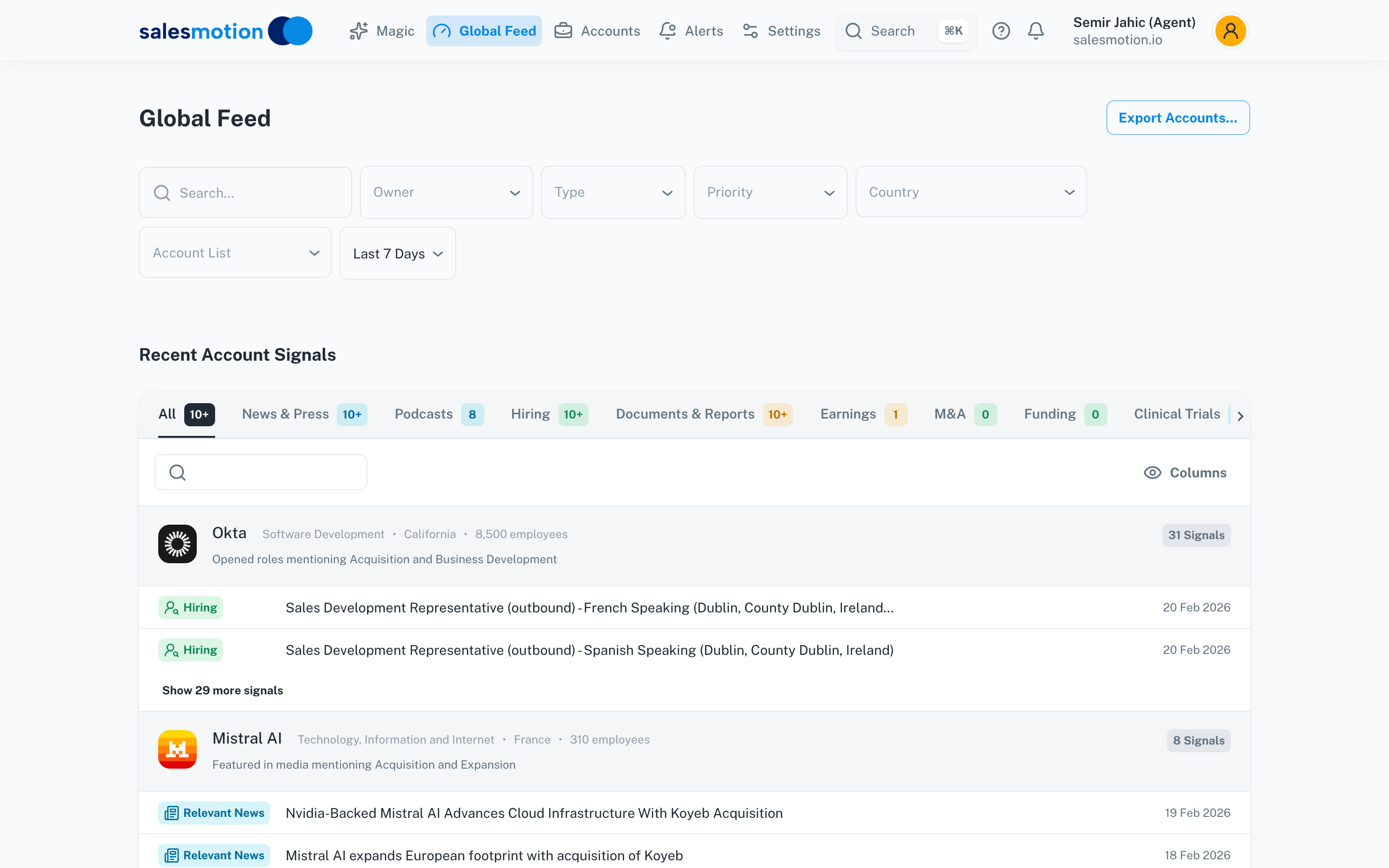 Salesmotion surfaces buying signals — hiring, earnings, news, M&A, funding — across your entire territory in a single feed, so reps act on the highest-value signals first.
Signal-Based Workflow: Enterprise Software Example
Trigger: A growth-stage enterprise software company announces a $150M Series D and posts 40 engineering roles in a single month. Their latest product blog describes a new AI module launching in Q3.
Platform action: The account brief updates with the funding event, the engineering hiring surge, the AI product announcement, the company's current technology stack (from job posting mentions), and leadership profiles including a recently hired VP of Engineering from a company that used your product.
Rep action: The rep reaches out to the VP of Engineering, referencing the funding round and the AI module launch, positioning their solution as supporting the engineering infrastructure needed to ship the new product on schedule. The outreach cites a similar company that scaled engineering 3x while reducing deployment cycle time.
Outcome: The conversation addresses the VP's immediate reality: scaling a team rapidly while delivering a new product on a tight timeline. The timing and specificity make the outreach stand out from generic vendor emails.
For more on selling to enterprise software companies, visit our sales intelligence for enterprise software page. Also explore our buying signals guide and B2B sales intelligence tools comparison.
Key Takeaways
- Enterprise software buyers are sophisticated evaluators who move fast once a decision is made. Timing your outreach to coincide with active investment cycles (post-funding, product launch, engineering scale-up) is more important than in any other industry.
- Engineering hiring surges are the most reliable leading indicator. A company hiring 50 engineers will need developer tools, infrastructure, and observability within months.
- Competitive responses create secondary buying signals. When a major competitor launches a new product, track how your target accounts respond, as those responses drive technology investment.
- Pre-IPO companies professionalize rapidly. Compliance, security, financial reporting, and vendor management all become urgent purchases in the 12-18 months before a public offering.
- Map signals to engineering maturity. A Series B company with 30 engineers and a public company with 5,000 engineers need entirely different solutions and messaging.
Frequently Asked Questions
What are the top buying signals for selling to enterprise software companies?
The strongest enterprise software buying signals are engineering hiring surges (indicating infrastructure investment), product launches (creating supporting technology needs), funding rounds and IPO filings (unlocking budget and professionalization), leadership changes (triggering vendor evaluations), and competitive responses (driving accelerated investment). These signals indicate active budget allocation and purchase urgency.
How do product launches create buying opportunities at enterprise software companies?
When an enterprise software company launches a new product or platform module, it needs supporting infrastructure: CI/CD tools, observability platforms, security solutions, data pipelines, and often new vendor relationships. The launch creates both immediate needs (pre-launch tooling) and ongoing needs (post-launch scaling and monitoring). Tracking product roadmap announcements gives sales teams advance notice of these windows.
Why are engineering hiring patterns so predictive of buying behavior?
Engineering hiring directly correlates with technology spending. Every engineer needs tools: IDEs, observability platforms, CI/CD pipelines, collaboration tools, and infrastructure access. A company hiring 50 engineers in a quarter will spend significantly on developer tooling within 3-6 months. Job postings also reveal technology stack details (mentioning specific frameworks, databases, and tools), providing direct insight into what the company uses and might replace.
How should sales teams track enterprise software buying signals at scale?
Enterprise software signals come from product blogs, funding databases, job boards, earnings transcripts, and competitive intelligence sources. The volume is high, with thousands of companies generating signals daily. A sales intelligence platform that aggregates these sources and enriches them with organizational and technical context helps reps focus on the highest-value opportunities without spending hours monitoring industry news.