Global fintech investment reached $51.9 billion in 2024, according to CB Insights, down from peak levels but still representing massive capital deployment. For B2B sales teams targeting fintech companies, every funding round, regulatory shift, and product launch creates a window of opportunity. Tracking fintech buying signals systematically separates teams that close deals from those that arrive after the vendor has already been selected. For a primer on what buying signals are and why they matter, see our guide to buying signals in sales.
TL;DR: FinTech buying signals include regulatory compliance changes, funding rounds, product launches, banking partnerships, leadership hires, geographic expansion, and earnings guidance. Monitoring these signals helps sales teams planning 2027 engage fintech accounts when budgets are active and priorities are shifting.
Why FinTech Buying Signals Demand Speed
Fintech companies operate at startup velocity with financial services complexity. A regulatory change can force a compliance tool purchase within weeks. A new banking partnership can trigger an infrastructure overhaul overnight. The window between a fintech company recognizing a need and selecting a vendor is often shorter than in traditional financial services, which makes real-time signal tracking essential.
Adopting a signal-based selling framework helps teams respond at the speed fintech demands. The fintech buying committee also differs from traditional banking. Decisions are made by a mix of technology leaders, compliance officers, product managers, and C-suite executives who often wear multiple hats. In early-stage fintechs, the CEO may approve tool purchases directly. In growth-stage fintechs, functional leaders have budgets and authority. Understanding the company's stage determines who your signals should target.
Fintech companies also face a unique tension: they need to innovate fast while maintaining strict regulatory compliance. This tension drives purchasing decisions in both directions. Innovation budgets fund new product capabilities. Compliance budgets fund risk and regulatory tools. Both create opportunities for B2B sellers.
See Salesmotion on a real account
Book a 15-minute demo and see how your team saves hours on account research.
Regulatory and Compliance Signals
Regulatory Compliance Changes
When regulators issue new rules for payments, lending, crypto, or banking-as-a-service, every fintech in that category must respond. The EU's PSD3 framework, evolving state money transmitter requirements in the U.S., and changing crypto regulations all create compliance-driven buying. Fintechs that need to meet new requirements often purchase compliance software, legal services, and audit tools within a compressed timeline.
Banking Partnership Announcements
When a fintech announces a new banking partner or sponsor bank relationship, it signals product expansion and regulatory readiness. These partnerships often require new compliance infrastructure, KYC/AML tools, and reporting capabilities. Track partnership announcements in fintech press and on company blogs.
Audit Findings and Consent Orders
Regulatory enforcement actions, consent orders, and audit findings are strong (if sensitive) buying signals. A fintech that receives a regulatory finding will invest in remediation tools, compliance consulting, and monitoring platforms. Track enforcement actions from the CFPB, OCC, FDIC, and state regulators.

“The moment we turned on Salesmotion, it became essential. No more hours on LinkedIn or Google to figure out who we're talking to. It's just there, served up to you, so it's always 'go time.'”
Adam Wainwright
Head of Revenue, Cacheflow
Funding and Growth Signals
Funding Rounds
Fintech funding creates immediate buying behavior. Seed-stage fintechs build core product infrastructure. Series A fintechs invest in go-to-market and compliance tooling. Series B and beyond invest in scaling operations, expanding teams, and professionalizing vendor relationships. The stage and size of funding directly predict which categories the company will buy from in the next 6-12 months.
Geographic Expansion
When a fintech announces expansion into a new country or region, it triggers regulatory, operational, and technology purchases. Each new market requires local compliance frameworks, payment rails, customer support infrastructure, and often localized product features. Track expansion announcements and international job postings as leading indicators.
Earnings Guidance and Strategic Commentary
Public fintechs like PayPal, Block, Adyen, and Toast provide quarterly guidance that reveals strategic priorities. Mentions of "investing in our platform," "expanding our merchant base," "building compliance infrastructure," or "accelerating product development" are direct statements of where the company will spend money. These buying signals are publicly available in earnings transcripts.
Organizational and Product Signals
Leadership Hires
A new Chief Compliance Officer signals a regulatory focus. A new VP of Engineering signals product investment. A new CRO signals go-to-market scaling. In fintech, leadership changes often precede major strategic shifts because new leaders are hired to execute specific mandates. Salesmotion monitors leadership changes across fintech territories and connects them to the company's recent announcements and strategic direction.
Product Launches and Feature Expansions
When a fintech launches a new product (buy-now-pay-later, embedded lending, crypto custody), it needs supporting infrastructure: analytics, risk management, compliance monitoring, and customer support tools. Product launches in fintech are particularly signal-rich because they often require entirely new vendor categories that the company has not purchased from before.
Technology Stack Migrations
Fintech companies outgrow their initial technology stacks quickly. A migration from a startup-grade payment processor to an enterprise solution, or from a basic data warehouse to a modern data platform, signals a maturation that opens buying windows across adjacent categories. Track technology mentions in job postings and on company engineering blogs.
“Automatic account profile detail I can use to manage my territory. Using Salesmotion AI to generate value statements per persona, account, etc. Using Salesmotion to give me a starting point based on new hires, or news alerts is critical.”
Adam Wainwright
Head of Revenue, Cacheflow
How to Operationalize FinTech Buying Signals
Fintech buying signals come from regulatory databases, funding trackers, company press releases, job boards, earnings transcripts, and industry publications. Tracking them manually across a territory of fintech accounts is a full-time job that no sales rep should be doing.
Automate signal aggregation. Use a platform that monitors regulatory announcements, funding databases, leadership changes, and product launches across your target accounts. Salesmotion aggregates signals from 1,000+ public sources, delivering enriched account intelligence briefs that combine financial, organizational, and regulatory data.
Build compliance-aware messaging. Fintech companies are sensitive about compliance topics. Frame your outreach around helping them meet regulatory requirements efficiently, not around the risk of non-compliance. Reference specific regulatory changes by name to demonstrate expertise.
Map signals to fintech stages. A pre-revenue fintech and a public fintech have completely different buying behaviors. Score signals against the company's stage (seed, growth, mature) to prioritize the highest-value opportunities.
Track the regulatory calendar. Major regulatory bodies publish rulemaking timelines months in advance. The CFPB, OCC, and EU regulators announce proposed rules before final rules take effect. Building these dates into your sales planning lets you prepare outreach and positioning before the compliance rush begins, giving your team a timing advantage over competitors who react after the deadline is announced.
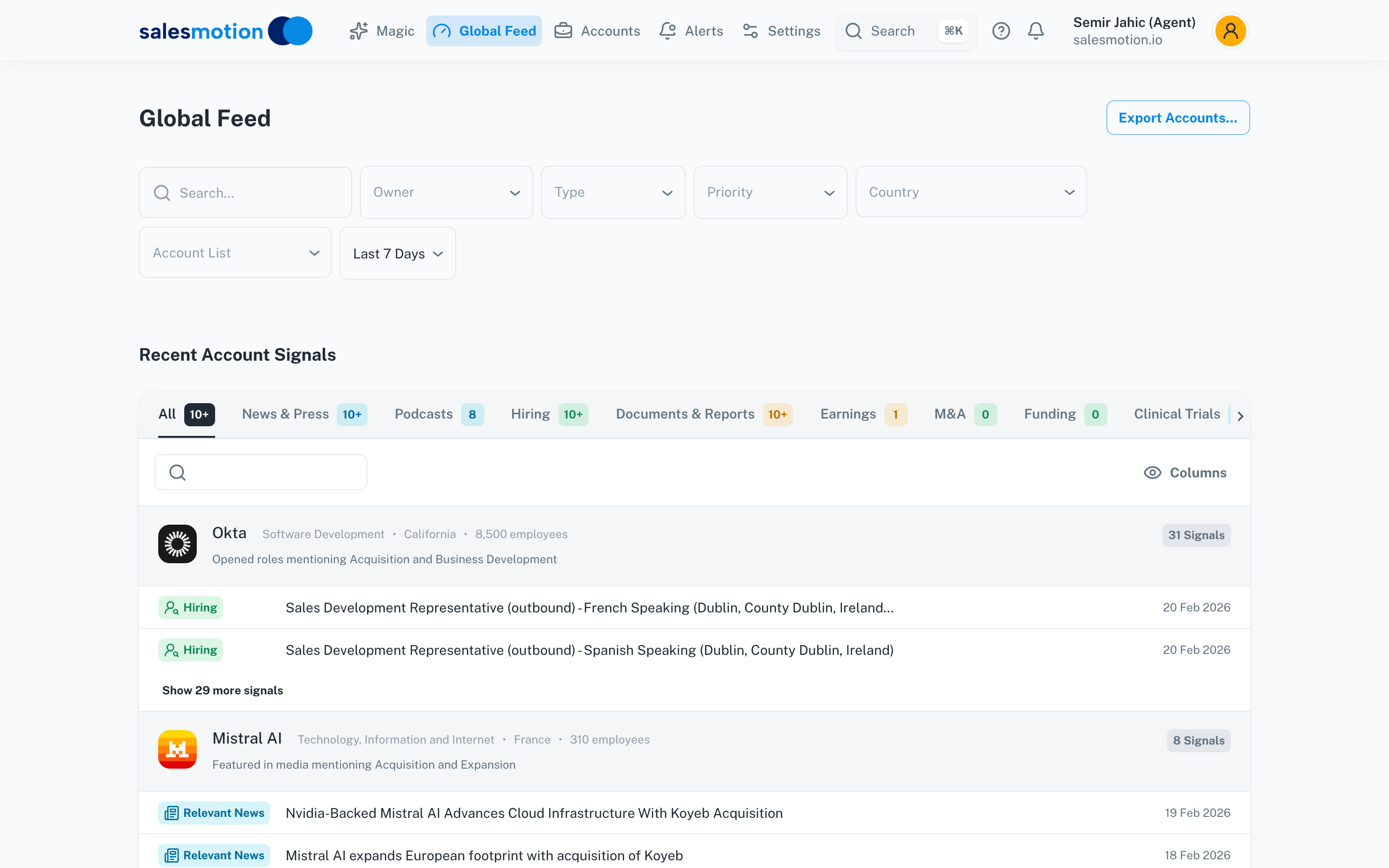 Salesmotion surfaces buying signals — hiring, earnings, news, M&A, funding — across your entire territory in a single feed, so reps act on the highest-value signals first.
Signal-Based Workflow: FinTech Example
Trigger: A Series B payments company announces a new European banking partnership and posts 5 compliance roles in London.
Platform action: The account brief updates with the partnership announcement, the compliance hiring surge, recent regulatory context (PSD2/PSD3 requirements for EU payment operations), and the company's leadership team including a recently hired Chief Compliance Officer.
Rep action: The rep references the EU expansion and the compliance hiring when reaching out to the Head of Operations. The outreach positions their solution as enabling faster EU compliance without building a full in-house team, citing a similar fintech client's experience.
Outcome: The conversation starts with a shared understanding of the account's challenge. The fintech is building EU compliance infrastructure under time pressure and welcomes a vendor who understands the specific regulatory landscape.
For detailed workflows and fintech-specific use cases, visit our sales intelligence for fintech page.
You can also learn more about how sales intelligence platforms track these signals and how to compare alternatives in our resource library. For parallel reading, explore our manufacturing buying signals guide.
Key Takeaways
- FinTech buying signals move faster than traditional financial services. Regulatory changes, funding rounds, and product launches can trigger purchasing decisions within weeks, not quarters.
- Regulatory compliance is the most reliable buying driver in fintech. Track regulatory announcements from the CFPB, OCC, and international regulators alongside company-specific signals for the strongest pipeline indicators.
- Funding stage determines buying category. Seed fintechs buy infrastructure, Series A fintechs buy compliance and GTM tools, and growth-stage fintechs buy at enterprise scale across multiple categories.
- Geographic expansion signals are high-value because each new market requires entirely new compliance, payments, and operational infrastructure.
- Automate fintech signal tracking to keep pace with the speed of the industry. Manual monitoring across regulatory databases, funding trackers, and job boards does not scale.
Frequently Asked Questions
What are the strongest buying signals in fintech B2B sales?
The strongest fintech buying signals are regulatory compliance changes (new rules requiring technology purchases), funding rounds (unlocking budget for growth), banking partnership announcements (triggering infrastructure needs), and leadership hires (especially Chief Compliance Officer and VP of Engineering roles). These signals indicate immediate budget availability and purchase urgency.
How do regulatory changes create fintech buying opportunities?
When regulators issue new requirements for payments, lending, crypto, or banking-as-a-service, every fintech in that category must comply within a defined timeline. This creates urgent, budget-approved purchasing for compliance software, legal services, audit tools, and monitoring platforms. The compliance deadline creates both urgency and a clear decision timeline that sales teams can plan around.
How should sales teams track fintech buying signals at scale?
Fintech signals come from regulatory databases, CB Insights, company press releases, job boards, and earnings transcripts. Manual monitoring is impractical for territories with more than 20 target accounts. A sales intelligence platform that aggregates these sources and delivers enriched account briefs enables reps to focus on selling instead of research.
Why is geographic expansion such a strong fintech buying signal?
Geographic expansion into a new country or region forces a fintech to build entirely new infrastructure: local compliance frameworks, payment processor relationships, customer support, and often a localized product. This creates buying opportunities across multiple vendor categories simultaneously, often on compressed timelines driven by market launch deadlines.