U.S. healthcare spending hit $4.8 trillion in 2024, according to CMS projections, and the pace of digital transformation in hospitals and health systems is accelerating. For B2B sales teams selling into healthcare, this creates a steady stream of healthcare buying signals that indicate when organizations are ready to invest in new technology, services, and infrastructure. The challenge is not finding opportunities. It is knowing which signals matter and tracking them systematically. If you are new to signal-based prospecting, our guide to buying signals in sales covers the fundamentals before you dive into the healthcare-specific playbook below.
TL;DR: Healthcare buying signals include EHR/EMR transitions, compliance mandates, CMS policy changes, hospital expansions, leadership hires, value-based care initiatives, and telehealth investments. Tracking these signals helps B2B sales teams engage healthcare organizations at the moment their priorities and budgets shift.
Why Healthcare Buying Signals Require a Different Approach
Healthcare organizations do not buy like SaaS companies or financial services firms. Their purchasing decisions are shaped by regulatory mandates, reimbursement changes, patient outcomes data, and accreditation requirements. A CMS policy change can create millions in new spending overnight. A Joint Commission finding can force an emergency technology purchase.
The buying committee in healthcare is also broader than most industries. A hospital technology purchase might involve the CIO, CMIO, CFO, department heads, compliance officers, and procurement. Each stakeholder responds to different signals. The CIO cares about interoperability mandates. The CFO watches reimbursement rate changes. The CMIO tracks clinical workflow efficiency. Teams that map signals to stakeholders and adopt a signal-based selling approach outperform those sending generic outreach.
Healthcare also has unique budget timing. Many health systems operate on fiscal years starting July 1, not January 1. Capital budget planning often begins 6-9 months before the fiscal year starts. Understanding these cycles is essential for timing your engagement.
Clinical and Operational Signals
EHR/EMR Transitions and Upgrades
When a health system announces an EHR migration or major upgrade, it triggers a cascade of buying activity. The organization will need implementation partners, data migration tools, training services, complementary applications, and integration middleware. Epic and Oracle Health (Cerner) migrations in particular create 12-24 month buying windows for vendors in adjacent categories. Track EHR transition announcements through KLAS Research and health IT trade publications.
Telehealth and Digital Health Investments
Telehealth adoption stabilized after the pandemic surge, but health systems continue investing in virtual care infrastructure. Announcements about telehealth platform expansions, remote patient monitoring programs, or digital front door initiatives signal technology buying. Watch for RFPs posted on state procurement sites and announcements in publications like Modern Healthcare.
Value-Based Care Initiatives
The shift from fee-for-service to value-based care is the most significant structural change in healthcare. When a health system joins an ACO (Accountable Care Organization), enters a bundled payment program, or announces a population health management initiative, it needs analytics platforms, care coordination tools, and patient engagement technology. CMS publishes lists of participating organizations, making these signals publicly trackable.
Hospital Expansion and Capital Projects
New facility construction, department expansions, and ambulatory care center openings all signal capital spending. These projects require medical equipment, IT infrastructure, workflow systems, and consulting services. Track construction permits, certificate of need (CON) applications (in states that require them), and bond issuance filings for healthcare construction projects.

“There's been a big focus on hyper personalization and relevance in our outbounding efforts. Salesmotion has been a key partner in hitting our significantly increased meeting targets. What stands out is how simple it is. Reps can log in and get valuable account insights within 30 seconds to a minute.”
Joe DeFrance
VP of Sales, Incredible Health
Regulatory and Policy Signals
CMS Policy Changes and Reimbursement Updates
CMS releases proposed and final rules multiple times per year that directly impact hospital operations. Changes to reimbursement rates, quality reporting requirements, and program participation rules create compliance-driven buying. When CMS announced new interoperability requirements under the 21st Century Cures Act, companies selling health information exchange technology saw a direct pipeline impact.
Compliance Mandates and Accreditation Changes
Joint Commission requirements, HIPAA enforcement actions, and state-level healthcare regulations all drive purchasing decisions. A hospital cited for a compliance deficiency will move quickly to address it. Track enforcement actions from the HHS Office for Civil Rights and Joint Commission standards updates.
State and Federal Funding Programs
Programs like the FCC's Healthcare Connect Fund, HRSA grants, and state Medicaid expansion create dedicated budgets for technology and services. When a health system receives grant funding for a specific initiative (broadband connectivity, behavioral health expansion, workforce development), it becomes a buyer with an allocated budget and a deadline to spend it.
Organizational Signals
Leadership Changes
In healthcare, a new CIO or CMIO almost always triggers a technology review. A new CFO may reassess vendor contracts for cost optimization. A new CEO often brings a strategic vision that includes technology investments. Salesmotion monitors these changes across your healthcare territory and surfaces the context around each hire, including the organization's recent strategic announcements and financial performance.
Workforce Changes and Hiring Patterns
Healthcare workforce shortages are driving technology purchases. When a health system posts roles for informaticists, data analysts, or digital health specialists, it signals an investment in technology infrastructure. Conversely, nursing shortage-driven investments in staffing platforms and workforce management tools create buying opportunities in adjacent categories.
M&A and Affiliations
Hospital mergers, acquisitions, and clinical affiliations create integration needs. When two health systems merge, they need to consolidate IT systems, standardize workflows, and often upgrade technology across both organizations. The wave of hospital consolidation in the U.S. creates ongoing buying signals for technology and services vendors.

“All of the vendors that I've worked with, all of the onboarding that I have had to deal with, I will say, hands down, Salesmotion was the easiest that I have had.”
Lyndsay Thomson
Head of Sales Operations, Cytel
How to Operationalize Healthcare Buying Signals
Healthcare buying signals come from diverse sources: CMS databases, state health department filings, KLAS reports, job boards, SEC filings for publicly traded health systems, and trade publications. Tracking them manually is impractical for any team with more than 20 target accounts.
Operationalizing these signals requires three things:
Centralized monitoring. Aggregate signals from regulatory databases, news sources, financial filings, and job boards into a single platform tied to your target account list. This eliminates the need for reps to manually scan multiple sources.
Contextual account briefs. A signal that "Hospital System X is migrating to Epic" becomes far more valuable when paired with context: the system's recent financial performance, leadership team, strategic priorities from their latest community health needs assessment, and current technology stack. Platforms like Salesmotion generate these enriched briefs automatically, connecting regulatory signals to organizational context.
CRM integration. Signals that do not reach reps in their daily workflow go unused. Push alerts and account updates directly into Salesforce or HubSpot so they trigger action within existing sales processes.
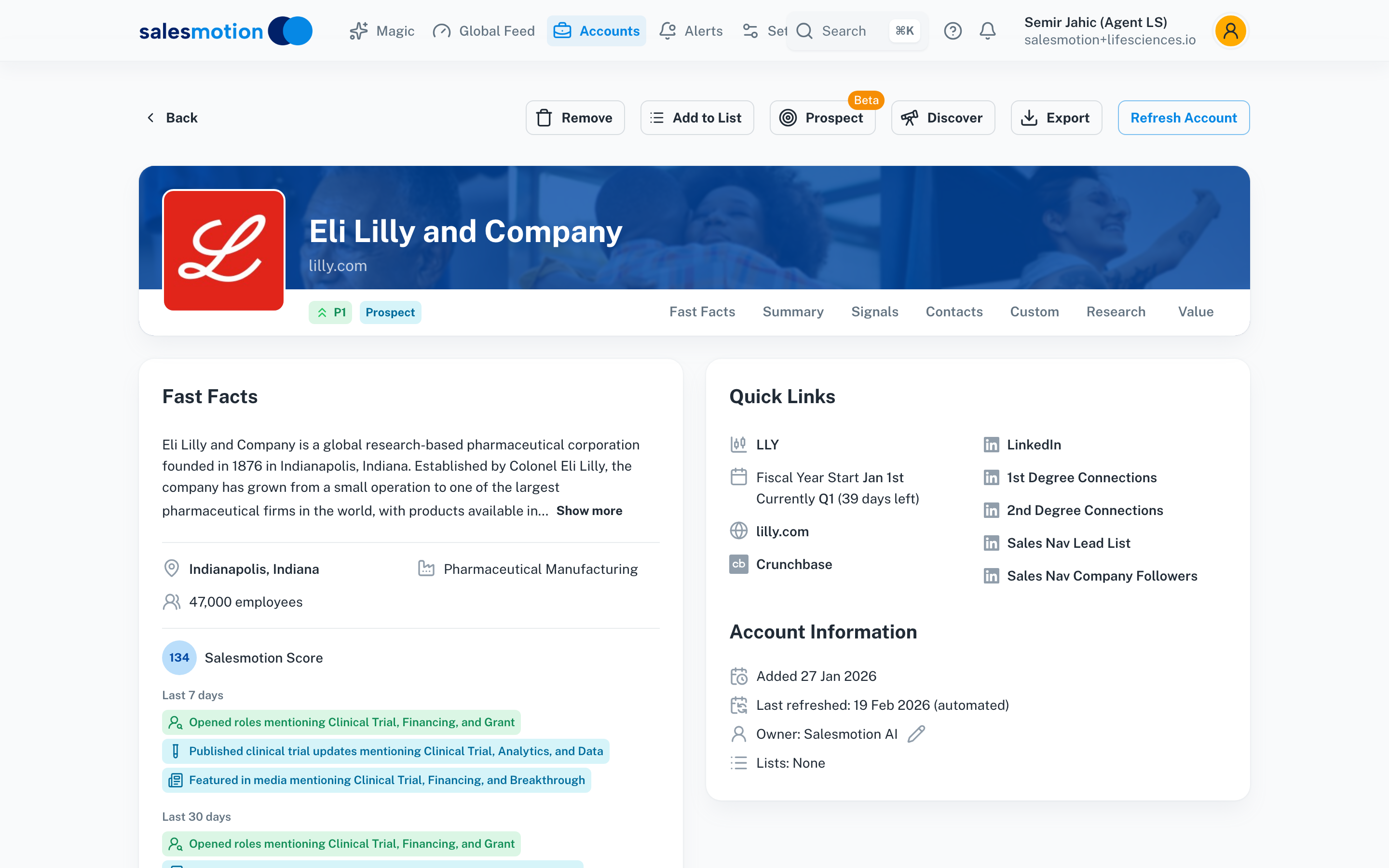 Salesmotion's Global Feed filtered to Clinical Trials — reps see new trial activity across their entire healthcare territory at a glance, with signal counts per account and direct links to source data.
Signal-Based Workflow: Healthcare Example
Trigger: A mid-sized health system announces it is joining a Medicare Shared Savings Program ACO, and the same organization posted a Director of Population Health Analytics role last week.
Platform action: Salesmotion surfaces the ACO announcement alongside the job posting, recent earnings commentary about "investing in data infrastructure to support value-based care," and a leadership profile of the newly appointed COO who previously led a successful value-based care transformation at another system.
Rep action: The rep reviews the enriched account brief and reaches out to the VP of Clinical Informatics with a message referencing the ACO participation and the organization's stated commitment to population health analytics. The outreach addresses a specific need rather than pitching a generic solution.
Outcome: The conversation starts at the strategic level: "How are you building your analytics capability for the MSSP?" instead of "Do you have 15 minutes for a demo?" The deal enters pipeline faster because the rep demonstrated understanding of the account's moment.
Connecting Healthcare Signals to Your Sales Strategy
Healthcare sales cycles are long, often 12-18 months for enterprise deals. Signals help you enter the cycle at the right moment and stay relevant throughout.
Map signals to buying stages. An EHR transition announcement is early-stage (12+ months from purchase). A compliance mandate with a deadline is late-stage (immediate need). A leadership change is mid-stage (new strategy, 3-6 month evaluation). Adjust your outreach cadence and messaging based on where the signal places the account in their buying journey.
Build healthcare-specific plays. Create playbooks tied to specific signal types: "CMS mandate response," "EHR migration partner," "value-based care analytics," and "post-merger integration." Each play includes tailored messaging, relevant case studies, and stakeholder mapping for that signal type. This aligns with account-based selling principles.
Track regulatory calendars. CMS publishes rulemaking timelines. Joint Commission updates standards on predictable schedules. State certificate of need filings follow set processes. Build these regulatory calendars into your planning so you can anticipate signals before they happen.
For more on how signal-driven sales intelligence works in healthcare, visit our sales intelligence for healthcare page. For adjacent verticals, see our guides to HR tech buying signals and fintech buying signals.
Key Takeaways
- Healthcare buying signals follow regulatory and accreditation timelines rather than typical B2B fiscal cycles. CMS rulemaking, Joint Commission standards, and state-level mandates drive purchasing behavior.
- EHR transitions create 12-24 month buying windows that extend beyond the primary vendor to implementation partners, integration tools, training, and complementary applications.
- Signal clusters (ACO participation + population health hiring + earnings commentary about data investment) reveal accounts with active buying intent more reliably than any single signal.
- Operationalizing healthcare signals requires centralized monitoring, contextual enrichment, and CRM integration. No rep can manually track CMS databases, job boards, and financial filings for 50+ accounts.
- Map signals to buying stages and build healthcare-specific outreach plays to make signal-based selling repeatable across the team.
Frequently Asked Questions
What are the strongest buying signals in healthcare B2B sales?
EHR/EMR transitions, CMS policy mandates with compliance deadlines, leadership changes (especially CIO and CMIO hires), value-based care program participation, and hospital expansion projects are among the strongest healthcare buying signals. These events indicate concrete budget allocation and organizational readiness for new vendor relationships.
How do CMS policy changes create buying opportunities?
CMS releases proposed and final rules that directly impact hospital operations, reimbursement, and quality reporting. When a new mandate requires specific technology capabilities (such as interoperability or electronic quality reporting), health systems must purchase or upgrade solutions to comply. The rulemaking timeline is public, giving sales teams months of advance notice to position their solutions.
How should sales teams track healthcare buying signals at scale?
Manual monitoring of CMS databases, state filings, KLAS reports, and job boards is not scalable for territories with dozens of target accounts. A sales intelligence platform that aggregates these sources, enriches signals with account context, and pushes alerts to the CRM enables reps to act on signals without spending hours on manual research.
Why do EHR migrations create so many buying opportunities?
An EHR migration affects nearly every clinical and operational workflow in a health system. Beyond the EHR vendor itself, the organization needs data migration services, interface engines, clinical decision support tools, training platforms, and often complementary applications that integrate with the new EHR. This creates a multi-year buying window that extends across dozens of vendor categories.