The average B2B sales team uses 13 tools. At least 5 of them now have "AI-powered" somewhere in their marketing. Every vendor in the sales technology space has added AI features, rebranded existing capabilities as AI, or launched new AI products in the past 18 months. For sales leaders evaluating these tools, the challenge isn't finding AI sales products. It's distinguishing between AI that genuinely improves revenue outcomes and AI that's a marketing label bolted onto the same software you already have. For a full category breakdown with pricing and ROI benchmarks, see our AI sales tools buyer's guide. This guide provides the evaluation framework for cutting through the noise.
TL;DR: Most "AI sales tools" fall into one of four categories: AI-enhanced CRM (Salesforce Einstein, HubSpot AI), AI-powered engagement (Outreach, Salesloft), AI conversation intelligence (Gong, Avoma), and AI account intelligence (signal monitoring and research automation). Evaluate each category against three criteria: does it measurably change rep behavior, does it reduce time-to-action on information, and can you measure ROI within 90 days? Tools that fail all three tests are AI theater.
The Four Categories of AI Sales Tools
Category 1: AI-Enhanced CRM
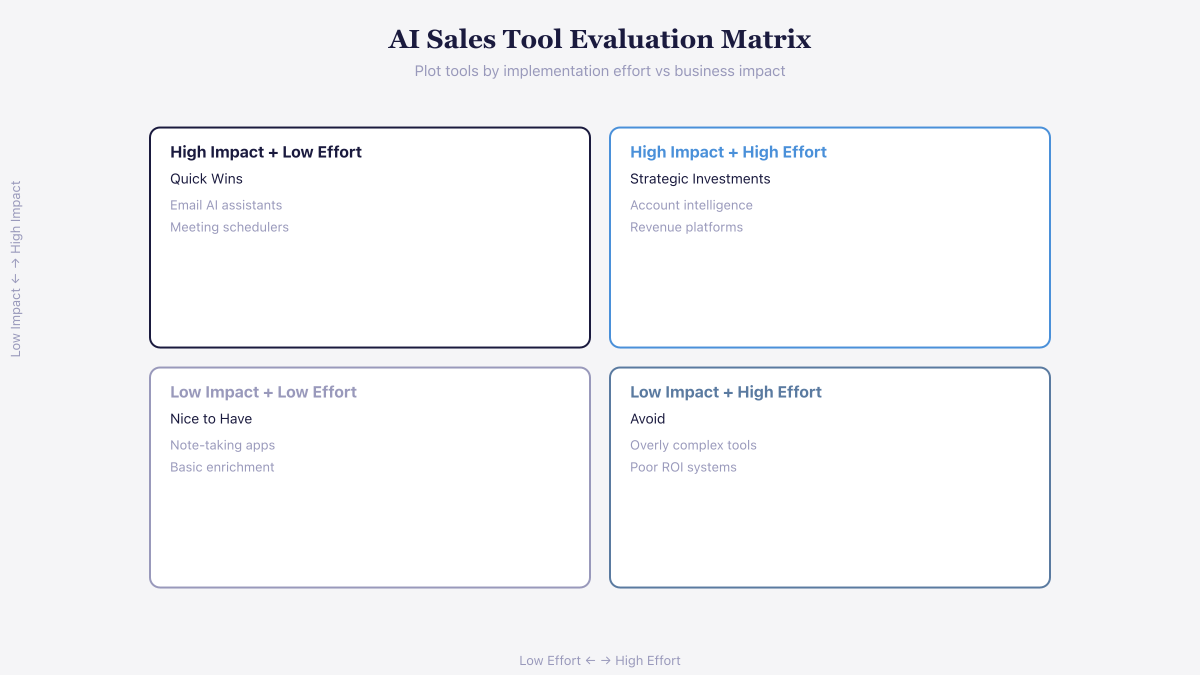 Plot AI tools by effort vs impact to prioritize quick wins and avoid low-ROI investments.
What it claims: Predictive lead scoring, AI-generated deal insights, automated data entry, forecasting recommendations.
What it actually does well: Reduces manual data entry (automatically logging activities, populating fields from emails), surfaces basic pipeline patterns (deals that match historical loss patterns), and provides conversational AI for querying CRM data ("show me all deals over $100K that haven't had activity this week").
Where it falls short: CRM AI is only as good as the data in the CRM. Most sales organizations have inconsistent, incomplete, or outdated CRM data. AI insights built on bad data produce confidently wrong recommendations. Additionally, CRM AI optimizes the system of record, not the selling process itself. A perfectly maintained CRM with terrible pipeline is still terrible pipeline.
Evaluation question: "If I improve my CRM data quality by 50%, would this AI feature change how my reps actually sell? Or would it just produce better reports about the same behavior?"
Category 2: AI-Powered Engagement
What it claims: AI-optimized send times, AI-generated email personalization, automated A/B testing, predictive response scoring.
What it actually does well: Optimizes tactical execution. AI can identify the best time to send emails to specific prospects, generate personalization snippets from LinkedIn and company data, and manage multi-step sequences more efficiently than manual cadence management.
Where it falls short: Engagement AI optimizes the how of outreach (timing, subject lines, templates) but not the what or why. If a rep is reaching the wrong account at the wrong time with no relevant context, optimizing the send time doesn't fix the fundamental problem. The highest-performing outreach combines the right account (prioritization), the right time (signal-driven), and the right message (context-specific). Engagement AI addresses only the execution layer.
Evaluation question: "Does this tool help my reps reach the right people at the right time with the right message? Or does it just help them send more emails more efficiently?"
Category 3: AI Conversation Intelligence
What it claims: Automated call analysis, AI coaching, deal risk detection from conversation patterns, competitive mention tracking.
What it actually does well: Eliminates manual note-taking, identifies coaching opportunities from call recordings, tracks competitive mentions across all conversations, and detects deal risk patterns (declining stakeholder engagement, increasing competitor mentions, sentiment shifts). For a detailed comparison of tools in this category, see our Gong alternatives guide.
Where it falls short: Conversation AI is inherently reactive. It analyzes what happened during a call but can't influence what happens before the call. A rep who enters a discovery call without research about the account's strategic priorities will have a mediocre conversation regardless of how well the AI analyzes it afterward. Post-call insights help with coaching but don't change the pre-call preparation that determines conversation quality.
Evaluation question: "Is the quality gap in my team's calls caused by what happens during the call (execution) or what happens before the call (preparation)? If it's preparation, conversation AI addresses the symptom, not the cause."
Category 4: AI Account Intelligence
What it claims: Automated account research, buying signal detection, AI-generated account briefs, outreach recommendations based on real-time account events. Platforms in this category include Salesmotion, Demandbase, and 6sense.
What it actually does well: Replaces 2-3 hours of manual research per account with automated intelligence gathering across public sources (news, SEC filings, job boards, social media, earnings calls). Surfaces timing signals (leadership changes, funding events, hiring surges) that tell reps when to engage. Generates context-specific outreach recommendations anchored to verified account events.
Where it falls short: Signal quality varies. Not every leadership change is relevant. Not every hiring spike indicates buying intent. The quality of the intelligence depends on how well the platform filters noise from signal and connects account events to your specific solution's value proposition.
Evaluation question: "Does this tool give my reps information they would act on differently than they act today? Or does it generate reports they'll glance at and ignore?"
The Three-Question Evaluation Framework
For any AI sales tool, apply these three tests:
Test 1: Does It Measurably Change Rep Behavior?
The most expensive AI tool is the one no one uses. Before evaluating features, assess whether the tool changes how reps spend their time.
Buyers apply this test before they sign. A RevOps lead at a software firm told us: "I need them to actually be using it in order for me to know if it's ... going to be valuable for them because they don't want to just be buying tools that they are not using."
Positive signals:
- Reps open the tool daily (not just when forced to during pipeline reviews)
- Reps reference the tool's output in their outreach and conversations
- Activity patterns change (more Tier 1 account engagement, less untargeted prospecting)
Red flags:
- The tool produces dashboards that managers review but reps ignore
- Implementation requires reps to add steps to their workflow
- The AI insights require interpretation from a RevOps team before reps can act
Test 2: Does It Reduce Time-to-Action?
The value of AI in sales is collapsing the time between information becoming available and a rep acting on it. A leadership change at a target account is most valuable on day 1. By day 30, the new leader has already been approached by every other vendor.
Evaluate time-to-action across the workflow:
| Workflow Step | Without AI | With AI Tool | Real Improvement? |
|---|---|---|---|
| Identifying which accounts to engage | Hours of manual research | Automated signal alerts | Yes, if signals are relevant and timely |
| Researching an account before outreach | 2-3 hours per account | AI-generated brief in minutes | Yes — Analytic Partners cut this from 3 hours to 15 minutes using Salesmotion |
| Writing personalized outreach | 20-30 minutes per email | AI-drafted email in seconds | Maybe — if the personalization is genuine, not generic |
| Analyzing a sales call | 30 minutes reviewing recording | AI summary in minutes | Yes, if the summary captures actionable insights |
| Forecasting pipeline | Hours of spreadsheet work | AI-predicted outcomes | Depends on data quality |
Test 3: Can You Measure ROI Within 90 Days?
Any AI tool that requires 6-12 months to demonstrate value is either too complex to implement or not actually changing outcomes. Demand measurable results within 90 days:
Meaningful 90-day metrics:
- Research time per account (before vs. after)
- Signal-to-meeting conversion rate
- Pipeline created from AI-informed outreach vs. baseline
- Forecast accuracy improvement
- Rep activity pattern changes (more high-value activities, fewer low-value activities)
Metrics that look good but don't matter:
- "AI interactions per day" (usage doesn't equal value)
- "Emails generated by AI" (volume doesn't equal pipeline)
- "Insights surfaced" (information delivered doesn't equal information acted on)

“The Business Development team gets 80 to 90 percent of what they need in 15 minutes. That is a complete shift in how our reps work.”
Andrew Giordano
VP of Global Commercial Operations, Analytic Partners
The Vendor Evaluation Checklist
When evaluating any AI sales tool, ask these specific questions:
About the AI:
- What data sources does the AI use? (If it's only your CRM data, it's limited to what you already have)
- How often is the model updated? (Annual model updates miss market changes)
- Can you explain how a specific recommendation was generated? (If the vendor can't, the rep won't trust it)
One buyer's shortcut for this part: a commercial excellence lead at a food manufacturer told us he tests every AI vendor with one figure he already knows about a well-known account.
About integration:
- Does it surface insights where reps already work (CRM, email, Slack) or require a separate application?
- Does it integrate with your engagement platform for action, or just deliver information?
- What's the setup time to first value?
About measurement:
- What specific metrics do current customers use to measure ROI?
- Can you connect me with a customer in my industry and company size?
- What's the average time to measurable ROI for new customers?
Teams like Analytic Partners evaluated account intelligence tools against these criteria and achieved measurable results within their first quarter: research time dropped from 3 hours to 15 minutes per account and qualified pipeline grew 40% year-over-year.
Key Takeaways
- AI sales tools fall into four categories: CRM enhancement, engagement optimization, conversation intelligence, and account intelligence. Each solves a different problem in the sales workflow.
- The three evaluation tests: Does it measurably change rep behavior? Does it reduce time-to-action on information? Can you measure ROI within 90 days?
- CRM AI improves reporting and data quality but doesn't change selling behavior. Engagement AI optimizes execution but not targeting. Conversation AI improves coaching but is reactive. Account intelligence addresses the preparation and prioritization gap that drives the most significant behavior change.
- Time-to-action is the most underrated evaluation criterion. Information that reaches a rep 30 days late is worthless regardless of how sophisticated the AI generating it is.
- Demand 90-day measurable ROI. Track research time reduction, signal-to-meeting conversion, and pipeline created from AI-informed outreach as primary metrics.
- Avoid "AI theater": tools that use AI branding without changing how reps actually sell. The test is simple — if you removed the AI features, would your team notice?

“The AI templates were a surprise delight. We expected the data, but the pre-built email suggestions turned out to be much better than expected and a huge help, especially for newer reps.”
Sabina Malochleb-Bazaud
Senior Sales Operations Administrator, Cytel
Frequently Asked Questions
What is an AI sales tool?
An AI sales tool uses artificial intelligence (machine learning, natural language processing, or predictive analytics) to automate, enhance, or optimize some aspect of the sales process. Categories include AI-enhanced CRM (automated data entry, predictive scoring), AI-powered engagement (optimized send times, AI-drafted emails), AI conversation intelligence (call analysis, coaching), and AI account intelligence (signal monitoring, research automation). The term is broadly applied, so evaluating whether the AI genuinely changes outcomes versus being a marketing label is essential.
How do I know if an AI sales tool is worth the investment?
Apply three tests: (1) Does it measurably change rep behavior — are reps doing things differently because of the tool? (2) Does it reduce time-to-action — can reps act on information faster than before? (3) Can you measure ROI within 90 days — are there concrete metrics improving (research time, pipeline creation, conversion rates)? If the tool fails all three tests, the AI features aren't translating to revenue impact.
Should I buy multiple AI sales tools or one platform?
Most enterprise teams benefit from a focused stack: one CRM with native AI features, one engagement platform, and one intelligence layer (either conversation intelligence or account intelligence, depending on whether the gap is call quality or pre-call preparation). Adding more tools creates integration complexity, data fragmentation, and adoption fatigue. Cytel consolidated five separate research tools into Salesmotion as a single intelligence layer, eliminating redundancy while increasing coverage. Consolidation toward fewer platforms with deeper AI capabilities is the trend for 2026.
What's the biggest mistake sales leaders make when buying AI tools?
Buying for the demo instead of the workflow. AI demos are impressive: the vendor shows a perfectly working example with clean data and ideal conditions. The reality is that your CRM data is messy, your reps are busy, and the integration takes longer than promised. Evaluate based on how the tool works in your actual environment with your actual data. Ask for a pilot with a small team rather than a full deployment based on a demo.