A business development director at a late-phase contract research organization once narrated the loop it took to send a single email. Pull a vertical-signal list, bulk-upload it to a contact enricher, filter by clinical-ops and CEO titles, open each company site, read the About, Programs, and Pipeline pages, infer the trial phase, then draft one message. By their own count, 10 to 15 minutes per company. That is the real shape of manual account research, and the cost is hidden because no dashboard line says "research." Do the math and the total is startling enough to rethink how the team spends its week.
TL;DR: Manual account research costs the average enterprise sales team $150,000+ per year in lost selling time. A 10-person team spending 6 hours per week on research burns 3,120 hours annually. Automating that workflow gives reps the equivalent of 7+ extra selling weeks each year.
The fix: replace the 5-tool manual research workflow with an AI account intelligence platform that aggregates all sources into pre-built briefs, cutting research time from 60 minutes to under 5 minutes per account.
How Much Time Does Account Research Actually Take?
The numbers vary by role, but the pattern is consistent across every B2B sales organization we talk to.
Account Executives with large territories (400-600+ accounts) spend 1-2 hours preparing for each first call. That includes reviewing the company website, LinkedIn profiles, recent news, financial filings, and competitive landscape. For an AE booking 4-5 first calls per week, that is 4-10 hours of prep time before a single conversation happens.
SDRs and BDRs toggle between 4-5 different sites and tools for each prospect. LinkedIn, the company website, ZoomInfo or similar data providers, industry news, and their CRM. Even at 15-20 minutes per prospect, a rep working 30 prospects per day loses hours to context switching alone — a problem that compounds when teams try to automate research across 500+ accounts without the right tooling.
Research and strategy teams supporting enterprise accounts spend even more. One team we spoke with had 10 people manually processing 150 accounts per week, building briefings that were often outdated by the time they reached the rep. The best account research tools solve this by keeping briefings continuously updated from live data sources.
Enterprise reps consistently report spending 6+ hours per week on manual research. That tracks with Salesforce's 2026 State of Sales report, which found reps spend 60% of their time on non-selling activities, with account research and call prep consuming roughly 14% of the average rep's week.
The field build lands in the same range: a rep researching 25 to 40 accounts a week at 10 to 15 minutes each spends 5 to 9 hours, 50 to 90 across a 10-person team.
See how many selling hours you'd get back
Salesmotion collapses the 5-tool, 60-minute research loop into one pre-built brief per account — so your reps spend the recovered hours selling, not researching.
The Dollar Cost Nobody Calculates
Here is where the conversation shifts from "that's just how sales works" to "we need to fix this immediately."
Take a mid-market or enterprise AE with a $100,000 OTE (on-target earnings). Using a standard 2,080-hour work year, that works out to roughly $48 per hour in direct compensation alone. Factor in benefits, tools, office space, and management overhead, and the fully loaded cost lands closer to $65-75 per hour.
Now apply that to research time:
| Scenario | Hours/Week | Annual Hours | Cost at $48/hr (OTE) | Cost at $70/hr (Loaded) |
|---|---|---|---|---|
| Single enterprise AE (6 hrs/wk) | 6 | 312 | $14,976 | $21,840 |
| 10-person AE team (6 hrs/wk each) | 60 | 3,120 | $149,760 | $218,400 |
| 25-person sales org (avg 5 hrs/wk) | 125 | 6,500 | $312,000 | $455,000 |
A 10-person team spending 6 hours per week on manual research burns $150,000-$218,000 per year before you account for the opportunity cost of deals that never happened because reps ran out of time.
And that opportunity cost is real. Only 28% of sales reps hit their annual quota in 2025, the lowest figure in six years. Every hour spent on research is an hour not spent building pipeline, running demos, or advancing deals — which is why sales rep productivity has become a board-level concern for most B2B companies.
The Hidden Multipliers
The raw time calculation understates the true cost. Three factors make it worse:
Context switching destroys focus. Toggling between LinkedIn, a company website, a news aggregator, SEC filings, and your CRM fragments attention. Research from the American Psychological Association shows task switching can consume up to 40% of productive time. Your reps are not just spending 6 hours researching. They are spending 6 fragmented hours that degrade the quality of the surrounding selling hours too.
Research quality degrades under time pressure. When reps know they have five calls that afternoon, they cut corners. They skim instead of reading. They miss the leadership change that happened last week or the earnings miss that would have changed their entire approach. Incomplete research leads to generic conversations, which leads to lower conversion rates.
Stale research gets repeated. That briefing a rep built three weeks ago? Half of it is outdated. New press releases, leadership changes, and competitive moves happen daily. Without a system that continuously updates, reps either work with stale information or re-research the same accounts repeatedly.

“We're saving about 6 hours per week per seller on account research alone. That's time they can reinvest in actually selling.”
Derek Rosen
Director, Strategic Accounts, Guild Education
The Four Hidden Costs
The dollar table captures recovered hours. It misses four costs with no line item:
- Ramp paid twice. The research loop lives in your best reps' heads, so you pay once in a new hire's salary and again in pipeline that stalls while they learn.
- A quality floor set by the busiest rep. Your top AE finds the catalyst in the earnings transcript while your newest SDR skims the homepage. The floor is set by who is busiest, not what is possible.
- Reactive missed timing. Paraphrasing one CRO leader: get busy for a week or miss the feed, and the signal is gone. Manual research is a snapshot on the rep's schedule, but the signal fires on the market's, the case for signal-based selling.
- Template-grade outreach. When every account costs 10 to 15 minutes, reps run out of road and send a generic ask the prospect spots.
What Your Team Could Do With 6 Extra Hours Per Week
The question is not just "how do we reduce research time?" It is "what would reps do with 312 extra hours per year?"
Here is what we see when teams automate their account research workflow:
More Pipeline, Better Pipeline
Six extra hours per week means 4-5 additional prospect conversations. Over a quarter, that is 60+ additional touchpoints per rep. For a 10-person team, that is 600 more conversations with potential buyers per quarter.
But it is not just volume. When reps arrive at calls better prepared (because automated research surfaces insights they would have missed manually), conversion rates improve. Reps who have detailed account intelligence ask sharper questions, tailor their pitch to the prospect's actual priorities, and build credibility faster.
Faster Ramp for New Hires
New reps spend the most time on research because they do not yet know where to look or what matters. Automating that workflow cuts ramp time significantly. Instead of spending their first weeks learning how to navigate five different research tools, new hires can focus on learning the product, the sales process, and how to have great conversations.
Consistent Preparation Across the Team
Manual research means inconsistent quality. Your best reps do thorough prep. Your average reps do the minimum. Automated research creates a consistent baseline where every rep walks into every call with the same depth of intelligence. That raises the floor for your entire team.
Strategic Account Coverage
When research takes 1-2 hours per account, reps can only deeply cover 20-30 accounts per quarter. When research takes 15 minutes, that number jumps to 100+. The math changes what kind of territory strategy is even possible.

“The Business Development team gets 80 to 90 percent of what they need in 15 minutes. That is a complete shift in how our reps work.”
Andrew Giordano
VP of Global Commercial Operations, Analytic Partners
Before and After: A Day in the Life
Before automation (enterprise AE, typical Tuesday):
- 8:00 AM: Open laptop, check email, review calendar (3 calls today)
- 8:30 AM: Start research for 10:00 AM call. Google the company, read recent press releases, check LinkedIn for the prospect's background, review last quarter's earnings, scan Glassdoor reviews. Find a relevant industry article to reference.
- 9:45 AM: Finish research, jot down talking points
- 10:00 AM: First call
- 10:45 AM: CRM notes, follow-up tasks
- 11:00 AM: Start research for 1:00 PM call. Repeat the same process.
- 12:15 PM: Lunch (while reading a prospect's annual report)
- 1:00 PM: Second call
- 1:45 PM: CRM notes, follow-up tasks
- 2:00 PM: Start research for 3:30 PM call
- 3:15 PM: Finish research
- 3:30 PM: Third call
- 4:15 PM: CRM notes, pipeline updates, internal Slack messages
- 5:00 PM: End of day. Three calls completed. Roughly 3.5 hours spent on research.
After automation (same AE, same Tuesday):
- 8:00 AM: Open laptop, review pre-built account briefings for today's three calls (15 minutes each, including talking points, recent signals, and stakeholder maps)
- 8:45 AM: Use freed time to prospect into two new accounts that showed buying signals overnight
- 9:30 AM: Send personalized outreach to both accounts using AI-generated talking points
- 10:00 AM: First call (better prepared, with insights the manual process would have missed)
- 10:45 AM: CRM notes, follow-up tasks
- 11:00 AM: Prep for next call (10 minutes, briefing already built). Use remaining time for deal strategy on a stalled opportunity.
- 1:00 PM: Second call
- 1:45 PM: CRM notes. Review a new account signal that just came in.
- 2:00 PM: Send outreach to a third new prospect. Prep for 3:30 PM call (10 minutes).
- 3:30 PM: Third call
- 4:15 PM: CRM notes. Review and prioritize tomorrow's pipeline.
- 5:00 PM: End of day. Three calls completed, plus three net-new outreach touches. Research time dropped from 3.5 hours to 45 minutes.
The difference is not subtle. It is nearly three hours reclaimed in a single day.
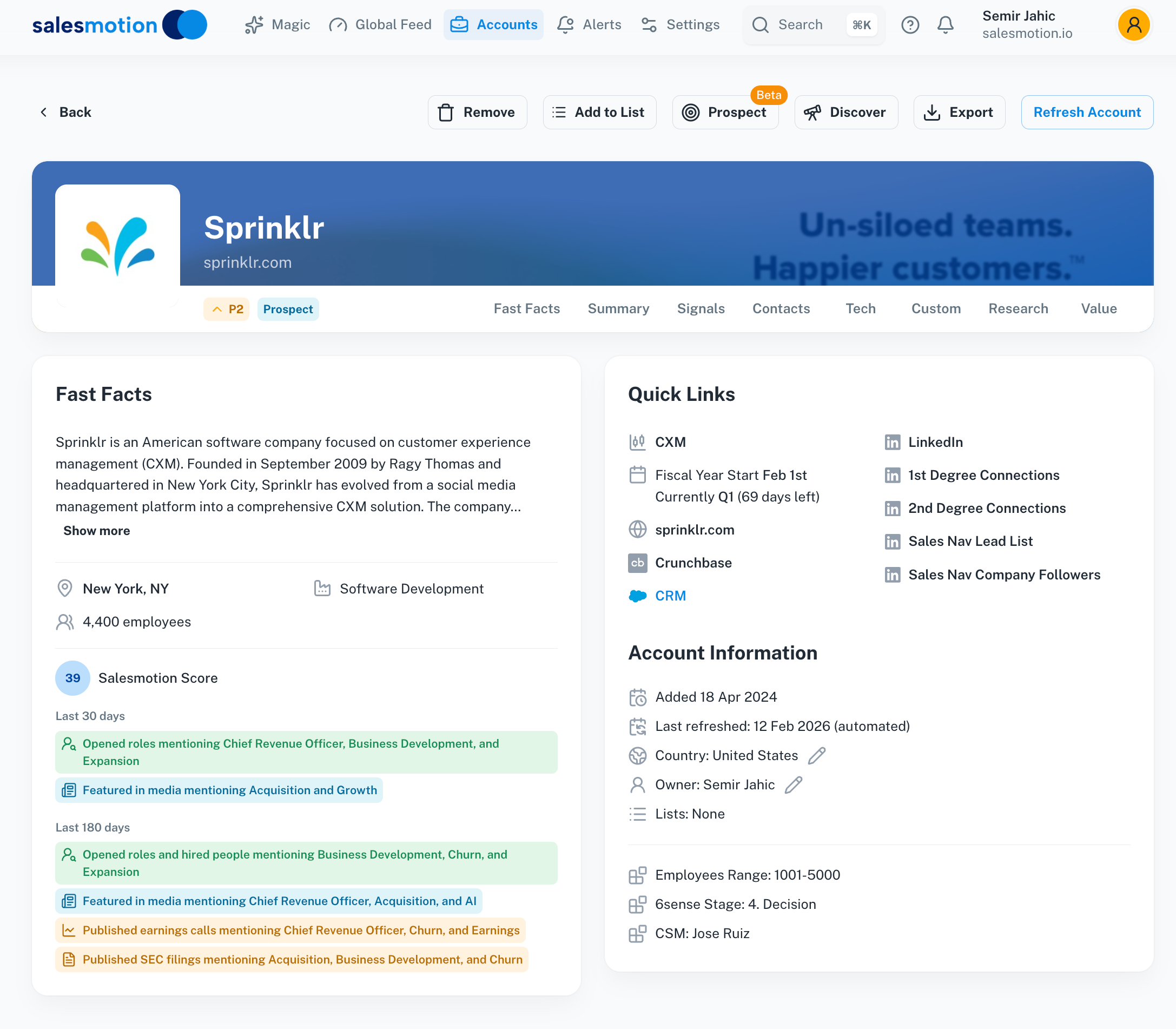 Everything a rep needs to know about an account, available in under 60 seconds instead of 60 minutes.
How to Calculate Your Team's Research Cost
Use this formula to calculate what manual research costs your specific organization:
Annual research cost per rep = (Hours per week on research) x (52 weeks) x (Fully loaded hourly cost)
Team research cost = (Annual cost per rep) x (Number of reps)
Opportunity cost = (Hours saved per week) x (Average meetings booked per hour of selling) x (Average deal value) x (Win rate)
For a concrete example: if a 10-person team saves 5 hours per week per rep, that is 2,600 hours returned to selling annually. If each selling hour produces 0.5 meetings, that is 1,300 additional meetings. At a 20% close rate and $50,000 average deal value, the pipeline impact is $13 million in additional opportunity creation.
Even if you discount that by 80% for real-world friction, you are still looking at $2.6 million in pipeline that would not have existed. And it misses the accounts reps quietly drop when busy.
Teams that have made this shift report measurable results. Guild Education cut 30 minutes per account and over 6 hours per week per seller after automating their research workflow with Salesmotion.
Why Does Manual Research Persist (And How Do You Break the Cycle)?
If the cost is so clear, why do most teams still rely on manual research? A few reasons:
"It's always been this way." Research is invisible work. It does not show up in CRM dashboards or pipeline reports. Leaders see the output (calls, meetings, proposals) but not the input (hours spent gathering context). Until someone calculates the actual cost, it feels like a fixed part of the job.
Fear of losing the human edge. Reps worry that automating research means losing the personal touch that makes their outreach effective. The opposite is true. AI account research gives reps better raw material to personalize with, not less.
Tool overload created skepticism. Sales teams already juggle an average of 8 tools to close deals, and more tools tend to lengthen the loop, not shorten it. One team described a prior tool with 80 licensed users and 3 daily actives. The shift only works when the automation replaces multiple tools rather than adding to the stack, which is the philosophy behind the best sales productivity tools.
"We can just use ChatGPT." That replaces manual research with manual prompting, one account at a time, with no territory monitoring, no live sources, no shared team context. Same reactive pattern.
Breaking the cycle starts with measurement. Calculate the number. Show your team what 6 hours per week actually costs. Then show them what is possible when that time goes back to selling.
Step-by-Step: How to Replace Manual Research with AI
If you are ready to automate account research, here is the implementation path that works for most B2B sales teams.
Step 1: Audit Your Current Research Workflow
Before choosing a tool, document where your reps actually spend their research time. The typical B2B SDR toggles between 5-8 tools per account: LinkedIn for contacts and company updates, ZoomInfo or Apollo for firmographics, Google for news, the company's IR page for earnings data, Glassdoor for culture signals, and their CRM for deal history. Time each step. Most teams discover that 60-70% of research time goes to aggregating information that an AI platform can consolidate automatically.
Step 2: Choose an AI Account Research Platform
Different platforms automate different parts of the research workflow. Here is how they compare:
| Platform | What It Automates | Best For | Pricing |
|---|---|---|---|
| Salesmotion | Full account intelligence + signals + cited briefs | Enterprise account research | From $85/mo |
| Clay | Data enrichment + custom workflow automation | Enrichment pipelines for GTM ops | Free tier; from $185/mo |
| Apollo.io | Contact data + basic company intel + sequences | Contact-first prospecting | Free tier; from $49/user/mo |
| 6sense | Intent data + anonymous account identification | ABM and demand gen alignment | Not published |
| Demandbase | ABM + account-level advertising + basic intel | Marketing-sales alignment | Custom |
The key differentiator: enrichment tools (Apollo, Clay) tell you who works at a company. Account intelligence platforms tell you what the company is doing right now and why they might buy. Choose based on whether your bottleneck is finding contacts or understanding accounts.
Step 3: Configure Signal Alerts for Your Territory
Load your target account list and configure monitoring for the buying signals that matter most to your business: leadership changes, earnings call mentions of your category, hiring surges in relevant departments, funding rounds, product launches, and competitive displacement events. The goal is to surface why now triggers that inform both whether to reach out and what to say.
Step 4: Integrate with Your CRM
Connect the intelligence platform to Salesforce or HubSpot so account briefs and signals surface where reps already work. If reps have to log into a separate tab, adoption will fail. The best implementations push intelligence directly into CRM record pages, Slack alerts, and email drafts.
Step 5: Train Reps on the 5-Minute Prep Workflow
Replace the 45-60 minute manual research process with a 5-minute brief review:
- Open the account brief (auto-generated from 1,000+ sources)
- Scan the top 2-3 signals — what just happened at this company?
- Identify 1-2 talking points anchored to those signals
- Draft or review the AI-generated outreach
- Send within minutes of the signal firing, not days
Teams that follow this workflow report going from 60 minutes per account to under 5, recovering 6+ hours per rep per week.
Key Takeaways
- Enterprise reps spend 6+ hours per week on manual account research, costing $15,000-$22,000 per rep annually in direct compensation alone.
- A 10-person sales team burns $150,000-$218,000 per year on manual research before accounting for opportunity cost.
- The true cost is higher when you factor in context switching, stale data, and inconsistent research quality across the team.
- Automating account research returns 300+ hours per rep per year to active selling, enabling more pipeline, faster ramp times, and better call preparation.
- Calculating your team's specific research cost is the first step toward building the business case for automation.
Frequently Asked Questions
How much time does the average sales rep spend on account research?
Industry benchmarks vary, but enterprise reps consistently report 5-7 hours per week on account research and call preparation. The Salesforce State of Sales 2026 report found that research and prep consume roughly 14% of a rep's total work week. SDRs working high volumes may spend less per account but more total time due to the number of prospects they touch daily.
What is the ROI of automating account research?
The direct ROI comes from time savings: if each rep saves 5-6 hours per week, that is 260-312 hours per year returned to selling at a fully loaded cost of $65-75 per hour. For a 10-person team, the savings alone are $169,000-$234,000 annually. The indirect ROI from better-prepared conversations, higher conversion rates, and increased pipeline coverage typically exceeds the direct savings by 3-5x.
Does automating research reduce the quality of sales conversations?
No. The concern is understandable but backwards. Automated research platforms like Salesmotion aggregate intelligence from hundreds of sources and surface insights that manual research would miss entirely. Reps still personalize their approach, but they start from a richer, more current foundation. Teams that automate research consistently report better conversation quality because reps arrive with deeper context on the prospect's priorities, recent moves, and competitive landscape.
How do I build a business case for account research automation?
Start by measuring current state. Have each rep track their research time for two weeks. Multiply by their fully loaded hourly cost to get the annual investment. Then calculate the opportunity cost using your team's average meetings-per-hour and deal metrics. Present both numbers alongside a specific before-and-after workflow showing how daily schedules change. Include at least one customer reference from a similar team size or industry to make the case concrete.
What tools replace manual account research?
The leading platforms for replacing manual account research are: Salesmotion (full account intelligence with signal monitoring across 1,000+ sources, from $85/mo), Clay (data enrichment workflows connecting 150+ data providers, from $185/mo), Apollo.io (contact data plus basic company intelligence, from $49/user/mo), 6sense (intent data and predictive analytics, quote-only), and Demandbase (ABM and account-level insights, custom pricing). For enterprise teams needing cited, research-grade account briefs with earnings call analysis and SEC filing monitoring, signal-driven platforms provide the deepest coverage.
How do I get started with AI research automation?
Start with a three-step process: (1) Audit where your reps spend research time — most teams find 60-70% goes to manual aggregation across LinkedIn, Google, and company websites. (2) Choose a platform based on your primary bottleneck — contact finding (Apollo, Clay) vs. account understanding (Salesmotion, 6sense). (3) Run a 30-day pilot with 5 reps and 50 target accounts, measuring time saved per account and meetings booked. Teams typically see measurable ROI within the first month.