In today's complex B2B world, a firm handshake and charisma won't cut it. Success isn't about landing one great pitch; it's about building a deep, resilient relationship that can navigate long sales cycles and rooms full of stakeholders.
TL;DR: Lasting B2B client relationships are built on continuous research, personalized outreach, and strategic multi-threading -- not charm. This playbook shows how to shift from reactive vendor to proactive advisor by delivering timely, relevant insights at every touchpoint.
This means shifting from a vendor who sells to a client to a partner who advises with them.
This guide provides a step-by-step playbook for sales and account teams ready to build connections that drive real growth.
Moving Beyond the Handshake

The core idea is simple: stop being a reactive vendor and start acting like a proactive advisor. You need to know what’s happening in your client's world—sometimes before they do—and connect your solution to their most pressing priorities.
Real relationship-building isn't about sending gift baskets. It's about delivering timely, relevant insights that help your clients succeed.
The difference between persistence and being a nuisance is the value you provide with each touchpoint. Annoying persistence is 'just checking in.' Valuable persistence is sharing a relevant article or a new insight about their competitor.
This mindset turns every interaction into a chance to build trust. It's a key part of any effective set of customer success strategies because it anchors the relationship in long-term value, not short-term wins.
Why a Systematic Approach Is Non-Negotiable
Relying on individual rep instincts is risky and leads to inconsistent results. A systematic approach gives your entire team a reliable blueprint for building strong relationships.
This involves using technology to automate research, track engagement, and operationalize your follow-up. The global CRM market is projected to hit $158.6 billion by 2033 for a reason. Companies know a solid infrastructure for managing client interactions is a huge competitive advantage.
To succeed, you need a process built on a few essential pillars. This foundation turns random outreach into a scalable relationship-building machine.
The Modern Relationship Building Framework at a Glance
| Framework Pillar | Primary Goal | Key Activities |
|---|---|---|
| Continuous Research | Maintain a real-time understanding of the client's business context. | Monitoring company news, funding rounds, new hires, product launches, and competitor moves. |
| Personalized Outreach | Engage contacts with timely and relevant messaging that adds value. | Crafting outreach based on specific signals; referencing their recent wins or challenges. |
| Deep Meeting Prep | Ensure every conversation is impactful and moves the deal forward. | Developing talk tracks aligned with the client's stated goals; preparing for objections. |
| Strategic Multi-threading | Build consensus and de-risk the deal by engaging multiple stakeholders. | Mapping the buying committee; tailoring value propositions for different roles. |
| Systematic Follow-up | Maintain momentum and stay top-of-mind without being a nuisance. | Using structured cadences with value-added touchpoints; tracking engagement. |
This framework ensures you show up with a purpose, knowing what to say, who to say it to, and when to say it.
See Salesmotion in action
Take a self-guided interactive tour — no signup required.
Mastering Continuous Research and Signal Monitoring
Strong client relationships start long before the first email. A quick scan of a company's website moments before a call is no longer enough. You have to become a student of your client's business, acting as an always-on intelligence hub.
This means shifting from one-off research to continuous monitoring. You're not just collecting facts; you're hunting for signals—key events that create opportunities for a meaningful conversation.

For example, a press release about a new product isn't just news. It’s a signal that their R&D priorities have shifted and new operational challenges are on the horizon. This is the material you need to build a relationship based on relevance.
What Signals Should You Be Tracking?
To build relationships that lead somewhere, focus on signals that point to a change in priorities, pain points, or personnel. These are the triggers that turn cold outreach into a timely, consultative conversation.
Here are the most valuable signals to track:
- Executive Hires: A new VP of Engineering often signals a new technical strategy or a fresh budget.
- Funding Rounds: Fresh capital is a clear sign of where a company is placing its bets for future growth.
- Product Launches: A major launch reveals the company's market focus and creates new operational challenges you might be able to solve.
- Mergers and Acquisitions: An acquisition creates massive internal change and turbulence—an opportunity for you to offer stability and expertise.
Tracking these events helps you move from "just checking in" to "I saw you hired a new CRO to expand into APAC, and I have some insights on that." For a deeper dive, exploring signal-based selling can provide a more structured approach.
Turning Raw Information Into Actionable Intelligence
Spotting a signal is the first step. The real work is connecting that signal to a client's potential needs. This separates a reporter of news from an interpreter of what that news means for their business.
The goal isn't just to know what happened, but to form a hypothesis about why it matters to them. A funding announcement isn't the reason to call; the strategic initiative that funding enables is the reason.
Let's walk through an example. You see a target account published a new case study with a major client.
Here's how to turn that into an intelligent narrative:
- The Signal: The company is promoting its success in the manufacturing sector.
- The Insight: This suggests a strategic push to capture more of that market.
- The Action: Your outreach can now be hyper-relevant. "Saw the great case study with [Manufacturer Name]. As companies scale into new verticals, they often face challenges with [mention a relevant pain point your solution solves]. Is that on your radar as you build on this momentum?"
This proves you’re an informed partner, not just another vendor. You can sharpen this process by leveraging call analytics to uncover subtle signals from your conversations. This feedback loop—from public signals to private conversations—is the engine of a strong client relationship.
All that research is worthless if it doesn't spark a real conversation. This is where you turn signals into outreach that gets a response.
Generic templates are dead. Timely, relevant outreach is what books meetings.
The goal is to sound like a well-informed peer with a valuable point of view. You’re not asking for their time; you’re offering an insight based on what’s happening in their world, right now.
That shift changes the entire dynamic.
Anchoring Your Outreach in Actionable Signals
Every message you send should be anchored to your research. Referencing a specific company event proves you’ve done your homework and aren't just blasting a generic pitch.
Here are a couple of real-world scenarios:
Scenario 1: New Executive Hire
- The Signal: A target account hired a new Chief Revenue Officer (CRO).
- The Flawed Approach: "Hi [Name], Congrats on the new role! I help CROs improve sales performance. Can we chat?"
- The Signal-Based Approach: "Hi [Name], Congrats on the new CRO role at [Company Name]. When a new sales leader joins, one of their first priorities is often evaluating the tech stack to support their strategy. I have some insights on how companies in your space are addressing [Pain Point] that might be useful. No pitch, just some ideas."
The second message shows you understand the role's pressures and positions you as a helpful resource.
Scenario 2: Recent Funding Announcement
- The Signal: The company announced a $50 million Series B for international expansion.
- The Flawed Approach: "Saw you raised money. We help companies scale. Let's connect."
- The Signal-Based Approach (via LinkedIn): "Congrats on the Series B! The plan for European expansion sounds ambitious. I recently worked with another SaaS firm on a similar market entry, and they ran into a few hurdles around [Specific Challenge]. Might be worth a brief chat to share what we learned."
This approach connects their public goal with a credible challenge you can help them think through. A strong outbound sales strategy should always be rooted in these kinds of timely triggers.
Preparing Talk Tracks for the First Meeting
Once you land the meeting, the real work begins. A quick LinkedIn scan five minutes before the call isn't enough. You need to prepare talk tracks—structured talking points that connect your solution to their recent initiatives and goals.
This isn't about memorizing a script; it's about having an informed point of view.
- Review Recent Signals Again: Revisit the company’s latest press releases or news. What are their top three priorities for this quarter?
- Connect Priorities to Pain: For each priority, brainstorm potential challenges. If they want to "increase enterprise market share," they will likely face "longer sales cycles."
- Align Your Solution: Frame your product's capabilities as direct solutions to those challenges. Lead with their problem, not your features.
For example, if their CEO mentioned "improving customer retention," your talk track isn't about your CRM integration. It's about how your platform helps teams "proactively identify at-risk accounts by monitoring engagement signals, which supports the company-wide retention goal."
The most powerful question you can ask in a first meeting isn't about their budget. It's this: "Based on your strategic goals for this year, what is the one operational bottleneck that, if removed, would have the biggest impact on your success?"
This question elevates the conversation from a product pitch to a strategic discussion, positioning you as a partner dedicated to solving their core challenges.

“Salesmotion helps you spot signals from prospect accounts, news items / job hiring alerts etc that indicate that now is a good time to reach out with a well-crafted message.”
Rob Douglas
Director of Sales, icit business intelligence
Expanding Influence with Multi-Threading and Stakeholder Mapping
Relying on a single contact is one of the riskiest mistakes in B2B sales. If your champion leaves the company or loses internal influence, your deal can stall overnight.
This is where multi-threading comes in. It’s the practice of building relationships with multiple stakeholders across the client’s organization. Think of it as weaving a strong web of influence rather than hanging by a single thread.
A multi-threaded deal is stronger. It gives you a 360-degree view of internal dynamics, helps you spot risks, and builds broad support for your solution.
Identifying the Key Players with Stakeholder Mapping
Before you can build that web, you need a map. Stakeholder mapping helps you identify who’s who in the buying decision. In most large deals, you'll encounter a few key personas:
- The Economic Buyer: The person with final budget authority. They care about ROI and strategic impact.
- The Technical User: The person or team who will be hands-on with your product. They care about features, usability, and workflow integration.
- Potential Blockers: People who can kill your deal, perhaps due to loyalty to a competitor or resistance to change.
This hierarchy shows how to prepare for any stakeholder conversation: Research, personalize your message, and align with their goals.
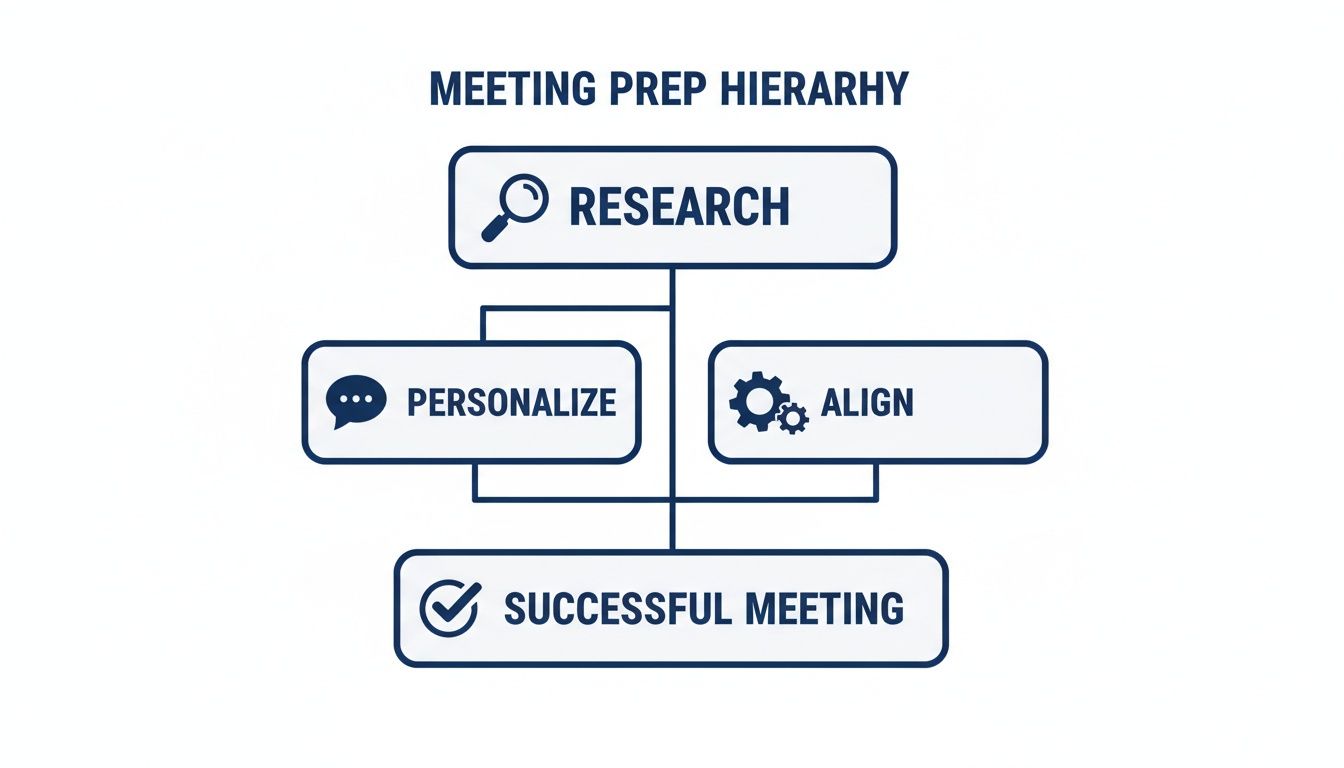
This process ensures every conversation is built on relevance, which is the currency of trust and influence.
How to Engage Different Stakeholders Effectively
Once you’ve mapped the key players, you can't use a generic message. Each persona cares about something different, and your approach must reflect that. Tailoring your communication is key to building a strong relationship with the entire account.
Here’s a quick guide to framing your conversations.
Stakeholder Persona Communication Guide
| Stakeholder Persona | Primary Focus | Effective Communication Strategy |
|---|---|---|
| Economic Buyer | ROI, Strategic Alignment, Business Outcomes | Frame the conversation around financial impact and long-term value. Show how your solution helps achieve major company objectives. |
| Technical User | Features, Usability, Workflow Impact | Get into the weeds. Offer a hands-on demo, discuss integration, and explain how it makes their daily work easier or more effective. |
| Champion | Their Personal Win, Project Success, Internal Credibility | Equip them with the business case, case studies, and data they need to sell your solution internally. Make them look good. |
| Potential Blocker | Risk Mitigation, Job Security, Status Quo | Acknowledge their concerns directly. Frame your solution as a way to reduce their risk or enhance their role, not replace it. |
Remember, the goal is to speak their language. A CFO doesn't care about API endpoints, and an engineer doesn't care about EBITDA projections.
A Practical Playbook for Multi-Threading
Expanding your influence is a delicate process. You can’t go over your champion's head; you need to bring them along as a partner.
Here’s a tactical approach:
-
Ask for Introductions Strategically: Be transparent with your champion. Frame the request around how it benefits them. For instance: "To make sure the business case is rock-solid, it would help to get 15 minutes with your boss, [Economic Buyer's Name], to hear their goals firsthand."
-
Lead with Value, Not an Ask: Never request a meeting without a compelling reason. For the economic buyer, offer a custom ROI analysis. For the technical user, offer a demo tailored to their specific use case.
-
Map Everything in Your CRM: Formally map every stakeholder, their role, and their concerns in your CRM. This creates a single source of truth for the team. A key part of this is effective champion tracking to gauge their influence and engagement.
Your goal isn't to collect contacts. It's to build a coalition of supporters who each see a clear, personal win in choosing your solution. When the technical lead, the economic buyer, and your champion are all advocating for you, the deal becomes almost unstoppable.
Multi-threading isn't just a sales tactic. It’s a foundational strategy for building resilient client relationships that de-risk deals and speed up sales cycles.
Turning Your Strategy Into a System with Cadence and Tools
Good intentions don't build client relationships; consistent action does.
All the research and personalization in the world won't matter if your follow-up is erratic. You need to move from a loose strategy to a solid system—a scalable, repeatable process that ensures no opportunity is missed.
The core of this system is your cadence. A good cadence is a structured sequence of touchpoints across different channels (email, LinkedIn, calls) that maintains momentum and delivers value. It’s the operational backbone of your relationship-building efforts.
Without a system, you're relying on memory and luck. With one, you're guaranteeing every key account gets the attention it deserves.
Designing Cadences That Add Value
Not all follow-ups are equal. A generic "just checking in" email adds zero value and can damage the relationship. Effective cadences are built around specific scenarios and always offer something useful.
Here are a few examples of value-driven follow-up cadences:
- Post-Meeting Recap: Send a summary email within a few hours outlining what was discussed and action items. A few days later, share a relevant case study.
- Industry Insight Nurture: After a major industry event, share an insightful article via LinkedIn. A week later, email your contact with a few points on how that trend could impact their business.
- Post-Proposal Follow-Up: A few days after sending a proposal, forward a testimonial from a similar client. A week later, invite their team to a short Q&A session with a technical expert.
To streamline your communication, you can explore methods like how to schedule LinkedIn posts from Notion, which helps organize your social touchpoints.
The rule is simple: every touchpoint must have a purpose beyond just reminding them you exist. If it doesn't offer a new insight or a helpful resource, don't send it.
This approach transforms your follow-up from a chore into a welcome, informative part of their week.
Using Your CRM to Operationalize Relationships
Your CRM should be the central nervous system for your relationship strategy. This is where you log every interaction, track stakeholders, and manage your cadences.
Systematizing your process in a CRM accomplishes two critical things:
- It creates accountability. Setting tasks for each step ensures follow-ups happen on schedule.
- It provides visibility. Anyone on your team can see an account's history, key players, and next steps.
This is what a dashboard in a modern account intelligence platform might look like, turning raw data into actionable insights.
Here, signals like news and hiring changes are tracked and centralized, giving your team a single source of truth for every key account.
Tracking Relationship Health
How do you know if your efforts are working? You need to track relationship health by measuring the depth and quality of your engagement.
In your CRM, you can monitor key metrics that indicate relationship strength:
- Multi-Threading Depth: How many key stakeholders are you actively engaged with? Moving from one contact to five is a clear sign of progress.
- Communication Frequency: Are you having regular, two-way conversations? Track response rates and meeting frequency.
- Champion Engagement: Is your primary champion actively sharing information and making introductions? Their engagement is a powerful leading indicator.
By turning these concepts into data points, you transform relationship-building from a soft skill into a measurable business process.

“Automatic account profile detail I can use to manage my territory. Using Salesmotion AI to generate value statements per persona, account, etc. Using Salesmotion to give me a starting point based on new hires, or news alerts is critical.”
Adam Wainwright
Head of Revenue, Cacheflow
Key Takeaways
- Lasting B2B client relationships are built on continuous research and timely, relevant insights rather than charm or gift baskets -- the goal is to shift from reactive vendor to proactive advisor.
- Multi-threading across multiple stakeholders inside an account protects deals from the single point of failure that kills most enterprise opportunities when a key contact leaves or loses influence.
- Personalized outreach grounded in real account intelligence -- like referencing a recent earnings call priority or a new executive hire -- transforms routine check-ins into valuable strategic conversations.
- Consistent value delivery between sales milestones is what separates trusted advisors from transactional vendors -- share relevant industry insights, make introductions, and help clients look good internally.
- Relationship strength can be measured through data points like multi-threading depth, communication frequency, and champion engagement, turning a soft skill into a trackable business process.
Got Questions? We've Got Answers
Even the best strategy encounters roadblocks. Here's how to handle a few common issues.
How Do You Rebuild a Client Relationship After a Mistake?
When a mistake happens, rebuilding trust is key. Start by owning it immediately and without excuses.
Next, explain exactly what you're doing to fix the problem now and what new process you're implementing to ensure it never happens again. This turns an apology into a demonstration of accountability.
Finally, over-deliver for a while. Be proactive, find small ways to add extra value, and prove through your actions that you’re committed to their success.
A sincere apology fixes the past, but a clear action plan secures the future. Clients need to see that you've not only heard their concerns but have also built a system to address them permanently.
This isn't just damage control; it's a chance to show you value the partnership enough to learn and evolve.
What's the Difference Between Being Persistent and Being Annoying?
The line between persistence and annoyance is value.
Annoying persistence is the lazy "just checking in" email. It serves only the sender.
Valuable persistence ensures every follow-up gives the client something new and useful.
Here’s how to stay on the right side of that line:
- Share a relevant article about an industry trend.
- Offer a quick insight about a competitor's recent move.
- Send a new case study that mirrors a challenge they mentioned.
- Invite them to an informative webinar that addresses one of their pain points.
Always have a client-centric reason for reaching out. When you do, you stop being a salesperson and start being a resource.
How Can You Measure the Health of a Client Relationship?
Measuring relationship health requires looking at both hard data and softer signals.
On the quantitative side, track key metrics:
- Stakeholder Depth: How many contacts are you engaged with? A relationship with one person is fragile; one with five is resilient.
- Communication Frequency: What is the cadence of two-way conversations? Quick email responses and regular meetings are good signs.
- Product Adoption Rates: Are they using your solution? Increased usage across different teams is a powerful indicator.
Qualitatively, listen to the nature of your conversations. Are they pulling you into strategic discussions? Does your champion proactively share internal information and advocate for you?
A healthy relationship feels like a genuine partnership, not just a series of transactions.
Stop wasting hours on manual research and start building relationships that matter. Salesmotion is an AI-powered account intelligence platform that delivers real-time signals and actionable context on your key accounts directly to your team. Learn more about how we help you win "why now" conversations.
Frequently Asked Questions
What does it mean to build client relationships in B2B sales?
Building client relationships in B2B sales means shifting from being a reactive vendor who sells to a client to a proactive advisor who partners with them. It requires continuous research into their business, personalized outreach anchored to real account signals, and consistent value delivery between sales milestones. The goal is to earn trust by demonstrating a deep understanding of their world, not by sending gift baskets or relying on charm.
Why is multi-threading important in B2B client relationships?
Multi-threading means building relationships with multiple stakeholders across a client organization rather than relying on a single point of contact. This is critical because if your only champion leaves the company, gets promoted to a different division, or loses internal influence, your deal can stall overnight. A multi-threaded approach gives you a 360-degree view of internal dynamics, helps you build broad consensus, and insulates your deals from unexpected personnel changes.
How do you personalize outreach without it feeling like a sales pitch?
Anchor every message to a specific, timely event from your research rather than leading with your product. Reference a recent funding announcement, a new executive hire, or a strategic initiative mentioned on an earnings call, and connect it to a challenge they may be facing. The key is to offer a valuable insight or perspective rather than making an ask, positioning yourself as a well-informed peer rather than another salesperson.
What signals should you track to strengthen client relationships?
The most valuable signals include executive hires (which often indicate new strategies and budgets), funding rounds (which reveal where a company is placing bets for growth), product launches (which create new operational challenges), and mergers and acquisitions (which generate massive internal change). Tracking these events lets you move from generic "just checking in" messages to relevant, timely conversations that demonstrate real awareness of their business.
How do you measure the health of a client relationship?
Track both quantitative metrics and qualitative indicators. On the data side, monitor multi-threading depth (how many stakeholders you are engaged with), communication frequency (the cadence of two-way conversations), and product adoption rates. Qualitatively, assess whether your champion proactively shares internal information, whether clients pull you into strategic discussions, and whether the relationship feels like a genuine partnership rather than a series of transactions.
What is the difference between being persistent and being annoying?
The difference is the value you provide with each touchpoint. Annoying persistence is the lazy "just checking in" email that serves only the sender. Valuable persistence ensures every follow-up gives the client something new and useful, whether it is a relevant article, an insight about a competitor's move, or a case study that mirrors their challenge. If every touchpoint offers genuine value, your follow-up becomes a welcome part of their week rather than an interruption.