Let’s be honest: the old way of doing outbound is a soul-crushing grind. It’s a numbers game built on “spray and pray,” where reps send hundreds of generic emails hoping one or two stick. This isn’t just inefficient; it’s the fast track to burning out your best people.
We're moving beyond that. Modern outbound sales automation isn't about sending more junk faster. It's about using real-world events to make your outreach timely, relevant, and helpful. It’s about turning a cold interruption into a welcome conversation.
Moving Beyond 'Spray and Pray' Outbound Sales

The biggest problem with traditional outbound is the "research tax"—the countless hours reps lose to manual work instead of selling. They piece together information from a dozen tabs for an email that probably lands in the trash.
This high-effort, low-reward cycle is exactly what top B2B revenue teams are leaving behind. They’re ditching basic email sequences for an intelligent, signal-driven approach.
The Shift to Signal-Driven Selling
Instead of blasting out more messages, this new model focuses on why and when you should reach out. It uses real-world business events as triggers to pinpoint accounts that are ready to talk right now.
These aren't just random news clippings. We're talking about specific, high-impact signals that open a window of opportunity.
A few classic examples:
- New Executive Hires: A new VP of Sales will almost certainly review their entire tech stack within 90 days.
- Funding Announcements: A fresh round of capital means new projects and technology investments are about to get greenlit.
- Company Expansion: Opening a new office signals growth, and growth requires new tools.
- Technology Stack Changes: If a company adopts a new CRM that integrates with your product, that’s not a coincidence—it's an opportunity.
When you build outreach around these moments, you stop being an annoying salesperson and start being a helpful resource. It’s a fundamental shift. To go deeper, check out our full guide on building a modern outbound sales strategy.
Eliminating the 'Research Tax'
The goal is to kill the manual grunt work. This frees your team to do what they were hired for: building relationships and closing deals. To really grasp this shift, it helps to understand what is outbound sales in today's landscape.
The sobering reality is that only 28% of a sales rep's week is spent actually selling. The rest is eaten up by research and admin tasks. This is where smart automation changes the game.
For any company with a long B2B sales cycle, a tool that cuts research time by 40-60% is a massive competitive advantage. It lets your reps focus on the high-value conversations that drive revenue.
Here’s a quick breakdown of how the two approaches stack up.
Manual vs. Signal-Driven Outbound: A Clear Comparison
This table shows the differences in process, efficiency, and outcomes between the old way and a modern, automated, signal-driven outbound motion.
| Activity | Traditional Manual Outbound | Automated Signal-Driven Outbound |
|---|---|---|
| Prospecting Focus | Volume-based lists, static ICPs | Trigger events, dynamic account intent |
| Research Process | Manual, time-consuming (LinkedIn, news, CRM) | Automated signal detection, real-time alerts |
| Outreach Timing | Based on rep's schedule or generic cadence | Timed to a specific business event or need |
| Messaging | Generic, feature-focused, company-centric | Hyper-relevant, problem-focused, buyer-centric |
| Rep Efficiency | High "research tax," low selling time (<30%) | Low "research tax," high selling time (>50%) |
| Conversion Rate | Low engagement, low conversion | High engagement, higher conversion |
| Core Metric | Number of activities (emails, calls) | Number of quality conversations generated |
The difference is stark. One approach is about brute force. The other is about precision, timing, and intelligence. By automating the detection of key signals, you empower your team to be strategic advisors, not just noise-makers.
See Salesmotion in action
Take a self-guided interactive tour — no signup required.
Identifying High-Impact Triggers And Buying Signals
Great outbound automation isn't about collecting every scrap of company news. It’s about knowing which signals actually open a window of opportunity. A true trigger event isn't just an update; it’s an event that creates a real, immediate reason for a prospect to consider your product.
This is where many teams stumble. They treat all information as equal, drowning reps in low-value news clippings. The secret is separating the high-intent buying signals from the background noise.
Mapping Triggers to Business Challenges
First, you need a clear framework that connects a trigger to a business challenge your product solves. The trigger is the what, but the business challenge is the why. Without a clear "why," your outreach feels random.
Here’s how to think about it:
- You sell marketing analytics software: The signal isn't "Company X hired a new CMO." The real trigger is that new marketing leaders re-evaluate their tech stack in the first 3-6 months.
- You're a logistics provider: The trigger isn't a generic press release. It's an announcement of a new manufacturing plant, which creates an immediate, complex shipping need.
- You're a cybersecurity firm: The trigger isn't just company news. It's a report about a competitor suffering a data breach. That creates a powerful sense of urgency for everyone in that industry.
This mapping process is the foundation for outreach that feels personal and timely. The edge of outbound sales automation is its power to deliver these 'why now' triggers, turning generic outreach into high-relevance conversations. This is critical when you consider that 52% of outbound marketers feel their strategies are ineffective—automation helps close that gap. You can explore more in sales statistics and what they mean for your team.
A good trigger answers the question: "Why should they talk to me this week instead of last week or next month?" If you can't answer that, it's not a strong enough signal.
Distinguishing Signal from Noise
Not all triggers are created equal. You have to categorize them based on their potential impact. This helps RevOps and sales leaders focus their teams on the accounts most likely to convert.
A practical way to do this is by sorting signals into tiers of intent.
Tier 1: High-Intent Signals (Act Immediately)
These events scream "we need something like this, now." They create a powerful reason for immediate outreach.
- A target account posts a job for a role your software replaces (e.g., "Manual Data Entry Clerk").
- A key executive mentions a strategic priority in a podcast interview that aligns perfectly with your value prop.
- The company announces M&A activity, which almost always triggers vendor consolidation.
Tier 2: Medium-Intent Signals (Nurture and Engage)
These signals suggest a potential future need but aren't as urgent. They're perfect for starting a relationship or kicking off a follow-up sequence.
- A new executive is hired in a relevant department.
- The company gets a new round of funding.
- They announce a partnership with a company that is already your customer.
Tier 3: Low-Intent Signals (Monitor and Track)
Think of these as useful context that doesn't warrant immediate outreach. They're great for account planning and staying informed.
- The company is mentioned in a broad industry trends report.
- They publish a new blog post or case study.
- A non-decision-maker engages with your company's content on LinkedIn.
By building this framework, you shift from reactive to proactive. Your outbound sales automation platform becomes a filter, turning market chaos into a prioritized list of opportunities. To go deeper on this, check out our guide on what a buying signal is and how to use it.

“The talking points are gold. If they're in Salesmotion, I know they're being discussed inside that business. That makes it easy to spark a real conversation, which is 90 percent of the battle.”
Andrew Giordano
VP of Global Commercial Operations, Analytic Partners
Designing Your Signal-Driven Sales Plays
Once you’ve pinpointed high-impact triggers, the next step is to build the engine that acts on them. This is where you architect smart plays that go beyond a simple email drip.
A well-designed play is a multi-channel sequence that feels less like automation and more like a perfectly timed, personal intervention. The goal is a repeatable yet flexible response for each key signal.
This isn't about rigid scripting. It's about a tested game plan that gives your reps a head start. Think of these plays as recipes—the core ingredients are set, but a great rep can add their own flavor.
This visual shows the core logic: a signal occurs, you map it to a pain point, and then you launch a pre-defined action.
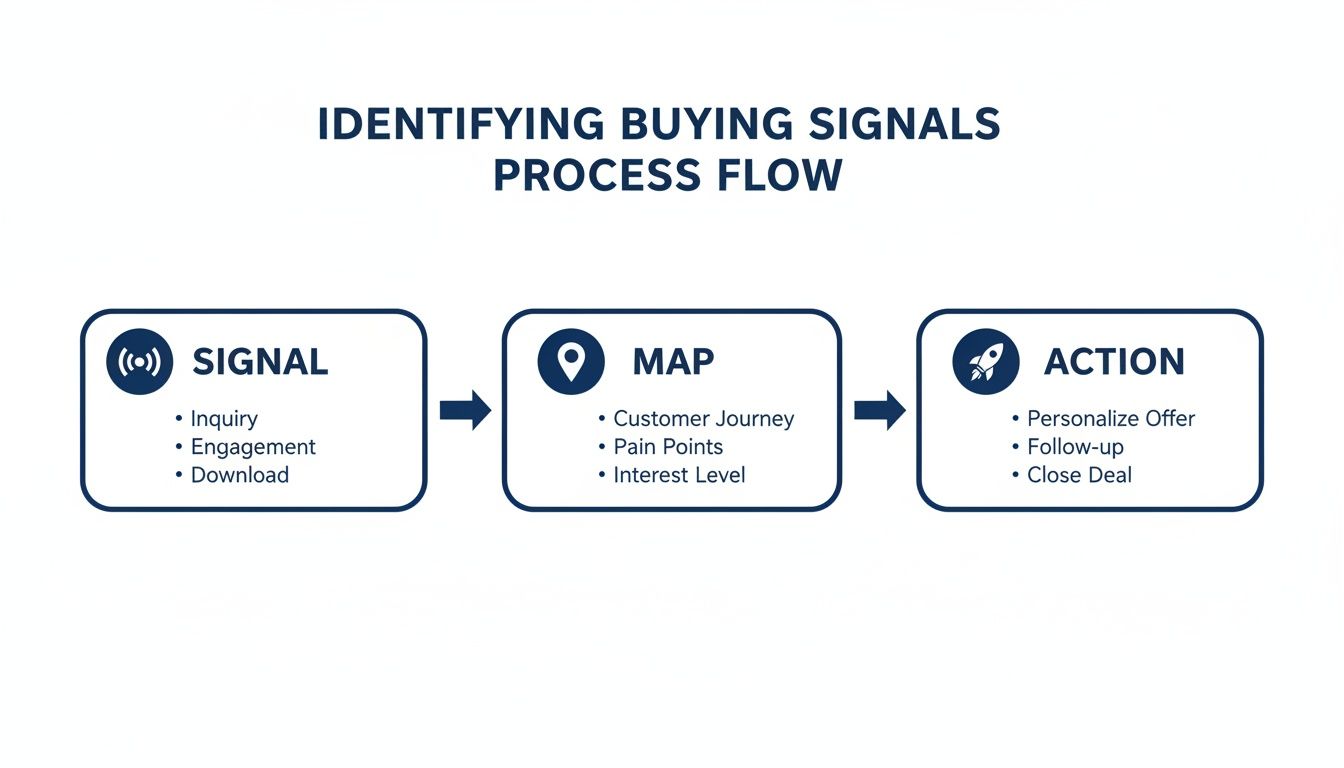
This process ensures every piece of outreach is connected to a real-world event, making it instantly relevant.
Architecting a Multi-Channel Play
A common mistake in outbound sales automation is thinking it's only about email. The most effective plays layer different channels to create a surround-sound effect, making your message hard to ignore.
Each channel serves a distinct purpose, building on the last.
Let's walk through a real-world scenario.
The Trigger: A target account in your CRM, a SaaS company, just announced a $50 million Series B funding round.
This is a Tier 2, medium-intent signal. It means they have fresh capital to invest in growth. Here's what an intelligent, automated play could look like:
- Day 1 (Instant Action): The signal triggers an automated LinkedIn connection request to the VP of Sales. The note is AI-generated to mention the funding: "Congrats on the Series B! Looking forward to following the growth."
- Day 2 (Email Outreach): An automated email is sent. The subject is specific: "Idea for scaling your sales team post-funding." The body references the funding, connects it to the challenge of scaling GTM teams, and links to a relevant case study.
- Day 4 (AE Task Creation): An automated task is created in the AE's CRM, prompting a call. The task includes a summary of the signal (funding amount, investors) so the rep has full context.
- Day 7 (Social Engagement): The system creates another task for the AE to engage with the VP of Sales' latest LinkedIn post—not with a sales pitch, but with a thoughtful comment.
This sequence is logical, respects the prospect's time, and builds context at every step. It's far better than a blast of five generic emails in a week.
Using AI for Hyper-Relevant Messaging
The real magic happens when you use AI to craft messaging that references the trigger. This makes your outreach stand out. Modern automation platforms can take a raw signal and generate a crisp "so what" for the rep.
Your outreach should immediately answer the prospect's silent question: "Why are you contacting me today?" If the trigger isn't in the first two sentences, you’ve lost.
Instead of a generic opening, AI helps you craft something specific:
- Weak Opening: "I saw your company is growing, and I wanted to introduce our solution..."
- Signal-Driven Opening: "Saw the news about your new Chicago office. As you build out that sales hub, ensuring consistent onboarding will be a top priority..."
This subtle shift changes the entire dynamic. The second example shows you’ve done your homework and understand the challenges that come with that growth signal. This level of personalization at scale is the core value of smart outbound sales automation.
Building a Library of Plays
You don't need a unique play for every signal. Start by building a handful of core plays for your most frequent, high-impact triggers. Focus on the events that consistently lead to quality conversations.
Your initial library might include:
- New Executive Hired Play: A sequence for welcoming a new leader and offering insights for their first 90 days.
- Funding Announcement Play: The multi-channel example we just walked through.
- Competitor Mention Play: A sequence triggered when a prospect’s competitor becomes your customer, leveraging social proof.
By developing a set of core responses, you create a system that runs consistently. For more ideas, explore our guide to signal-driven sales playbooks. As you gather data, you can refine and expand your library, making your automation engine smarter over time.
Weaving Automation Into Your Daily Sales Workflow

Here’s a hard truth: a perfect sales play is useless if your reps find it too difficult to use. The biggest hurdle to adoption isn't strategy—it’s the friction of adding a new process to an already-packed day.
Real outbound sales automation succeeds when it feels invisible. It needs to embed itself into the tools your team already lives in.
The goal is to make acting on a buying signal the easiest, most logical next step. When an alert pops up, a rep shouldn't have to open three new tabs to piece together the context. The insight, the "so what," and the next action should be served up on a silver platter.
This is how you create a clean workflow that reps actually want to use because it makes their lives easier. It’s about meeting them where they are.
Delivering Insights Directly Into Your Workflow
To get your team on board, push real-time intelligence into their core applications. For any sales team, that means their communication hub (like Slack) and their system of record (the CRM).
Imagine a funding announcement doesn't just land in an email that gets buried. Instead, a notification pops up in a dedicated Slack channel, like #tier-1-account-signals.
This alert isn't just a link. It's a structured message that includes:
- The Signal: "Acme Corp just raised a $30M Series C."
- The Context: A one-sentence summary of what the funding is for.
- The Action: A direct link to a pre-built outreach template or sequence.
This simple workflow transforms news into an immediate, actionable task. You’ve just eliminated the manual steps that kill momentum.
The core principle is simple: bring the work to the worker, not the other way around. Every click you save and every bit of context you provide increases the odds that a rep will act on a signal.
Automating Meeting Preparation
Another high-friction area is prepping for sales calls. Reps often burn 30-60 minutes before a big meeting, scrambling for the latest company news. This is a perfect spot for outbound sales automation to shine.
By connecting your signal intelligence platform to your CRM and calendar, you can create automated pre-meeting briefs. When an AE has a discovery call scheduled, a brief can be automatically attached to the calendar event 24 hours beforehand.
This isn't a generic data dump. It's a curated summary of the most relevant, recent signals about that account. You're arming the AE with fresh intelligence to build credibility. Making this seamless is a huge part of what effective sales process automation looks like.
Making It Effortless To Act
The data doesn't lie. Inside sales reps often spend only 24% of their day actively selling. Automation delivers a massive ROI here. Companies report 10-20% lifts in efficiency just by shifting from manual work to precision workflows. You can learn more about how the modern sales team is evolving at Saastr.com.
To truly weave automation into your daily sales workflow and craft more authentic emails, consider using a powerful AI email writer. These tools help translate trigger events into compelling, human-sounding outreach, saving reps time while improving message quality.
Ultimately, successful integration comes down to one thing: making it incredibly easy for reps to do the right thing. When you push alerts and context into their existing tools, powerful automation becomes an indispensable part of their daily routine.

“All of the vendors that I've worked with, all of the onboarding that I have had to deal with, I will say, hands down, Salesmotion was the easiest that I have had.”
Lyndsay Thomson
Head of Sales Operations, Cytel
Measuring And Optimizing Your Automation Strategy
An outbound automation engine is only as good as the pipeline it generates. To prove its worth, you have to move beyond vanity metrics like email open rates. Opens don't pay the bills.
The real measure of success for your outbound sales automation is its direct impact on revenue. This means focusing on KPIs that reflect pipeline health and sales velocity. Your goal isn't just to be busy; it's to be effective. Measuring the right things is the only way to know the difference.
Focusing on Revenue-Centric KPIs
To get a true picture of performance, your dashboard needs to track the numbers that connect automated activities to sales outcomes. These are the metrics that tell you if your strategy is working.
Here are the core KPIs for every RevOps leader:
- Positive Reply Rate by Persona: Are you getting thoughtful responses from your target buyers? This is more valuable than a generic reply rate.
- Meeting-Booked Rate per Sales Play: How many qualified meetings come from your "New Executive Hire" play versus your "Funding Announcement" play? This helps you double down on what works.
- Pipeline Velocity: How quickly are deals from automated plays moving through the sales cycle? If signal-driven leads close faster, that's a massive win.
- Conversion Rate from Signal to Opportunity: What percentage of accounts that hit a trigger (e.g., tech stack change) turned into a qualified pipeline within 90 days?
Tracking these KPIs shifts the conversation from "how many emails did we send?" to "how much qualified pipeline did our automation create?"
Using Signal-Based Scoring for Prioritization
Not all accounts are created equal, and not every signal carries the same weight. This is where RevOps can build a signal-based scoring system. This ensures your team’s time is spent on accounts with the highest probability of closing.
Think of it like a credit score for account engagement. A simple framework might look like this:
| Signal Type | Description | Score Value |
|---|---|---|
| High-Intent Job Posting | Account is hiring for a role your product replaces. | +25 |
| Funding Announcement | Company just received a new round of capital. | +15 |
| New Executive Hire | A key decision-maker has joined the company. | +10 |
| Negative Competitor News | A competitor is mentioned in negative press. | +10 |
| Website Visit | Someone from the account visited your pricing page. | +5 |
When an account's score crosses a certain threshold, it can be automatically flagged for an AE to review. This data-driven approach removes the guesswork and helps sales leaders direct effort where it will have the biggest impact.
The ultimate goal of measurement isn't just to report on the past; it's to predict the future. Signal-based scoring helps you identify which accounts are heating up before your competitors do.
Creating a Continuous Feedback Loop with A/B Testing
An outbound sales automation strategy should never be "set it and forget it." The best revenue teams constantly test and refine their approach based on real performance data. This creates a powerful feedback loop where your engine gets smarter with every interaction.
A structured A/B testing framework is essential. The key is to isolate one variable at a time to get clean, actionable insights.
Here are a few high-impact areas to start testing:
- Messaging: Test different subject lines or calls-to-action for the same trigger. Does a direct CTA ("Book 15 minutes") outperform a softer one ("Thoughts on this?")?
- Sequence Structure: For your "Funding Announcement" play, test a 3-step sequence against a 5-step one. Does adding more touches increase meetings booked, or does it just create noise?
- Channel Mix: Try leading with a LinkedIn connection request in one version of a play and an email in another. See which channel produces a better response rate for different personas.
By systematically testing these elements, you replace assumptions with data. This continuous optimization is what separates a good automation strategy from a great one.
Common Questions About Outbound Sales Automation
As teams shift toward automated, signal-driven sales, practical questions always come up. It's a big change from the old way of doing things.
We've heard these questions from sales leaders and reps on the front lines. Here are some straight, practical answers to help you get the most value out of outbound sales automation.
How Do I Start Without Overwhelming My Team?
This is the number one concern, and for good reason. The trick is to start small and get a quick win. Don't try to track every signal for every account right out of the gate.
Instead, pick one or two high-impact triggers you already know move the needle. For many companies, that’s a new executive hire or a big funding announcement.
Here’s a simple way to roll it out:
- Pick a Pilot Group: Grab a small crew of your most adaptable AEs or SDRs—think 3-5 reps—to pilot the new workflow. This minimizes disruption and helps you create internal champions.
- Define One Core Play: Build out just one solid, multi-channel sales play tied to your chosen trigger. Document it clearly and train the pilot group on how to run it.
- Integrate One Tool: Focus on getting alerts into the one place your team lives. For most, that’s Slack. Nail that single integration before adding more complexity.
By starting with a tight focus, you can prove the concept's value fast, work out any kinks, and build momentum. Once the pilot group sees results, the rest of the team will want in.
Will Automation Make My Reps Sound Like Robots?
This is a huge fear, but it comes from a misunderstanding of what modern automation is for. The goal isn't to replace the rep; it's to arm them with better intel so they can be more human and relevant.
Old-school automation was about blasting generic templates. Smart outbound sales automation is about context. It surfaces the "why you, why now" for the rep, giving their outreach a powerful foundation.
The platform handles the what (the signal) and the when (the timing). The rep’s job is to deliver the how—the personal touch, empathy, and insight that builds a real connection.
Think of it this way: the automation serves up the key talking points. It's still on the rep to weave that into a compelling story. The best platforms use AI to generate a first draft of the messaging, but it's always intended to be polished and personalized by a human.
What’s the Role of RevOps in This Process?
Revenue Operations is the backbone of a successful signal-driven sales strategy. They're the architects who build, maintain, and tune the automation engine. Without a strong RevOps function, your strategy will be inconsistent and difficult to scale.
RevOps owns several critical pieces of this puzzle.
Here’s what lands on their plate:
- System Integration: Making sure the signal intelligence platform talks seamlessly with your CRM, sales engagement tools, and communication hubs.
- Playbook Design: Partnering with sales leadership to design, build, and A/B test the sales plays your reps will run.
- Data and Reporting: Defining the KPIs that matter, building the dashboards, and analyzing what’s working.
- Lead and Account Scoring: Creating and refining the signal-based scoring models that help prioritize accounts for the sales team.
In short, RevOps makes sure the machine runs smoothly so reps can focus on selling. They turn a great strategy into a functional, measurable workflow.
Ready to stop the manual research and start acting on real buying signals? Salesmotion is an AI-powered intelligence platform that monitors your target accounts and turns triggers into pipeline. See how we can help your B2B revenue team win more timely conversations. Learn more at Salesmotion.