You can feel the difference the first time you run a standard pharma sequence into a biotech list.
The pharma version looks polished. It names your platform, lists integrations, mentions compliance, and asks for a discovery call next week. The biotech version of that same email gets ignored because it misses the only question that matters: why now?
If you're learning how to sell to biotech companies, start here. Biotech buyers don't move like large pharma teams. The company may have a scientist-founder as CEO. The commercial leader may have been hired recently and still be building the function. The operations lead may also be handling vendor evaluation. They care about milestones, cash efficiency, and whether you can help without creating drag.
That changes everything about prospecting, qualification, messaging, and deal design.
TL;DR: To sell to biotech companies, treat it as a timing game. Prioritize accounts by recent change (financing, clinical progress, leadership hires, partnerships) instead of size, reach the few people who own the next milestone, lead with evidence tied to that milestone, and make the first deal a tightly scoped pilot. Build your 2027 biotech territory from those triggers, not from a static list.
Selling to Biotech Is a Timing Game Not a Numbers Game
A rep sees a biotech announce a fresh round, drops that account into a standard outbound cadence, and expects the same motion that works in big pharma. Six weeks later, nothing has moved. The problem usually is not coverage. It is timing.
Biotech buying does not follow the steady procurement rhythm you see in larger pharmaceutical organizations. In founder-led science companies, priorities can shift fast after a financing event, a program update, a key hire, or a partnership announcement. Budget appears, disappears, or gets redirected based on the next milestone the company has to hit.
That creates a very different sales motion. In big pharma, broad account coverage can pay off because teams, budgets, and buying processes are more stable. In biotech, a smaller set of well-timed accounts will beat a larger list worked with generic persistence.
Why the high-volume play fails
High-volume outbound assumes the account has ongoing demand, clear category awareness, and enough internal structure to evaluate vendors on your schedule. Early and growth-stage biotech rarely look like that.
A company can spend one quarter focused on generating preclinical evidence, then shift to trial preparation, then pause new vendor work because the board wants tighter cash control. If your outreach lands outside the 3 to 6 month period after a real trigger, even a strong offer gets treated as noise.
We see this mistake all the time. Reps confuse low response with low fit, then add more touches. In biotech, that usually makes the account colder, not warmer.
Practical rule: Relevance beats persistence. A message tied to a specific company event and a clear operating problem will outperform a longer sequence built on surface-level personalization.
The fastest way to improve timing is to prospect from events, not static lists. This guide to biotech buying signals is a good starting point if you need a sharper trigger model.
What good timing looks like
Good timing means catching the account when the operating model changed and the team has not fully built the answer yet.
Fresh funding is the obvious example, but funding alone is too broad. The better window is the period right after capital hits, when leadership starts converting that money into hires, systems, external partners, and execution plans. That window is often short. Once priorities are set and vendors are chosen, you are competing against inertia.
The same pattern shows up after a clinical milestone, a commercial hire, or a strategic partnership. The buyer set changes. The internal owner changes. The standard for implementation speed changes too.
Your job is to spot that shift early, show that you understand the milestone pressure behind it, and make a low-friction next step easy. In biotech, that is how deals start.
Service providers who sell to sponsors describe the same goal. A sales-operations lead at a life-sciences services firm told us: "as soon as they start talking about it, even if it's not approved yet, we want to be in the conversation so we can obviously suggest our services rather than someone else."
See Salesmotion in action
Take a self-guided interactive tour — no signup required.
Identify and Prioritize Your Ideal Biotech Profile
Most target account lists for biotech are badly built. They lean too hard on headcount, geography, or broad industry codes. That's lazy segmentation, and it produces weak pipeline.
In biotech, the better question is simple: which companies have the strongest reason to act now?
Build around inflection, not size
A small biotech with fresh capital and a program moving forward can be a better target than a larger company that's operationally flat. Buyers in this market don't spend because they've crossed an employee threshold. They spend when the business hits a milestone that creates pressure.
A chief commercial officer at a CRO told us where that pressure often starts: "many of these companies are coming out of stealth mode they've got some money they have to do their first trial"
That pressure is real. A peer-reviewed analysis notes that only about 20% of compounds advance from phase 1 initiation to market approval, and it estimates the cost to gain approval for a single product at $800 million. The same paper notes that biotech companies have raised more than $120 billion in financing, much of it directed to R&D (peer-reviewed biotech financing and attrition analysis). That environment makes buyers extremely sensitive to anything that helps them de-risk execution.
Here's a better way to rank accounts:
- Program stage: Prioritize companies approaching a stage transition where operations, evidence, or commercialization work gets harder.
- Capital posture: Companies with fresh financing usually have more room to act than companies conserving runway.
- Leadership buildout: New commercial or operational hires often signal active budget formation.
- Business model fit: Platform biotech, therapeutic biotech, tools, and launch-stage companies buy for different reasons. Treating them as one segment creates noise.
A simple scoring lens
You don't need a complicated model. You need a disciplined one.
| Priority factor | What it tells you | Why it matters |
|---|---|---|
| Clinical progress | The company is entering a new execution phase | Urgency rises when internal processes need to scale |
| Recent financing | Budget may be available and not yet fully allocated | Timing matters more than account size |
| Leadership changes | New owners are defining plans and vendors | Messaging can map to a fresh mandate |
| Commercial transition | The company is moving beyond pure R&D | Buying criteria often expand beyond science teams |
One practical way to speed up this work is to use tools that assemble account context from public signals instead of asking reps to piece it together manually. For example, biotech account research workflows can help structure account selection around stage, leadership, and company momentum rather than static firmographics.
What to avoid
Reps usually miss in biotech for one of three reasons:
- They chase logos, not readiness. The account looks impressive, but nothing inside the business is changing.
- They overweight headcount. A bigger team doesn't always mean a better opportunity.
- They target too early. If the company has interest but no active trigger, you'll spend time educating without creating movement.
The best biotech territory plans feel narrow. That's usually a good sign.

“Salesmotion has been a game-changer for me. I used to spend 12 hours a week on prospect research, now it's down to 4. Plus I'm finding stuff I was totally missing - podcasts, news mentions, the good bits.”
George Treschi
Account Executive, FY25 President's Club, Sigma
Decode the Signals That Unlock Biotech Budgets
Budget in biotech often appears after a change in company reality. That's why trigger quality matters more than lead volume.
The four signals below deserve the most attention because they usually indicate a shift in urgency, ownership, or available spend.
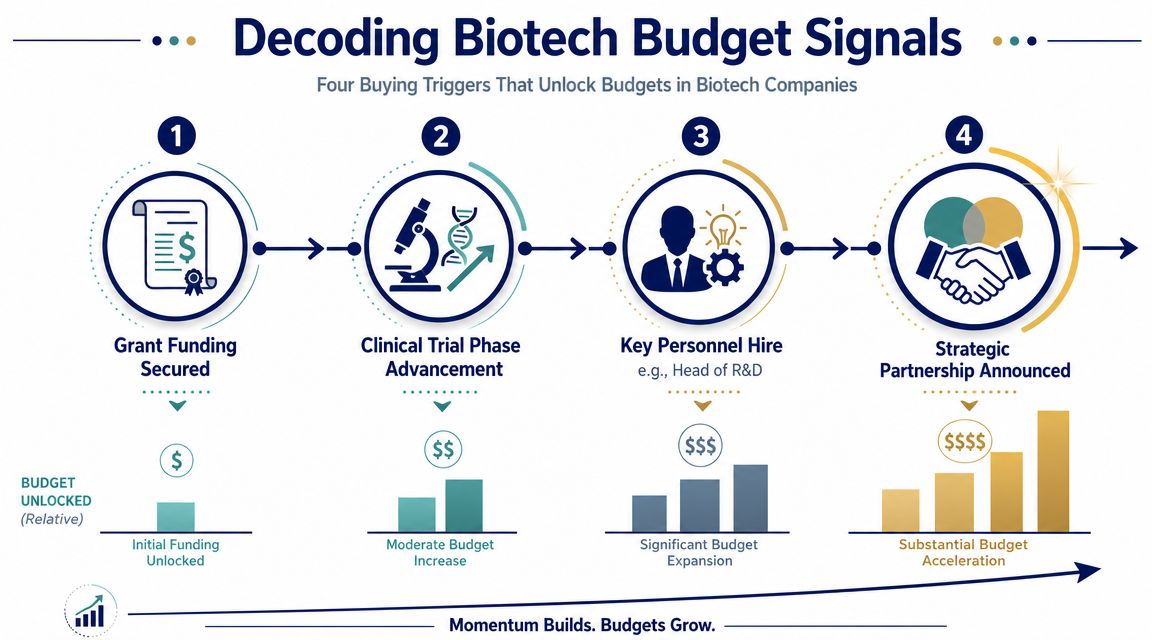
Funding changes the clock
A funding announcement doesn't automatically mean a deal. It means the company now has to put capital to work against board-approved priorities.
The practical mistake reps make is waiting too long. Once budgets are assigned and internal projects are scoped, your chance to shape the conversation drops. Early outreach works best when it's tied to what the capital is likely intended to support.
Good contacts after funding usually include the CEO, COO, operations lead, or a newly authorized commercial or clinical leader. The email shouldn't say congratulations and pitch features. It should connect the funding event to the next operational challenge.
A stronger message sounds like this in principle: you just expanded your ability to execute, and companies at this point often need to remove bottlenecks quickly.
Clinical advancement changes the problem
A company moving from one clinical stage to the next doesn't just have momentum. It has new operational demands.
McKinsey notes that the buying center and its priorities shift when a biotech moves from R&D toward commercialization, which is why stage-aware messaging works better than generic outreach (McKinsey on biotech stage inflection points).
When a biotech crosses a program milestone, don't ask, "Do you have interest?" Ask, "What just became harder for them to execute?"
If the company just advanced clinically, your outreach should reflect the likely downstream pressure. More coordination. More data scrutiny. More handoffs. More need for repeatability.
Leadership hires create new buying energy
A new CBO, VP Commercial, operations leader, or senior clinical hire is often one of the cleanest openings in biotech sales.
New leaders are expected to make change. They're usually assessing gaps, setting priorities, and deciding which vendors belong in the next phase of the business. That makes them far more responsive to outreach that acknowledges their mandate.
The wrong message introduces your product. The right message introduces a hypothesis about what they're now responsible for fixing.
Partnerships can validate spend
When a biotech announces a partnership with a large pharma company or another strategic player, that event often does two useful things. It validates the program externally and creates internal pressure to execute at a higher standard.
That doesn't mean every partnership creates immediate budget. It does mean the company's tolerance for operational weakness usually drops. If your offer helps the team handle complexity, speed, coordination, or evidence, this is a credible time to start the conversation.
For teams that don't want reps monitoring all of this manually, tools that track biotech-specific triggers can help. Mentioning one directly, Salesmotion tracks signals such as financing, hiring, and company updates, then ties them to outreach context for reps.
Map the People Behind the Pipeline
A lot of sales advice talks about the buying committee as if every life sciences account looks the same. It doesn't.
One industry guide says biotech and life sciences buying committees typically include 6 to 11 stakeholders across commercial, scientific, procurement, and IT functions (life sciences stakeholder map). In early-stage biotech, that group is often smaller, tighter, and much more concentrated around a few leaders who wear multiple hats.
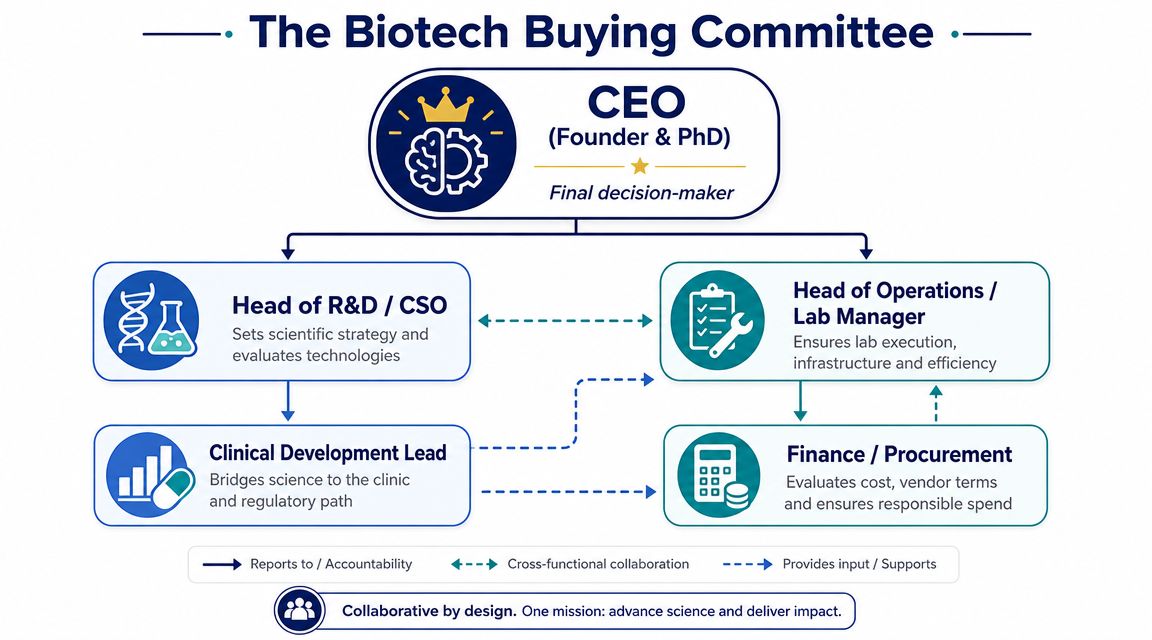
The scientist-founder
In biotech, the CEO may still be the scientific heart of the company. That changes the tone of the sale.
This buyer rarely wants slick positioning. They want confidence that your team understands the risk environment, won't disrupt critical work, and can support decisions with evidence. If you speak in generic business abstractions, you lose credibility fast.
Useful questions for this persona:
- On milestone pressure: What upcoming program milestone has the most cross-functional dependency?
- On evidence quality: Where do data integrity or workflow gaps create decision risk?
- On implementation caution: What would make a new vendor feel additive rather than distracting?
The operational owner
This could be a Head of Clinical Operations, lab operations leader, COO, or program manager. They usually care less about category language and more about throughput, coordination, and whether your team creates extra work.
Your job here is to show that you understand handoffs and constraints. If your implementation requires heavy internal lift, say so clearly. Don't hide it.
A concise talk track works better than a broad pitch:
We don't need a full transformation to prove value. We need one well-scoped use case tied to the next milestone.
The emerging commercial leader
When a company starts hiring commercial talent, a new buyer enters the process. This person is often building a function from scratch while also trying to earn internal trust.
They respond well to messaging about sequencing, rollout, and what needs to be in place before commercialization pressure peaks. They also tend to think harder about cross-functional adoption than the scientist-founder does.
How to map the account quickly
Don't overcomplicate this. For most biotech opportunities, you need answers to four questions:
- Who can say yes?
- Who will feel the day-to-day pain first?
- Who can block the deal on technical, financial, or operational grounds?
- Who benefits personally if this works?
If you're building this map from scratch, decision-maker research techniques can help you identify the people behind the title list and understand what they own.
A biotech deal usually stalls when reps talk to only one person, usually the most visible one.

“The Business Development team gets 80 to 90 percent of what they need in 15 minutes. That is a complete shift in how our reps work.”
Andrew Giordano
VP of Global Commercial Operations, Analytic Partners
Craft Your Evidence-Driven Outreach Sequence
Biotech buyers don't need another email that says you help companies streamline workflows. They need a reason to believe you understand the moment they're in.
The easiest way to see the difference is to compare bad outreach with good outreach.
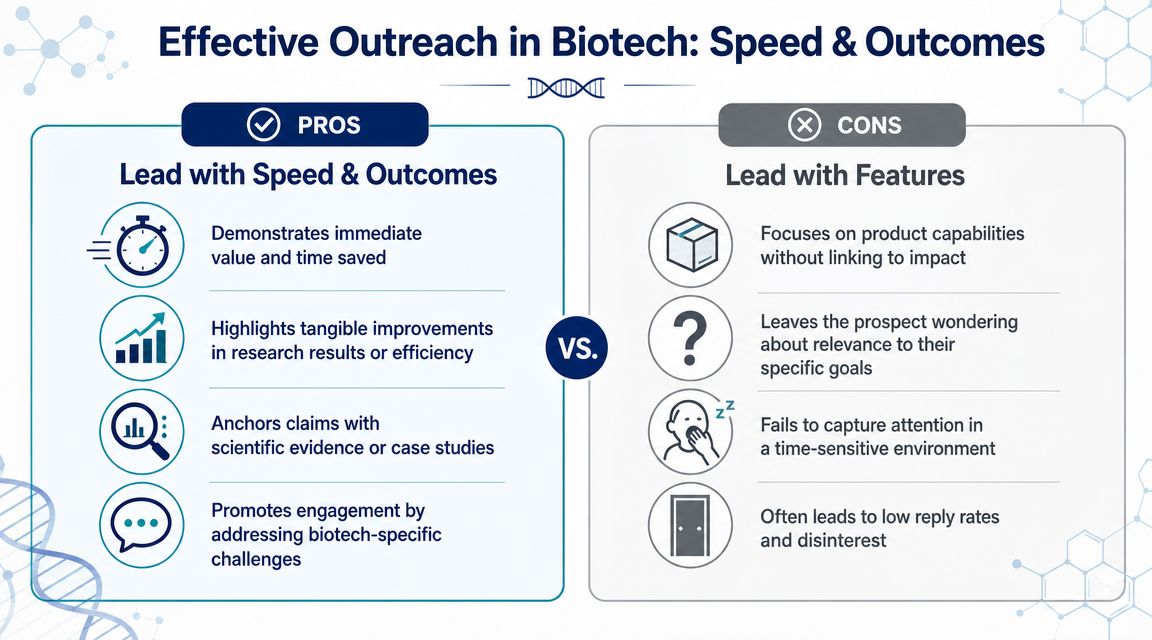
What weak outreach sounds like
A rep sees a biotech account, grabs the VP title, and sends this:
Hi Sarah, We help life sciences teams centralize data, improve collaboration, and increase efficiency with an end-to-end platform. Would you be open to a quick call next week?
Nothing in that note is false. It's just not useful. It doesn't reference a trigger, a stage change, a likely pain point, or the person's mandate. It reads like it could have gone to any company in any regulated industry.
What better outreach sounds like
A stronger note starts with observed change and a plausible operational consequence.
You announced a new commercial leader and a broader push toward launch readiness. At this point, teams often run into handoff issues between scientific, operational, and commercial workstreams. If that's on your plate, worth comparing notes on where those transitions usually slow down and how to tighten them before rollout pressure increases.
That works because it respects the buyer's context. It doesn't force a product demo before you've earned the conversation.
Field note: If your first sentence couldn't only have been written to this account, rewrite it.
A practical sequence you can use
Stage-aware outreach matters here. As noted earlier, McKinsey points out that biotech buying priorities shift as companies move from R&D toward commercialization, so your message has to move with them rather than staying fixed.
Try a sequence like this:
- Email one: Lead with the trigger. Show you understand what probably changed inside the business.
- Email two: Add a short point of view. Name one operational risk or friction point common at that stage.
- Call or voicemail: Reference the same trigger. Keep it tight and hypothesis-led.
- Email three: Offer a focused conversation around one near-term outcome, not a broad platform overview.
- LinkedIn touch: Reinforce relevance with a brief note tied to the company's milestone or leadership move.
A simple email template:
Subject: Question on your next operating milestone
Hi [Name], I saw [company event]. When biotech teams hit that point, they often need to tighten [specific process] without adding burden to a small team.
The reason I'm reaching out is that this usually becomes urgent before [likely next milestone]. If that's an active priority, I'd be glad to share how teams approach the rollout without creating a heavy internal project.
Worth a conversation?
For more examples and messaging patterns, this piece on cold outreach to biotechs is useful.
From Pilot Offer to Closed Won
Once a biotech buyer engages, don't jump straight to a full rollout proposal unless they ask for it. Most biotech teams are willing to move fast, but they still need to protect budget and internal attention.
That's why the pilot matters.

Sell the pilot as risk reduction
The wrong pilot is an open-ended trial of your product. It creates work, vague expectations, and no real business case.
The right pilot is a tightly scoped project tied to a near-term milestone. It answers one important question: can you solve an immediate problem without consuming the team's bandwidth?
That framing matters with founder-led biotech companies because they aren't just evaluating software or services. They're evaluating distraction risk.
What a biotech-ready pilot includes
A good pilot proposal is short, concrete, and honest about effort.
Use this checklist:
- Clear business problem: Name the specific workflow, process gap, or execution risk being addressed.
- Near-term milestone tie-in: Connect the project to an upcoming internal or program event.
- Defined users: Specify who from their side and your side will participate.
- Short implementation path: Show what happens first, second, and third.
- Success criteria: Agree on what evidence would justify expansion.
- Post-pilot decision plan: Define what happens if the pilot works.
You don't need a giant statement of work. You need enough structure to make approval easy.
The commercial logic behind fast pilots
Biotech buyers are cautious for rational reasons. They're operating in a high-risk environment, and they don't want to absorb a broad deployment before they've seen proof in their setting.
A focused pilot shortens that leap. It gives the internal champion something concrete to take back to leadership, and it gives the skeptical stakeholder a bounded commitment instead of an enterprise promise.
If the buyer says, "We like this, but we're not ready for a full rollout," that's usually not a stall. It's your cue to redesign the ask.
The strongest pilot proposals also make expansion feel natural. If the first project works, the next phase should already be visible. Not in a manipulative way. In a practical one.
For example, if the pilot solves a process issue tied to a clinical milestone, the expansion path might support broader coordination, reporting, or commercialization readiness. The point is continuity. Buyers should feel that the first engagement was built to prove a useful operating model, not just to win a logo.
The Modern Playbook for Biotech Sales
A founder closes a financing round on Tuesday. By Friday, the team is reprioritizing programs, adding outside vendors, and trying to make the next milestone feel achievable. If you reach out three months later with a generic platform pitch, you are late.
That is the modern biotech motion.
Selling to biotech works when you treat it as a timing-driven, evidence-driven sale built for founder-led companies. This is not a lighter version of enterprise pharma selling. The buying process is shaped by funding events, technical milestones, small teams, and tight operating discipline. The window that matters most is often the 3 to 6 months after a financing, licensing event, or program inflection.
The core issue for many sales teams is not messaging. It is prioritization.
Strong biotech reps spend less time trying to cover the whole market and more time concentrating on accounts that just changed. They start with momentum, not TAM. They look for companies that have a live reason to act, then they build outreach around that reason.
A practical playbook looks like this:
- Prioritize change over company size
- Build target lists from funding, hiring, pipeline, and trial signals
- Contact the person closest to the active initiative
- Lead with proof that fits a scientific and operational review
- Structure the first deal so a cautious buyer can say yes
That sequence sounds simple. It is. The hard part is doing it consistently.
Biotech buyers do not reward broad positioning or enterprise theater. They respond to reps who understand where the company is in its build cycle, what the next milestone is, and what kind of evidence will hold up inside a small, technical decision group. In practice, that means your best opportunities often come from younger companies with fresh capital and an urgent need to build fast, not from the biggest logos on your list.
Those younger companies are also the hardest to spot. A business development lead at a clinical research services firm told us: "you're catching so much data from the big guys that it's hard. Through that to find, you know, the small guys."
That is also why the biotech motion differs so sharply from pharma. Pharma buying often favors scale, process, and broad stakeholder alignment across established functions. Biotech buying is narrower and faster when the timing is right. A founder, a functional lead, and a technical evaluator may be enough to get a pilot approved if the problem is tied to a near-term milestone and the scope is controlled.
The reps who win this market are usually the ones who show up early with a relevant point of view and a manageable first step.
If your team is trying to sell into biotech with generic news alerts and manual account research, Salesmotion can help by tracking account signals, assembling account context, and turning those triggers into outreach your reps can use.