Every life sciences sales team has run the same experiment by now. You hand a prospect list to an AI tool, generate 200 personalized emails, and wait for meetings to roll in. Then the response rate comes back at 0.3%, and you wonder whether the AI wrote the wrong thing or picked the wrong tone.
It wrote the wrong thing at the wrong time to the wrong person. That is the uncomfortable truth about cold outreach to biotechs: the bottleneck is not copywriting. It is intelligence. Over 60% of life sciences companies have started implementing generative AI for commercial workflows, yet only 6% have successfully scaled it, according to recent industry analysis. The gap is not technology. It is knowing who to contact and when they are actually making decisions.
TL;DR: Cold outreach to biotechs fails because most teams optimize for email copy when the real problem is timing and relevance. Sponsors and biotech decision-makers ignore generic pitches regardless of how well-written they are. Signal-driven outreach, timed to specific events like phase transitions, funding rounds, and leadership changes, generates 15 to 25% response rates compared to 1 to 2% for untargeted emails. The teams winning in life sciences pair account intelligence with AI-assisted personalization, not AI-generated spam at scale.
The AI Email Arms Race Is Already Over
Here is what happened: AI SDR tools flooded the market in 2024 and 2025, promising to automate outbound prospecting. Sales teams in CROs, clinical site networks, and pharma service providers adopted them aggressively. The result was predictable. Biotech executives went from receiving a handful of prospecting emails per day to dozens of AI-generated messages, all referencing the same LinkedIn profile data, the same company description, and the same vague value proposition.
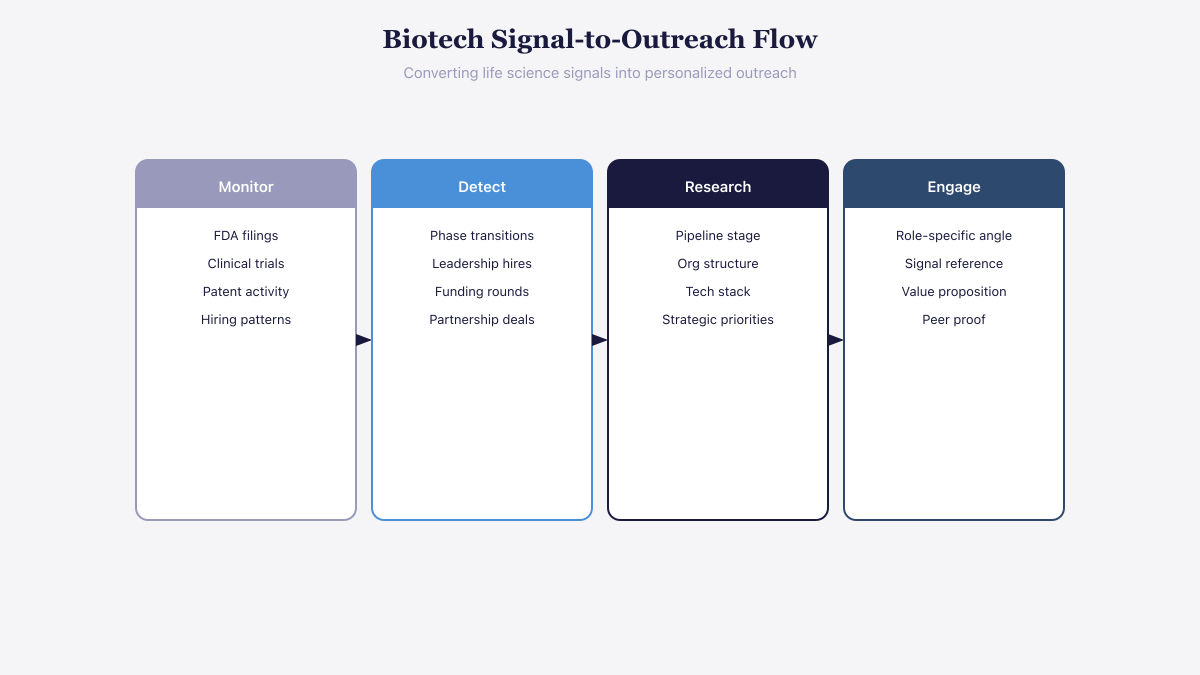 Converting biotech signals into outreach requires a structured four-step workflow.
The backlash is already here. Spam filters are tightening. Buyer-side AI agents are being developed specifically to screen and block automated outreach. And the numbers tell the story: fully autonomous AI SDR deployments are struggling with response rates below 0.5% on cold outbound, while human-crafted outreach still achieves 3 to 5%. For a detailed cost-vs-output comparison, see our analysis of AI SDRs vs human SDRs. The AI-assisted sweet spot, where AI handles research and drafting while humans refine and send, reaches 5 to 10% and higher when paired with strong personalization.
But even these numbers miss the point. A 5% response rate on a poorly targeted list still means 95% of your effort is wasted. The question is not how to write better emails. It is how to know which 20 people out of your list of 2,000 are actively making a decision right now.
See Salesmotion on a real account
Book a 15-minute demo and see how your team saves hours on account research.
Why Biotech Decision-Makers Ignore Your Outreach
The fundamental asymmetry in biotech sales is this: a VP of Clinical Operations at a mid-size biotech might evaluate site partners or CRO relationships two to three times per year, when a trial progresses to a new phase, when enrollment stalls, or when leadership changes priorities. The rest of the year, they are not buying. No amount of copywriting brilliance will create urgency that does not exist.
Most cold outreach ignores this reality. Teams build prospect lists based on static criteria (company size, therapeutic area, job title) and blast emails on a cadence. The email might reference the recipient's company and title. It might even mention a recent publication or conference appearance. But if it arrives three months before or after the decision window, it is irrelevant.
A static list also misses the sponsors that are not on it yet. A business development director at a CRO told us: "Maybe I don't have this company in my list, but I would like to know because I would like to chase them like as early as possible."
This is why buying signals matter more than email templates. The signals that indicate a biotech is actively evaluating partners are public and trackable:
- Phase transitions and trial results. A successful Phase 2 readout almost always triggers Phase 3 planning, with new site selection, expanded vendor needs, and budget allocation happening within weeks.
- Funding events. A Series B or C round at a clinical-stage biotech tells you exactly which therapeutic programs are about to scale. Earnings calls from public companies reveal pipeline priorities in their own words.
- Leadership changes. A new VP of Clinical Operations or Head of Site Management is almost always reassessing vendor relationships. The first 90 days of a new leader's tenure is the highest-probability window for engagement.
- Enrollment delays and protocol amendments. ClinicalTrials.gov status changes and amendments signal that a sponsor needs help now, not next quarter.
The difference is stark. According to recent industry data, outreach timed to business signals generates 40% call-to-meeting conversion rates, compared to low single digits for generic cold campaigns. Signal-based leads show up to 3x higher qualification rates than inbound-only leads.
Arriving late is the common failure. A business development lead at a clinical research services firm told us: "if I don't find it until six months later, they've already probably created their plan for their phase two, even if they haven't initiated it yet."

“The AI templates were a surprise delight. We expected the data, but the pre-built email suggestions turned out to be much better than expected and a huge help, especially for newer reps.”
Sabina Malochleb-Bazaud
Senior Sales Operations Administrator, Cytel
What Signal-Timed Outreach Looks Like in Practice
Frameworks are easy to agree with. Execution is where most teams stall. Here is an anonymized walkthrough of how signal-driven outreach works in biotech, based on patterns we see across life sciences commercial teams.
Day 1: The signal fires. A clinical-stage biotech announces positive topline results from a Phase 2 trial in immunology. The press release goes out on a Monday morning. ClinicalTrials.gov shows the sponsor has already updated the study status and posted a new registration for a planned Phase 3 expansion across 80 sites in North America and Europe.
Day 2-3: Research and context building. Instead of firing off a congratulatory email (which every other vendor will send), the BD lead pulls the sponsor's full picture. They review the Phase 2 enrollment history and find that two geographies underperformed on recruitment. They check the leadership team and discover the sponsor hired a new Head of Clinical Operations six weeks ago. They scan the competitive landscape and identify two other biotechs running trials in the same indication, which means investigator competition for sites.
Day 4: Targeted outreach. The email references the Phase 2 results, acknowledges the Phase 3 expansion plans, and makes a specific observation: "Based on your Phase 2 enrollment patterns, it looks like EU sites in the Nordics underperformed relative to your Western European sites. Our network has strong immunology referral relationships in Sweden and Denmark, and three of our PIs have direct experience with your endpoint measurement approach. Would a 20-minute call to discuss feasibility alignment be useful?"
Week 2: The response. The VP of Clinical Operations replies. The email stood out because it demonstrated specific knowledge of their trial, not just their company. The conversation leads to a feasibility discussion, and by the time the formal RFP goes out two months later, the CRO is already on the shortlist.
This sequence works because the outreach was triggered by a real event, enriched by account research, and specific to the sponsor's situation. For a deeper look at this approach across the life sciences sales cycle, see our guide to signal-based prospecting in life sciences.
The AI-Assisted Approach That Actually Works
The answer is not to abandon AI. It is to stop using AI for the wrong task. AI is excellent at research synthesis, pattern recognition, and draft generation. It is terrible at judgment, timing, and relationship context. The winning formula in biotech outreach pairs AI capabilities with human intelligence at each stage.
Signal monitoring at scale. No human team can manually track ClinicalTrials.gov updates, SEC filings, funding announcements, leadership changes, and conference activity across 200+ target accounts every day. This is where sales intelligence platforms replace five disconnected tools with a single prioritized feed. The AI surfaces what changed. The human decides what matters.
Research synthesis. When a signal fires, AI can assemble the context in minutes: the sponsor's pipeline, recent trial history, leadership team, strategic priorities from their latest earnings call, and competitive landscape. Work that used to take two to three hours per account compresses to fifteen minutes. Outreach's 2025 data report found that 100% of AI-powered SDR users reported time savings, with nearly 40% saving four to seven hours per week.
Draft generation with human editing. AI-generated first drafts that reference specific signals and account context give reps a strong starting point. But the final message needs human judgment: the right tone for the relationship, awareness of competitive dynamics the AI might miss, and the instinct for what detail will actually resonate with this particular buyer. Salesmotion's prospecting module takes this approach, generating tailored email drafts grounded in real account signals and research so reps can refine and send rather than starting from a blank page.
Cadence intelligence. Instead of sending follow-ups on a fixed schedule (day 3, day 7, day 14), signal-aware systems trigger follow-ups based on new events at the account. A protocol amendment at a target sponsor is a better reason to re-engage than an arbitrary timer.
This is the model that produces results. AI-assisted outreach with human refinement achieves 5 to 10% or higher response rates, and when combined with signal timing, teams report 15 to 25% response rates on triggered campaigns with up to 40% call-to-meeting conversion.

“All of the vendors that I've worked with, all of the onboarding that I have had to deal with, I will say, hands down, Salesmotion was the easiest that I have had.”
Lyndsay Thomson
Head of Sales Operations, Cytel
Scaling This Without Burning Out Your Team
The objection every sales leader raises: "This sounds great for one account. How do we do it across 200?" The answer is infrastructure, not headcount.
When Cytel, a global leader in advanced analytics for life sciences, evaluated their commercial workflow, the bottleneck was clear. Their team of reps toggled across five or more disconnected tools to prepare for a single sponsor conversation. Research time consumed the first hour of every day. New hires took weeks to build enough industry context to send credible outreach.
After consolidating into a single account intelligence platform, the results were measurable:
- Research time cut by 50% across the sales team, recovering hundreds of selling hours per quarter
- Account planning prep reduced by 30%, directly accelerating pipeline reviews and QBR cycles
- Five disconnected tools replaced by one, eliminating context-switching and ensuring every rep worked from the same intelligence
- New hire ramp time compressed through AI-generated messaging templates that doubled as a learning tool for understanding accounts, therapeutic areas, and sponsor priorities
Jillian Cormier, VP of Business Development at Cytel, described the shift: for newer reps, the platform functions as both a research tool and a learning tool, helping them understand the account, the context, and how to message effectively without needing weeks of training.
The math is straightforward. If each signal-driven outreach requires 30 minutes of research instead of three hours, a team of ten reps can cover 4x more accounts at the same quality level. That is not a marginal improvement. It is the difference between reaching 50 sponsors per quarter and reaching 200.
Key Takeaways
- Cold outreach to biotechs fails because of timing, not copywriting. Decision-makers evaluate vendors two to three times per year. If your email arrives outside that window, copy quality is irrelevant.
- Fully autonomous AI SDR deployments are struggling. Response rates below 0.5% on cold outbound, with 94% of life sciences AI implementations failing to scale. The technology works. The application model is wrong.
- Signal-driven outreach produces dramatically better results. 15 to 25% response rates on triggered campaigns, with 3x higher qualification rates compared to untargeted outbound.
- The winning model is AI-assisted, not AI-autonomous. AI handles signal monitoring, research synthesis, and draft generation. Humans provide judgment, timing, and relationship context.
- Personalization means account intelligence, not mail merge. Referencing a prospect's name and company is not personalization. Referencing their Phase 2 enrollment challenges in a specific geography is.
- Infrastructure beats headcount. Cytel cut research time by 50% and account planning prep by 30% by consolidating five tools into one platform, letting the same team cover dramatically more accounts.
Frequently Asked Questions
Why does cold outreach fail specifically in biotech and pharma?
Biotech decision-makers operate on long, irregular buying cycles tied to clinical trial timelines, not fiscal quarter budgets. A VP of Clinical Operations might evaluate new CRO or site partnerships only when a trial reaches a phase transition, enrollment stalls, or leadership changes priorities. Generic outreach that arrives outside these decision windows gets ignored regardless of quality. The industry is also smaller and more relationship-driven than other B2B sectors, so impersonal outreach carries a reputational cost.
Are AI SDR tools effective for life sciences prospecting?
Partially. AI SDR tools are effective for research synthesis, signal monitoring, and generating draft outreach based on account intelligence. In life sciences, fully autonomous outbound is a hard fit: the complexity of clinical trial workflows, the regulatory sensitivity of sponsor relationships, and the small size of buyer networks make human judgment essential in the final outreach. The most successful teams use AI to compress the research phase and generate starting drafts, then apply human editing and timing decisions.
What are the best signals to track for biotech prospecting?
The highest-value signals include clinical trial phase transitions (especially positive Phase 2 results indicating Phase 3 planning), funding rounds (Series B/C for clinical-stage biotechs), leadership changes in clinical operations, enrollment delays visible through ClinicalTrials.gov amendments, and FDA regulatory actions like Breakthrough Therapy or Fast Track designations. Stacking multiple signals at the same account (e.g., positive results plus a new CMO plus fresh funding) produces the highest qualification rates.
How long does it take to see results from signal-based outreach?
Most teams see measurable improvement within 30 to 60 days of implementing signal monitoring. The first campaigns timed to specific triggers typically show a 3 to 5x improvement in response rates compared to untargeted outbound. Longer-term results, like pipeline growth and shortened sales cycles, become visible over one to two quarters as the compounding effect of better-targeted outreach builds relationship momentum. For a practical framework, see our guide to prospecting templates that incorporate signal references.