Life sciences M&A spending climbed 81% year over year to $240 billion in 2025, with over $300 billion in branded drugs losing exclusivity by 2030. That means pharma, biotech, and CRO budgets are moving fast, and so are the buying committees behind them. If you sell into life sciences, your window to be on the shortlist is smaller than you think.
TL;DR: Selling to life sciences companies requires understanding multi-stakeholder buying committees, regulatory constraints, and the patent cliff urgency driving procurement decisions. Timing your outreach to leadership changes, clinical milestones, and M&A activity separates reps who get meetings from those who get ignored.
Understanding the Life Sciences Buyer
Life sciences organizations operate under layers of complexity that most B2B sellers underestimate. Pharma companies, biotech startups, and contract research organizations (CROs) each have distinct procurement patterns, but they share a common trait: decisions involve 6 to 11 stakeholders across scientific, commercial, regulatory, and procurement functions.
According to McKinsey, more than 70% of new molecular entity revenues now come from externally sourced products. Pharma is a buying industry. That means procurement teams are constantly evaluating new vendors, partners, and platforms. But the evaluation process is slow, methodical, and risk-averse.
Budget cycles in life sciences typically follow annual planning with Q3/Q4 approvals for the following year. However, unplanned budget releases happen frequently around clinical trial milestones, regulatory approvals, and M&A integration periods. Reps who only prospect during annual planning miss the majority of buying windows.
The biggest mistake sellers make is treating life sciences like any other enterprise vertical. The regulatory environment, scientific rigor expectations, and compliance requirements create a buying culture where every vendor must earn trust before earning a meeting.
See Salesmotion on a real account
Book a 15-minute demo and see how your team saves hours on account research.
Key Decision Makers and Their Priorities
Understanding who sits on the buying committee is half the battle. In life sciences, the committee composition shifts depending on the solution being evaluated.
Commercial and Sales Leadership
VPs of Sales, Chief Commercial Officers, and Heads of Business Development evaluate tools that improve territory planning, account targeting, and competitive intelligence. Their primary concern is pipeline velocity and deal quality.
Scientific and Clinical Leaders
In CROs and biotech, scientific leadership (VP of Clinical Operations, Medical Directors) influences purchasing decisions for any tool that touches trial data, site selection, or scientific workflows. They prioritize accuracy, compliance, and evidence-based claims.
Procurement and Vendor Management
Life sciences procurement is notoriously rigorous. Vendor qualification processes can take 3 to 6 months and require security assessments, data handling documentation, and sometimes on-site audits. Procurement teams evaluate total cost of ownership, not just license fees.
IT and Data Security
With HIPAA, GDPR, and GxP compliance requirements, IT teams have veto power over any solution that handles sensitive data. They evaluate data residency, encryption, SOC 2 compliance, and integration architecture.
The key insight for sellers: you need to multi-thread across at least three of these personas simultaneously. A single-threaded deal in life sciences almost always stalls in procurement.

“The AI templates were a surprise delight. We expected the data, but the pre-built email suggestions turned out to be much better than expected and a huge help, especially for newer reps.”
Sabina Malochleb-Bazaud
Senior Sales Operations Administrator, Cytel
The Sales Approach That Works
Lead with Industry Knowledge, Not Product Features
Life sciences buyers can spot a generic pitch in seconds. Your first interaction must demonstrate that you understand their specific challenges: patent cliffs, pipeline gaps, regulatory timelines, and competitive dynamics.
Before any outreach, research the company's pipeline status, recent earnings commentary, leadership changes, and strategic initiatives. This is where most reps fail. Manual research across SEC filings, ClinicalTrials.gov, PubMed, and industry news takes 2 to 3 hours per account. Teams using Salesmotion cut that to under 5 minutes by pulling account briefs from over 1,000 sources automatically, covering everything from clinical trial updates to executive moves.
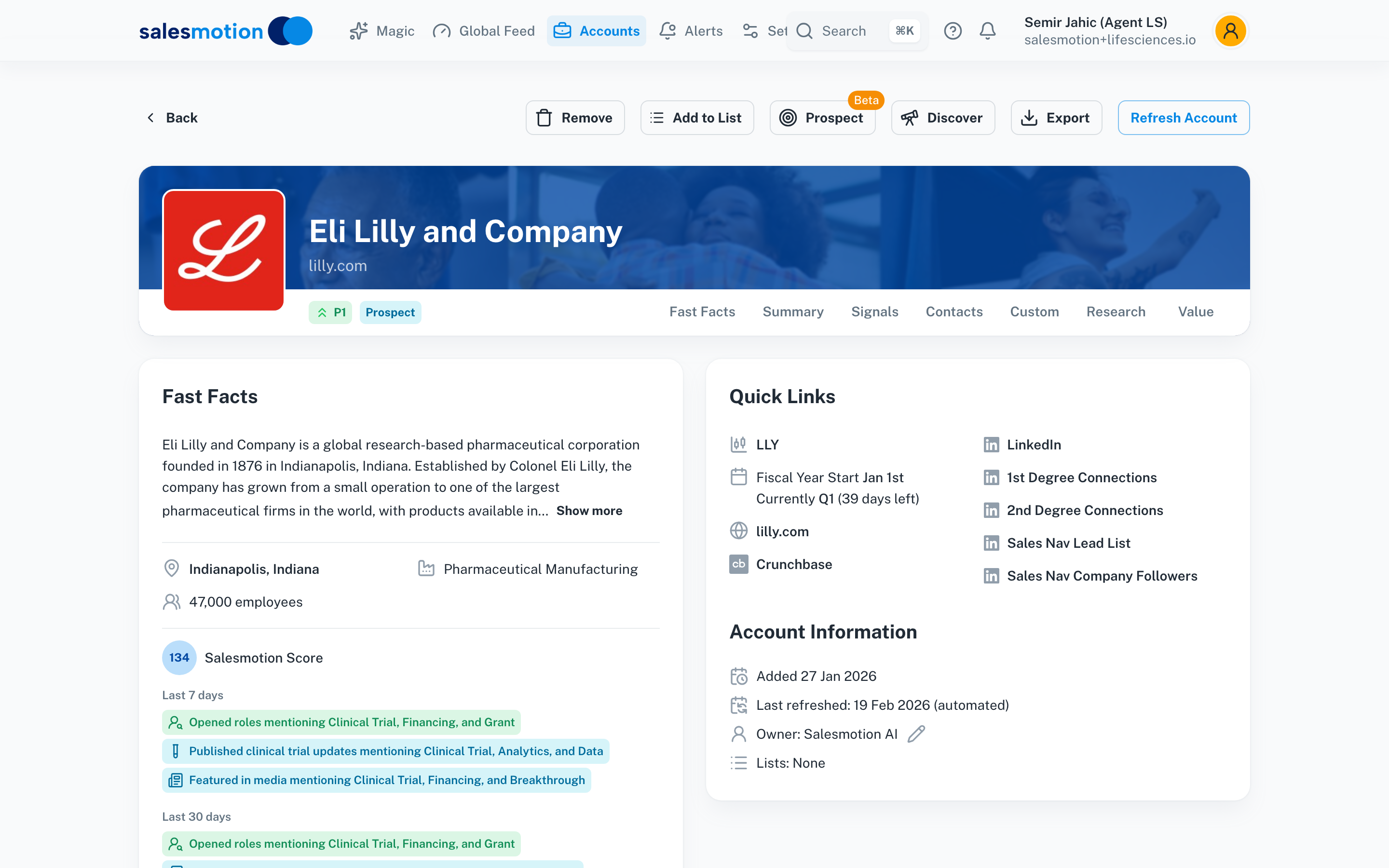 Salesmotion generates complete account briefs for life sciences companies — key insights, executive commentary, clinical trial activity, and strategic priorities — in minutes instead of hours.
Build a Multi-Stakeholder Engagement Plan
Map the buying committee before your first outreach. Identify the economic buyer (usually VP-level or above), the technical evaluator (IT/data security), the end users (commercial team), and the internal champion who will shepherd your deal through procurement.
Create persona-specific messaging: the CCO gets an ROI story about pipeline acceleration. The VP of Clinical Operations gets a compliance and accuracy narrative. Procurement gets a total cost of ownership comparison with their current tool stack.
Use Compliance as a Differentiator
Most sellers view compliance as a hurdle. Smart sellers use it as a wedge. If your solution is already SOC 2 certified, GDPR-compliant, and has completed life sciences vendor qualification before, lead with that. It removes the biggest objection and shortens the procurement timeline by weeks.
Signals That Indicate Purchase Readiness
Timing is everything in life sciences sales. Here are the buying signals that indicate a company is entering a purchase window:
Leadership Changes: A new CCO, VP of Sales, or Head of Commercial Operations typically triggers a 90-day review of existing tools and vendors. New leaders want to put their stamp on the tech stack.
Clinical Trial Milestones: Phase transitions (especially Phase II to Phase III) create budget releases and new operational requirements. A biotech entering Phase III needs commercial readiness tools they did not need in Phase II.
M&A Activity: When a pharma company acquires a biotech, integration teams evaluate which tools to keep, consolidate, or replace. The 6 to 12 months post-acquisition is a prime buying window.
Earnings Commentary: Listen for language about "commercial transformation," "digital acceleration," or "sales force effectiveness" in quarterly earnings calls. These phrases signal active budget allocation.
Hiring Patterns: When a life sciences company starts hiring commercial roles (territory managers, MSLs, commercial analysts), they are building capacity that requires supporting technology.
Cytel, a life sciences analytics company, reduced their sales research time by 50% and consolidated five research tools into one by using Salesmotion to track these exact signals across their target accounts. Their team went from spending hours toggling between data sources to having account intelligence delivered automatically. As Lyndsay Thomson, Head of Sales Ops at Cytel, described it, the platform had the easiest onboarding process of any tool they had deployed. Read the full case study.

“All of the vendors that I've worked with, all of the onboarding that I have had to deal with, I will say, hands down, Salesmotion was the easiest that I have had.”
Lyndsay Thomson
Head of Sales Operations, Cytel
Outreach That Gets Responses
Example: Signal-Triggered Outreach to a Pharma CCO
Signal: Target account just announced a new Chief Commercial Officer, and their Q3 earnings call mentioned "accelerating commercial readiness for three late-stage assets."
Subject line: Commercial readiness for your late-stage portfolio
Body: Congratulations on the CCO appointment. With three assets approaching commercial milestones and the leadership transition underway, I imagine evaluating your commercial intelligence stack is on the near-term agenda.
We work with life sciences commercial teams to consolidate account research (pipeline status, competitive moves, KOL mapping, territory intelligence) into a single platform. One CRO client cut account planning prep time by 30% within the first quarter.
Worth a 15-minute conversation to see if this applies to your situation?
Why this works: It references a specific signal (CCO appointment), demonstrates industry knowledge (late-stage commercial readiness), offers a relevant proof point, and makes a low-commitment ask.
Example: Post-Acquisition Outreach to a VP of Sales
Signal: Pharma company completed an acquisition of a biotech. Integration is underway.
Subject line: Post-acquisition intelligence consolidation
Body: As you integrate the commercial teams post-acquisition, you are likely evaluating which tools to keep and where to consolidate. Most teams I work with in similar situations find they are running 4 to 6 overlapping research and intelligence tools across the legacy organizations.
We help life sciences sales teams consolidate account research, competitive intelligence, and signal monitoring into one platform. Happy to share how other teams have handled the integration period. Would next week work for a quick call?
Common Mistakes When Selling to Life Sciences
Ignoring procurement timelines. If your champion says "we want to move fast," that still means 3 to 6 months in life sciences. Build procurement buffer into every forecast.
Generic messaging. Referencing "healthcare" when selling to a biotech is an instant credibility killer. Know the difference between pharma, biotech, CROs, CDMOs, and medical device companies.
Skipping the compliance conversation. Waiting until late in the sales cycle to address data security and compliance creates deal-killing surprises. Address it proactively in your first meeting.
Single-threading the deal. With 6 to 11 stakeholders involved, relying on one champion is a recipe for stalled deals. Build relationships across multiple functions simultaneously.
Misunderstanding budget cycles. Life sciences budgets are not just annual. Clinical milestones, M&A events, and regulatory approvals trigger unplanned budget releases throughout the year.
Ready to see how account intelligence works for life sciences sales teams? Explore the Sales Intelligence for Life Sciences page to see industry-specific use cases and results.
Frequently Asked Questions
How long is the typical sales cycle when selling to life sciences companies?
Sales cycles in life sciences typically range from 6 to 18 months, depending on deal size and the vendor qualification process. Smaller SaaS purchases ($10K to $50K annually) may close in 3 to 6 months, while enterprise platform deals often require 9 to 12 months. Procurement qualification alone can take 2 to 4 months. Building compliance documentation early and multi-threading across stakeholders are the two most effective ways to compress timelines.
What compliance requirements should I prepare for when selling to pharma?
Expect SOC 2 Type II certification, GDPR compliance documentation, data processing agreements, and potentially GxP validation depending on your solution's proximity to clinical data. Many pharma procurement teams also require completed security questionnaires (often 200+ questions), data residency disclosures, and evidence of business continuity planning. Preparing these materials before your first procurement meeting can save 4 to 8 weeks.
How do I identify the right buying signals for life sciences accounts?
Focus on leadership changes in commercial and operations roles, clinical trial phase transitions, M&A announcements, earnings call language about commercial transformation, and hiring patterns for commercial-facing roles. These signals indicate active budget allocation and strategic shifts that create openings for new vendor conversations. Monitoring sources like SEC filings, ClinicalTrials.gov, and industry news systematically is essential. An account intelligence platform can automate this monitoring across all your target accounts simultaneously.
Should I target pharma, biotech, or CROs differently?
Yes. Pharma companies have established procurement processes and larger budgets but move slowly. Biotech companies are more agile and founder-driven but have tighter budgets and less procurement infrastructure. CROs are operationally focused and evaluate tools based on efficiency gains and scalability. Tailor your value proposition to each: ROI and compliance for pharma, speed and flexibility for biotech, and operational efficiency for CROs.
Key Takeaways
- Life sciences buying committees include 6 to 11 stakeholders across commercial, scientific, procurement, and IT functions. Multi-thread from the start.
- Compliance readiness (SOC 2, GDPR, GxP) is not a late-stage checkbox. Lead with it to differentiate and shorten procurement timelines.
- Time your outreach to leadership changes, clinical milestones, M&A activity, and earnings commentary for the highest response rates.
- Tailor messaging to the specific sub-vertical (pharma, biotech, CRO) rather than using generic "life sciences" language.
- Teams like Cytel have cut research time by 50% and consolidated five tools into one using account intelligence, freeing reps to focus on selling instead of research.
- Explore the Sales Intelligence for Life Sciences page for industry-specific use cases.