The biotech sector saw over $75 billion in venture financing and public offerings in 2024, according to BioPharma Dive, with each dollar tied to clinical milestones, FDA decisions, and partnership deals that reshape company priorities. For B2B sales teams selling into biotech companies, buying signals are uniquely binary: a positive Phase III readout can triple a company's market cap and unlock massive spending overnight, while a clinical failure can freeze procurement entirely. Tracking biotech buying signals, especially clinical trial and FDA triggers, gives sales teams the timing precision this volatile market demands.
TL;DR: Biotech buying signals include clinical trial milestones (Phase I/II/III transitions), FDA decisions, PDUFA dates, partnership deals, funding rounds, pipeline updates, conference data presentations, and patent filings. These signals indicate when biotech companies are most likely to invest in new technology, services, and infrastructure.
Why Biotech Buying Signals Are Binary and Time-Sensitive
Biotech companies do not follow the predictable quarterly rhythms of SaaS or manufacturing. Their spending is driven by clinical and regulatory milestones that arrive on their own schedule. A company that was conserving cash last month may become an aggressive buyer after a positive trial readout. A company that was hiring may implement a freeze after an FDA rejection.
This binary dynamic creates both risk and opportunity for B2B sales teams. The opportunity: when a biotech company has a positive milestone, there is a finite window where they are building capabilities and open to new vendors. The risk: if you miss that window, the company may complete its vendor evaluations before you engage.
The biotech buying committee typically includes the Chief Scientific Officer, Chief Medical Officer, Chief Commercial Officer (for later-stage companies), CTO, and Head of Procurement. Pre-commercial biotechs have smaller teams where decision-making is faster but budgets are tighter. Post-Phase III biotechs preparing for commercial launch behave more like mid-size pharma companies. Finding verified contacts for each of these roles is covered in B2B contact data for life sciences sales.
Clinical Trial Signals
Phase Transitions (Phase I to II to III)
Each phase transition represents a growing commitment. Phase I to Phase II means the drug showed acceptable safety and the company is investing in efficacy data. Phase II to Phase III is the most significant signal: the company is committing hundreds of millions to a pivotal trial, which drives hiring, technology purchases, and vendor partnerships. Track phase transitions on ClinicalTrials.gov and in company press releases.
Clinical Data Readouts
Positive data readouts at medical conferences (ASCO, ASH, AACR, ESMO) are among the strongest buying signals in biotech. A positive readout validates the pipeline, increases investor confidence, and triggers commercial planning. Negative readouts trigger restructuring, pipeline reprioritization, and sometimes M&A activity. Both create distinct buying patterns that sales teams can anticipate.
Enrollment Milestones
When a biotech announces enrollment completion for a pivotal trial, it signals that the data readout is approaching. This creates a defined timeline for commercial preparation: the company knows roughly when it will need launch infrastructure. Track enrollment milestones as a leading indicator of future purchasing.
Adaptive Trial Designs and Protocol Amendments
Protocol amendments and adaptive trial changes reveal evolving strategy. An amendment that expands enrollment suggests confidence. An amendment that adds a new arm suggests a broader indication strategy (and broader commercial potential). These nuanced signals are visible on ClinicalTrials.gov and in SEC filings.

“The AI templates were a surprise delight. We expected the data, but the pre-built email suggestions turned out to be much better than expected and a huge help, especially for newer reps.”
Sabina Malochleb-Bazaud
Senior Sales Operations Administrator, Cytel
FDA and Regulatory Signals
PDUFA Dates
PDUFA (Prescription Drug User Fee Act) dates are published months in advance and represent the FDA's target action date for drug applications. These dates create predictable buying windows: companies prepare for both approval scenarios (commercial launch infrastructure) and rejection scenarios (regulatory strategy, advisory committee preparations). Track PDUFA dates from the FDA calendar and in SEC filings.
FDA Advisory Committee Meetings
Advisory committee (AdCom) meetings create high-intensity periods for biotech companies. A positive AdCom vote signals likely approval. A negative vote creates uncertainty. Both scenarios trigger vendor activity: positive outcomes accelerate commercial preparation, and negative outcomes require regulatory strategy consultants and communication support.
Breakthrough Therapy and Fast Track Designations
When the FDA grants Breakthrough Therapy, Fast Track, or Priority Review designations, it signals an accelerated timeline. Companies with these designations need to compress their commercial preparation into a shorter window, creating urgency for technology and services purchases.
Financial and Strategic Signals
Funding Rounds and Follow-On Offerings
Biotech funding events are closely tied to clinical milestones. A follow-on public offering after a positive Phase II readout signals confidence and provides capital for Phase III and commercial preparation. An IPO filing for a clinical-stage company creates a professionalization event similar to pre-IPO SaaS companies. Salesmotion tracks these financial events alongside clinical milestones, giving sales teams enriched account intelligence that connects the funding to the specific pipeline catalyst.
For the rounds announced in the last 60 days, with modality, phase and a source link for each, see the biotech funding tracker.
Partnership and Licensing Deals
When a biotech announces a licensing deal, co-development agreement, or commercial partnership with a larger pharma company, it signals pipeline validation and creates new infrastructure needs. The partner relationship often requires new data sharing platforms, co-monitoring tools, and joint commercial planning capabilities.
Patent Filings and IP Activity
Patent filings reveal a company's future direction. A surge of patent applications in a specific therapeutic area signals investment in that area. Patent expirations create generic competition risks that drive commercial strategy changes. Track patent activity through the USPTO and patent analytics services.

“All of the vendors that I've worked with, all of the onboarding that I have had to deal with, I will say, hands down, Salesmotion was the easiest that I have had.”
Lyndsay Thomson
Head of Sales Operations, Cytel
Organizational Signals
Leadership Changes
A new Chief Commercial Officer at a clinical-stage biotech signals commercial launch preparation. A new CMO indicates a pipeline strategy shift. A new CTO suggests technology infrastructure investment. In biotech, leadership hires are particularly meaningful because they are often tied to specific milestones: companies hire CCOs when they expect approval within 18-24 months.
Conference Presentations and Investor Events
Biotech companies reveal their priorities through conference presentations and investor day events. A company presenting Phase III data at ASCO is signaling confidence in that program. JPM Healthcare Conference presentations in January reveal the year's strategic priorities. Track which accounts are presenting, what data they share, and how investors react.
How to Operationalize Biotech Buying Signals
Biotech buying signals come from ClinicalTrials.gov, FDA databases, SEC filings, medical conference agendas, press releases, and patent databases. The time-sensitivity of these signals makes automated monitoring essential.
Build a milestone calendar. Map the expected clinical milestones, PDUFA dates, and conference presentations for your target accounts. This calendar gives your team advance notice of buying windows.
Score by pipeline stage. Late-stage biotechs (Phase III and NDA/BLA filed) have larger, more immediate buying needs than early-stage (Phase I) companies. Prioritize signals from later-stage companies for the highest pipeline impact.
Create milestone-specific plays. Build outreach sequences tied to specific biotech events: "positive Phase III readout" play, "PDUFA preparation" play, "commercial launch" play, and "partnership announcement" play. Each play should reference the specific milestone and position your solution against the company's current needs.
Salesmotion helps biotech sales teams operationalize these signals by aggregating clinical, financial, and organizational data into enriched account briefs that update automatically as milestones occur.
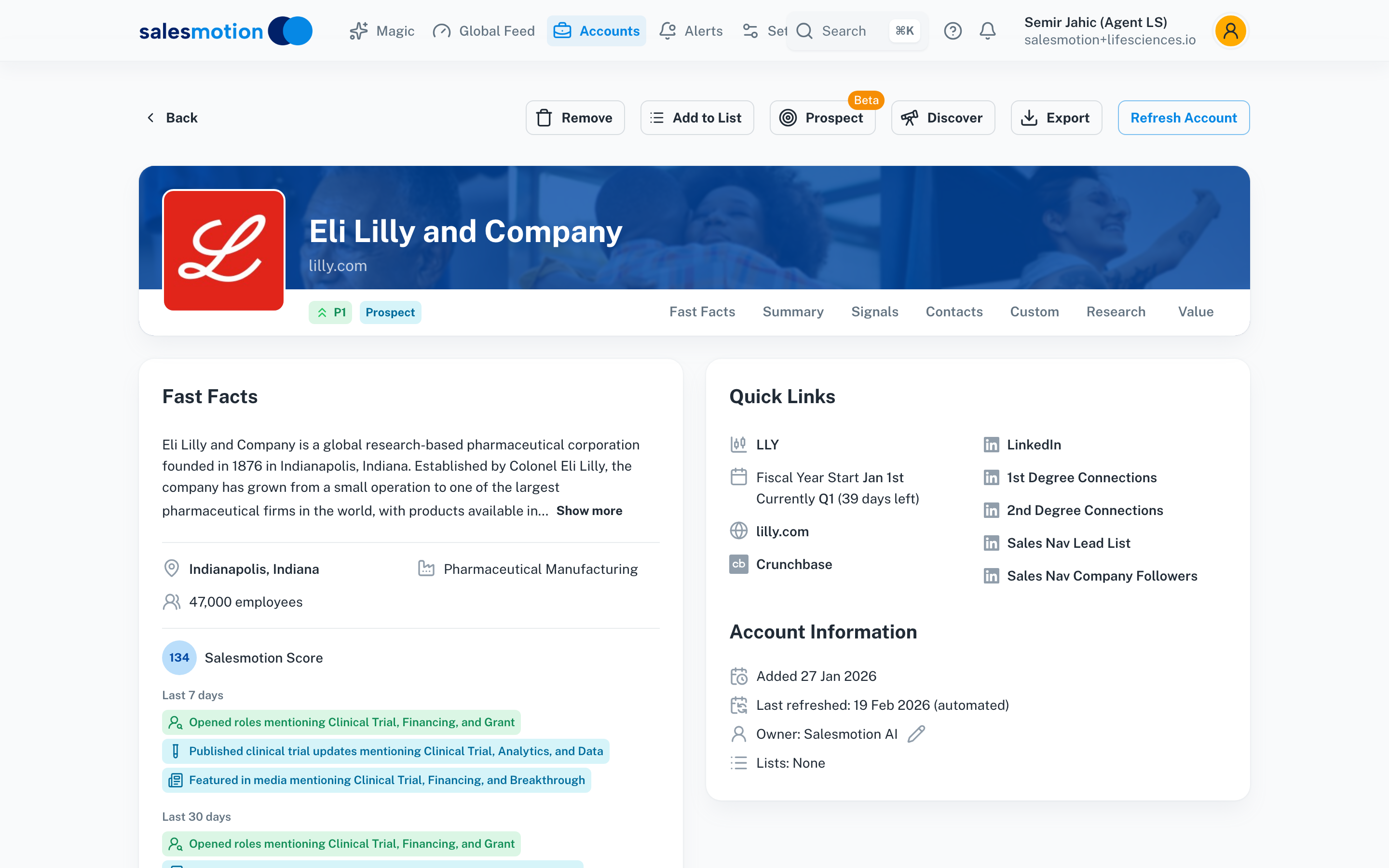 Salesmotion's Global Feed filtered to Clinical Trials — reps see new trial activity across their entire biotech territory at a glance, with signal counts per account and direct links to source data.
Signal-Based Workflow: Biotech Example
Trigger: A mid-cap biotech reports positive Phase III data at a medical conference. Their stock jumps 40%. In the same week, they post a Chief Commercial Officer role and 6 commercial operations positions.
Platform action: The account brief updates with the trial readout, the stock reaction, the CCO search, the commercial hiring surge, and a summary of the company's latest investor presentation (which outlined a commercial launch timeline for H1 2027).
Rep action: The rep reviews the brief and identifies the convergence: positive data, commercial leadership search, and a stated launch timeline. They reach out to the VP of Commercial Strategy, referencing the Phase III success and the company's need to build commercial analytics capabilities ahead of the 2027 launch. The outreach positions their solution as supporting the specific analytics needs of a first-time commercial launch.
Outcome: The conversation is immediately relevant because the rep understands the account's clinical milestone and commercial timeline. The biotech is actively building its commercial team and evaluating vendors, making the timing ideal.
For more on selling to biotech and life sciences companies, visit our sales intelligence for biotech page. Also explore the related life sciences buying signals post and our alternatives comparison.
Key Takeaways
- Biotech buying signals are binary and time-sensitive. A positive Phase III readout creates an immediate buying window, while a clinical failure can freeze procurement. Speed matters more in biotech than in any other industry.
- PDUFA dates create predictable, calendar-based buying windows. Companies prepare for both approval and rejection scenarios, driving vendor evaluations in the months leading up to the FDA decision date.
- Clinical trial phase transitions signal growing investment commitment. Phase II to Phase III is the most significant transition, committing hundreds of millions and triggering commercial preparation.
- Financial signals (funding rounds, partnership deals) are closely tied to clinical milestones in biotech. A follow-on offering after positive data confirms the company's commitment and provides capital for the next phase.
- Build a milestone calendar for your biotech territory. Knowing the expected readout dates, PDUFA dates, and conference presentations for each account gives your team advance notice of buying windows.
Frequently Asked Questions
What are the most important buying signals in biotech B2B sales?
The strongest biotech buying signals are positive clinical trial readouts (triggering commercial preparation and technology investment), PDUFA dates (creating predictable buying windows), Phase II to Phase III transitions (committing major capital and expanding vendor needs), partnership and licensing deals (validating pipeline and creating infrastructure needs), and CCO hires (signaling commercial launch within 18-24 months).
How do PDUFA dates create predictable buying opportunities?
PDUFA dates are published months in advance, telling sales teams exactly when the FDA will make a decision. Companies prepare for both scenarios: approval drives commercial launch infrastructure purchases, while rejection drives regulatory strategy and pipeline reprioritization. The 3-6 months before a PDUFA date represent a peak buying window as the company builds capabilities for whichever outcome occurs.
Why is the Phase II to Phase III transition such a critical signal?
Phase III trials require massive investment: expanded site networks, larger data management platforms, regulatory submission tools, and often new CRO partnerships. The company is committing hundreds of millions to the pivotal trial, which signals confidence in the program and creates a multi-year buying cycle. Companies entering Phase III also begin commercial planning, driving additional technology and services purchases.
How should sales teams track biotech buying signals at scale?
Biotech signals come from ClinicalTrials.gov, FDA databases, SEC filings, medical conference agendas, and patent databases. The time-sensitivity of these signals makes manual monitoring impractical. A sales intelligence platform that aggregates clinical, financial, and organizational signals and delivers enriched account briefs enables reps to act quickly when high-value milestones occur.