Only 7% of industrial manufacturing sales happen through digital channels, and the average buying committee for a $500K equipment purchase includes 5 to 11 stakeholders across procurement, operations, engineering, finance, and safety. Manufacturing is one of the last B2B verticals where relationships still drive deals, but the companies that combine relationship selling with data-driven account intelligence are pulling ahead.
TL;DR: Manufacturing sales cycles are long (6 to 18 months), involve multiple technical and business stakeholders, and require deep product knowledge. Successful sellers map complex buying committees, lead with operational impact, and time outreach to capital expenditure cycles, supply chain shifts, and digital transformation initiatives.
Understanding the Manufacturing Buyer
Manufacturing companies buy differently from SaaS companies or financial services firms. Purchase decisions are driven by operational necessity, not trend adoption. A plant manager does not buy new software because a competitor did. They buy it because their current process is causing downtime, quality defects, or safety incidents.
According to Sagefrog's 2026 B2B manufacturing trends report, industrial buyers complete around 70% of their research before contacting a supplier. This means your website, content, and digital presence must provide technical depth (specifications, integration guides, ROI calculators) that serves engineers, procurement managers, and plant operators who are self-educating.
Budget cycles in manufacturing align with capital expenditure (CapEx) planning, which typically happens in Q3/Q4 for the following fiscal year. However, operational expenditure (OpEx) decisions on software and services can happen throughout the year, especially when tied to specific production challenges or efficiency mandates from leadership.
The manufacturing buying process is inherently conservative. Companies that have run the same processes for decades are reluctant to change. Every new vendor represents risk: production disruption, integration failure, or quality impact. Overcoming this inertia requires proof of operational impact from similar manufacturing environments, not just generic ROI projections.
Key Decision Makers and Their Priorities
Plant Manager / VP of Operations
The operational buyer who evaluates solutions based on production uptime, throughput improvement, waste reduction, and worker safety. They are pragmatic, data-driven, and skeptical of vendor claims. They want to see the solution work in an environment similar to theirs before committing.
Procurement Manager
Procurement in manufacturing is heavily structured. RFQ and RFP processes are standard for purchases above threshold amounts. Procurement evaluates total cost of ownership, warranty terms, delivery timelines, supplier qualification, and often requires on-site audits. Building a direct relationship with procurement early prevents delays.
Engineering Leadership
Engineers evaluate technical specifications, compatibility with existing systems (ERP, MES, SCADA), and implementation requirements. They are the most technically rigorous evaluators on the committee and often serve as internal champions when they find a solution that genuinely improves their workflow.
CFO / Finance
For CapEx purchases, finance evaluates payback period, depreciation schedules, and impact on overall operational costs. For OpEx (software subscriptions), they evaluate cost per user, contract flexibility, and alignment with efficiency improvement targets.
Safety and Compliance
In regulated manufacturing (food and beverage, pharmaceutical, aerospace), compliance officers evaluate whether the solution meets industry standards (ISO 9001, FDA 21 CFR Part 11, AS9100). Their approval is a prerequisite for any deployment.

“The AI templates were a surprise delight. We expected the data, but the pre-built email suggestions turned out to be much better than expected and a huge help, especially for newer reps.”
Sabina Malochleb-Bazaud
Senior Sales Operations Administrator, Cytel
The Sales Approach That Works
Speak Operations, Not Technology
Manufacturing buyers evaluate solutions through an operations lens. Instead of describing your "AI-powered analytics platform," describe how it "reduces unplanned downtime by identifying maintenance needs before equipment fails." Map every product capability to an operational outcome that the plant manager measures daily.
Before outreach, research the company's production focus, recent expansion or consolidation announcements, supply chain challenges, and leadership changes. Account intelligence tools can surface these signals automatically. Salesmotion monitors hiring patterns, earnings commentary, and strategic initiatives across manufacturing companies, giving reps the context they need to craft relevant outreach in minutes rather than hours.
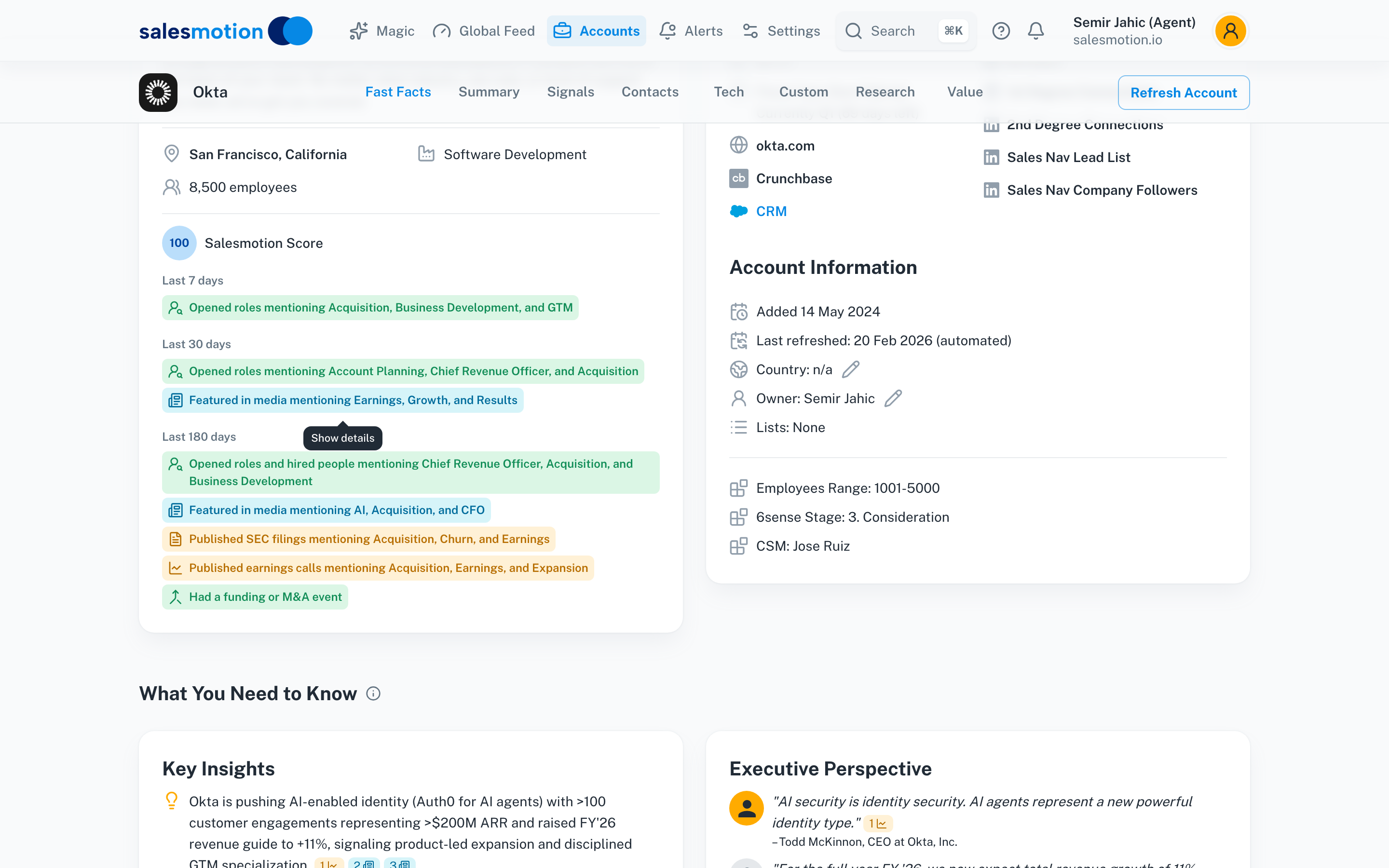 Salesmotion generates a complete account brief in minutes — key insights, executive quotes, opportunities, and talking points — so reps walk into every meeting prepared.
Offer Proof from Their Industry Segment
Manufacturing spans automotive, aerospace, food and beverage, pharmaceutical, chemicals, electronics, and heavy industry. A case study from a food manufacturer does not carry weight with an aerospace supplier. Build segment-specific reference customers and demo environments that match the buyer's manufacturing type.
Plan for Long Sales Cycles
With 6 to 18-month cycles and 5 to 11 stakeholders, manufacturing deals require structured account plans. Map every stakeholder, their role in the decision, their key concerns, and the internal politics that influence their vote. Use account planning frameworks to keep complex deals on track.
Build a multi-touch engagement plan that provides value at each stage: technical white papers for engineers, ROI models for finance, pilot proposals for operations, and compliance documentation for safety teams.
Signals That Indicate Purchase Readiness
Manufacturing companies produce distinct buying signals that indicate active evaluation or budget availability:
Capital Expenditure Announcements: When a manufacturer announces a new production line, plant expansion, or facility modernization, supporting technology purchases follow. These announcements typically appear in earnings calls, press releases, and industry publications.
Supply Chain Disruptions: Companies experiencing supply chain challenges actively seek solutions that improve visibility, reduce dependency on single suppliers, or automate procurement processes. Track news about supply chain issues at your target accounts.
Digital Transformation Initiatives: Manufacturing companies announcing Industry 4.0, IoT, or digital twin initiatives are allocating technology budgets. These announcements signal openness to new vendors and solutions.
Leadership Changes: A new VP of Operations, Chief Manufacturing Officer, or CTO signals a strategic review. New leaders in manufacturing often focus first on the technology stack and operational efficiency.
Regulatory Changes: New environmental regulations, safety standards, or quality requirements create mandatory compliance investments. Track regulatory changes relevant to your target accounts' industries.
M&A Activity: Manufacturing consolidation creates integration projects where technology decisions are revisited. The acquiring company evaluates which systems to standardize across the combined operations.

“The Business Development team gets 80 to 90 percent of what they need in 15 minutes. That is a complete shift in how our reps work.”
Andrew Giordano
VP of Global Commercial Operations, Analytic Partners
Outreach Templates for Manufacturing Buyers
Example: Post-Expansion Outreach to a VP of Operations
Signal: Manufacturer announced a $50M plant expansion with production starting in Q3.
Subject line: Intelligence support for the new facility launch
Body: Congratulations on the expansion. As you build out the team and vendor relationships for the new facility, your commercial team will need updated intelligence on the expanded customer base and competitive landscape in the new market.
We help manufacturing commercial teams consolidate account research, competitive monitoring, and market intelligence into one platform. Would 15 minutes next week make sense to discuss how this fits your expansion timeline?
Example: Digital Transformation Outreach to a CTO
Signal: Manufacturer's earnings call mentioned "Industry 4.0 acceleration" and "operational technology modernization."
Subject line: Intelligence layer for your Industry 4.0 initiative
Body: Your Q3 commentary on Industry 4.0 acceleration caught my attention. As you modernize operational technology, the commercial team's intelligence tools often lag behind. Many manufacturing sales teams still rely on manual research across disparate sources.
We work with manufacturing companies to automate account intelligence, so commercial teams can focus on relationships rather than data gathering. Happy to share relevant examples from similar manufacturers.
Common Mistakes When Selling to Manufacturing Companies
Using SaaS sales tactics. Manufacturing buyers are not impressed by urgency-based closing techniques, limited-time offers, or high-frequency email sequences. These approaches damage credibility in a relationship-driven industry. Be patient, be consultative, and earn trust over time.
Ignoring the technical evaluation. Engineers and operations teams will test your solution rigorously. Glossing over technical specifications, integration requirements, or performance benchmarks creates skepticism that spreads through the buying committee.
Underestimating procurement complexity. Manufacturing procurement processes are formal and structured. RFPs, supplier qualifications, on-site audits, and multi-round evaluations are standard. Build procurement engagement into your sales process from the start.
Neglecting safety and compliance. In regulated manufacturing, compliance is not an afterthought. If your solution touches production data, quality systems, or safety processes, prepare compliance documentation before your first meeting.
Treating all manufacturers the same. Automotive, aerospace, food and beverage, and pharmaceutical manufacturing have fundamentally different sales approaches, regulatory environments, and buying criteria. Customize your messaging for each segment.
Explore the Sales Intelligence for Manufacturing page for manufacturing-specific use cases and workflows.
Frequently Asked Questions
How long does a typical manufacturing sales cycle take?
Manufacturing sales cycles range from 6 to 18 months depending on deal size and complexity. Software-as-a-service solutions may close in 3 to 6 months at mid-market companies, while capital equipment purchases typically take 9 to 18 months. The procurement process alone (RFP, evaluation, supplier qualification) often takes 2 to 4 months. Building relationships with procurement early and providing compliance documentation proactively are the most effective ways to compress timelines.
How do I get past procurement gatekeepers in manufacturing?
Build a direct relationship with procurement early in the process, rather than treating them as an obstacle. Provide your supplier qualification package, pricing breakdowns, and reference customers proactively. Understand their RFP scoring criteria and tailor your responses accordingly. If possible, engage procurement through a warm introduction from an internal champion (such as the VP of Operations or engineering lead) who has already validated your solution's technical fit.
What is the best way to demonstrate ROI to manufacturing buyers?
Manufacturing buyers respond to operational metrics: reduction in downtime, improvement in throughput, decrease in defect rates, labor cost savings, and payback period. Create ROI models specific to the buyer's production environment using their actual production volumes, labor costs, and efficiency targets. Pilot programs with measurable outcomes are the most persuasive proof point, especially when the pilot runs in the buyer's own facility.
Should I target different manufacturing sub-sectors differently?
Absolutely. Automotive manufacturers prioritize just-in-time efficiency and supply chain visibility. Aerospace companies focus on traceability, compliance (AS9100), and quality. Food and beverage manufacturers need FDA compliance and batch tracking. Pharmaceutical manufacturers require FDA 21 CFR Part 11 validation. Each sub-sector has unique regulatory requirements, buying personas, and evaluation criteria. Using the same pitch across segments signals a lack of domain understanding.
Key Takeaways
- Manufacturing buying committees include 5 to 11 stakeholders across operations, engineering, procurement, finance, and compliance. Multi-threaded engagement is essential.
- Lead with operational impact metrics (uptime, throughput, defect reduction), not technology features, to earn credibility with plant managers and operations leaders.
- Time outreach to CapEx announcements, supply chain disruptions, digital transformation initiatives, and leadership changes for the highest response rates.
- Manufacturing sales cycles are 6 to 18 months. Build structured account plans and provide value at every stage to maintain momentum.
- Customize your approach for each manufacturing sub-sector rather than using generic messaging.
- Visit the Sales Intelligence for Manufacturing page for industry-specific use cases.