In 2021, Gartner predicted that 75% of the highest-growth companies would deploy a revenue operations model by 2025. RevOps teams are becoming the central nervous system of modern B2B organizations, owning the data, processes, and technology that connect marketing, sales, and customer success. If you want to sell to RevOps teams, expect your most important buyer to also be your most demanding one.
TL;DR: RevOps teams evaluate tools based on data quality, integration depth, and measurable workflow improvement. They are technically sophisticated, skeptical of vendor claims, and allergic to tools that create data silos. Successful sellers prove integration first, demonstrate clean data handling, and time outreach to tech stack reviews, leadership changes, and scaling events.
Understanding the RevOps Buyer
RevOps is not a single role. It is a function that spans revenue operations, sales operations, marketing operations, and customer success operations. In small companies, one person handles all of these. In enterprise organizations, RevOps teams can include 10 to 20 specialists across data management, automation, analytics, and enablement.
What makes RevOps buyers unique is their dual perspective: they understand both the technical infrastructure (CRM configuration, data pipelines, integration architecture) and the business impact (pipeline velocity, win rates, forecast accuracy). This means they evaluate vendors on both dimensions simultaneously. A tool with great features but poor data quality will not survive RevOps scrutiny.
RevOps teams are also the most tool-aware buyers in any organization. They manage the entire go-to-market tech stack and deal with the consequences of every bad purchasing decision: broken integrations, duplicate data, and reporting inconsistencies. As a result, they are inherently cautious about adding new tools and deeply skeptical of vendor claims about "seamless integration."
RevOps teams also have to justify their own existence to leadership. Sellers who help RevOps demonstrate their impact build powerful champions.
Key Decision Makers and Their Priorities
VP / Director of Revenue Operations
The strategic leader who evaluates tools based on their contribution to revenue efficiency: pipeline coverage, forecast accuracy, sales cycle length, and conversion rates. They report to the CRO or CEO and need to demonstrate the ROI of every tool in the stack.
Sales Operations Manager
Owns CRM administration, territory management, compensation plans, and reporting. They evaluate tools based on Salesforce/HubSpot integration depth, reporting accuracy, and workflow automation. Their biggest pain: cleaning up data messes caused by poorly integrated tools.
Marketing Operations Manager
Manages the marketing automation platform, lead routing, scoring models, and attribution reporting. They evaluate tools based on data synchronization, lead lifecycle tracking, and campaign attribution accuracy.
Data and Analytics
RevOps increasingly includes dedicated data roles that build dashboards, data pipelines, and predictive models. They evaluate tools based on API quality, data export capabilities, and compatibility with BI platforms (Looker, Tableau, Power BI).
CRO / VP of Sales
In many organizations, the CRO has final budget approval for RevOps tool purchases. They care about pipeline and quota attainment impact, not technical architecture. RevOps recommends; the CRO approves.

“We have very limited bandwidth, but Salesmotion was up and running in days. The template made it easy to load our accounts and embedding it in Salesforce was simple. It was one of the easiest rollouts we've done.”
Andrew Giordano
VP of Global Commercial Operations, Analytic Partners
The Sales Approach That Works
Lead with Data Quality, Not Features
RevOps teams have been burned by tools that promise rich data but deliver duplicates, outdated records, and inconsistent formatting. Before showing features, demonstrate your data quality: coverage rates, accuracy benchmarks, refresh frequency, and deduplication logic. Offer a data audit where you show the buyer the quality of data you can provide for their specific accounts (RevOps will judge it against the standards in a B2B data quality guide).
Prove Integration Before Everything Else
RevOps will not buy a tool they cannot integrate with their existing stack. Show native integrations with Salesforce, HubSpot, Outreach, Gong, and whatever else they use. Provide API documentation, data flow diagrams, and a clear answer to "how does this sync with our CRM?" in the first meeting. Salesmotion's Salesforce and HubSpot integrations are designed for this exact requirement, putting account intelligence inside the CRM where reps already work.
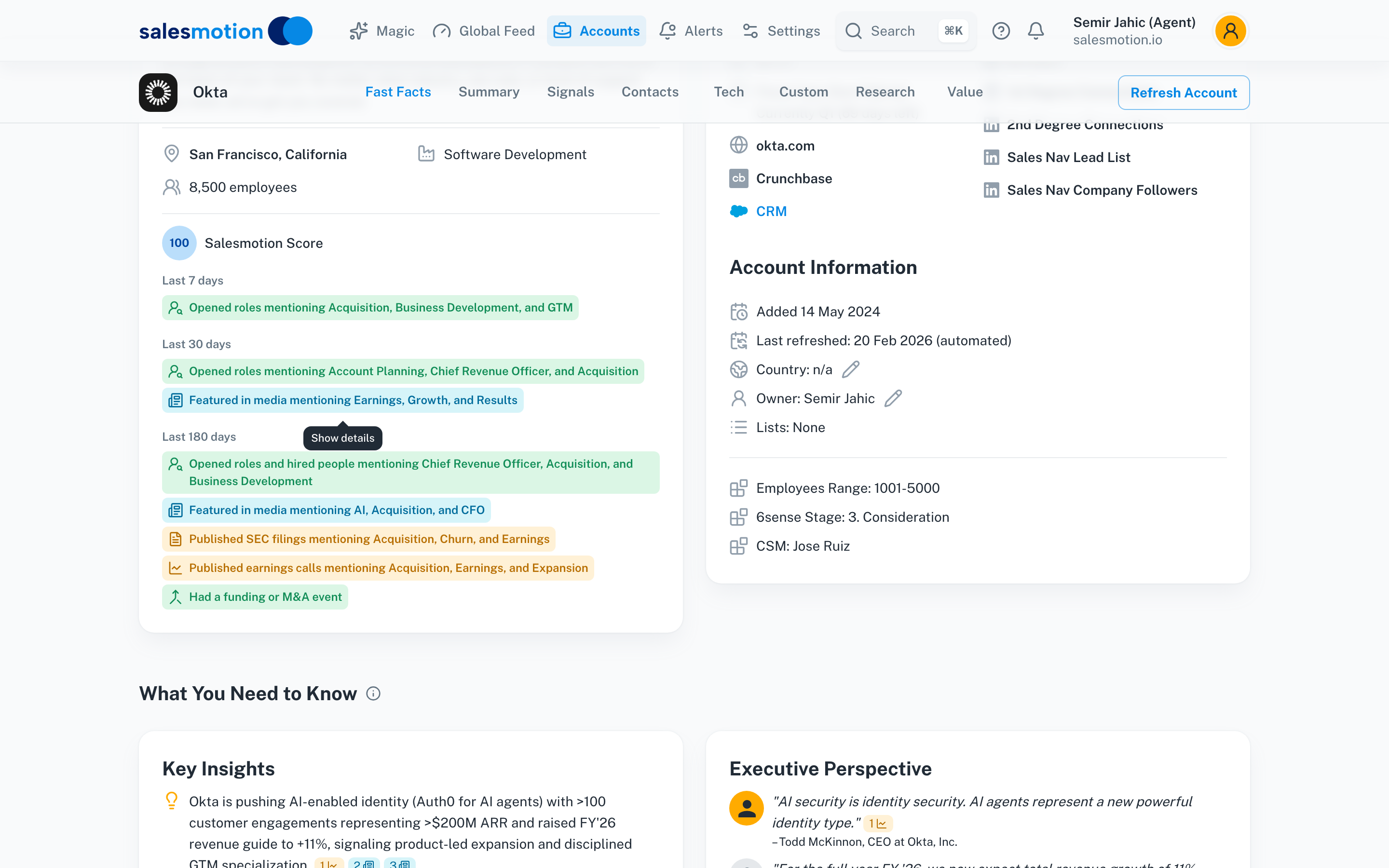 Salesmotion generates an account brief in minutes (key insights, executive quotes, opportunities, and talking points) so reps walk into every meeting prepared.
Quantify Workflow Improvement
RevOps buyers want to know: how many hours per week does this save my team? How does this reduce data entry? How does this improve forecast accuracy? Provide specific numbers from customer implementations, not theoretical projections.
Analytic Partners' VP of Global Commercial Ops, Andrew Giordano, described their experience this way: the team gets 80 to 90% of what they need for prospecting and meeting prep within 15 minutes using Salesmotion, compared to 3 hours of manual research previously. That is an 85% reduction in research time across the commercial team. Read the full case study.
Signals That Indicate Purchase Readiness
RevOps teams generate specific buying signals when they are evaluating new tools:
Tech Stack Review Cycles: Most RevOps teams conduct formal stack reviews quarterly or semi-annually. These reviews often coincide with renewal dates for existing tools. Track when target accounts' contracts with competitors are likely up for renewal.
New RevOps Leadership: When a company hires a new VP of RevOps, Head of Sales Ops, or Director of Revenue Operations, expect a tool stack review early in their tenure. New leaders evaluate what is working, what is redundant, and where gaps exist.
Rapid Scaling: Companies growing headcount fast face immediate RevOps challenges: territory reassignment, CRM scaling, data quality degradation, and onboarding automation. These scaling events create urgent tool needs.
CRM Migration: Companies migrating from HubSpot to Salesforce (or vice versa) are rebuilding their entire tech stack. This is the highest-intent signal for new RevOps tool adoption.
Funding Rounds: Post-funding companies often invest in RevOps infrastructure to support their growth plan. Series B and C rounds frequently trigger RevOps hiring and tool investment (see the funding round sales trigger guide).
Reporting and Forecasting Complaints: When sales leadership publicly discusses forecast inaccuracy, pipeline visibility issues, or reporting gaps, RevOps is actively looking for solutions.
“The Business Development team gets 80 to 90 percent of what they need in 15 minutes. That is a complete shift in how our reps work.”
Andrew Giordano
VP of Global Commercial Operations, Analytic Partners
Outreach Templates for RevOps Buyers
Example: Post-Hiring Outreach to a New VP of RevOps
Signal: Company hired their first VP of Revenue Operations. Previous three months show 40% sales headcount growth.
Subject line: RevOps stack build for the scaling phase
Body: Congrats on the VP of RevOps hire. With 40% sales headcount growth in the last quarter, your team is likely evaluating where the current stack needs reinforcement: data quality, account intelligence, pipeline visibility, or all three.
We help RevOps teams plug account intelligence directly into Salesforce/HubSpot, so reps get research-backed context on every account without leaving the CRM. One client reduced account research from 3 hours to 15 minutes per account.
Worth a 15-minute technical walkthrough?
Example: CRM Migration Outreach to a Sales Ops Director
Signal: Company is migrating from HubSpot to Salesforce. Job postings reference Salesforce Admin roles.
Subject line: Account intelligence for the Salesforce migration
Body: I noticed the Salesforce migration is underway. As you rebuild integrations and data flows, this is the ideal time to evaluate what account intelligence feeds into the new CRM.
Our Salesforce integration pushes account briefs, buying signals, and the Salesmotion Score directly into Salesforce account records. Happy to show you the data model and integration architecture. Would a technical call next week work?
Common Mistakes When Selling to RevOps Teams
Leading with the sales pitch instead of the technical demo. RevOps buyers want to see the product, test the integration, and evaluate data quality before hearing an ROI story. Flip the standard sales process: demo first, then build the business case.
Claiming "seamless integration" without proof. Every vendor claims easy integration. RevOps teams have heard this promise broken dozens of times. Provide a sandbox environment, live integration walkthrough, and reference customers who can speak to the actual integration experience.
Creating another data silo. If your solution stores data outside the CRM without bidirectional sync, RevOps will reject it. Every piece of data your tool generates should flow back into the sales intelligence infrastructure they already have.
Underestimating the evaluation depth. RevOps will test your API, stress-test your data quality, and compare you against several alternatives. Be prepared for a structured evaluation with technical requirements documents and detailed scoring criteria.
Selling to the CRO without RevOps buy-in. Even if the CRO loves your product, they will ask RevOps for a recommendation. If RevOps has not evaluated your solution, the deal stalls. Always build the RevOps relationship first.
Explore the Sales Intelligence for RevOps page for RevOps-specific use cases and integration workflows.
Frequently Asked Questions
How do RevOps teams evaluate new tools?
RevOps teams follow a structured evaluation process: identify the specific workflow problem, shortlist a few solutions, conduct technical evaluations (API testing, data quality audits, integration verification), run a time-boxed pilot, and build a business case for the CRO or CFO. They prioritize data quality, CRM integration depth, and measurable workflow improvement over features. Tools that create data silos or require manual data entry are eliminated early.
What integration capabilities are most important to RevOps buyers?
Native CRM integration (Salesforce and HubSpot) is the baseline requirement. Beyond that, RevOps evaluates bidirectional data sync, real-time vs. batch synchronization, field mapping flexibility, and API quality for custom integrations. Integration with the broader GTM stack (Outreach, Gong, Marketo, Slack) is increasingly important. Provide detailed API documentation, a data flow diagram, and a sandbox environment during evaluation.
How do I build a RevOps champion within a target account?
Engage RevOps with a technical-first approach: offer a data quality audit showing what intelligence you can provide for their specific accounts, demonstrate your integration in a sandbox environment, and share documentation that addresses their concerns proactively. RevOps professionals become champions when they believe your tool will make their stack cleaner, their data better, and their team more efficient. Reference customers in similar company stages and industries strengthen your case.
What is the typical budget range for RevOps tool purchases?
RevOps tool budgets vary widely by company size and category, and many vendors price per seat or per account rather than publishing a flat range. Salesmotion, for example, publishes its plans on its pricing page. The budget usually comes from the CRO or VP of Sales budget line, with RevOps making the recommendation, so a clear build vs buy and ROI case matters.
Key Takeaways
- RevOps teams evaluate tools on data quality, integration depth, and measurable workflow improvement. Lead with these, not feature lists.
- Native CRM integration (Salesforce, HubSpot) with bidirectional data sync is a baseline requirement, not a differentiator. Prove it works before pitching.
- New RevOps leadership, CRM migrations, rapid scaling events, and funding rounds are the highest-intent buying signals for RevOps tool adoption.
- Analytic Partners reduced account research time by 85% (from 3 hours to 15 minutes per account) by integrating account intelligence directly into their sales workflow.
- Visit the Sales Intelligence for RevOps page for RevOps-specific use cases and integration details.