Your best prospects are telling you exactly what they need. It is right there on their website — in the job postings, the leadership page, the press releases, the product announcements. The problem is that nobody has time to read 200 websites.
Learning how to identify your ICP and target buyers from a company website is one of the highest-ROI skills in B2B sales, and almost nobody does it systematically. According to Salesgenie research, 82% of top-performing sellers always research prospects before reaching out, compared to just 49% of average sellers. The gap between "some research" and "systematic ICP research" is where deals are won or lost.
TL;DR: Company websites contain at least seven distinct ICP signals most reps overlook: careers pages, leadership bios, press releases, tech stack clues, pricing models, customer logos, and "About Us" language. A structured scoring rubric turns this qualitative data into a repeatable account prioritization system. Once you hit 50+ accounts, manual research collapses and automation becomes essential.
Why Company Websites Are Underrated ICP Research Tools
Most sales teams build their ideal customer profile from CRM data and firmographics: industry, employee count, revenue. That is necessary but incomplete. It tells you the shape of a company, not the substance. As Mark Roberge, founding CRO of HubSpot and Harvard Business School professor, argued in The Sales Acceleration Formula: sales can be predictable when you use data to identify patterns rather than relying on gut instinct. Company websites are one of the richest free data sources available for building that pattern recognition.
Company websites tell you what a business actually cares about right now. The language on their homepage reveals positioning. Their careers page reveals growth priorities. Their leadership team structure reveals decision-making patterns. None of this shows up in a contact database.
According to Gartner's ICP development framework, the best ICPs combine firmographic attributes with environmental and behavioral signals. A company website is one of the richest free sources of those behavioral and environmental signals. You just need to know where to look.
The payoff is substantial. According to the TOPO Account-Based Benchmark Report, organizations with a strong ICP have 68% higher account win rates. More than 80% of the most successful account-based organizations say they have a strong ICP, while only 42% of other companies say the same.
The problem? It takes 15-20 minutes to properly research a single company website. Multiply that across a territory of 200 accounts, and you are looking at 50+ hours of manual work. That is why most reps default to the quick glance approach and miss the signals that matter.

“We're no longer fishing. We know who the right customers are, and we can qualify them quickly. Salesmotion has had a direct impact on pipeline quality.”
Andrew Giordano
VP of Global Commercial Operations, Analytic Partners
This analysis, automated
The Research Agent reads company websites, pricing pages, and signals to score ICP fit automatically — for every account, every day.
The 7 Signals to Extract from Any Company Website
Here is the framework I teach every sales team I work with. Each signal maps directly to an ICP scoring criterion.
1. Careers Page (Growth Trajectory and Pain Indicators)
This is the single most underrated page on any company website. A Landbase analysis of hiring signals found that hiring decisions often precede technology investments, making them one of the most predictive early indicators of buying intent.
What to look for:
- Volume of open roles. A company posting 50+ roles is in growth mode and likely budgeting for new tools.
- Role types. If they are hiring 15 SDRs, they need sales enablement tools. Hiring data engineers? They are investing in infrastructure. Hiring a VP of Revenue Operations? A buying decision is coming.
- Geographic expansion. Roles in new regions signal market expansion, which means new processes and new tool needs.
- Repeated postings. The same role posted for 3+ months suggests a pain point they cannot solve internally.
2. About Us Page (Company Culture and Maturity Stage)
The "About Us" page reveals more than most reps realize. Pay attention to:
- Founding year and growth milestones. A 3-year-old startup has different buying patterns than a 30-year-old enterprise.
- Mission language. Companies that talk about "digital transformation" or "AI-first" are signaling technology adoption appetite.
- Employee count claims. Compare their stated size to LinkedIn data. Rapid growth (or shrinkage) is a buying signal.
- Funding mentions. If they list recent funding rounds, they have budget to spend.
3. Leadership Team (Decision-Making Structure)
Research from Gartner shows that B2B buying committees now average 11 stakeholders. The leadership page tells you who those stakeholders might be.
- Title patterns. A CRO signals a unified revenue organization. Separate VP Sales and VP Marketing titles suggest siloed teams.
- C-suite backgrounds. Leaders who came from large enterprises often replicate those procurement patterns.
- Recent additions. A new CTO or VP Engineering often triggers a technology review within the first 90 days.
- Board members. Investors on the board often push specific operational playbooks, including technology decisions.
4. Press Releases and News (Timing Signals)
The press or news section gives you real-time buying triggers:
- Product launches. New products require new go-to-market motions.
- Partnerships and integrations. These reveal their ecosystem and potential compatibility with your solution.
- Acquisitions. M&A activity creates a 6-12 month window of technology consolidation.
- Earnings commentary (public companies). Mentions of "cost efficiency," "operational excellence," or "go-to-market investments" tell you where budget is flowing.
5. Technology Stack Clues (Technographic Signals)
You do not need BuiltWith or Wappalyzer to find technology signals on a website (though both are excellent tools). Many companies reveal their stack on their site:
- Integrations page. Lists their current ecosystem. If they integrate with Salesforce, they probably have a Salesforce-centric buying process.
- Job descriptions. "Experience with Marketo required" tells you their marketing automation stack. "Proficient in Snowflake" tells you their data infrastructure.
- Customer-facing features. A chatbot on their site reveals their support technology. The analytics cookies in their footer reveal their marketing stack.
- Blog posts. Engineering blogs often mention specific technologies by name.
As Alexa Grabell, CEO of Pocus, puts it: "More is not better. You need relevant data at the right time with relevant context." The goal is not to catalog every technology on a prospect's website. It is to identify the signals that tell you whether this company fits your ICP and how to approach them.
Wappalyzer's research on technographics shows that technology-driven campaigns see 28% higher conversion rates. Knowing what tools a prospect already uses lets you position around existing workflows, not against them.
6. Pricing Model (Budget and Decision Complexity)
If the company publishes pricing, you have a goldmine of ICP data:
- Self-serve pricing. Likely a product-led growth motion. Deals may be smaller but faster to close.
- "Contact us" pricing. Enterprise sales process with procurement involvement. Longer cycle, larger deal.
- Tiered plans. Look at the feature gates. What they charge more for reveals what their customers value most.
- Free tier existence. Suggests a land-and-expand model. Your champion might be a user, not a buyer.
7. Customer Logos and Case Studies (Peer Validation Mapping)
The customers they showcase reveal who they consider their ICP, and by extension, whether they match yours:
- Industry concentration. If 80% of their logos are financial services, that is their core market.
- Company size patterns. Enterprise logos (Fortune 500s) vs. startup logos tell you their market positioning.
- Case study depth. Companies that publish detailed case studies with metrics are typically data-driven in their own purchasing decisions.
- Partner logos vs. customer logos. These signal different relationships and different entry points for your outreach.
See Salesmotion on a real account
Book a 15-minute demo and see how your team saves hours on account research.
Step-by-Step Walkthrough: Researching a Real Company
Let me walk through how this works in practice. I will use an anonymized example based on a real research session.
Target company: A mid-market SaaS company (let us call them "CloudOps"), 400 employees, Series C funded.
Step 1: Careers Page Scan (3 minutes)
CloudOps has 47 open roles. 12 are in sales (including 3 SDRs, 2 AEs, and a VP of Sales). 8 are in engineering. They are also hiring their first "Head of Revenue Operations."
ICP signal: Aggressive sales growth, likely building infrastructure for the first time. The RevOps hire means they are standardizing processes and will need tools to support that.
Step 2: About Us Review (2 minutes)
Founded in 2019. 400 employees, up from 180 two years ago. Series C at $85M. Three co-founders, all technical backgrounds.
ICP signal: Hypergrowth phase. Budget exists. Technical founders may mean a bottom-up or product-led evaluation process.
Step 3: Leadership Check (2 minutes)
New CRO hired 4 months ago (announced on LinkedIn, confirmed on the website). Came from a company that used Salesforce and Gong. The CFO joined 6 months ago from a public company.
ICP signal: The CRO is likely rebuilding the sales stack. They have enterprise-grade financial oversight now (CFO from public company), which means more structured procurement.
Step 4: Press/News Review (2 minutes)
Two press releases in the last quarter. One announcing a new product line for healthcare, one about a strategic partnership with AWS.
ICP signal: Healthcare expansion means compliance requirements and new buyer personas. AWS partnership signals cloud-first infrastructure.
Step 5: Tech Stack Clues (2 minutes)
Job descriptions mention Salesforce, Outreach, Snowflake, and Looker. The website runs HubSpot tracking (visible in page source). Integration page lists Slack, Jira, and GitHub.
ICP signal: Mixed stack with Salesforce for CRM and HubSpot for marketing. Outreach for sequences. They will want tools that integrate with Salesforce, not replace it.
Step 6: Pricing Model (1 minute)
CloudOps has published pricing with three tiers. Enterprise tier says "Contact us." The Professional tier is $99/user/month.
ICP signal: They sell to both SMB (self-serve) and enterprise (sales-assisted). Their own buying process probably mirrors this, so expect a champion-led evaluation with procurement approval.
Step 7: Customer Logos (1 minute)
Eight logos displayed, mostly mid-market SaaS companies and two healthcare organizations.
ICP signal: Their entry into healthcare aligns with the press release. They are a mid-market-focused company serving mid-market customers, which means their buying process will also be mid-market (faster than enterprise, but still multi-stakeholder).
Total research time: ~13 minutes. The output is a detailed account brief that tells a rep exactly how to approach this company, who to talk to, and what to lead with.
Building an ICP Scoring Rubric from Website Research
Raw signals are useful. A scoring system makes them actionable. Here is a rubric framework adapted from Prediqte's ICP scoring research and validated with our own customers.
| Signal | High Fit (3 pts) | Medium Fit (2 pts) | Low Fit (1 pt) |
|---|---|---|---|
| Hiring velocity | 10+ relevant roles open | 3-9 relevant roles | 0-2 roles |
| Leadership changes | New CxO in last 90 days | New VP in last 6 months | No recent changes |
| Funding / growth | Recent funding round or IPO | Steady growth signals | Flat or contracting |
| Tech stack fit | Uses complementary tools | Partial overlap | Uses competing solution |
| Decision complexity | "Contact us" pricing | Tiered with enterprise plan | Self-serve only |
| Market signals | M&A, new product lines, expansion | Partnerships announced | No recent news |
| Customer alignment | Serves your ICP's industry | Some overlap | No overlap |
Scoring tiers:
- 18-21 points: Tier 1 account. Prioritize immediately. These accounts have active buying signals and strong fit.
- 12-17 points: Tier 2 account. Add to nurture sequence. Monitor for signal changes.
- 7-11 points: Tier 3 account. Low priority. Revisit quarterly.
Salesmotion's Take
When I started Salesmotion, every VC told me "sales tech is a red ocean." But my ICP was not the typical US SaaS company. I found blue ocean in packaging companies in Asia, marketing consultancies in the UK, and high-tech manufacturing in Switzerland. Your ICP might be hiding in plain sight on company websites if you know what signals to look for — the lesson is that the best ICPs often come from patterns you would never guess without doing the research.

Semir Jahic
CEO & Co-Founder, Salesmotion
This is where the ICP scoring process creates compounding value. According to Apollo's ICP framework research, teams using structured ICP scores see 1.8x higher average contract values and 15-20% shorter sales cycles compared to teams without systematic scoring.
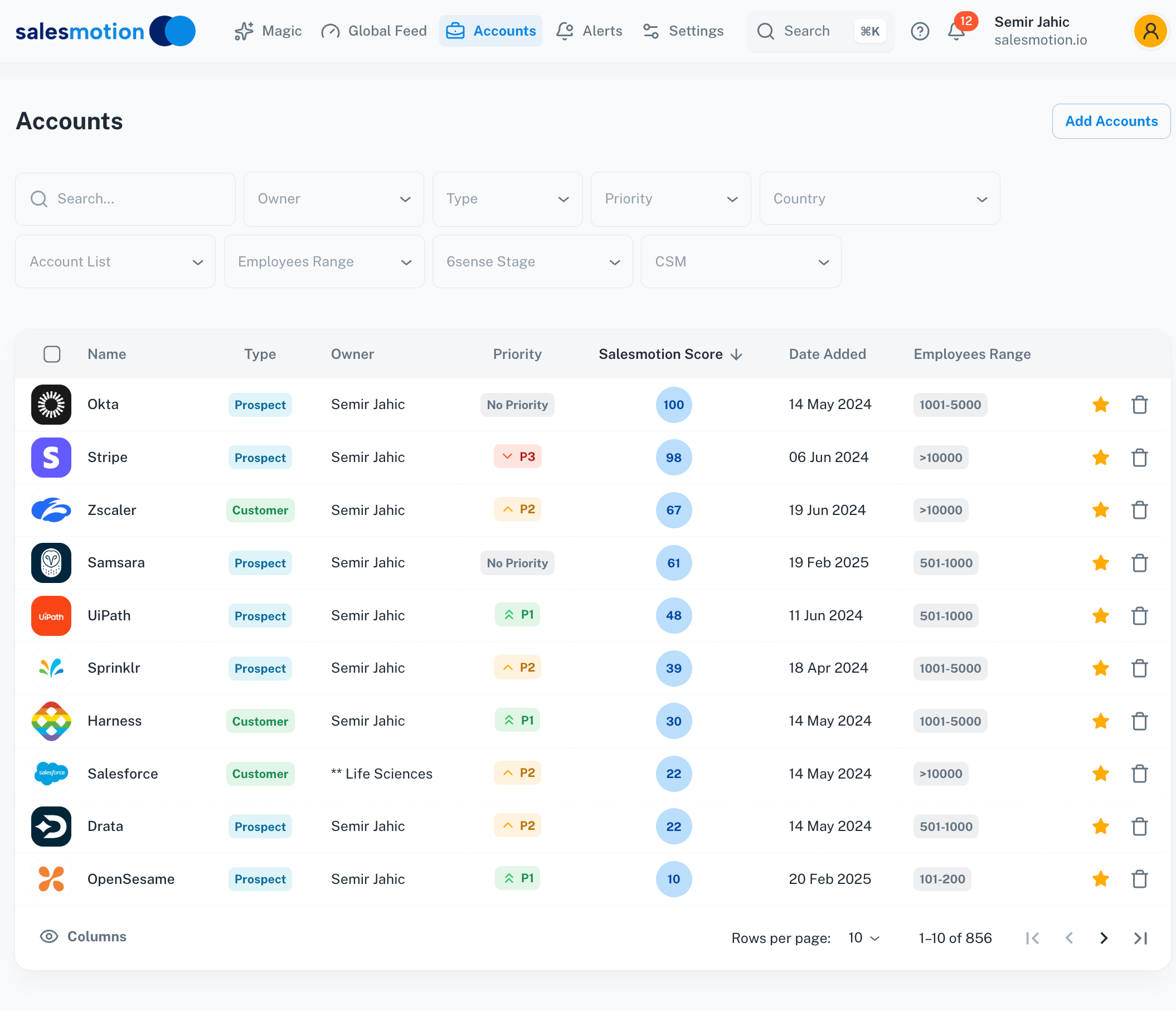 An account scoring dashboard that automates the manual rubric above, combining website signals with additional data sources for continuous prioritization.

“With Salesmotion, you realize just how much time you were spending on low-value tasks. Now that our team isn't drowning in manual research, they can truly focus on execution, which is priceless for a startup.”
Adam Wainwright
Head of Revenue, Cacheflow
Scaling Website Research Beyond 20 Accounts
Here is where I have to be honest. The framework above works brilliantly for your top 20 target accounts. It completely falls apart at 50+.
The math is simple. At 13 minutes per account, researching 200 accounts takes over 43 hours. No rep has that time. And even if they did, the research goes stale within weeks. New hires, new press releases, new leadership changes, all happening in real time across your entire territory.
This is exactly the wall that Jeff Dalo at Analytic Partners hit. As Senior Director of Business Development, Jeff's job is to research Fortune 500 accounts deeply enough to walk into conversations as a subject-matter expert. Before adopting account intelligence tooling, that research took hours per account across multiple tools. After, he cut it to roughly 15 minutes per account — and uncovered signals he was previously missing entirely.
The workflow shift looks like this in practice:
- Signal fires: A target account posts a VP of Revenue Operations role (the same careers page signal from our CloudOps example).
- Platform action: An account intelligence tool flags the account, updates the account brief with the hiring signal, and cross-references it against recent earnings commentary and leadership changes.
- Rep action: The rep receives an alert with the full context and enters the first meeting already knowing the company's growth trajectory, tech stack, and likely pain points.
- Outcome: Instead of a generic discovery call, the first conversation is consultative. The rep references the RevOps hire and connects it to the company's stated growth initiative. Deal progression accelerates because discovery is half-done before the call starts.
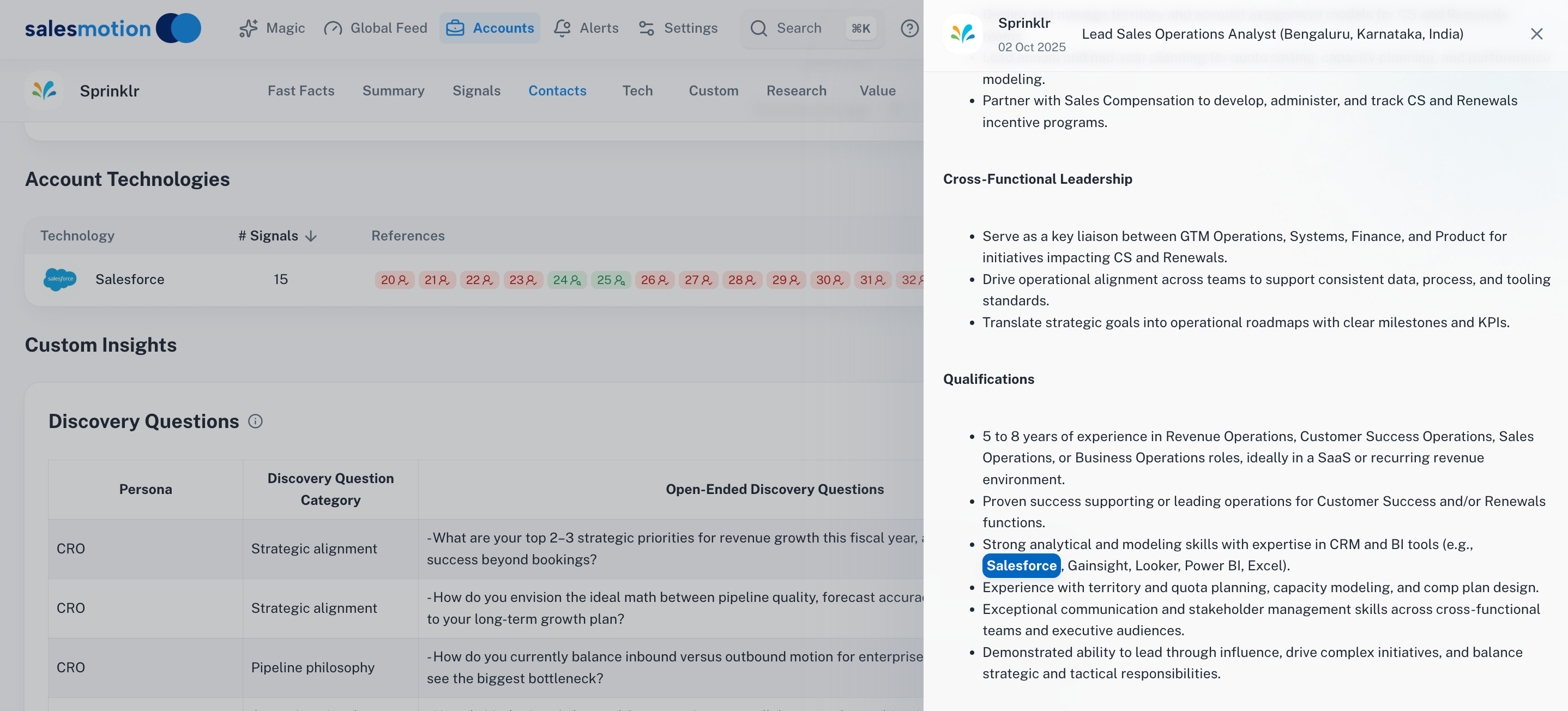 Automated tech stack detection surfaces the same technographic signals you would manually extract from job postings and integrations pages — across every account in your territory.
For account-based selling teams managing 50-200 accounts, the difference between manual website research and automated account intelligence is the difference between guessing which accounts to prioritize and knowing.
From ICP Signals to Prospect Prioritization
The signals you extract from company websites are not just for qualifying accounts. They directly inform who to contact and what to say.
Once you have scored an account, map the signals to specific buyer personas:
- Hiring a VP of RevOps? Your first outreach should go to the incoming hire (if identified) or the CRO who approved the role. The pain point is operational: they need infrastructure.
- New CTO in the last 90 days? Lead with technology consolidation. New CTOs audit the entire stack within their first quarter.
- Healthcare expansion announced? Reach out to the head of that new division. They are building everything from scratch and need tools fast.
- Series C funding? The board is expecting growth metrics. Connect with the VP of Sales who has a mandate to hit aggressive pipeline targets.
This is where website research connects to B2B prospecting execution. The signals tell you who to call, when to call, and what to say on that call.
According to Brixon Group's research on B2B buyer behavior, buyers complete 80% of their journey before talking to a rep. Your research needs to match or exceed what the buyer already knows about their own company's situation. Showing up with surface-level talking points wastes everyone's time.
Key Takeaways
- Company websites contain seven distinct ICP signals that most reps overlook: careers pages, About Us, leadership team, press releases, tech stack clues, pricing models, and customer logos.
- Careers pages are the single most predictive signal source. Hiring decisions precede technology investments, making open roles an early indicator of buying intent.
- Organizations with a strong ICP have 68% higher account win rates (TOPO/Gartner). A structured scoring rubric turns qualitative website research into repeatable account prioritization.
- Manual website research works for your top 20 accounts but collapses beyond 50. At 13 minutes per account, researching 200 accounts takes 43+ hours, and the data goes stale within weeks.
- Map ICP signals directly to buyer personas and outreach messaging. The same signals that qualify an account also tell you who to contact and what to lead with.
- Account intelligence platforms automate the manual process, monitoring hundreds of sources per account and surfacing signals in real time so reps can focus on selling, not researching.
Frequently Asked Questions
How long does it take to research a company website for ICP signals?
A thorough manual review using the seven-signal framework takes 12-15 minutes per company. This includes scanning the careers page, About Us, leadership team, press releases, tech stack clues, pricing model, and customer logos. For your top 20 target accounts, that is 4-5 hours of focused research. Beyond that, automation tools become essential. Forrester's research shows that buyers increasingly prefer self-service research, which means the intelligence you bring to the first conversation matters more than ever.
What is the difference between ICP scoring and lead scoring?
ICP scoring evaluates how well a company (account) matches your ideal customer profile based on firmographic, technographic, and behavioral signals. Lead scoring evaluates how engaged an individual contact is with your marketing. They complement each other: ICP scoring tells you which companies to target, lead scoring tells you which people within those companies are showing interest. According to Cognism's ICP research, the most effective sales teams use both: ICP scoring to prioritize accounts and lead scoring to prioritize contacts within those accounts.
Can I use free tools to automate website research for ICP identification?
Partially. Tools like Wappalyzer (free tier) can identify technology stacks, and BuiltWith provides technology lookups. Google Alerts can track press mentions. LinkedIn gives you leadership changes and hiring data. However, free tools create a fragmented workflow where you are still toggling between five or more tabs and manually synthesizing signals. For systematic ICP identification across 50+ accounts, purpose-built account intelligence platforms combine all these signals into a single view and continuously monitor for changes, which is what separates sporadic research from scalable account intelligence.
Which website signal is the strongest predictor of buying intent?
Based on patterns across thousands of accounts, the combination of leadership changes plus hiring velocity is the strongest predictor. A new CxO hire paired with aggressive recruiting in a specific function (like sales or engineering) signals both budget authority and operational urgency. According to Autobound's analysis of hiring signals, hiring decisions often precede technology purchase decisions by 30-90 days. If you can only check one signal, start with the careers page.