LinkedIn is often still treated like a list-building tool. That's backwards. LinkedIn generates 80% of all B2B social media leads, and its visitor-to-lead conversion rate is 2.74%, which is 277% more effective than other major social platforms according to Brenton Way's LinkedIn marketing statistics roundup. The opportunity isn't just access to people. It's access to context.
TL;DR: Lead generation using LinkedIn works when outreach is tied to a signal, not a list. Tighten your profile and company page, build a core ICP list and an active signal list in Sales Navigator, then turn each trigger (a new executive, a job posting, a public comment) into a short message that explains why it matters and asks one easy question. Warm accounts with comments and content first, and measure signal-to-conversation and conversation-to-meeting rates.
That's where most lead generation using LinkedIn breaks down. Reps can spot a signal like a leadership hire, a hiring push, or a burst of executive activity, but they still send the same tired message. The prospect sees a pitch with a thin personalization layer and ignores it. The issue usually isn't effort. It's the gap between noticing something and knowing what to do with it.
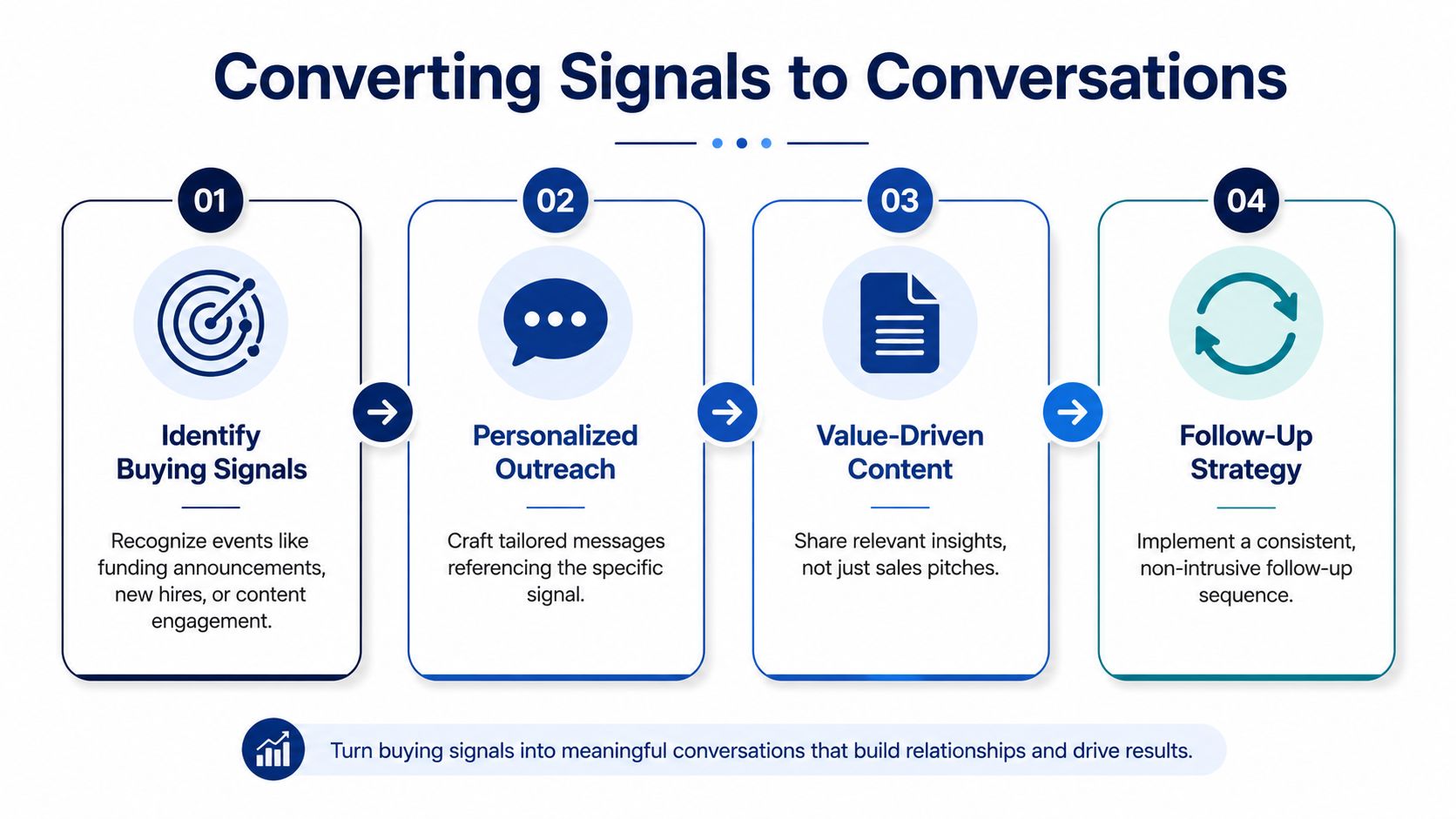
The playbook that works now is simple to describe and hard to execute consistently. Watch for signals. Interpret the “so what.” Turn that into outreach while the timing still matters. When teams get that sequence right, LinkedIn stops being a networking site and starts becoming a live feed of reasons to start relevant conversations.
Beyond the Connection Request The Modern LinkedIn Playbook
The old model was built on volume. Pull a list, send requests, drop a pitch, repeat. It still fills activity dashboards, but it rarely creates serious pipeline because buyers can tell when a message was written for a segment instead of for them.
That matters more now because LinkedIn is too valuable to waste on generic outreach. If the channel already produces the bulk of B2B social leads, the main question isn't whether to use it. The question is whether your team is using it with enough relevance to deserve a reply.
Why mass outreach keeps getting ignored
A lot of outbound teams confuse personalization with relevance. Mentioning a recent post is personalization. Explaining why a recent event at their company likely changed a priority is relevance.
Those are not the same thing.
Here's what weak outreach usually looks like:
- It starts with the seller's agenda: The message jumps straight to a demo ask.
- It uses shallow context: A rep references a title, post, or company name, but never connects it to a business implication.
- It arrives at the wrong moment: The account fits the ICP, but there's no trigger that makes the outreach timely.
By contrast, modern lead generation using LinkedIn works when outreach is tied to an actual business event and a clear hypothesis.
Practical rule: Don't ask, “Does this account match our ICP?” Ask, “What changed recently that makes this conversation make sense right now?”
That mindset shift is what separates noise from pipeline. It also lines up with a smarter view of outreach quality, which is covered well in this piece on why LinkedIn outreach relevance beats volume.
Treat LinkedIn like a signal stream
The strongest reps don't open LinkedIn looking for names. They open it looking for movement.
They want evidence that a company is hiring into a problem, reorganizing around a priority, expanding into a market, reacting to competition, or putting a new executive in charge of a result. Every one of those events can become a better opening than “thought I'd reach out.”
A simple comparison makes the shift clear:
| Approach | What the rep sees | What the rep sends |
|---|---|---|
| Static prospecting | A target account with the right title | Generic intro and pitch |
| Signal-driven prospecting | A target account with a recent trigger | Contextual message tied to the trigger |
The second approach takes more thinking. That's why it wins.
See Salesmotion in action
Take a self-guided interactive tour — no signup required.
Optimize Your Profile and Company Page to Attract Leads
Before outreach works, your profile has to survive inspection. Prospects click before they reply. If your LinkedIn presence reads like a resume, a quota statement, or a generic company brochure, you lose trust before the conversation starts.

Fix the personal profile first
A strong sales profile does three jobs. It tells the right buyer who you help, signals that you understand a business problem, and gives the prospect a reason not to dismiss you as another random seller.
Use this checklist:
- Headline with buyer context: Don't just list your role. Say who you work with and the problem area you focus on.
- About section with a point of view: Write in plain English. Explain what situations you guide buyers through and what kinds of conversations you usually have.
- Featured section with proof: Add useful assets like a webinar, customer story, industry breakdown, or thoughtful post. The goal is credibility, not volume.
- Experience section with specifics: Show what kinds of teams, functions, or outcomes you support. Keep it practical.
- Profile activity that looks alive: A profile with occasional thoughtful posts and comments feels more trustworthy than a perfectly polished page with no visible activity.
Your profile should answer the prospect's silent question: “If I accept this request, will this person waste my time?”
Write for the buyer, not for recruiters
A lot of profiles still read like career summaries. That's fine if your goal is hiring visibility. It doesn't help much with lead generation using LinkedIn.
A better format is closer to market positioning:
I work with revenue teams that need cleaner account context before outreach. Most are dealing with scattered signals, uneven research quality, and generic messaging that doesn't land.
That's stronger than listing awards, years in role, or broad claims about being “results-driven.”
Turn the company page into a trust layer
Your company page matters more than many sales teams admit. Prospects check it to validate whether the business looks active, credible, and relevant to the problem being discussed.
A useful company page usually includes:
- Clear positioning that says what the company does without jargon.
- Recent updates that show momentum, product direction, or customer education.
- Content tied to buyer concerns instead of only product announcements.
- Visible consistency across brand language, visuals, and leadership presence.
For many teams, the company page works best when it supports the same message architecture used in outreach. The pain points on the page should match the themes your reps discuss in DMs.
If you need a practical framework for tightening that foundation, this guide on lead generation best practices is worth reviewing.
A strong profile doesn't close deals. It removes doubt early enough for the conversation to start.

“Salesmotion helps you spot signals from prospect accounts, news items / job hiring alerts etc that indicate that now is a good time to reach out with a well-crafted message.”
Rob Douglas
Director of Sales, icit business intelligence
Finding Your Ideal Customers with Precision Targeting
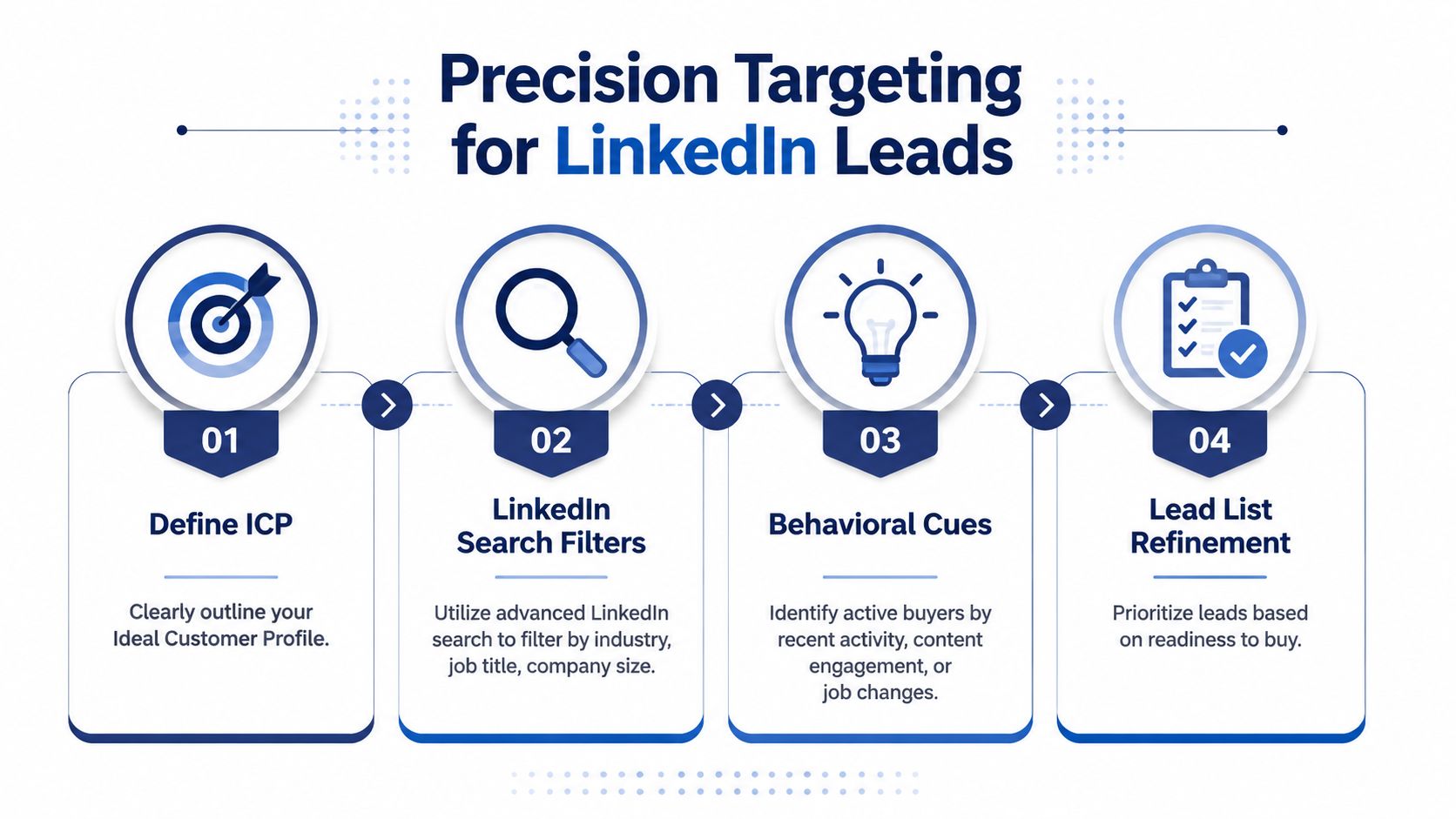
Targeting on LinkedIn usually fails in one of two ways. Teams go too broad and attract vague interest, or they go too narrow and burn through a tiny pool with repetitive messaging. Good targeting sits between those extremes and adds a second layer often missed: current relevance.
For paid LinkedIn B2B lead generation campaigns, the target audience should sit between 50,000 and 500,000 members, with segmentation and exclusions layered carefully to improve conversion quality, according to Firebrand's LinkedIn lead generation best practices. Even if you're doing organic prospecting rather than paid, the principle still holds. Precision beats both spray-and-pray and overfitted targeting.
Build your list in layers
Start with the obvious filters in Sales Navigator. Industry, company size, geography, function, and seniority still matter. They define your market.
But don't stop there. Static fit only tells you who could buy. It doesn't tell you who has a reason to engage now.
A better workflow looks like this:
| Layer | What to filter for | Why it matters |
|---|---|---|
| ICP fit | Industry, size, function, seniority | Confirms baseline relevance |
| Operating context | Hiring patterns, org structure, business model | Reveals how the company likely works |
| Trigger conditions | Leadership change, hiring push, active posting, market activity | Creates a reason to reach out now |
| Exclusions | Competitors, bad-fit segments, low-priority accounts | Protects quality and time |
Use signals as a primary filter
Most prospecting lists begin with firmographics and add signals later. Flip that.
If a company recently hired a new revenue leader, launched a new function, expanded hiring in a category your product supports, or showed executive activity around a known pain point, that account should move up the queue. Those conditions create urgency and message clarity.
This is also where manual qualification gets messy. Reps have to check company pages, job postings, leadership updates, content activity, and account news one by one. If that work is happening in spreadsheets and browser tabs, quality drops fast.
For teams trying to clean up that step, AI agent lead qualification is a useful reference point because it shows how automation can help sort stronger leads from weak ones before reps spend time on outreach.
Search for readiness, not just fit
A practical way to run Sales Navigator is to build two lists for every segment.
The first list is your core ICP list. These are companies that fit your market on paper.
The second is your active signal list. These are companies from the same market that are showing fresh movement. The moment the second list exists, priorities become clearer. Reps stop arguing about who to contact and start working from context.
Use prompts like these when refining a list:
- Who just changed leadership? A new executive often re-evaluates tools, processes, and reporting lines.
- Who's hiring into a pain area? Job descriptions often reveal internal priorities better than a polished company page.
- Who's posting or commenting with intent? Executive activity can expose current initiatives or friction points.
- Who should be excluded? Remove students, consultants, peer vendors, and segments that create engagement but rarely convert.
Field note: The best prospect list is not the biggest qualified list. It's the shortest list with a credible reason to contact each account now.
If you want to sharpen this motion further, this article on intent-based targeting goes deeper on separating broad-fit accounts from high-intent ones.
From Signal to Conversation Crafting Outreach That Works
Often, teams stall at this point. They can see the trigger, but they can't turn it into a good message. That gap is bigger than most leaders think. Most content on LinkedIn lead gen fails to bridge the “Intent Signal → Actionable Outreach” gap, and 65% of reps still spend 2–3 hours manually stitching together account context instead of selling, according to Martal's breakdown of LinkedIn lead generation gaps.
That number feels believable because this work is still painfully manual in many teams. A rep finds an announcement, opens the company page, scans executive profiles, checks hiring, reviews recent posts, then tries to turn all that into one message that sounds natural. Most give up early and fall back to a template.
The signal-to-action formula
Every high-quality outreach sequence needs three parts:
-
Signal
What happened? -
So what
Why does that event likely matter to this stakeholder? -
Conversation angle
What low-friction message can you send that turns the signal into a useful exchange?
Most bad outreach skips step two. That's the whole game.
The New Executive play
A target account hires a new CRO, VP of Sales, or Head of Operations. Most reps respond with congratulations and a meeting ask. That rarely works.
The better move is to infer the likely pressure behind the hire.
A new executive usually means one of three things: the board wants change, the previous setup wasn't delivering, or the business is entering a new phase. Your message should reflect one of those realities without sounding invasive.
Connection request example
“Congrats on the new role. New revenue leadership usually comes with a quick push to evaluate what's working, what's bloated, and where execution is lagging. Curious what's highest on your list right now.”
First DM after acceptance
“Thanks for connecting. I noticed the timing of the move and figured your team is probably tightening priorities fast. We've seen leaders in similar seats focus first on visibility into active accounts, rep focus, and cleaner reasons to reach out. Is account prioritization one of the areas you're reworking?”
Why this works: it ties the role change to likely operating decisions. It doesn't pitch product first.
The Job Posting play
Job posts are one of the cleanest signals in lead generation using LinkedIn because companies write them in their own language. They often expose internal pain directly.
If a company is hiring for RevOps, sales enablement, implementation, security, or customer success roles that overlap with your value, don't just say you saw the post. Pull out the operational implication.
Signal: They're hiring for a RevOps manager with responsibilities around forecasting, CRM hygiene, and process standardization.
So what: Their current systems may be fragmented, or leadership may be pushing for tighter execution and visibility.
Message structure:
- Open on the hiring signal
- Name the probable challenge behind it
- Ask one question that invites context
Example DM
“Saw the RevOps hiring push. Roles like that usually show up when leadership wants cleaner reporting and less manual work across the funnel. Are you trying to standardize process right now, or is this more about fixing visibility gaps?”
That is much stronger than “noticed you're hiring and thought we could help.”
The Competitor Mention play
This one is underused because it requires more nuance. If an executive mentions a competitor, a category problem, or a strategic initiative in an interview, podcast, or public post, you've got a live opening. But only if you focus on the implication, not on your eagerness.
Scenario: A leader talks publicly about pressure to improve speed, reduce wasted effort, or support a new go-to-market push.
Your outreach should sound like pattern recognition.
When a prospect names a strategic problem publicly, don't mirror their exact words back to them like a transcript. Translate the issue into a business consequence and respond to that.
Connection request example
“Your comments on scaling go-to-market execution without adding more noise were sharp. A lot of teams hit that point where activity increases faster than clarity. Interested to compare notes.”
First DM
“You mentioned execution strain as the team scales. That usually shows up as bad prioritization, uneven outreach quality, or too much research time before each touch. Which one is biting harder right now?”
The content engagement play
This is the softest motion, but it's often the easiest to start. If someone likes, comments on, or posts around a problem space you understand, don't jump into a pitch. Stay in the thread of the idea.
A simple structure works:
- Reference the post or theme
- Add one grounded observation
- Ask one easy question
Example
Saw your post on outbound quality slipping when teams chase activity targets. I agree. Teams often don't have a volume problem. They have a weak ‘why now' problem. Are you seeing that more in targeting or in rep messaging?
Keep the first message easy to answer
The best first DMs do not try to close. They try to diagnose.
Use this checklist before sending:
- Is it tied to a real signal?
- Did I explain why that signal matters?
- Am I asking a question that a busy operator could answer quickly?
- Would this message still make sense if the product were never mentioned?
If the answer to that last question is no, the outreach is still too seller-centric.

“Automatic account profile detail I can use to manage my territory. Using Salesmotion AI to generate value statements per persona, account, etc. Using Salesmotion to give me a starting point based on new hires, or news alerts is critical.”
Adam Wainwright
Head of Revenue, Cacheflow
Scaling Your Influence with Content and Engagement
Good outbound works better when the prospect has seen you before. Not because your personal brand needs to be huge, but because familiarity lowers resistance. A thoughtful comment, a useful post, or a consistent point of view can make a later DM feel like a continuation instead of an interruption.
That's why content and prospecting shouldn't sit in separate buckets. They feed each other.
Warm the account before the ask
One of the clearest patterns in high-performing outreach is simple: avoid cold InMails and warm prospects first with 5–10 substantive comments per day on their posts before sending a connection request, as described in this Reddit discussion on effective LinkedIn lead gen. The tactic works because it builds familiarity before you appear in the inbox.
Most reps comment badly. They write “great point” or “agree.” That adds nothing.
Better comments do one of three things:
- Add a pattern: Connect the post to a broader operating issue.
- Add an example: Mention a similar scenario you've seen in the market.
- Add a question: Invite the poster to extend their thinking.
Use a simple rep content model
Sales reps don't need to become creators. They need a repeatable content habit that supports trust.
A practical model is:
| Content type | What to post | Why it helps |
|---|---|---|
| Observation | A short take on a market pattern | Shows commercial judgment |
| Breakdown | A simple framework or lesson from the field | Proves you can be useful |
| Reaction | A response to industry news or a customer problem | Creates relevance with target buyers |
A rep who posts occasionally about the same pain points they discuss in outreach becomes easier to trust. The prospect checks the profile and sees coherence. That matters.
Build surround sound, not noise
The strongest motion is usually a sequence, not a single touch. A prospect sees your comment on a peer's post. Then they notice a short post from you on the same business issue. Then they receive a connection request that references a timely signal. That sequence feels intentional.
Buyers don't need more content. They need repeated evidence that you understand the problem they're dealing with.
When teams get this right, content stops being a brand exercise and becomes part of the sales system.
Automate Your Workflow and Measure What Matters
Manual execution can absolutely produce results. It can also break the moment the team needs consistency across more accounts, more reps, and more signals. The issue isn't whether a good rep can do this work. The issue is whether the team can do it every day without losing speed and quality.
That matters because 70% of LinkedIn leads fail to convert due to poor ICP fit or weak “why now” triggers, as highlighted in LinkedIn's lead generation best practices guidance. Volume won't fix that. Better timing and qualification will.
Track the metrics that expose message quality
Connection acceptance matters, but it's not enough. A healthy LinkedIn motion should be judged by deeper indicators:
- Signal-to-conversation rate: Which triggers start replies?
- Conversation-to-meeting rate: Which talk tracks turn interest into a scheduled call?
- Meeting quality: Are the accounts right, and is timing real?
- Follow-up speed: Are leads routed to reps fast enough to keep context fresh?
Teams that manage sales motions inside shared systems often benefit from tightening workflow inside the tools they already use. If your team lives in Google Workspace, this guide on how to improve sales management within Google Workspace is a sensible companion resource for operational cleanup.
Automation is the scaling layer
The painful part of lead generation using LinkedIn isn't sending the message. It's everything before the message. Monitoring accounts. Noticing changes. Researching stakeholders. Interpreting the trigger. Writing something that sounds like a human who did the homework.
Once that workload increases, manual execution turns into selective execution. Reps only research the hottest accounts. Everything else gets generic treatment or no treatment at all.
That's the point where automation stops being a nice-to-have and becomes infrastructure. If you're thinking through how to systematize signal monitoring, prioritization, and personalized prospecting, this piece on sales prospecting automation lays out the operational case clearly.
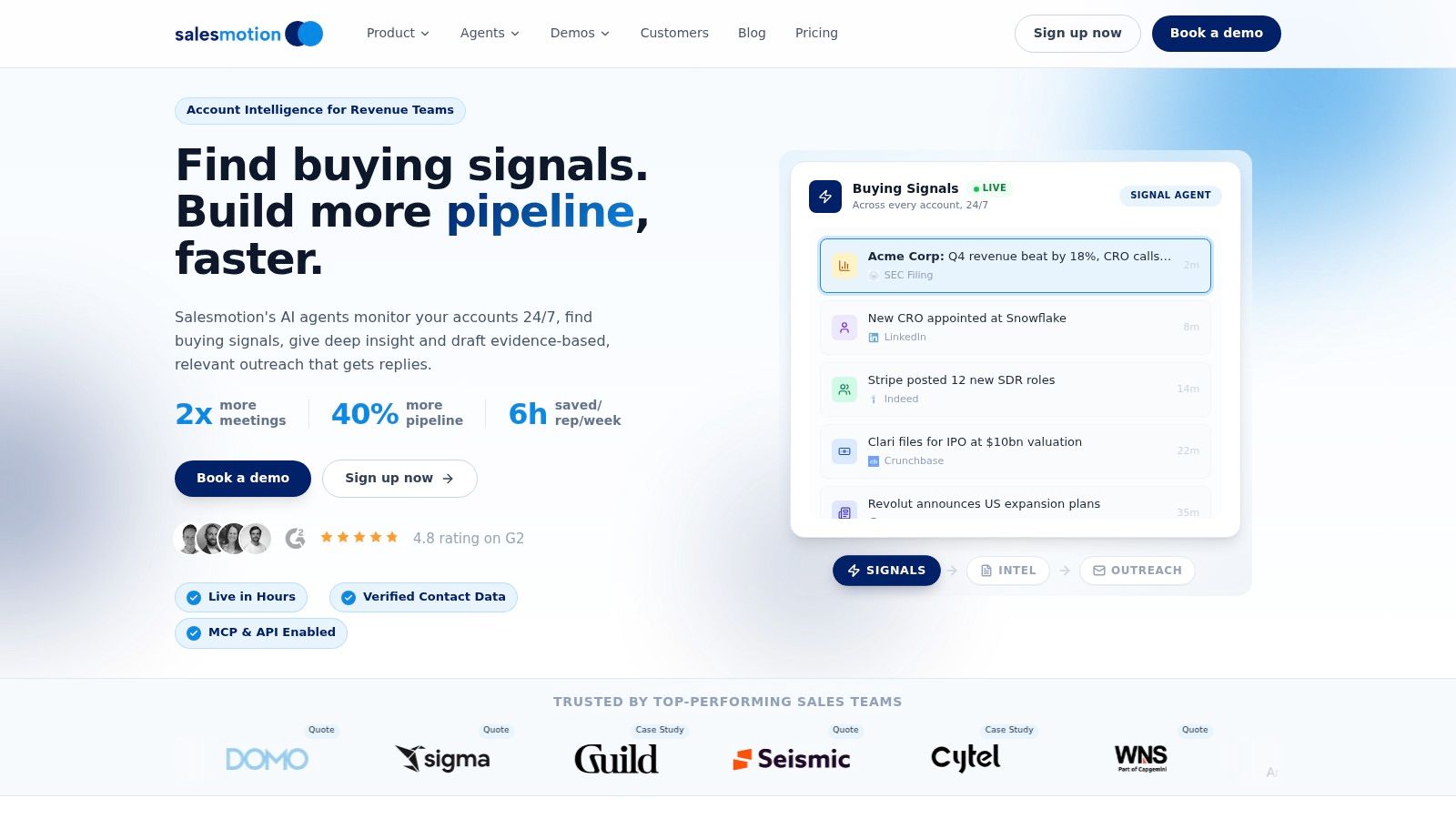
If your team wants more pipeline from LinkedIn without asking reps to spend hours stitching together account research, Salesmotion is built for that exact problem. Its AI agents track account signals, explain the “so what,” and turn fresh context into outreach your reps can readily use. That means less manual research, faster follow-up, and more conversations that start at the right moment.