LinkedIn has made volume-based outreach nearly impossible, and many sales teams are still solving the wrong problem. In late 2025, LinkedIn capped Open InMail sends to under 100 per month, down from a practical limit of 800. That is an 87% drop in outbound capacity overnight. The teams scrambling to find workarounds are missing the point.
The teams booking the most meetings on LinkedIn were never relying on volume. They were sending fewer, better messages to people who actually had a reason to respond. LinkedIn outreach has always rewarded relevance over reach. The platform just made that truth impossible to ignore.
TL;DR: LinkedIn's InMail caps killed spray-and-pray outreach. With under 100 Open InMails per month and strict connection request limits, the only path to pipeline is message relevance. Signal-driven outreach, timed to buying signals like funding rounds, leadership changes, and strategic shifts, achieves 15 to 25% response rates versus 1 to 2% for generic templates. The winners are not optimizing their profiles harder. They are showing up with messages so specific that prospects respond because they want to.
Why LinkedIn Is Forcing a Quality-Over-Quantity Shift
The numbers tell a clear story. LinkedIn now enforces hard limits across every outreach channel:
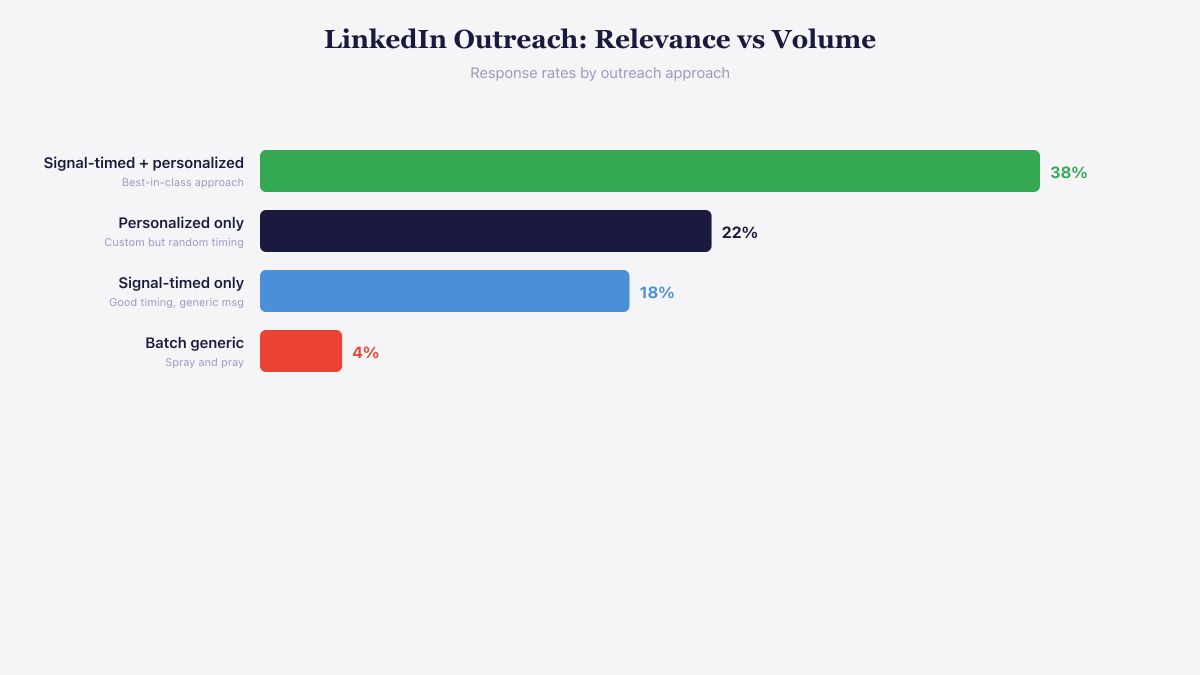 Signal-timed, personalized LinkedIn outreach gets 10x the response rate of batch generic messages.
- Connection requests: 100 to 200 per week depending on account health and Social Selling Index
- InMails: 50 credits per month with Sales Navigator (no option to buy more)
- Open InMails: Capped at roughly 100 per month, down from 800
- Total daily activity: Around 250 actions per day before triggering flags
For teams that were sending 800+ messages per month from a single account, this is a structural problem. But here is what the data shows: personalized LinkedIn messages achieve 93% higher acceptance rates than generic outreach. InMail response rates range from 10 to 25% when personalized, compared to under 1% for templated mass sends. LinkedIn is not punishing outreach. It is punishing lazy outreach.
The platform even builds this into its economics. When a prospect responds to your InMail, you get the credit back. When they ignore it, the credit is gone. LinkedIn is literally pricing relevance: every ignored message costs you capacity. Every response earns it back.
This means the ROI equation has flipped. The question is no longer "how do I send more messages?" It is "how do I make every message worth sending?"
See Salesmotion on a real account
Book a 15-minute demo and see how your team saves hours on account research.
The Real Problem Is Not Your Profile or Your Template
Most LinkedIn outreach advice focuses on optimization mechanics: update your headline, add a banner image, write a compelling About section, keep messages under 400 characters, use soft CTAs. This advice is not wrong. It is just insufficient.
A perfectly optimized profile sending a generic message to someone who is not in a buying cycle will still get ignored. The mechanics are table stakes. What separates a 2% response rate from a 20% response rate is whether you know something specific about the prospect's situation that makes your message relevant right now.
A business development rep at a software firm told us: "I can't make it relevant for them if I don't do deep research." That is the gap between the two response rates, said by someone who sends the messages.
Consider two messages to the same VP of Sales:
Message A: "Hi Sarah, I help sales teams improve their outreach. Would love to connect and share how we've helped companies like yours."
Message B: "Hi Sarah, saw your team just opened three new AE roles in EMEA. We helped a similar company ramp their new hires to quota 40% faster using structured account research. Worth a quick conversation?"
Message B works because it references a specific, verifiable signal (the hiring posts) and connects it to a relevant outcome. The prospect does not respond because the copy is better. They respond because the sender clearly understands their situation.
A business development rep at an HR software firm told us prospects are often surprised when he quotes their own CEO back to them, and that it explains the initiative they are working on.
This is the intelligence gap. Most sales teams invest in LinkedIn automation tools, profile optimization, and message templates. Very few invest in the research infrastructure that makes every message land.

“The talking points are gold. If they're in Salesmotion, I know they're being discussed inside that business. That makes it easy to spark a real conversation, which is 90 percent of the battle.”
Andrew Giordano
VP of Global Commercial Operations, Analytic Partners
The Signals That Make LinkedIn Messages Impossible to Ignore
Not every piece of account news is worth a message. The signals that reliably trigger responses on LinkedIn fall into categories that indicate active decision-making or organizational change:
Leadership changes. A new VP of Sales, CRO, or Head of Revenue Operations almost always reassesses existing tools and vendor relationships within their first 90 days. Reaching out with relevant context during this window generates 3 to 4x higher response rates than cold outreach to established leaders.
Hiring patterns. When a company posts multiple roles in a specific function, it signals investment and potential pain points. A company hiring five SDRs probably needs better prospecting tools. A company hiring a Head of RevOps is about to re-evaluate their entire stack.
Funding and financial events. A Series B biotech or a public company reporting strong earnings with expanded sales targets will be making vendor decisions within months. Referencing specific financial context in your outreach demonstrates that you follow their business, not just their LinkedIn profile.
Strategic announcements. Product launches, market expansion, partnerships, and acquisitions all create new needs. A company entering a new geographic market needs partners who understand that market. Mentioning the specific announcement in your first message cuts through the noise.
Competitive shifts. When a prospect's competitor makes a major move, it creates urgency. If their competitor just adopted a new approach or tool in your category, your prospect is likely evaluating options too.
For a comprehensive breakdown of which signals drive the highest response rates in enterprise sales, see our dedicated guide.
What Signal-Driven LinkedIn Outreach Looks Like
Here is a concrete example of how this works in practice, based on patterns across B2B sales teams.
Monday morning: A sales rep's signal feed shows that a target account, a mid-market SaaS company, just announced a $40M Series C. The CEO's quote in the press release mentions "tripling our sales team by end of year."
Monday, 30 minutes later: The rep checks the account's recent LinkedIn activity. The VP of Sales posted last week about building a "repeatable outbound motion." Two new SDR roles were posted on the careers page three days ago. The CRO was hired four months ago, meaning they are past the learning phase and actively building.
Monday, 45 minutes later: The rep sends a connection request to the VP of Sales with no note (blank requests get 55 to 68% acceptance versus 30% for templated notes). Simultaneously, the rep sends an InMail to the CRO:
"Congrats on the Series C. Saw the plan to triple the sales team. We've helped similar companies cut new rep ramp time by 50% by giving them structured account intelligence from day one. Happy to share what we've seen work if it is useful."
Wednesday: The CRO accepts and replies. The message stood out because it referenced a real event, connected it to a specific problem (ramping new reps), and offered a concrete outcome, not a vague "let's connect."
This entire sequence took under an hour. The research was not manual Googling. It was a structured feed of account intelligence that surfaced the funding event, the hiring signals, and the leadership context in one view.

“The moment we turned on Salesmotion, it became essential. No more hours on LinkedIn or Google to figure out who we're talking to. It's just there, served up to you, so it's always 'go time.'”
Adam Wainwright
Head of Revenue, Cacheflow
Building Relevance at Scale
The obvious objection: "I can do this for five accounts. I cannot do this for 200." That is exactly right if you are doing the research manually.
The average sales rep spends two to three hours researching each account before outreach. At that rate, a rep covering 200 accounts needs 400 to 600 hours of research per year just to send relevant first messages. That is 10 to 15 weeks of pure research time that comes directly out of selling time.
This is where sales intelligence platforms change the math. Instead of manually monitoring LinkedIn, news sites, SEC filings, and job boards for each account, a centralized platform aggregates signals across your entire target list and surfaces what changed overnight. The rep's job shifts from "find the signal" to "act on the signal."
Salesmotion's prospecting module takes this further by generating tailored message drafts grounded in real account signals and research. Instead of starting from a blank page or a generic template, reps get a draft that already references the specific trigger, the account context, and a relevant value proposition. They review, refine, and send, turning what used to be a 30-minute research-and-write process into a 5-minute review-and-send workflow.
The impact compounds. When Analytic Partners, a global marketing analytics leader, consolidated their account research into a single intelligence platform, they cut research time by 85%, from three hours to fifteen minutes per account. Their qualified pipeline grew 40% year over year. The improvement did not come from sending more messages. It came from sending better ones to the right accounts at the right time.
The Metrics That Actually Matter
If you are measuring LinkedIn outreach by messages sent, you are optimizing for the wrong thing. The metrics that predict pipeline from LinkedIn are:
Connection request acceptance rate. Target 30% or higher. Below 20%, LinkedIn starts restricting your account. Blank requests to well-targeted prospects consistently outperform templated connection notes.
InMail response rate. The benchmark for signal-based selling is 15 to 25%. If you are below 10%, your targeting or messaging needs work. Above 25%, you are in the top tier.
Qualified reply rate. Not just responses, but responses that indicate genuine interest. A strong target is 48% of replies being qualified or positive. This separates teams sending relevant outreach from those generating polite declines.
Profile view-to-conversation rate. When someone views your profile after receiving a message, that is interest. If they view but do not respond, your profile may not be reinforcing the message. Make sure your headline states a clear value proposition, not just your job title.
Credit recovery rate. Track what percentage of your InMail credits get returned through responses. This is LinkedIn's own measure of your relevance. High credit recovery means you are sending messages people actually want to receive.
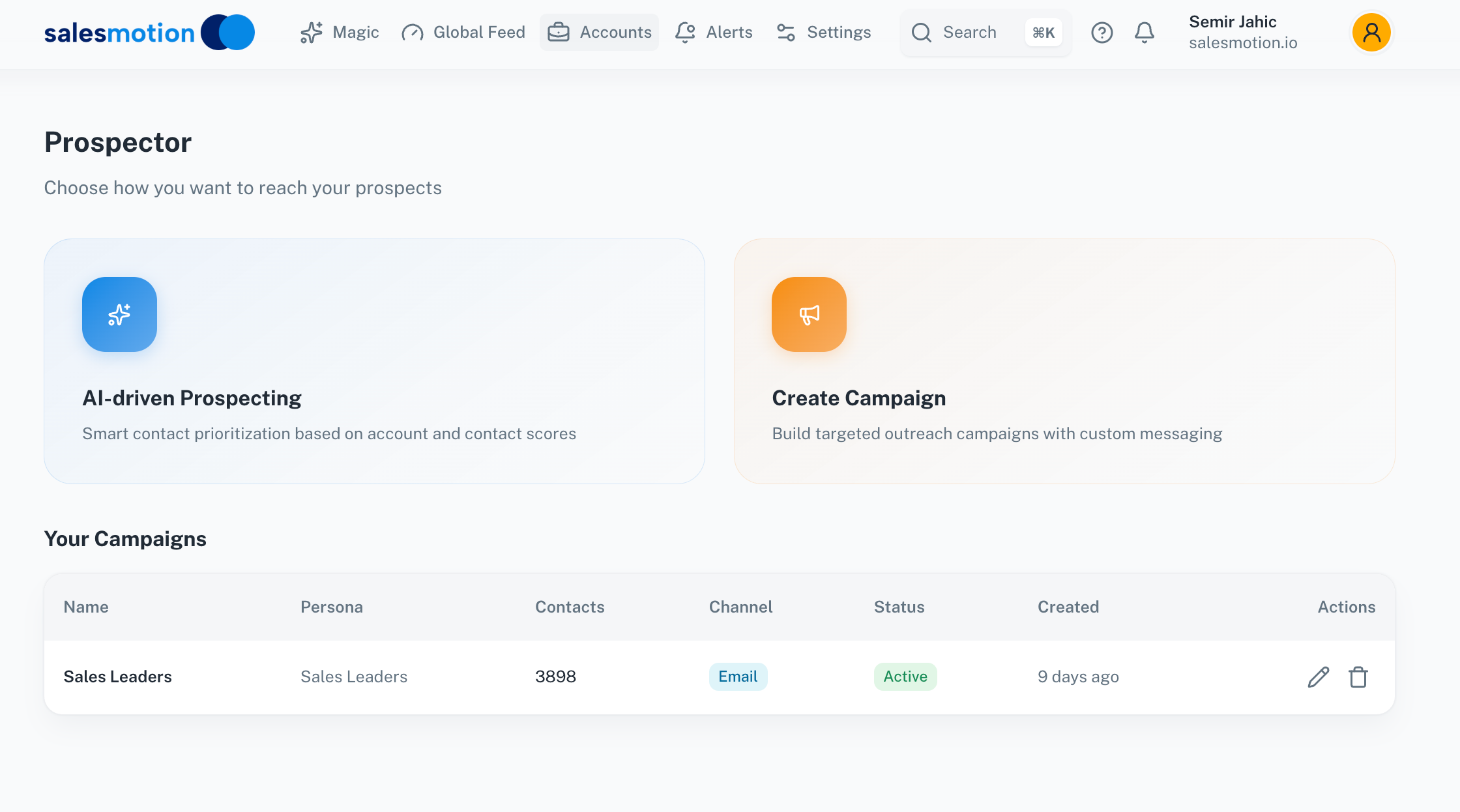 An AI prospecting module drafts personalized LinkedIn messages grounded in real account signals — turning 30 minutes of research and writing into a 5-minute review.
Key Takeaways
- LinkedIn's InMail caps killed volume-based outreach. Open InMails dropped 87%, from roughly 800 to under 100 per month. The only path forward is relevance.
- Personalized messages achieve 93% higher acceptance rates and 10 to 25% InMail response rates, versus under 1% for generic templates. LinkedIn's credit system literally rewards quality.
- The intelligence gap matters more than profile optimization. A perfect profile sending generic messages still gets ignored. Knowing something specific about the prospect's situation is what drives responses.
- Signal-driven outreach targets the decision window. Leadership changes, hiring patterns, funding events, and competitive shifts indicate when a prospect is actively evaluating. Reaching them during this window produces 3 to 4x higher response rates.
- Research infrastructure beats automation tools. Reps spending two to three hours per account on manual research cannot scale. Centralizing account intelligence cuts that to minutes and shifts time from research to selling.
- Measure relevance, not volume. Track acceptance rates, InMail response rates, qualified reply percentage, and credit recovery. These predict pipeline. Messages sent does not.
Frequently Asked Questions
Why did LinkedIn cut InMail limits?
LinkedIn began capping Open InMail sends in late 2025, reducing the practical limit from roughly 800 per month to under 100 for many accounts. The change targets mass outreach that degrades the platform experience. LinkedIn's business model depends on users engaging with messages, so the platform increasingly rewards personalized, relevant outreach and penalizes volume-based approaches. Sales Navigator Advanced and Recruiter plans appear least impacted.
What is the best LinkedIn outreach response rate to target?
For signal-driven, personalized outreach, target 15 to 25% InMail response rates and 30%+ connection request acceptance rates. Generic outreach typically achieves under 5%. The most important metric is qualified reply rate: aim for 48% of responses being positive or expressing genuine interest. If your response rate is high but your qualified rate is low, your targeting needs refinement.
How do you personalize LinkedIn messages at scale?
Manual personalization does not scale beyond a handful of accounts. The most effective approach combines signal monitoring (tracking buying signals like funding, hiring, and leadership changes across your target accounts) with AI-assisted message drafting that references specific triggers. This shifts the rep's role from researching and writing to reviewing and sending, compressing a 30-minute process into 5 minutes per message while maintaining genuine relevance.
Are LinkedIn automation tools still worth using in 2027?
Automation tools that focus purely on volume (mass connection requests, templated InMails) are increasingly risky. If you have hundreds of ignored requests piling up, learn how to bulk withdraw LinkedIn invites to clean up your account. LinkedIn detects similar messages sent from a single account and penalizes repeat offenders with restrictions. The tools worth investing in are those that help with signal monitoring, account research, and personalized prospecting, not those that simply blast messages faster.