U.S. manufacturing construction spending surpassed $230 billion in 2024, according to the U.S. Census Bureau, driven by reshoring, CHIPS Act investments, and clean energy mandates. Behind every new facility, automation initiative, and supply chain overhaul is a set of manufacturing buying signals that B2B sales teams can track systematically. The challenge in manufacturing sales is not a lack of opportunity. It is knowing which signals predict purchasing behavior and which are just noise. Our guide to buying signals in sales covers the fundamentals; this post dives into the signals specific to manufacturing.
TL;DR: Manufacturing buying signals include facility expansions, automation investments, supply chain disruptions, sustainability initiatives, leadership changes, M&A activity, and earnings commentary. Tracking these signals helps B2B sellers engage manufacturing accounts when capital budgets are active and operational priorities are shifting.
Why Manufacturing Buying Signals Move Slowly but Signal Big
Manufacturing buying cycles are long, often 12-24 months from initial evaluation to purchase order. But the signals that trigger those cycles are visible months in advance. A facility expansion announced today will drive technology purchases for the next two years. A supply chain disruption creates immediate demand for visibility and planning tools. An earnings call mentioning "automation investment" telegraphs budget allocation.
The manufacturing buying committee is also distinct. Decisions involve plant managers, operations VPs, procurement directors, CIOs, and often the CFO for capital expenditures above a certain threshold. Each stakeholder responds to different signals. The plant manager cares about operational efficiency. The VP of Supply Chain watches disruption risks. The CIO evaluates digital transformation initiatives. Teams that map signals to stakeholders and follow a signal-based selling discipline create more relevant outreach.
Manufacturing also has a heavier compliance burden than many industries. Environmental regulations, OSHA requirements, quality standards (ISO 9001, AS9100, IATF 16949), and industry-specific certifications all drive technology and services purchases. Regulatory signals are highly predictable because rulemaking timelines are public.
See Salesmotion on a real account
Book a 15-minute demo and see how your team saves hours on account research.
Facility and Capital Investment Signals
Facility Expansions and New Plant Construction
New manufacturing facilities are among the strongest buying signals in the industry. A company building a new plant needs everything from MES (manufacturing execution systems) to quality management software, ERP modules, environmental monitoring tools, and workforce management platforms. Track facility announcements through SEC filings, state economic development agency press releases, and construction industry publications.
Automation and Robotics Investments
When a manufacturer announces an automation initiative, smart factory project, or robotics deployment, it signals a multi-year technology investment cycle. Automation projects require integration platforms, data analytics tools, predictive maintenance software, and often workforce reskilling programs. According to the International Federation of Robotics, industrial robot installations reached a new record in 2024, and each installation triggers downstream technology purchases.
Capital Expenditure Announcements
Public manufacturers disclose capital expenditure plans in earnings calls and annual reports. When a company announces increasing CapEx by 20%, you know budgets are expanding. When they specify "investing in digital manufacturing" or "modernizing our production infrastructure," the signal is even clearer. Search earnings transcripts for CapEx-related keywords.

“The Business Development team gets 80 to 90 percent of what they need in 15 minutes. That is a complete shift in how our reps work.”
Andrew Giordano
VP of Global Commercial Operations, Analytic Partners
Supply Chain and Operations Signals
Supply Chain Disruptions and Realignment
Supply chain disruptions create urgent buying behavior. When a manufacturer's key supplier faces a disruption, the manufacturer may need supply chain visibility platforms, alternative supplier discovery tools, inventory optimization software, and risk management solutions. Track supply chain disruption reports from Resilinc and industry trade publications.
Sustainability and ESG Initiatives
Environmental sustainability is a growing driver of manufacturing technology purchases. When a manufacturer announces carbon reduction targets, Scope 3 emissions tracking, or circular economy initiatives, it needs environmental management systems, energy monitoring tools, and supply chain sustainability platforms. Track sustainability reports and ESG commitments published on company websites.
Lean Manufacturing and Continuous Improvement Programs
Announcements about Six Sigma deployments, lean manufacturing initiatives, or operational excellence programs signal investment in quality management tools, process analytics, and workforce training platforms. These programs often have dedicated budgets and multi-year timelines.
Organizational and Financial Signals
Leadership Changes
A new VP of Operations or VP of Manufacturing signals a strategic shift. A new CIO indicates technology transformation. A new Chief Sustainability Officer reveals environmental investment priorities. In manufacturing, leadership changes at the VP level and above often precede major vendor evaluations. Salesmotion tracks these changes and surfaces the context behind each hire, connecting leadership transitions to the company's recent strategic announcements and earnings commentary.
M&A Activity
Manufacturing M&A creates integration needs across IT, operations, quality systems, and supply chain management. When two manufacturers merge, they consolidate ERP systems, standardize quality processes, and often upgrade technology across both organizations. Divestitures create new standalone companies that build their own technology stacks from scratch.
Earnings Mentions of Strategy and Investment
Quarterly earnings calls are among the richest sources of manufacturing buying signals. Listen for mentions of "digital transformation," "Industry 4.0," "automation," "supply chain resilience," "sustainability investment," and "operational efficiency." These are direct statements of where the company will allocate budget. Earnings transcripts are publicly available and searchable.

“Salesmotion has been a game-changer for me. I used to spend 12 hours a week on prospect research, now it's down to 4. Plus I'm finding stuff I was totally missing - podcasts, news mentions, the good bits.”
George Treschi
Account Executive, FY25 President's Club, Sigma
How to Operationalize Manufacturing Buying Signals
Manufacturing buying signals come from SEC filings, construction permits, job boards, trade publications, sustainability reports, and earnings transcripts. No rep can monitor all of these sources manually across a territory of manufacturing accounts.
Automate signal aggregation. Use a platform that monitors financial filings, leadership changes, facility announcements, and strategic initiatives across your target accounts. Salesmotion aggregates signals from 1,000+ sources and delivers enriched account intelligence briefs that connect financial, operational, and organizational data for each account.
Build industry-specific plays. Create outreach sequences tied to specific manufacturing signals: "facility expansion" play, "automation initiative" play, "sustainability compliance" play, and "post-merger integration" play. Each play should include industry-specific language and relevant case studies.
Prioritize by signal density. Manufacturing accounts with multiple concurrent signals (facility expansion + automation investment + leadership change) are significantly higher priority than accounts with a single signal. Use signal clustering to focus your team's efforts.
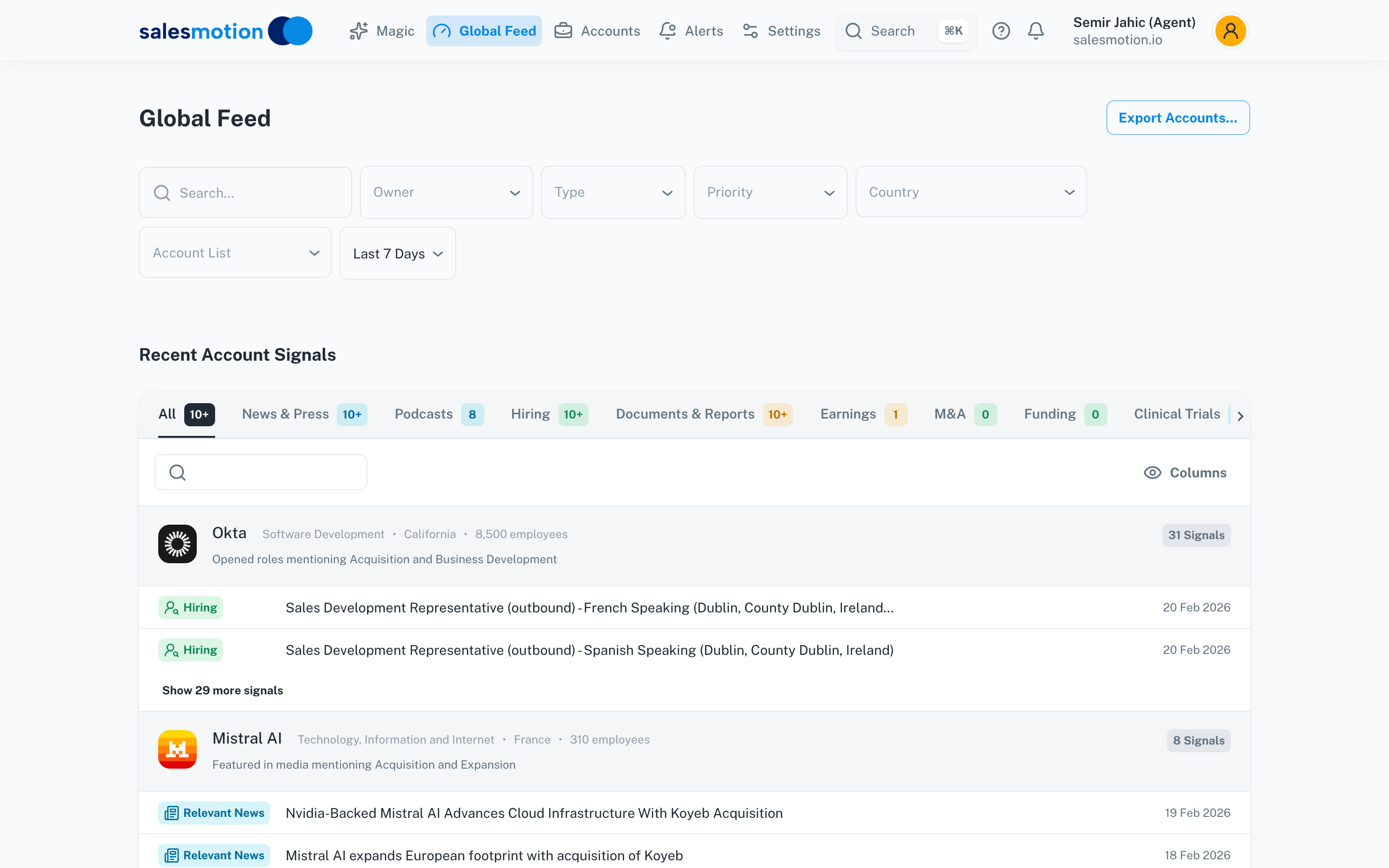 Salesmotion surfaces buying signals — hiring, earnings, news, M&A, funding — across your entire territory in a single feed, so reps act on the highest-value signals first.
Signal-Based Workflow: Manufacturing Example
Trigger: A mid-cap industrial manufacturer announces a $200M facility expansion for electric vehicle components. In the same month, they post a VP of Digital Manufacturing role and their earnings call mentions "investing in smart factory infrastructure."
Platform action: The account brief updates with the facility announcement, the leadership hire, the earnings commentary, and a list of the company's current technology vendors and key stakeholders.
Rep action: The rep reviews the brief and identifies the confluence of signals: new facility + digital manufacturing leadership + smart factory investment. They reach out to the VP of IT, referencing the EV component facility and the company's stated smart factory goals, positioning their solution as supporting the digital infrastructure that the new facility will require.
Outcome: The conversation focuses on a specific, funded initiative rather than a generic capability pitch. The deal aligns with a capital project that has executive sponsorship and a concrete timeline.
For industry-specific workflows and use cases, visit our sales intelligence for manufacturing page. Also explore our account research resources and alternatives comparison for broader context. For related verticals, see our healthcare buying signals guide.
Key Takeaways
- Manufacturing buying cycles are long (12-24 months), but the signals that trigger them are visible months in advance. Facility announcements, CapEx disclosures, and earnings commentary all forecast purchasing behavior.
- Supply chain disruptions create urgent, high-priority buying windows for visibility, planning, and risk management tools. These opportunities move faster than typical manufacturing procurement.
- Sustainability and ESG commitments are becoming a major driver of manufacturing technology purchases. Track carbon reduction targets and Scope 3 emissions initiatives as buying signals.
- Signal clusters (facility expansion + automation hire + earnings mention) identify the highest-value accounts. A manufacturer with three concurrent signals is in an active investment cycle.
- Build manufacturing-specific outreach plays that reference the specific initiative, facility, or regulatory driver behind the signal. Generic outreach underperforms in an industry where relationships and technical credibility matter.
Frequently Asked Questions
What are the most important buying signals in manufacturing B2B sales?
The strongest manufacturing buying signals are facility expansions and new plant construction, automation and smart factory investments, supply chain disruptions requiring new technology, sustainability/ESG initiative announcements, and leadership changes at the VP and C-suite level. These signals indicate active capital budgets and strategic priorities that drive technology and services purchases.
How do facility expansions create buying opportunities?
A new manufacturing facility requires technology across every operational domain: MES, ERP, quality management, environmental monitoring, workforce management, and supply chain systems. The buying window typically extends 18-24 months from announcement to full operation. Sales teams that engage early in the facility planning process can influence vendor selection before formal RFPs are issued.
Why are earnings calls so valuable for manufacturing sales intelligence?
Public manufacturers disclose capital expenditure plans, strategic priorities, and investment areas during quarterly earnings calls. Phrases like "investing in automation," "building supply chain resilience," or "expanding our digital manufacturing capabilities" are explicit statements of purchasing intent. These transcripts are publicly available and provide a direct window into where the company will spend money over the next 12-18 months.
How can sales teams track manufacturing buying signals at scale?
Manufacturing signals are scattered across SEC filings, construction permits, job boards, sustainability reports, and trade publications. Manual monitoring does not scale past 15-20 target accounts. A sales intelligence platform that aggregates these sources and enriches signals with account context enables reps to focus their time on selling rather than research.