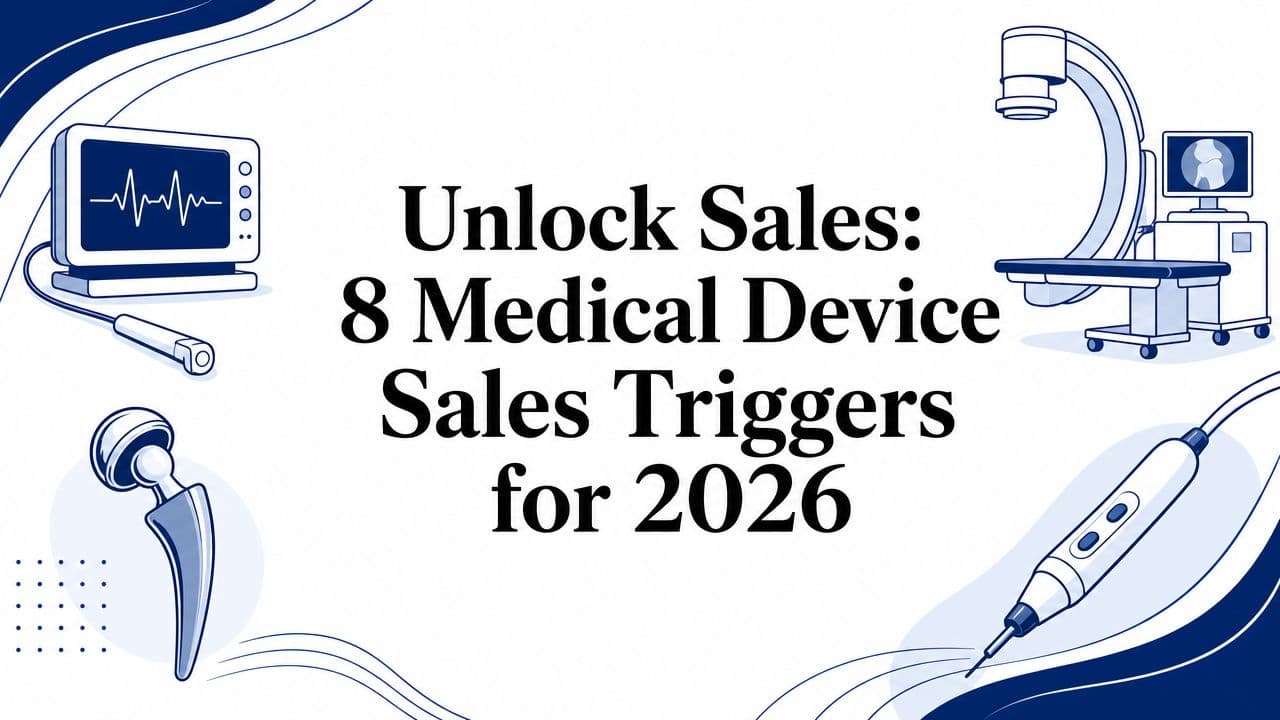
Medical device sales triggers are the events that open a buying window at a hospital, health system or ambulatory surgery center: an FDA clearance, a merger, a new CMO or procurement leader, a new clinical program, a capital budget cycle, a competitor's failure, growth, or a research partnership. In medical device sales, timing beats volume, and in medtech the first person who likes your device usually isn't the person who can buy it.
TL;DR: The eight medical device sales triggers worth building a territory around are FDA clearances and approvals, hospital and health system M&A, CMO or procurement leadership changes, new clinical program launches, capital budget cycles and funding announcements, competitive loss or vendor dissatisfaction, organizational growth, and clinical trial or research partnerships. For each one, find the signal early, translate it into the operational consequence for the account, and work the clinical, procurement and executive stakeholders in parallel.
That's why medical device sales triggers matter. The best reps don't just hunt for interest. They catch the moment when clinical need, budget, leadership attention, and procurement process start lining up. That's when a conversation turns into an evaluation, and an evaluation turns into a real deal.
The medtech cycle has its own friction. Physician preference can open the door, but procurement, value analysis committees, finance, and supply chain control whether the deal moves. If you only work the surgeon, you'll lose late. If you only work procurement, you'll never create urgency. You need both, and you need a reason to show up now.
The market is large enough that small shifts matter. One industry summary puts the medical equipment market at $512.29 billion in 2022, with projected growth to $799.67 billion by 2030. In a market of that scale, untargeted outreach is lazy territory management. Trigger-based selling, the core of signal-based selling, is how teams focus on the accounts where something changed. Expect only a minority of accounts to move in any quarter: in Salesmotion's B2B buying signals benchmark, 16.9% of pharma, biotech and life sciences companies had a hard trigger event in Q3 2026.
What follows is the practical version. Not just a list of medical device sales triggers, but the playbook behind them: where to find the signal, how to prioritize it, who to contact first, and how to multi-thread the account before your competitor even logs the event. If you use a platform like Salesmotion for life sciences and medtech to monitor these signals, this gets faster. But the principle is the same either way. Spot change early, translate it into business impact, and move. For the wider tool category, see our guide to medical sales software.
1. FDA Clearance or Approval Announcements

When a device gets FDA 510(k) clearance or PMA approval, don't treat it like industry trivia. Treat it like a buying signal. Someone just validated a category, and every hospital or health system that has been “monitoring the space” may now have a reason to re-open an evaluation.
This matters in two directions. If your own company gets cleared, you have a narrow window to shape the market narrative before competitors reposition. If a competitor gets cleared, target accounts may start comparing workflows, reimbursement fit, training burden, and capital requirements across the category.
What this trigger really means
A clearance announcement often tells you three things at once. The category is becoming more real to buyers. Internal champions now have a current event to point to. Procurement may ask departments whether they need to review current vendors, future budgets, or technology roadmaps.
In practical terms, this is especially strong when the approved product affects surgical workflow, connected device infrastructure, imaging integration, or service contracts. Think of what happened when Intuitive Surgical updates pushed hospitals to revisit robotic surgery planning, or when new glucose monitoring approvals forced IT and procurement teams to revisit device connectivity and data handling.
Practical rule: Don't lead with “saw the FDA news.” Lead with the operational consequence for the account.
Signal sources and outreach
Watch FDA CDRH announcements weekly. If you don't want reps checking databases manually, use Salesmotion to monitor approvals and competitor product moves, then route alerts to the account owner with the “so what” already attached.
Prioritize accounts using simple filters:
- Category fit: Accounts already using related products, running evaluations, or expanding the relevant service line.
- Stakeholder density: Accounts where you already know both a clinical champion and a supply chain or procurement contact.
- Timing risk: Accounts with active capital planning, VAC review activity, or recent leadership attention in the service area.
Then move fast:
- Clinical first: Send the department chief or physician champion a note on what the approval changes clinically.
- Economic second: Send procurement or supply chain a separate note on standardization, service burden, or competitive exposure.
- Executive layer: If the category is strategic, brief the CMO or service line leader on whether this changes roadmap timing.
Salesmotion's Outreach Agent is useful here because this trigger is only valuable if the message is specific. “A competitor got cleared” is weak. “This approval likely changes how your cardiac program will evaluate platform options this quarter” gets meetings.
2. Hospital and Health System M&A and Consolidation Activity

Hospital consolidation creates confusion for clinicians and opportunity for vendors. New parent systems want standardization. Legacy sites want continuity. Procurement wants influence. That tension creates an opening for companies that can speak to integration, not just product features.
I like this trigger because it changes the sales motion itself. A standalone-facility pitch becomes a network-level standardization conversation. That's a different deal with different buyers.
What to look for after the announcement
The press release is not the actual trigger. The actual trigger is what happens next. Integration committees get formed. Materials management starts comparing vendor footprints. Clinical leaders start asking whether they need one platform, one tray strategy, one service model, or one contract structure across sites.
That's when incumbents get exposed. A vendor who won on local relationships can lose when the system wants portfolio simplification. A challenger can win if they make standardization easier, lower administrative burden, or help the new system reduce product sprawl.
Examples are easy to picture. If one health system acquires community hospitals and wants a common cardiology or ortho approach, legacy preferences start getting reviewed. If a merger expands a regional network, service support, training consistency, and enterprise contracting suddenly matter more than local rep familiarity.
How to work the account
Your first move isn't a generic congrats email. It's a short integration hypothesis.
Post-merger deals are won by the rep who can explain how device choice affects integration speed, not the rep who sends the nicest introduction.
Use public filings, trade coverage, health system news, and executive statements to identify the likely integration leaders. Then map three groups:
- Clinical operators: Service line chiefs, department chairs, physician leaders
- Operational owners: COO, supply chain, materials management, contracting
- Executive sponsors: CMO, CFO, transformation office, integration office
Your message should change by persona:
- Clinicians: “How do you maintain case quality and training consistency across newly combined sites?”
- Procurement: “How do you reduce vendor complexity without disrupting current volume?”
- Executives: “How do you standardize in a way that supports margin and integration speed?”
Salesmotion's Research Agent can help here because post-merger account maps change fast. The most useful output is not just news. It's a working brief on who owns integration, what got acquired, which service lines matter, and where rationalization pressure is likely to hit first.

“The talking points are gold. If they're in Salesmotion, I know they're being discussed inside that business. That makes it easy to spark a real conversation, which is 90 percent of the battle.”
Andrew Giordano
VP of Global Commercial Operations, Analytic Partners
3. Chief Medical Officer or VP Procurement Leadership Changes

A new CMO or VP of Supply Chain often reopens decisions everyone else thought were settled. New leaders review contracts, ask why certain vendors are entrenched, and look for wins that show they're improving cost, quality, or operational control.
This is one of the most reliable medical device sales triggers because it changes both appetite and access. Fresh leaders are often willing to take meetings that longtime executives ignored.
Why leadership changes create movement
New clinical leaders often care about evidence, physician alignment, and service line reputation. New procurement leaders often care about standardization, contracting discipline, and whether incumbent vendors earn their footprint. Same account, different pressure.
That's why one event can change the buying center. A surgeon may still love your device, but a new supply chain leader may now demand a stronger economic case. Or the reverse. A new CMO may finally give air cover to a platform clinicians wanted but procurement had parked.
There's also a sequencing issue. If you wait until the new executive is overwhelmed, you miss the window. Early outreach works best when it's useful, brief, and clearly tied to their likely priorities.
How to approach without sounding opportunistic
Start with research, not outreach. Review their prior roles, visible initiatives, public interviews, and any themes tied to quality, standardization, physician engagement, or digital transformation. If you need a process for that, see the guide on how to track leadership changes for sales.
Then build your sequence around relevance:
- First touch: Recognize the move and connect it to a real priority they've owned before.
- Second touch: Offer a market briefing, category update, or peer perspective that helps them orient.
- Third touch: Bring in the stakeholder beneath them who will operationalize change.
A practical example. If a health system hires a new VP of Supply Chain from a more centralized IDN, don't pitch product specs first. Lead with how your portfolio supports standardization, contract compliance, service consistency, and clinician adoption. If the account hires a new CMO known for expanding procedural programs, lead with readiness, evidence, and implementation support.
LinkedIn is useful for initial detection. Salesmotion's Signal Agent can automate the flag, and the Research Agent can save the rep from spending hours piecing together background manually.
4. New Clinical Initiative or Program Launches
A hospital announcing a new cardiac surgery program, robotics center, trauma designation, stroke program, or ambulatory surgery expansion is one of the cleanest triggers in medtech. New programs need equipment, training, protocols, workflow changes, and committee decisions. That means there's a real project behind the press release.
At this stage, many reps get sloppy. They blast outreach to the announced program leader and ignore everyone else. That misses how these programs are truly built.
The signal behind the headline
A new program launch usually means a planning group already exists. Clinical leadership is defining capabilities. Operations is mapping staffing and room readiness. Finance is watching spend. Supply chain is anticipating sourcing work. Sometimes facilities or IT are involved too.
That gives you multiple ways in. A robotics-assisted surgery center may involve surgeons, OR leadership, sterile processing, finance, and capital committees. A new trauma program may involve emergency medicine, imaging, anesthesia, nursing leadership, and procurement.
Real scenarios are easy to spot. If a regional system launches a structural heart offering, device vendors should assume there will be questions around physician training, case support, patient pathway fit, and committee review. If a hospital adds a new robotics program, buyers will compare not just the robot, but instruments, service burden, room design implications, and adoption planning.
How to multi-thread the launch
Don't treat the announcement as permission to sell. Treat it as permission to plan your internal map.
Use hospital press releases, accreditation notices, department updates, and local business coverage to identify the build team. Salesmotion's Research Agent is useful here because it can help connect the public announcement to the likely committee structure and stakeholder list.
A good response usually has three tracks:
- Clinical track: Program director, chief of service, physician champions
- Operational track: OR leadership, service line administration, sterile processing, biomed
- Financial track: Procurement, capital committee support, finance, VAC participants
If you can't explain why the program launch matters to both the clinician and the budget owner, you don't have a sales trigger yet. You have news.
Your outreach should reflect the stage. Early stage messages should focus on planning risk, implementation support, and category insight. Later stage messages can get more specific on evaluation, workflow, and vendor choice. Salesmotion's Outreach Agent can help tailor those sequences by persona so the surgeon doesn't get the same email as the procurement manager.

“All of the vendors that I've worked with, all of the onboarding that I have had to deal with, I will say, hands down, Salesmotion was the easiest that I have had.”
Lyndsay Thomson
Head of Sales Operations, Cytel
5. Capital Equipment Budget Cycles and Funding Announcements
Hospital budget timing is boring until it wins you deals. Then it becomes one of the most practical triggers in the territory. For organizations that buy devices, especially capital equipment, Q3 and Q4 often shape what gets funded for the following year. If you show up after the budget is set, you're usually too late unless there's urgent replacement pain.
This trigger is stronger than people think because it connects need to permission. Interest without budget is a long nurture. Budget without a clear clinical driver gets delayed. When both line up, things move.
Where budget signals show up
Look beyond big press releases. Capital intent can show up in board materials, planning documents, public budget commentary, annual reports, community investment updates, and service line announcements. Construction and renovation news often sits right next to future equipment demand.
If a system is investing in a new tower, a renovation, a specialty center, or a major procedural expansion, someone is already thinking about equipment categories, installation timing, and vendor options. Even when the exact device list isn't public, the spending direction gives you enough to start mapping.
For private and public systems, the signal is often stronger when it's paired with a strategic theme. Cardiovascular expansion, oncology modernization, imaging refresh, ASC growth, and operating room redesign usually pull device decisions behind them.
How to turn budget intelligence into action
The first rule is simple. Get in before finance locks the plan. The second is just as important. Don't talk to finance the same way you talk to clinicians.
For publicly visible funding activity, Salesmotion's Research Agent can help scan financial documents and planning language. The same logic shows up in broader trigger selling around funding events, which the funding round sales trigger post covers. For capital equipment, buyers may also raise tax treatment and the timing of the purchase within their fiscal year, so know the basics before the call.
Use three outreach angles:
- Department head: “What problem should this budget solve?”
- Finance or capital committee support: “How does this purchase affect utilization, workflow, or service burden?”
- Procurement: “What sourcing path and timeline should we align to?”
Keep your prioritization tight:
- Accounts with a visible strategic investment
- Accounts where you already have a clinical foothold
- Accounts with linked construction, renovation, or service line growth
- Accounts approaching annual planning windows
This trigger rewards disciplined reps. The rep who knows the budgeting calendar usually beats the rep with the better brochure.
6. Competitive Loss or Vendor Dissatisfaction Signals
Some triggers create interest. This one creates pain. Product recalls, safety alerts, service failures, contract friction, supply disruption, quality concerns, or negative word of mouth can push an account from passive loyalty to active reconsideration.
These are high-value moments, but they're easy to mishandle. If you come in gloating, you'll lose trust. If you wait too long, the incumbent repairs the relationship or another competitor gets there first.
What counts as a real dissatisfaction signal
The strongest signals are concrete. A recall. A warning letter. Repeated backorder complaints. A visible quality system issue. Clinical feedback that a device is creating workflow headaches. Contract tension after service underperformance. A VAC review triggered by concerns about reliability or value.
The medtech operating context matters here. Industry guidance increasingly emphasizes a single source of truth, account-level analytics, and leading indicators rather than waiting for lagging revenue signals to tell you where the pipeline is stalling. That's the core argument in Axtria's discussion of data management and sales operations opportunities in medical devices. In practice, dissatisfaction is one of those leading indicators if you can detect it early.
A good real-world scenario: a hospital experiences repeated supply friction with an implant line and starts qualifying backup vendors. Or a warning letter raises internal compliance questions, prompting supply chain and clinical users to review alternatives. Those are not casual complaints. They're procurement motion.
How to respond without sounding predatory
Lead with stability, not attack. Buyers don't want a victory lap from you. They want a safe option and a fast path to evaluation.
Use a short sequence:
- Acknowledge the operational risk: Keep it factual and calm.
- Offer a low-friction next step: Backup qualification, comparison review, service coverage discussion, or implementation plan.
- Arm your internal champion: Give them language they can use with procurement or the VAC.
Buyers switching under pressure care less about your marketing story and more about whether you can make the next month easier.
Salesmotion's Signal Agent is helpful here because these signals can come from recalls, regulatory updates, news, job activity, executive comments, and other scattered sources. The key is not more alerts. It's identifying which accounts already have exposure in the affected category, then getting the rep to the right stakeholder quickly.
7. Organizational Growth Signals
Growth creates equipment demand before the purchase order appears. A new site, a renovation, a hiring push, an ASC opening, a physician recruitment wave, or a facility expansion all point to future device needs. Not every growth signal becomes an opportunity, but enough do that this belongs in every medtech trigger model.
This one is especially useful when selling into hospitals and health systems because it lets you get ahead of formal sourcing. By the time an RFP is visible, someone else may already be shaping requirements.
Which growth signals matter most
Not all hiring is equal. A backfill nurse posting is noise. A cluster of surgeon, interventionalist, imaging, cath lab, or specialty technician hires is different. That often indicates capacity growth, service line investment, or upcoming procedural expansion.
The same is true for real estate and facility announcements. Construction and renovation signals often precede capital equipment planning. New outpatient sites, ambulatory surgery centers, cancer centers, or procedural suites usually drive workflow and equipment decisions before the building opens.
The under-covered question is signal durability. Which triggers are near-term buying events and which are just broad market noise? Expansion into ASCs, staffing patterns, and service line growth often matter more than generic market optimism because they tie to real account behavior.
How to prioritize and message the account
A growth signal gets stronger when it meets one of these tests:
- Operational specificity: New location, named campus, specific service line
- Talent specificity: Hiring for clinicians or technical staff tied to your category
- Timing visibility: Opening timeline, phased expansion, construction progress
- Stakeholder overlap: Known leaders in operations, service line, and procurement
If you want a repeatable process, the guide on hiring surges as a buying signal is directly relevant. In practice, route these alerts by territory and score them higher when hiring aligns with a known program build.
Your outreach should mention the actual growth event. “Noticed you're hiring for the new West Campus imaging team” works. “Wanted to introduce our company as you grow” gets deleted. For larger expansions, package the offer around readiness, standardization, and phased rollout rather than a one-off product pitch.
8. Clinical Trial Announcements and Research Partnerships
Research activity is often an early clue that a buyer is moving before the broader institution catches up. When a hospital joins a clinical trial, announces a research partnership, or builds a physician-led study effort in your category, you're seeing clinician interest, institutional attention, and early adopter behavior at the same time.
That doesn't always create an immediate purchase. It does create a relationship path that many competitors miss because they only watch procurement events.
Why research signals matter in device sales
Research-active physicians often shape downstream adoption. They influence peers, define evaluation criteria, and help internal committees understand whether a technology is worth institutional support. If your category depends on physician preference, this matters a lot.
This is also where digital engagement can help. In research-oriented conversations, clinicians may be receptive to richer, mobile-supported evidence reviews and more interactive discussions than the old leave-behind model.
A realistic scenario: a hospital joins a robotics or imaging research initiative, and the principal investigator becomes the first serious internal champion for a broader platform evaluation. Or a research partnership around a connected monitoring workflow exposes IT, biomed, and service line leadership to a device category earlier than procurement would have otherwise looked.
How to work research without forcing the sale
Track trial registries, hospital research news, grant announcements, and university health system updates. Salesmotion can help monitor those sources and attach stakeholder context so the rep doesn't have to build the map from scratch. If you need a starting point, see the post on how to find clinical trials.
Your motion should be lighter and longer-term than a hard budget trigger:
- Start with the PI or research lead: Offer relevant evidence, implementation insight, or category perspective.
- Expand to operational stakeholders: Ask what the trial or partnership means for workflow, training, data capture, or equipment support.
- Watch for institutionalization: The moment the research effort starts influencing service line planning or capital thinking, add procurement and administration.
There's also a staffing angle in some clinical environments, particularly where advanced practice staffing supports new programs or research operations. That's not the primary trigger, but workforce expansion can reinforce the buying case when you discuss care model readiness.
Medical Device Sales Triggers: 8-Point Comparison
| Trigger | Implementation complexity | Resource requirements | Expected outcomes | Ideal use cases | Key advantages |
|---|---|---|---|---|---|
| FDA Clearance or Approval Announcements | Low–Moderate (monitor + rapid outreach) | Real-time regulatory monitoring, rapid sales & clinical response | Short-term RFPs/procurement windows (30–90 days) | Competitive displacement; market validation plays | High time-sensitivity; clear regulatory validation |
| Hospital/Health System M&A and Consolidation Activity | High (multi-stakeholder integration) | Account-based teams, executive engagement, long sales resources | Predictable 6–18+ month integration procurement cycles; large enterprise deals | Enterprise standardization; multi-facility rollouts | Predictable budgets; large-scale deployment opportunities |
| Chief Medical Officer or VP Procurement Leadership Changes | Moderate (relationship-building) | Executive research, personalized outreach, KOL engagement | 90–180 day strategic review windows; higher switching probability | Vendor replacements; establishing new preferred-vendor relationships | Direct access to decision-makers; incumbents vulnerable |
| New Clinical Initiative or Program Launches | Moderate–High (committee approvals) | Clinical evidence, program-specific demos, multi-stakeholder outreach | Defined procurement tied to program launch (6–18 months) | New service lines, specialty centers, program-specific equipment | No incumbent advantage; clear procurement timeline |
| Capital Equipment Budget Cycles and Funding Announcements | Low–Moderate (timing alignment) | Financial document monitoring, CFO-focused ROI materials | Predictable fiscal-year purchasing windows; quantifiable opportunity size | High-cost capital equipment tied to departmental budgets | Hard signal of available budget; clear dollar allocation |
| Competitive Loss or Vendor Dissatisfaction Signals | Moderate (rapid, evidence-based response) | Clinical outcome data, safety validation, fast outreach capability | Immediate replacement opportunities; high conversion likelihood | Recalls, safety alerts, adverse outcomes, supply failures | Highest-confidence trigger; urgent buyer intent |
| Organizational Growth Signals (Hiring, Expansion, Openings) | Moderate (long runway planning) | Expansion mapping, facility-level contacts, pricing packages | 12–24 month procurement cycles; multi-device orders for new sites | New clinics/hospitals, staffing surges, facility expansions | New procurement with no incumbent; multiple engagement points |
| Clinical Trial Announcements and Research Partnerships | High (research coordination) | Long-term KOL engagement, trial support, customized devices | Long runway (12–36 months) with potential for institutional adoption | Early-adopter devices, innovation-led platforms, research-grade equipment | Access to opinion leaders; data generation that drives adoption |
Operationalizing Triggers From Manual Effort to Automated Pipeline
Knowing these medical device sales triggers is useful. Operating on them consistently is what creates pipeline.
Sales teams often falter here for a simple reason. The signals are scattered. FDA activity lives in one place. Hospital expansion news shows up somewhere else. Leadership changes show up on LinkedIn. Research activity sits in registries and press releases. Budget clues hide in planning documents. By the time a rep manually pieces it together, the window is already warm for someone else.
The best medtech teams build a trigger system, not a research habit. They define which signals matter by product line and territory, decide how those signals will be scored, and attach a default action to each one. That's how you move from “interesting update” to booked meeting.
A practical operating model looks like this:
- Monitor the right sources: FDA updates, hospital newsrooms, hiring patterns, trial registries, leadership changes, construction announcements, and service line expansion signals.
- Score by fit and urgency: Product relevance, account size, known stakeholder access, timing, and whether a clinical and procurement path both exist.
- Route fast: The account owner gets the alert with context, not just a link.
- Launch a multi-touch sequence: One message for the clinical side, one for procurement, one for executive or operational leadership.
- Track response by trigger type: Over time, teams learn which signals create meetings, evaluations, and real opportunities in each category.
This also lines up with how medtech buying centers behave now: hospital margin pressure gives value analysis committees and procurement more weight, not just clinician enthusiasm. That makes stakeholder mapping after a trigger just as important as the trigger itself. In plain English, the same event can excite a surgeon and slow down in contracting if you don't adjust your motion.
Another practical shift is digital readiness. If the account already expects richer in-field interactions, you can compress the sales cycle by bringing product data, workflow visuals, and evidence into the same meeting instead of creating extra follow-up. That's part of why hybrid selling now matters in medtech. It doesn't replace relationships. It gives those relationships more usable context at the moment of change.
If you want to scale this, a platform like Salesmotion can help. Its model is straightforward. The Signal Agent watches target accounts for changes. The Research Agent builds the account brief and stakeholder context. The Outreach Agent turns that into outreach a rep can review and send. That doesn't remove judgment. It removes the manual lag that kills timing.
The teams that win don't chase every signal. They work the few that create urgency, map the buying center correctly, and show up with a clear why now. That's the winning playbook.
If your team wants a faster way to spot medtech-specific signals and turn them into outreach, book a 30-minute Salesmotion demo. It helps sales teams monitor account changes, understand the “so what,” and act on triggers with less manual research.