The counterintuitive part of a funding round sales trigger is this: the announcement itself usually isn't the opportunity. The operational change that follows is.
That matters because most reps still treat funding news like PR. They send a quick congratulations email, mention the raise, and hope the timing does the work. It doesn't. Teams that win on funding triggers treat the announcement as a starting gun for research, prioritization, and fast outreach tied to a specific business change.
That approach is worth taking seriously. Funding round announcements can drive a 25-40% uplift in inbound leads and pipeline velocity, and startups raising Series A or later saw a median 32% increase in qualified sales opportunities within 90 days of announcement, according to Republic Europe's summary of the underlying analysis. Fresh capital changes budgets, urgency, and internal priorities at the same time. Few other signals do that.
Why Funding Is Your Highest-Intent Sales Trigger

A funding round sales trigger works because it answers the hardest question in outbound: why now?
Most prospecting signals are indirect. A company posts a job opening. A leader changes roles. A team talks about a new initiative on LinkedIn. Useful, yes. But those signals often leave you guessing about budget, urgency, and internal commitment.
A funding event is different. A company that just raised capital has a mandate to deploy it. Investors didn't wire money so the business could sit still. They expect hiring, market expansion, product investment, infrastructure upgrades, and faster execution. For revenue teams, that means the buyer is more likely to be evaluating systems, vendors, and outside help right now.
Why this trigger beats generic growth signals
The strongest trigger events combine three things:
- Budget availability: There's now capital allocated for growth.
- Executive urgency: Leadership needs to show progress.
- Public context: The company often tells the market what it plans to do next.
That combination is rare. It's why funded accounts tend to be more commercially active than companies that only look “interesting” from the outside.
Practical rule: Don't treat funding as a vanity signal. Treat it as a purchase-planning signal.
If you're building an early-stage company yourself, it's also worth understanding the fundraising side of the table. Founders trying to secure investment for your launch often communicate exactly what they need capital for. Those same public narratives become useful inputs for sales teams trying to map likely buying needs after the round closes.
The real signal is the downstream motion
The money matters. The planned use of that money matters more.
A Series B company saying it will expand sales in North America is a better signal for enablement, CRM hygiene, prospecting infrastructure, and onboarding tools than the funding headline alone. A company raising to deepen product and engineering is a different play. The trigger is still valid, but the buyer set, message, and timing change.
If your team is still new to signal-based outbound, this guide on what a trigger event is in sales is a useful baseline. The big shift is learning to stop chasing news and start translating signals into action.
See Salesmotion in action
Take a self-guided interactive tour — no signup required.
Decoding the Signal Where to Find and What It Means
Finding funding news isn't hard. Interpreting it well is where many organizations falter.
A lot of bad outreach starts with a shallow workflow: set a Google Alert, see a headline, blast a sequence. That produces noise, and the market is already flooded with it. An estimated 62% of B2B sales outreach tied to funding news yielded less than a 5% response rate due to over-saturation and poor targeting, and about 40% of seed rounds are extension or bridge rounds rather than pure growth signals, according to Uncapped's discussion of funding context.
Where to look
Use multiple sources because each one tells you something different:
- Crunchbase: Good for broad monitoring and quick confirmation that a round happened.
- Company press releases: Best place to find stated use of funds, expansion plans, and leadership quotes.
- SEC filings: Useful for public companies or situations where formal disclosure matters more than media coverage.
- LinkedIn posts from founders or investors: Helpful for tone, hiring intent, and which initiatives leadership is spotlighting.
- Industry publications: Good for additional context, especially if the company is entering a new market or category.
The point isn't to gather more links. It's to answer a short list of operator questions: What did they raise? At what stage? What do they say they'll do with it? Which teams are about to feel pressure?
For teams that want examples beyond funding, this roundup of sales trigger event examples is useful because it helps reps see how funding stacks with hiring, executive changes, and expansion news.
Funding Stage Sales Signal Matrix
| Round Stage | What It Signals | Your Sales Play |
|---|---|---|
| Seed | Early validation. The company may still be proving the core product and figuring out repeatability. Some rounds are bridge or extension rounds, which can signal caution rather than acceleration. | Build a relationship, don't force a full sales cycle. Watch for follow-on signals like hiring, customer momentum, or a leadership addition. |
| Series A | Product-market fit is becoming more real. The company usually needs foundational systems, repeatable process, and tighter reporting. | Prioritize tools and services that help create operating discipline. Tie outreach to scaling basics, not enterprise transformation. |
| Series B | The company is moving from proving to scaling. Headcount grows, teams specialize, and process gaps get expensive fast. | This is prime territory for a funding round sales trigger play. Focus on speed, productivity, onboarding, data quality, and infrastructure. |
| Series C and beyond | Scale mode. Leadership is under pressure to expand efficiently across teams, regions, and segments. | Sell against complexity. Show how your product supports coordination, standardization, and faster execution across a larger org. |
What the stage tells your reps
Seed is where many teams waste time. The company may have money, but not necessarily the buying posture you want. There are exceptions, but pushing too hard here usually creates activity without pipeline.
Series A is where the conversation gets interesting. There's enough maturity for a budget conversation, but the company still feels every operational bottleneck. Series B and C are where the signal often becomes urgent because scale creates pain faster than the team can solve it internally.
The best reps don't ask, “Did they raise?” They ask, “What new problem did the raise just make urgent?”

“Consolidation of prospect company information that I can use frequently to be way better informed when I'm doing my outbound, preparing for a meeting, or building relationships. Ease of use and Customer Support is excellent.”
Werner Schmidt
CEO & Co-Founder, Lative
The 14-Day Playbook Timing Your Outreach for Impact
Sales teams often lose funding-triggered deals before they send the first message. They react too late.
That lag is expensive. Seed-funded startups contacted within 72 hours of a funding announcement see 35% higher initial meeting booking rates, while 78% of sales teams react more than a week late due to manual monitoring, based on Qubit Capital's discussion of timing around funding signals. Even if your product doesn't sell to seed companies, the lesson holds: speed changes outcomes.
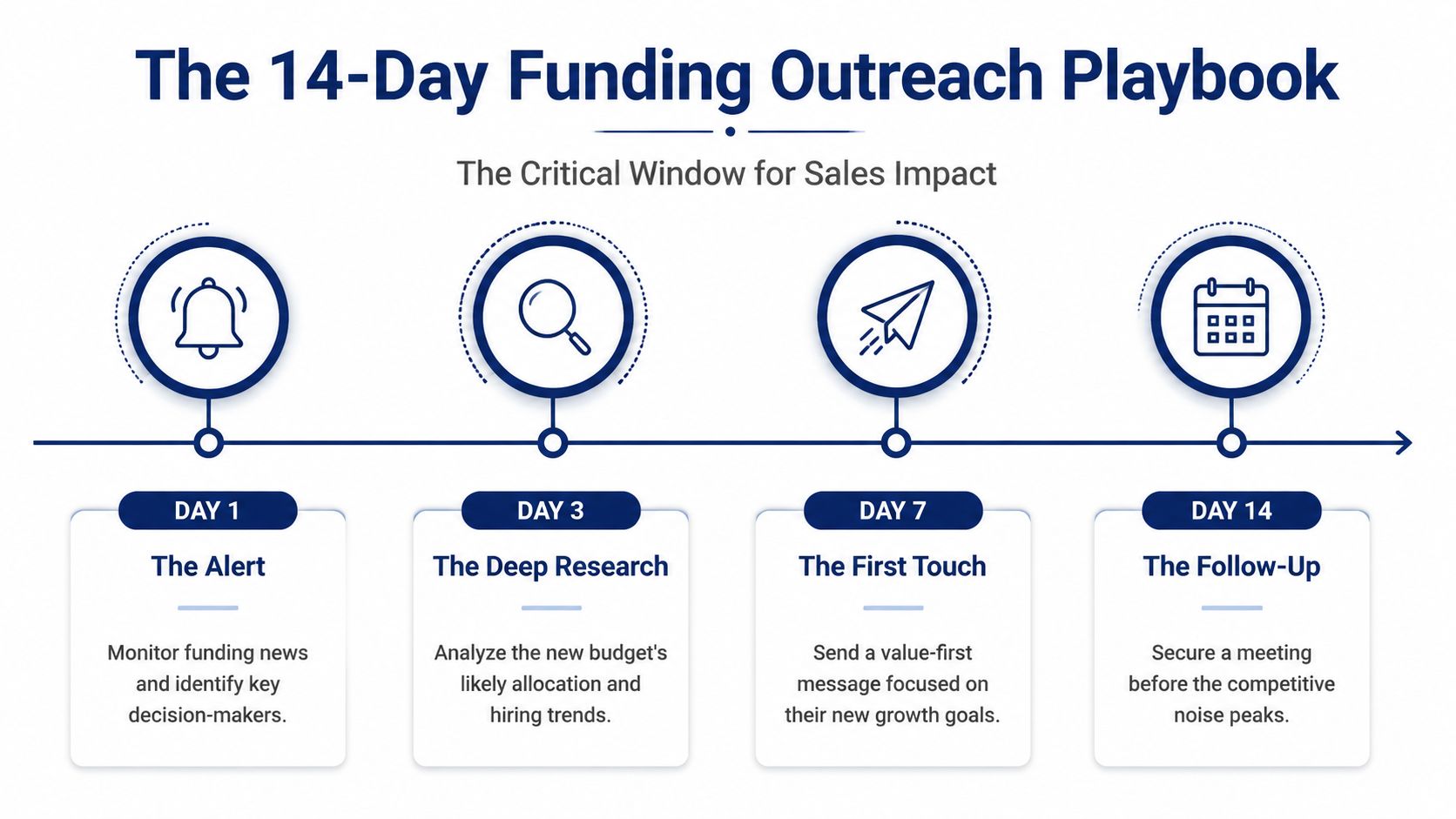
Day 0 to 2
This window is about detection and interpretation, not writing clever copy.
Start with the announcement, then move immediately into context:
- Confirm the stage and source. Was it seed, Series A, Series B, or later?
- Read the press release closely. Look for phrases like expanding go-to-market, entering new markets, hiring, or investing in infrastructure.
- Check hiring pages and LinkedIn. Hiring patterns tell you where the money is going.
- Map stakeholders. Identify the functional leader who owns the problem your product solves.
If your reps are doing this manually across dozens or hundreds of accounts, they'll always be late. Tooling becomes essential. Salesmotion monitors funding events across target accounts, tracks sources like press releases and filings, and builds context around what the capital is being used for so reps can act without starting from zero.
Day 3 to 7
This is the first outreach wave. The goal isn't to mention the funding fastest. It's to connect your message to the operational consequence of the funding before every competitor does.
A simple example: a prospect raises Series C, then hires 15 account executives in 60 days. That's not just “growth.” It's a live signal that they likely need sales tools, onboarding support, manager enablement, territory planning, and reporting infrastructure now.
A Series C company hiring 15 AEs in two months doesn't need another congratulatory email. It needs vendors who understand the cost of ramping a sales team without breaking process.
Use that logic to decide channel and target:
- Founders get fewer, sharper notes.
- Functional leaders get more specific problem framing.
- Multi-threaded accounts should get coordinated outreach, not duplicate noise.
Day 8 to 14
This is follow-up, but intelligent follow-up.
Most reps send the same message twice with a different subject line. A better move is to add one new piece of evidence. Maybe the company posted roles in RevOps. Maybe the new VP Sales commented on expansion. Maybe the careers page now shows SDR openings across two regions.
A practical cadence inside this window:
- Email one: Tie your message to the likely use of funds.
- LinkedIn touch: Reference a hiring or scaling initiative.
- Email two: Add a new operational signal.
- Call or voicemail: Keep it short and specific to the current moment.
If your team needs a broader framework for channel timing, this guide on the best time to cold call helps reps think about timing beyond just email sends.
Crafting Your Message Dont Say Congrats on the Raise
The fastest way to waste a funding round sales trigger is to center your outreach on the funding itself.
“Congrats on the raise” is polite. It's also useless. The buyer already has a full inbox of those. Your message needs to show you understand what the raise changes for their business.

Top-performing teams use multi-step cadences with data anchors, and benchmark meeting conversion rates for tested messaging sit at 15-25%, as described in Allied VC's breakdown of execution benchmarks. The phrase to focus on there is data anchors. Relevance beats enthusiasm.
What to say instead
Lead with the business implication, not the announcement.
Bad version:
- Congrats on the raise. Would love to show you what we do.
Better version:
- Saw that you're expanding the sales org after the round. Teams usually hit process friction when headcount grows before systems do.
That second message tells the buyer you understand the work ahead. It sounds like a peer observation, not a template.
Three message patterns that work
Pattern one
Use when the company has stated a growth plan publicly.
- Subject: Scaling sales after the round
- Email: Noticed the team is using the new capital to grow go-to-market. When headcount expands quickly, onboarding consistency and pipeline inspection usually become harder before they get easier. We help revenue teams tighten that layer so new reps ramp into a system that already works. Worth comparing notes?
Pattern two
Use when hiring activity confirms the likely use of funds.
- Subject: Your AE hiring wave
- Email: I saw the open roles across the sales team. That usually means managers are about to absorb more onboarding, more coaching, and more forecasting pressure at the same time. If that's a current priority, I can share how teams structure the workflow so growth doesn't create avoidable drag.
Pattern three
Use when the buyer may be getting hit by generic funding outreach.
- Subject: Not a note about the raise
- Email: You're probably getting a lot of congratulatory emails. The more useful question is what gets harder over the next quarter. Based on the hiring pattern and expansion plan, my guess is sales process consistency is near the top of the list. If that's right, happy to send a few ideas.
Message test: If you remove the funding sentence and the email still makes sense, you probably wrote it correctly.
For reps who need fresh openings beyond standard templates, these sales conversation starters are a good reference.
What doesn't work
A few patterns fail over and over:
- Generic praise: It flatters, but it doesn't create a reason to reply.
- Long company history recaps: Buyers know their own story.
- Product dump in paragraph one: You're skipping the diagnosis.
- Obvious automation: If the note could have gone to any funded startup, it will read that way.
The job isn't to prove you saw the news. The job is to prove you understand the consequence of the news.

“This is my singular place that very simply summarizes a company's top initiatives, strategies and connects them to my solution. Something I would spend hours researching manually, now it's automated.”
Derek Rosen
Director, Strategic Accounts, Guild Education
Automating and Measuring Your Trigger-Based Plays
If funding-trigger outreach lives in one rep's notebook, it won't scale. You need a system.
That system has two jobs. First, it should catch the trigger quickly and route it to the right owner. Second, it should let you measure whether funded-account plays outperform the rest of your outbound motion.
Build the workflow first
Start simple inside your CRM and sales engagement stack.
- Create a trigger field: Mark accounts by event type, funding stage, and announcement date.
- Route ownership clearly: Decide whether SDRs, AEs, or account teams own funded-account follow-up.
- Launch a dedicated sequence: Don't dump these accounts into generic prospecting cadences.
- Add follow-up tasks: Reps should have prompts to check hiring pages, leadership changes, and job postings during the first two weeks.
If your team is tightening the automation layer around these workflows, practical guides like SubmitMySaas marketing automation tips can help you avoid brittle handoffs between systems.
Measure the right metrics
Many RevOps teams get stuck at this stage. Opens and clicks are weak indicators for a trigger-based motion. The more useful metrics are further down the funnel.
Elite teams track Trigger Response Rate at 20-35%, Meeting Conversion Rate from those responses at 15-25%, and Pipeline Velocity reduction of 25-40% compared to cold outreach, according to GrowthList's benchmark framework for sales trigger events.
A practical scoreboard looks like this:
| KPI | What it tells you |
|---|---|
| Trigger Response Rate | Whether your initial relevance is strong enough to earn replies |
| Meeting Conversion Rate | Whether replies are turning into actual sales conversations |
| Trigger-to-Meeting Time | Whether reps are acting fast enough once the signal appears |
| Pipeline Velocity | Whether trigger-sourced deals are moving faster than standard outbound |
| Win rate by source | Whether funded-account opportunities are actually better, not just noisier |
Common operational mistakes
The biggest misses are usually process problems, not rep effort.
- No prioritization logic: Seed and bridge rounds get the same treatment as scale rounds.
- No source tagging: You can't compare trigger-sourced deals against other prospecting channels.
- No ownership model: Everyone sees the alert, nobody acts.
- No review loop: Messaging doesn't improve because nobody studies which signals convert.
The point of automation isn't to send more emails. It's to shorten the distance between a real-world signal and a relevant action.
Putting It All Together A Real-World Example
A clean funding round sales trigger play usually looks boring from the outside. That's a good sign. Boring means the team followed a process instead of improvising.
A rep spots a Series C announcement for a target account. The press release says the company plans to expand its sales team and enter a new segment. Within days, the careers page starts showing multiple AE and RevOps openings. That combination matters more than the headline. The raise created the budget. The hiring confirms where the budget is going.
The account gets prioritized. The rep doesn't send a congratulations note. Instead, the first message goes to the revenue leader and says, in plain terms, that rapid AE hiring usually creates three immediate problems: uneven onboarding, poor pipeline inspection, and extra pressure on frontline managers. The CTA is simple. Compare notes on how teams handle that transition without slowing ramp.
A second touch goes to RevOps a few days later. Different angle. Same trigger. It references the hiring pattern and asks how they're thinking about territory design, process consistency, and data quality as the team expands. That message works because it sounds like it came from someone who understands growth mechanics, not someone scraping news.
The reply doesn't happen because the rep mentioned the funding. It happens because the rep connected the funding to a pressing operational issue.
That's the whole playbook in one motion:
- detect the signal fast
- figure out what the capital is for
- identify who will feel the pain first
- message the business change, not the PR event
- track whether those conversations become pipeline faster than your standard outbound
Teams that do this consistently stop treating funding news as trivia. They use it as a repeatable source of timely, relevant conversations.
If you want that workflow to run without reps manually checking press releases, job pages, and account updates, Salesmotion gives revenue teams a way to monitor target accounts for funding and other buying signals, turn those signals into usable context, and move from alert to outreach with less manual research.