The Miller Heiman Blue Sheet is one of the most widely used deal qualification and management tools in enterprise B2B sales. Originally developed as part of the Strategic Selling methodology, the Blue Sheet forces reps to map every deal systematically: who's involved, what they want, where the risks are, and what needs to happen next. Despite being several decades old, the framework remains popular because the problem it solves hasn't changed. Complex enterprise deals still fail for the same reasons: missed stakeholders, misunderstood buying criteria, and unidentified competition.
TL;DR: The Miller Heiman Blue Sheet is a deal analysis template that maps buying influences, red flags, and action items for complex B2B opportunities. It's most effective for enterprise deals with 4+ stakeholders and sales cycles exceeding 90 days. The framework's biggest weakness is maintenance: Blue Sheets go stale as deals evolve. Teams that combine the Blue Sheet structure with automated account intelligence keep the analysis current without the manual research burden.
The Miller Heiman Methodology in 60 Seconds
The Blue Sheet sits inside the broader Miller Heiman sales methodology, which has two complementary components:
- Strategic Selling — the deal planning system. It maps buying influences, competitive positioning, and decision dynamics for complex opportunities. The Blue Sheet is the primary tool for executing Strategic Selling.
- Conceptual Selling — the conversation system. It structures how reps run discovery calls and meetings around the buyer's concept of what they need, not the seller's product pitch.
Together, they form a complete framework for navigating enterprise deals with 4+ stakeholders and long sales cycles. The Blue Sheet is where strategy meets execution: it translates the methodology's principles into a structured, repeatable process that any rep can follow.
For the full methodology breakdown including Conceptual Selling techniques and how to adapt the framework for modern B2B, see our complete Miller Heiman guide.
Stop Blue Sheets from going stale
Salesmotion auto-updates buying influences, signals, and talking points across every account — so your Blue Sheets stay current without manual rework. From $85/mo, live in an hour.
What the Miller Heiman Blue Sheet Covers
The Blue Sheet is organized around six core sections that together provide a complete picture of a complex deal. Here's what each section requires and why it matters.
1. Buying Influences
The Blue Sheet identifies four types of buying influences in every deal:
Economic Buyer: The person with final approval authority. They sign the check and can say yes when everyone else says no. In enterprise deals, this is often a C-suite executive or VP with budget ownership.
User Buyers: The people who will actually use your solution daily. Their evaluation criteria center on functionality, ease of use, and impact on their workflow. Winning over User Buyers prevents post-sale adoption failures.
Technical Buyers: The people who evaluate whether your solution meets technical requirements: security, integration, scalability, compliance. They can't say yes, but they can say no. IT, security, and procurement teams often fill this role.
Coach: An internal advocate who provides intelligence about the decision process, competitive dynamics, and stakeholder politics. A strong Coach is the single most important buying influence for deal success.
Mapping all four types for every deal prevents the most common failure in complex sales: building a relationship with one champion while ignoring the other stakeholders who can block or derail the decision.
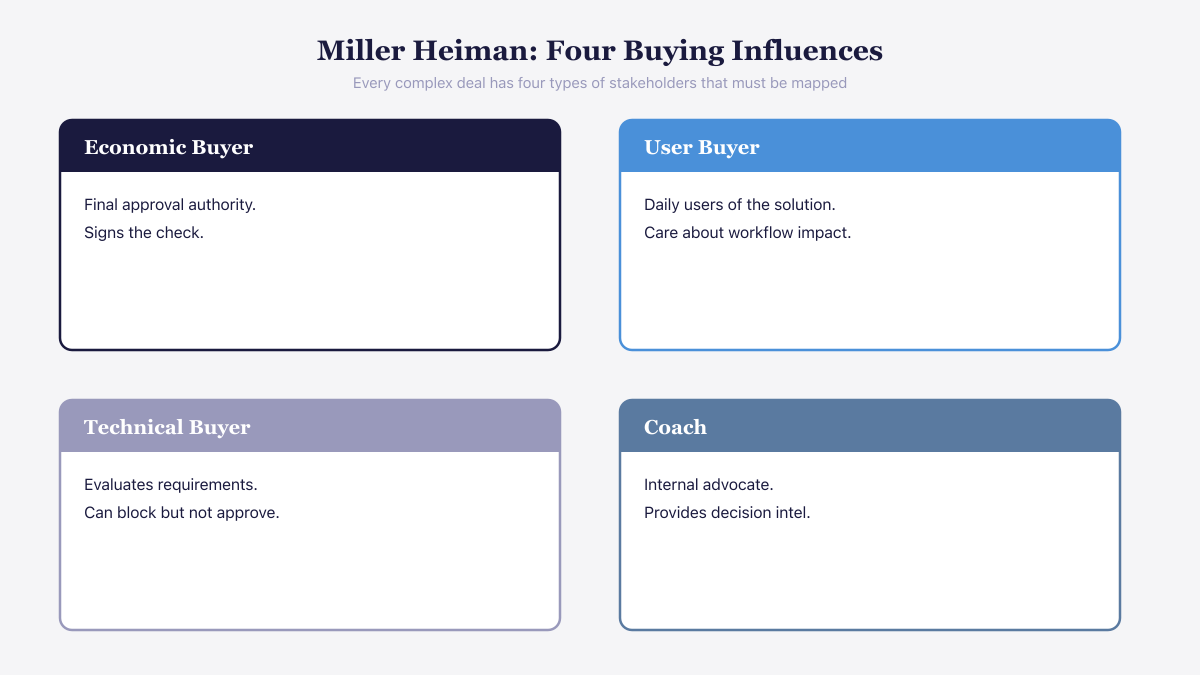 The four buying influence types in the Miller Heiman Blue Sheet. Each role requires a different engagement strategy.
2. Red Flags and Strengths
The Blue Sheet requires reps to explicitly identify:
- Red flags: Gaps in information, missing buying influence access, competitive threats, timing risks, or organizational changes that could derail the deal.
- Strengths: Areas where your solution aligns perfectly with the buyer's requirements, existing relationships that provide access, and competitive advantages.
This section forces honest assessment. Reps naturally focus on deal strengths. The Blue Sheet requires them to confront risks early enough to address them.
3. Response Modes
Each buying influence operates in one of four response modes:
- Growth: They want to grow and see your solution as enabling that growth.
- Trouble: They're experiencing a problem and need a solution urgently.
- Even keel: They're satisfied with the status quo and see no reason to change.
- Overconfident: They believe they're doing better than they actually are.
Understanding response modes determines messaging strategy. Growth and Trouble modes create natural urgency. Even Keel and Overconfident modes require a different approach: creating awareness of risks they don't yet see.
4. Win-Results
For each buying influence, the Blue Sheet maps both organizational results (business outcomes) and personal wins (career advancement, reduced stress, recognition). The insight is that every buying decision satisfies both professional and personal motivations. Reps who address only the business case miss the personal motivations that often tip close decisions.
5. Ideal Customer Profile Alignment
The Blue Sheet assesses how well the opportunity matches your ideal customer profile. Deals that score poorly on ICP alignment are flagged early, preventing resource investment in low-probability opportunities.
6. Action Plan
Based on the analysis above, the Blue Sheet produces specific next steps: who to contact, what information to gather, which red flags to address, and what milestones to hit before the next review.

“My ultimate goal is to know more about the company than they know themselves. Before, that took hours across multiple tools. With Salesmotion, I can get there in 30 minutes or less and walk into a Fortune 500 conversation fully prepared.”
Jeff Dalo
Senior Director Business Development, Analytic Partners
How Top Teams Actually Use the Blue Sheet
The Blue Sheet template is straightforward. Using it effectively is harder. Here's what separates teams that get value from the framework from those that treat it as administrative overhead.
Review at Every Stage Gate
The Blue Sheet should be updated and reviewed every time a deal moves between pipeline stages. Most teams only complete it once (during qualification) and never return to it. The value of the framework compounds with updates because deals change:
- New stakeholders enter the evaluation
- Competitive dynamics shift
- Organizational changes affect the decision timeline
- Requirements expand or narrow as the evaluation deepens
A Blue Sheet that reflects the deal as it was three months ago is worse than no Blue Sheet, because it creates false confidence.
Use It for Pipeline Reviews, Not Just Deal Coaching
The most effective sales managers use Blue Sheets to identify patterns across the pipeline:
- Which buying influence type is consistently missing? If you never have Coach access, that's a systematic gap in your sales process.
- Which red flags appear most often? Common red flags across multiple deals point to positioning or qualification problems.
- Where do deals stall? If most deals stall after Technical Buyer engagement, your technical sales support may need improvement.
Fill Red Flag Gaps With Intelligence
The Blue Sheet's biggest limitation is that reps can only document what they know. Unknown stakeholders, undisclosed competitive evaluations, and undetected organizational changes create blind spots that the framework can't address without continuous account research feeding it from the outside.
This is where account intelligence fills the gap. Salesmotion monitors 1,000+ sources for leadership changes, hiring patterns, competitive moves, and strategic initiative language from earnings calls. When a new VP joins the buying committee, the platform flags the change and surfaces their background, previous vendor preferences, and likely priorities — the kind of company intelligence that would otherwise take hours to assemble by hand. When the account starts evaluating a competitor or when an earnings call shifts strategic direction, these signals update the rep's account brief before they hear about it from their Coach.
The result: Blue Sheets that stay current between reviews without requiring hours of manual research. Cytel's sales team reduced account planning preparation by 30% after replacing five separate research tools with automated intelligence that kept stakeholder maps and competitive landscapes current in real time.
Blue Sheet Template: Free Download Structure
Free Blue Sheet Template
Complete Miller Heiman Blue Sheet with all 8 canonical sections, dropdown menus, response mode guides, and win-results planning. No email required.
No email required. Includes 4 sheets: Blue Sheet, Response Modes, Win-Results, and Instructions.
While the official Miller Heiman Blue Sheet is part of their commercial Strategic Selling program, here's the structure you can implement in any format (spreadsheet, CRM, or document):
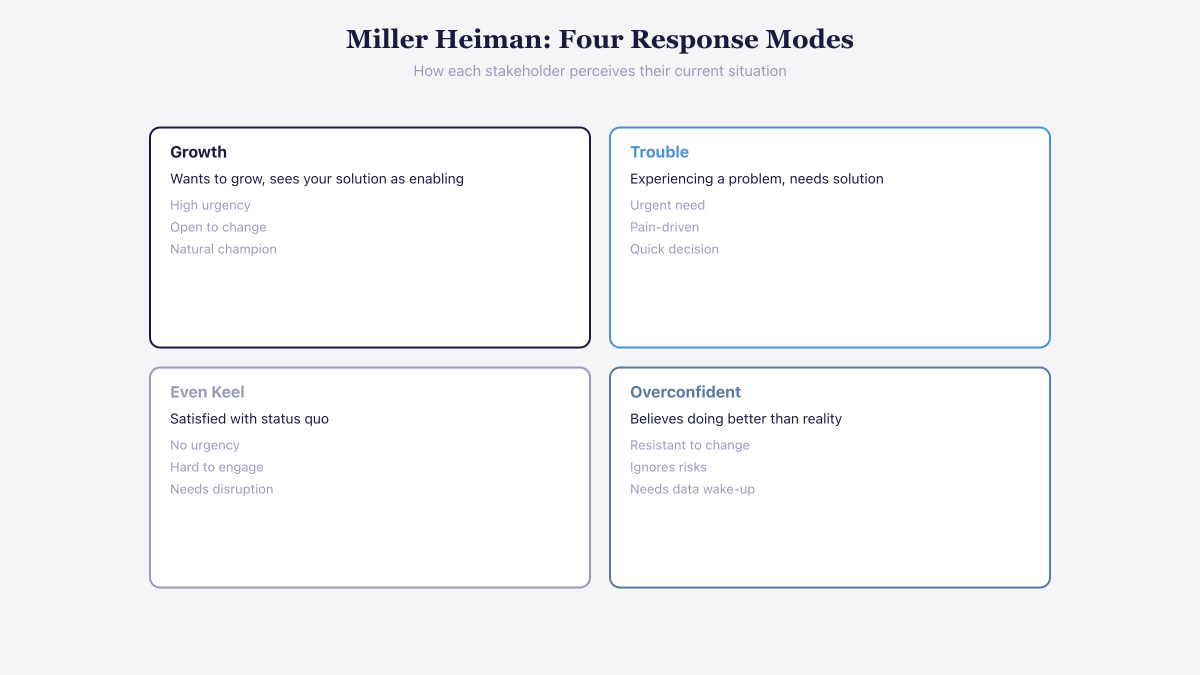 Each stakeholder operates in one of four response modes that determines your messaging strategy.
Section 1: Opportunity Overview
Capture the deal's vital signs in one place so anyone reviewing the Blue Sheet can understand the opportunity in 30 seconds.
- Account name and industry — Context matters. A $200K deal at a 50-person startup has different dynamics than $200K at a Fortune 500.
- Opportunity value and deal structure — Total contract value, payment terms (annual vs. multi-year), and whether expansion is likely.
- Expected close date and confidence level — Not the date in your CRM (which is often aspirational). The date based on the buyer's actual timeline and procurement process.
- Current pipeline stage and next milestone — What specific event moves this deal forward? "Follow-up meeting" is too vague. "Technical evaluation with IT security team on March 15" is actionable.
- Sales methodology score — If you use MEDDIC, BANT, or similar, include the qualification score here for cross-reference.
Example: "Acme Corp, $180K ACV, 2-year term. Stage 3 (Evaluation). Next milestone: ROI presentation to CFO on April 2. MEDDIC score: 4/6 (missing Champion confirmation and Paper Process clarity)."
Section 2: Buying Influences Grid
This is the core of the Blue Sheet. Map every person involved in or affecting the decision. The most common deal-killing mistake is an incomplete grid — stakeholders you don't know about can veto deals you think you've won.
| Name | Role | Influence Type | Response Mode | Win-Results (Business) | Win-Results (Personal) | Relationship Strength (1-5) | Access Level |
|---|---|---|---|---|---|---|---|
| Sarah Chen | VP of Sales | Economic Buyer | Growth | 20% pipeline increase | Board visibility, promotion path | 4 | Direct |
| Marcus Rivera | Sales Ops Director | Technical Buyer | Trouble | Reduce tool sprawl from 5→2 | Stop firefighting integrations | 3 | Direct |
| Two AE team leads | End users | User Buyers | Even Keel | Faster account research | Less manual grunt work | 2 | Indirect (via Marcus) |
| (empty — need to identify) | (unknown) | Coach | — | — | — | 0 | None |
How to fill this out: Start with everyone you've spoken to. Then ask: "Who else will be in the room when this decision is made?" and "Who could kill this deal that I haven't met?" An empty Coach row is a critical red flag — every deal needs an internal advocate who will tell you what's really happening behind closed doors.
Section 3: Red Flags
Red flags are information gaps, risks, or obstacles that could derail the deal. Be brutally honest here. The point isn't to build a case for the deal — it's to identify what could go wrong early enough to fix it.
| Red Flag | Severity | Mitigation Plan |
|---|---|---|
| No Coach identified | High | Ask Marcus who internally has advocated for this type of change before. Offer to present results from a similar company to build internal champion. |
| Haven't met the CFO (likely co-signer on $180K+) | High | Request an ROI-focused meeting through Sarah. Prepare CFO-specific business case with 18-month payback analysis. |
| Competitor (Vendor X) has existing relationship with IT | Medium | Differentiate on integration speed. Prepare side-by-side comparison on total cost of ownership including implementation. |
| Q3 budget freeze rumored | Medium | Confirm budget allocation timeline with Sarah. Offer Q2 signing with Q3 start to lock in before freeze. |
If you can't list at least 3 red flags, you don't know the deal well enough. Every complex deal has risks. A blank Red Flags section is itself the biggest red flag.
Section 4: Strengths
Strengths are the assets, relationships, and alignment points that give you an advantage. Map these explicitly so you can leverage them in your strategy and protect them if the competitive landscape shifts.
| Strength | Type | How to Leverage |
|---|---|---|
| Sarah is a former customer from previous company | Relationship | She's seen implementation success firsthand. Ask her to share her experience with the CFO. |
| Their stated priority (#1 in annual plan) is "sales productivity" | Alignment | Anchor every conversation to this priority. Use their own language in proposals. |
| Competitor's solution requires 6-month implementation; ours takes 6 weeks | Competitive | Quantify the cost of 5 months of delay. $180K in value delivered sooner = strong argument for faster time-to-value. |
| Technical evaluation went well — Marcus gave verbal approval | Process | Lock this in writing. Ask Marcus for a formal recommendation email to Sarah before the next meeting. |
Section 5: Competition
Document every competitor in the deal — including the status quo (doing nothing). For each, note their likely positioning and your counter-strategy.
| Competitor | Their Likely Pitch | Their Strength | Their Weakness | Your Counter |
|---|---|---|---|---|
| Vendor X | Established platform, broad feature set | IT team already knows them | Expensive, 6-month implementation | Time-to-value: "You'll be live in 6 weeks, not 6 months. What's the cost of waiting?" |
| Status quo (manual process) | "We're fine with what we have" | Zero cost, zero risk | Doesn't scale with their growth plan | "You're hiring 8 AEs this quarter. How does the manual process scale to a team that's 40% larger?" |
| Do-it-yourself (internal build) | "We'll build it ourselves" | Full control, no vendor dependency | Engineering time is expensive and slow | "Your eng team's backlog is 6 months deep. Is this really where you want to spend their cycles?" |
The "status quo" and "do nothing" are competitors in every deal. Always include them. More deals are lost to inaction than to any named competitor. Understanding indirect competitors helps you prepare for these non-obvious threats.
Section 6: Action Plan
Translate the analysis above into specific, time-bound actions. Every action needs an owner, a deadline, and a clear expected outcome. "Follow up with Sarah" isn't an action plan — it's a wish.
| Action | Owner | Deadline | Expected Outcome |
|---|---|---|---|
| Send CFO-ready ROI analysis to Sarah for internal distribution | Rep | March 18 | CFO agrees to 30-min meeting |
| Identify potential Coach through Marcus's team | Rep | March 20 | Name and access path to internal advocate |
| Deliver technical security questionnaire to IT | SE | March 22 | Remove Technical Buyer blocker |
| Executive alignment call: our VP Sales → their CRO | Rep + VP | March 28 | Executive sponsorship and timeline commitment |
| Send competitive comparison (vs. Vendor X) focusing on TCO and implementation speed | Rep | March 25 | Neutralize Vendor X's incumbent advantage |
Review and update this action plan weekly. Completed items roll off; new items surface from updated red flags and changing deal dynamics.
Tips for Implementation
- Start with your top 10 deals. Don't try to Blue Sheet every opportunity immediately.
- Integrate with your CRM. Build Blue Sheet fields directly into Salesforce or HubSpot opportunity records rather than using separate documents.
- Review weekly for active deals. Monthly is too infrequent for enterprise deals that evolve quickly.
- Use deal review meetings to validate. The Blue Sheet should spark discussion, not replace it.
Run Strategic Selling on every account, not just the top 10
Salesmotion identifies Economic Buyers, User Buyers, and Coaches across your entire territory — so the Blue Sheet framework scales beyond the deals your reps care most about.
Book a 15-min walkthrough →Blue Sheet in Practice: A Deal Walkthrough
Here's how a Blue Sheet analysis works on a real enterprise opportunity, showing how automated intelligence changes the process.
The deal: A $250K platform sale to a mid-market financial services company with a 6-month evaluation timeline.
Week 1: Initial Blue Sheet Build
The rep completes the buying influence map after the first discovery call. They've identified three of four influence types: Sarah (VP of Sales, Economic Buyer), Marcus (Sales Ops Director, Technical Buyer), and two User Buyers on the sales team. The Coach slot is empty. Red flag logged.
Week 4: Intelligence Updates the Picture
A leadership change signal fires: the company just hired a new CRO from a competitor's customer base. This changes everything. The new CRO is now the real Economic Buyer, not Sarah. The rep's account brief auto-updates with the CRO's background, previous vendor preferences, and the strategic priorities they mentioned in a recent podcast appearance. The Blue Sheet's buying influence map and response modes need immediate revision.
Without automated monitoring, the rep might not learn about the CRO for 2-3 weeks, by which time a competitor who caught the signal earlier has already booked an introductory meeting. This is exactly the gap a signal agent closes — watching every account for leadership moves, hiring, and earnings shifts so a stale Blue Sheet never costs you the deal.
Week 8: Competitive Signal Changes Strategy
An earnings call transcript reveals the company's CEO committing to "modernizing the sales technology stack" as a Q3 priority. Simultaneously, the account posts a VP of Revenue Operations role. Two converging signals that indicate budget allocation and organizational readiness.
The rep updates the Blue Sheet: new red flag resolved (budget confirmation), new strength added (executive mandate), and new action item (engage the incoming VP RevOps as a potential Champion).
The outcome: The rep enters every deal review with an up-to-date Blue Sheet because intelligence flows in continuously. The manager spends review meetings on strategy ("How do we position against the CRO's previous vendor?") instead of data gathering ("Has anything changed at this account?").
Why the Blue Sheet Breaks at Scale (And What to Do About It)
The Blue Sheet is a powerful framework for individual deal analysis. It struggles operationally when:
- Reps manage 20+ active opportunities. Maintaining detailed Blue Sheets for every deal requires hours per week that compete with selling time.
- Information changes faster than reviews happen. A new hiring signal, leadership change, or competitive move can invalidate a Blue Sheet between review cycles.
- Stakeholder data lives in the rep's head. If a rep leaves, the intelligence about buying influences, response modes, and win-results leaves with them.
- Manual research is the bottleneck. Identifying new stakeholders, tracking competitive moves, and understanding organizational changes requires continuous research that most reps don't have time for.
The solution isn't abandoning the Blue Sheet. It's automating the intelligence that feeds it. When account research, stakeholder monitoring, and competitive intelligence are handled by automated account intelligence tools, reps spend their Blue Sheet time on strategy and analysis rather than data gathering.
Quick-Reference: Complete Filled Blue Sheet
Here is the full example from this guide consolidated into a single reference you can use as a starting point for your own Blue Sheets.
Opportunity: Acme Corp — $180K ACV, 2-year term. Stage 3 (Evaluation). MEDDIC: 4/6.
Buying Influences:
| Name | Influence Type | Response Mode | Business Win | Personal Win | Strength (1-5) |
|---|---|---|---|---|---|
| Sarah Chen, VP Sales | Economic Buyer | Growth | 20% pipeline increase | Board visibility | 4 |
| Marcus Rivera, Sales Ops Dir | Technical Buyer | Trouble | Tool sprawl 5→2 | Stop firefighting | 3 |
| Two AE leads | User Buyers | Even Keel | Faster research | Less manual work | 2 |
| (TBD) | Coach | — | — | — | 0 |
Top Red Flags: (1) No Coach identified. (2) Haven't met CFO. (3) Competitor has IT relationship. (4) Q3 budget freeze rumored.
Top Strengths: (1) Sarah is former customer. (2) Strategic priority alignment ("sales productivity"). (3) Faster implementation vs. competitor. (4) Strong technical evaluation results.
Immediate Actions: (1) Send CFO-ready ROI analysis → March 18. (2) Identify Coach via Marcus → March 20. (3) Security questionnaire to IT → March 22. (4) Exec alignment call → March 28.
Use this as a template. Copy the structure, replace with your deal's details, and review weekly.
Grab the Template
Ready to use this on your next deal? Download the complete Blue Sheet in Excel or PDF.
No email required. Includes 4 sheets: Blue Sheet, Response Modes, Win-Results, and Instructions.
Key Takeaways
- The Miller Heiman Blue Sheet maps four buying influence types (Economic, User, Technical, Coach), red flags, response modes, and win-results for complex enterprise deals.
- The framework is most effective for deals with 4+ stakeholders and 90+ day sales cycles. For simpler deals, it adds overhead without proportional value.
- The biggest failure mode is completing the Blue Sheet once and never updating it. Reviews should happen at every stage gate, not quarterly.
- Use Blue Sheets for pipeline pattern analysis (which influence types are consistently missing, where deals stall) in addition to individual deal coaching.
- Fill the intelligence gap with automated monitoring. Red flags you don't know about are the most dangerous, and automated signals surface risks that buyer conversations alone can't reveal.
- Integrate the Blue Sheet into your CRM. Standalone documents get abandoned. CRM-native fields become part of the deal management workflow.
Frequently Asked Questions
What is a Miller Heiman Blue Sheet?
The Miller Heiman Blue Sheet is a deal analysis and management template from the Strategic Selling methodology. It structures the evaluation of complex B2B opportunities by mapping four types of buying influences (Economic Buyer, User Buyer, Technical Buyer, and Coach), identifying red flags and deal strengths, understanding each stakeholder's response mode and personal win-results, and producing a specific action plan. The name comes from the original paper template's blue color.
When should you use a Blue Sheet?
Use Blue Sheets for complex enterprise opportunities with four or more stakeholders, deal sizes above $50K, and sales cycles exceeding 90 days. For simpler deals with one or two decision-makers and short cycles, the framework adds administrative overhead without proportional value. Focus Blue Sheet discipline on your top 10-20 active opportunities rather than trying to apply it to every deal in the pipeline.
How is the Blue Sheet different from MEDDIC?
MEDDIC is a qualification framework that determines whether a deal is worth pursuing. The Blue Sheet is a deal management tool that maps how to win a qualified deal. They're complementary: MEDDIC qualifies the opportunity, and the Blue Sheet provides the detailed stakeholder and competitive analysis needed to close it. Many enterprise teams use both, with MEDDIC driving pipeline hygiene and the Blue Sheet driving deal strategy.
How often should a Blue Sheet be updated?
Update the Blue Sheet at every pipeline stage transition and during weekly deal reviews for your top opportunities. Monthly updates are too infrequent for enterprise deals where stakeholders, competitive dynamics, and organizational priorities change weekly. The most effective teams maintain living Blue Sheets that incorporate automated intelligence from monitoring tools, reducing the manual update burden while keeping the analysis current.