The sales engagement platform market shifted dramatically in December 2025 when Salesloft and Clari completed their merger. The merger announcement cited $10 trillion in annual revenue under management across more than 5,000 organizations. That merger changed the Outreach vs Salesloft comparison from a straightforward feature-by-feature evaluation into a more complex question: do you need a sales engagement tool, or do you need a revenue orchestration platform? And where does account intelligence fit in a stack that's increasingly consolidating?
TL;DR: Outreach leads in enterprise-grade automation, forecasting, and deal management. Salesloft, now combined with Clari, leads in ease of use, coaching, and now has competitive forecasting capabilities. Both platforms are built around the engagement problem (how to reach buyers), and their research and prioritization agents draw mainly on their own engagement and conversation data. Teams seeing the best results pair their engagement platform with an account intelligence layer that provides the research and signals that make outreach relevant.
Side-by-Side Comparison
| Feature | Outreach | Salesloft | Salesmotion |
|---|---|---|---|
| Best for | Enterprise outbound | Mid-market engagement | Account intelligence |
| Starting price | Not published (quote only) | Not published (quote only) | $85/mo |
| AI features | AI agents (Omni, Research, Revenue, Deal) + Kaia | Rhythm (signal-based) | Research + Signal Agent |
| Setup time | Varies by rollout | Varies by rollout | <1 hour |
| Core strength | Sequencing + forecasting | Coaching + ease of use | Signals + account research |
| Best paired with | Account intelligence tool | Account intelligence tool | Engagement platform |
Outreach and Salesloft solve how to reach buyers. Salesmotion solves which buyers to reach and why. Most teams need both layers — book a demo to see how they fit together.
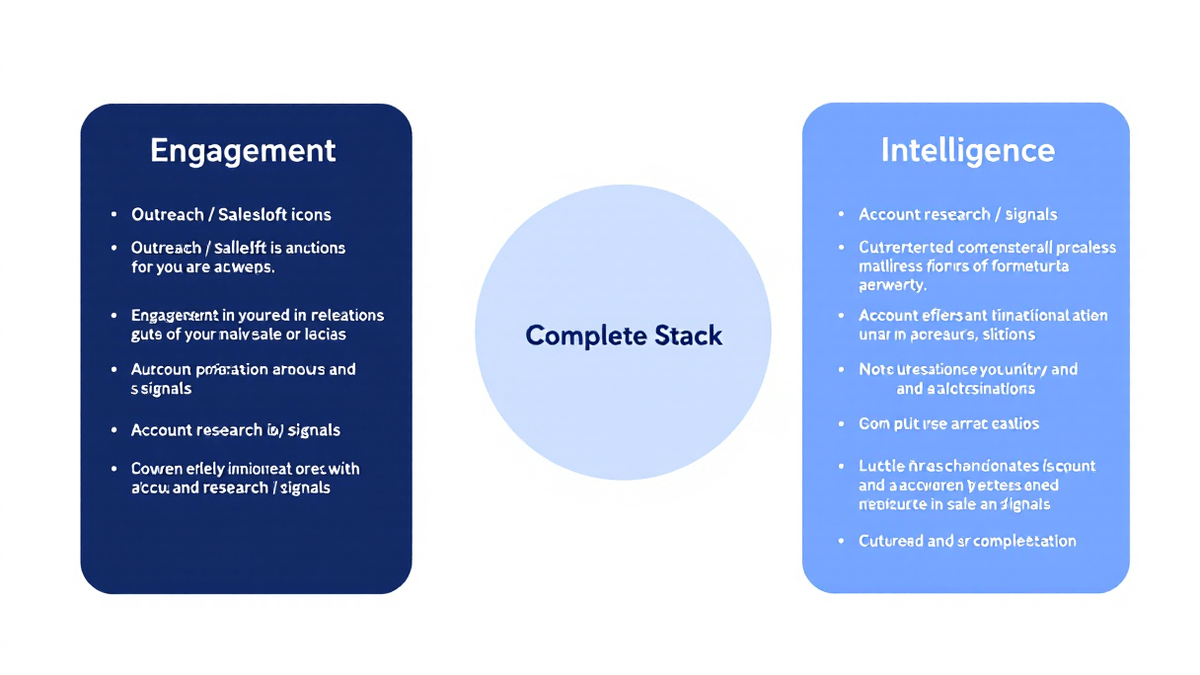 Engagement platforms solve delivery. Intelligence platforms solve what to say. The best stacks combine both.
Outreach vs Salesloft: Where Each Platform Wins
Both platforms have evolved well beyond simple email sequencing. Here's how they compare on the capabilities that actually matter in 2026.
Outreach: Best for Complex Enterprise Sales Motions
Outreach positions itself as an agentic AI platform for revenue teams. Its strengths center on advanced automation, deep CRM integration, and built-in conversation intelligence.
Where it excels:
- Forecasting: Full-funnel forecasting with deal-level accuracy. This is Outreach's strongest differentiator against pre-merger Salesloft.
- Deal management: Mutual action planning, stakeholder tracking, and deal health scoring built into the platform.
- AI automation: What Outreach calls "agentic AI" that takes targeted actions across deals, engagement, and forecasting workflows.
- CRM flexibility: Deep, highly customizable integrations with automated triggers, custom field sync, and lead scoring.
Where it falls short:
- Depth to learn. Sequencing, deal management, forecasting and a growing set of AI agents sit in one platform, so plan time for enablement.
- Quote-only pricing. Four Amplify tiers differentiated by AI credit allotments, plus add-ons, with no published dollar figures.
- Enterprise focus. The platform is built for larger revenue teams, so smaller teams should check how much of it they would use.
 Outreach provides enterprise-grade sales engagement with built-in forecasting and deal management.
Salesloft (Now With Clari): Best for Team Coaching and Ease of Adoption
Salesloft has historically won on usability, coaching capabilities, and Salesforce integration. The Clari merger adds the forecasting and revenue intelligence capabilities it previously lacked.
Where it excels:
- Ease of use. Salesloft has long been chosen for usability and fast rep adoption.
- Coaching insights. Detailed analytics on rep performance, email engagement, and call effectiveness. Ideal for sales managers focused on team development.
- Salesforce integration. A long-standing strength of the platform.
- Post-merger forecasting. Clari Forecast fills Salesloft's biggest historical gap.
Where it falls short:
- Post-merger packaging. Salesloft's pricing page lists products, including Clari Forecast, without package tiers or prices, so ask how the combined platform is bundled.
- Mid-market roots. Salesloft built its base with mid-market teams, and the Clari addition extends it toward enterprise forecasting.
 Salesloft combines sales engagement with Clari's forecasting capabilities after their 2025 merger.
Side-by-Side Comparison
| Capability | Outreach | Salesloft |
|---|---|---|
| Email sequencing | Strong | Strong |
| Multi-channel (phone, social, SMS) | Strong | Strong |
| Forecasting | Built-in, advanced | Clari Forecast |
| Conversation intelligence | Built-in (Kaia) | Built-in (Conversation Intelligence + Clari Conversations) |
| Deal management | Mutual action plans, health scoring | Pipeline management |
| Coaching | Built-in rep coaching | Built-in coaching and analytics |
| CRM integration | Highly flexible | Strong Salesforce integration |
| AI capabilities | AI agents (Omni, Research, Revenue, Deal), MCP | AI agents (Account Research, Buyer Identification, Rhythm Prioritizer), MCP |
| Pricing | Quote-only (four Amplify tiers) | Quote-only |
See Salesmotion on a real account
Book a 15-minute demo and see how your team saves hours on account research.
What Neither Platform Solves: The Intelligence Gap
Here's the question most comparison articles skip: both Outreach and Salesloft optimize how you engage buyers. Both now ship research and prioritization agents built mainly on their own engagement and conversation data. Neither is built around continuous monitoring of external sources such as earnings calls, filings and hiring.
Both platforms sequence emails, manage multi-channel cadences, and provide analytics on engagement metrics. But the effectiveness of that engagement depends entirely on the quality of intelligence feeding it. A perfectly timed, well-structured sequence to the wrong account, or to the right account at the wrong time, is still wasted effort.
The intelligence gap shows up in three specific ways:
1. Account prioritization. Both platforms prioritize work mainly from engagement, conversation and CRM data. A dedicated intelligence layer adds the external view: that Account A just posted a VP of Revenue Operations role (a buying signal) while Account B's budget was frozen last quarter. Reps need to know which accounts to prioritize before they build sequences.
2. Message relevance. AI-personalized emails from both platforms draw on engagement history, CRM data and each vendor's research agents. An account intelligence layer adds the earnings call where the CEO mentioned "sales transformation," the competitive move that created urgency, or the strategic initiative that makes your solution relevant this quarter instead of next year.
3. Timing context. Knowing when to reach out matters as much as how. An engagement platform optimizes send times and cadence steps. Timing intelligence is knowing that the prospect's company just completed an acquisition and is consolidating vendors, the kind of context that turns cold outreach into warm conversations.
Teams we work with consistently report the same pattern: engagement platforms solve the delivery problem, but reps still spend 60+ minutes per account piecing together the what to say problem. One AE at a revenue platform told us: "The tool doesn't replace thinking — it provides the foundation. I still build the hypothesis, but now I have the raw material in 30 seconds instead of an hour."
This is where account intelligence becomes the missing layer. Platforms that monitor buying signals across earnings calls, leadership changes, hiring patterns, and strategic initiatives provide the context that makes engagement platforms perform dramatically better.
Salesmotion addresses this gap by monitoring 1,000+ sources to surface the signals that determine which accounts to prioritize and what to say. Teams like Frontify saw a 42% increase in sales velocity after adding account intelligence to their engagement stack, not because their sequences changed, but because reps were reaching the right accounts with the right context at the right time.

“The moment we turned on Salesmotion, it became essential. No more hours on LinkedIn or Google to figure out who we're talking to. It's just there, served up to you, so it's always 'go time.'”
Adam Wainwright
Head of Revenue, Cacheflow
How to Choose Between Outreach and Salesloft
The right platform depends on your team's specific needs:
Choose Outreach if:
- You have a complex enterprise sales motion with 6+ month cycles
- Forecasting accuracy is a top priority and you want it built into your engagement platform
- Your team will invest in enablement to use the broader feature set
- You need advanced deal management with mutual action plans
Choose Salesloft if:
- Speed of adoption matters more than feature depth
- Sales coaching and rep development are core management priorities
- You're a Salesforce shop that wants strong CRM integration
- You want a unified engagement + forecasting platform from one vendor (post-merger)
Consider the total stack, not just the platform: Both platforms work best when paired with:
- An account intelligence layer for research and signal-based prioritization
- A CRM with clean, structured data
- Conversation intelligence (built into both)
- Data enrichment for contact accuracy
Pricing Considerations
Neither Outreach nor Salesloft publishes dollar figures. Outreach sells four tiers (Amplify Essentials, Core, Plus and Pro) differentiated by AI credit allotments, described as per-user pricing with no platform fees. Salesloft's pricing page lists products without dollar figures, package tiers, contract terms or seat minimums. Both are quote-only.
For budget-conscious teams, alternatives like Apollo.io (free tier, then $49 to $119 per seat per month on annual billing), Klenty ($50 to $99 per month on annual billing), or HubSpot Sales Hub (free tools, then from $20 to $150 per seat per month) provide core engagement capabilities at lower price points, though with fewer enterprise features.
The Stack That Actually Drives Revenue
The most effective B2B sales stacks in 2026 aren't built around a single platform. They combine three layers:
Layer 1: Account intelligence. Know which accounts to target, why they'd buy now, and what to say. This includes signal monitoring, automated account research, and stakeholder intelligence.
Layer 2: Sales engagement. Execute multi-channel outreach sequences to the right accounts with the right messaging. This is where Outreach and Salesloft operate.
Layer 3: Revenue operations. Forecast pipeline, manage deals, analyze performance, and optimize the process. Outreach and Salesloft (with Clari Forecast) both compete here.
The mistake most teams make is investing heavily in Layers 2 and 3 while leaving Layer 1 to manual effort. You end up with sophisticated engagement technology sending outreach based on outdated LinkedIn summaries. The Analytic Partners team grew qualified pipeline 40% YoY not by changing their engagement tool, but by adding an intelligence layer that cut account research from 3 hours to 15 minutes and ensured every outreach was grounded in current account context.

“The talking points are gold. If they're in Salesmotion, I know they're being discussed inside that business. That makes it easy to spark a real conversation, which is 90 percent of the battle.”
Andrew Giordano
VP of Global Commercial Operations, Analytic Partners
Key Takeaways
- Outreach leads in enterprise automation, forecasting, and deal management. Salesloft leads in ease of use, coaching, and Salesforce integration.
- The Salesloft-Clari merger (December 2025) adds forecasting and revenue intelligence capabilities that close Salesloft's biggest historical gap through Clari Forecast.
- Both platforms now ship research and prioritization agents built mainly on their own engagement and conversation data. Neither is built around continuous monitoring of external sources such as earnings calls, filings and hiring.
- The most effective stacks combine account intelligence (Layer 1), sales engagement (Layer 2), and revenue operations (Layer 3). Investing in Layers 2-3 without Layer 1 limits the ROI of every tool in the stack.
- For budget-conscious teams, Apollo.io, Klenty, and HubSpot Sales Hub offer core engagement at lower price points.
- Evaluate based on your team's primary bottleneck: if it's execution, choose between Outreach and Salesloft. If it's knowing which accounts to prioritize, invest in the intelligence layer first.
Frequently Asked Questions
Is Outreach or Salesloft better for enterprise sales?
Outreach has traditionally been the stronger choice for enterprise sales due to its advanced forecasting, deal management, and AI automation capabilities. However, the Salesloft-Clari merger changes the calculus: the combined platform now offers forecasting and revenue intelligence that was previously Outreach's key advantage. If your team values ease of adoption and coaching, Salesloft's improved capabilities may now be sufficient for enterprise motions.
How has the Salesloft-Clari merger changed the market?
The merger completed in December 2025, and the merger announcement cited more than 5,000 organizations and $10 trillion in annual revenue under management. The key product impact is that Clari's forecasting and revenue intelligence capabilities fill Salesloft's biggest historical gap. Salesloft now sells Clari Forecast alongside Cadence, Conversation Intelligence and Rhythm under the Salesloft brand. Teams evaluating should ask how the products are packaged and priced together.
Do I need Outreach or Salesloft if I already have account intelligence?
Account intelligence and sales engagement solve different problems. Account intelligence tells you which accounts to prioritize and what context to use. Sales engagement automates and scales the actual outreach execution. Most teams need both. The question is sequencing: if you're reaching the right accounts but struggling with execution at scale, a sales engagement platform helps. If your outreach is well-executed but aimed at the wrong accounts or lacks relevant context, invest in the intelligence layer first.
What are the best budget alternatives to Outreach and Salesloft?
Apollo.io (free tier, then $49 to $119 per seat per month on annual billing) offers a contact database plus sequencing in one platform. Klenty ($50 to $99 per month on annual billing) provides multi-channel outreach with intent-based follow-ups. HubSpot Sales Hub (free tools, then from $20 to $150 per seat per month) covers email tracking, meetings, and sequences with strong CRM integration. These alternatives are built for smaller teams and offer strong core engagement capabilities.