
Most sales advice on prospecting tells reps to watch LinkedIn, track press releases, and jump on funding news. That advice isn't wrong. It's just crowded. Every seller sees the same public headlines, and by the time they hit inboxes, the angle is usually stale.
If you sell into public companies, the cleaner signal often sits one layer deeper. SEC filings for sales prospecting give you direct access to how a company describes its priorities, constraints, risks, leadership moves, and operating changes in its own formal disclosures. The SEC's filing search gives the public access to “millions of informational documents” in EDGAR, with both real-time and daily filing search available through the SEC filings search portal. That matters because it lets reps work from primary-source intelligence instead of recycled summaries.
The gap is simple. Most reps don't know where to look. The few who do often read filings like background material instead of using them to build a point of view for outreach. That's the opportunity.
Key Takeaways
- SEC filings are higher-signal than headlines. They exist to disclose material information, not to market the company — so they reveal real priorities, constraints, and risks before LinkedIn does.
- Four filings cover most outbound triggers. The 10-K (annual strategy & risks), 10-Q (quarterly updates), 8-K (material events like leadership changes or acquisitions), and DEF 14A (executive moves and compensation).
- Read for triggers, not background. Search for phrases like "we plan to invest," "we are expanding," "we have hired," or "we are evaluating" — each is a buying signal a competitor isn't seeing.
- Automation makes it scale. Account intelligence tools that monitor EDGAR continuously surface filing-driven triggers to reps as alerts, so the playbook works across hundreds of accounts, not just five.
See Salesmotion in action
Take a self-guided interactive tour — no signup required.
Why Your Team Is Missing the Best Sales Triggers
Most outbound teams are over-indexed on loud signals. A company posts a product launch on LinkedIn. A trade publication covers a new executive hire. A press release announces a partnership. Then every SDR in the category sends the same email with slightly different wording.
SEC filings are different because they don't exist to market the company. They exist to disclose material information. That changes the quality of the signal.
Why filings beat headlines
A press release tells you what the company wants the market to notice. A filing often tells you what leadership must disclose, even when the message is uncomfortable. That's where sales relevance lives.
You'll see:
- Strategic priorities in annual and quarterly disclosures
- Self-declared risks that often map to business pain
- Leadership and governance changes with immediate org impact
- Material events that create a valid “why now”
For teams selling into public companies, that's a better starting point than generic social monitoring. If you already train reps to work from sales trigger events, SEC disclosures deserve a place near the top of that list because they're structured, repeatable, and tied to real reporting obligations.
Practical rule: If the company had to disclose it formally, it's usually more useful than a marketing post about it.
Why most teams still ignore them
The main reason is intimidation. Reps hear “10-K” and assume investor relations, not pipeline creation. They assume filings are for analysts, finance teams, or legal people.
That's a mistake. For a seller, the question isn't “Can I interpret every accounting detail?” It's “Can I find evidence of change, pressure, or priority that justifies outreach?” In most cases, yes.
There's also an operating issue. Manual prospecting is already time-heavy. Managers trying to scale outbound often solve for volume first, which is why they hire specialists and build focused prospecting capacity. If your team is trying to increase account coverage without bloating AE calendars, a dedicated Hire SDR model can create room for deeper trigger-based research instead of shallow list blasting.
The hidden edge
The edge isn't that SEC filings are secret. They're public and free. The edge is that very few reps turn them into workflow.
That's why this works. The filing gives you a source document. Your outreach turns that document into relevance. And because the filing cadence is predictable, you can monitor accounts systematically instead of waiting for random news breaks.

“The account and contact signals are key for reaching out at important times, and the value-add messaging it creates unique to every contact helps save time and efficiency.”
Daniel Pitman
Mid-Market Account Executive, Black Swan Data
Decoding the Four Key SEC Filings for Sales
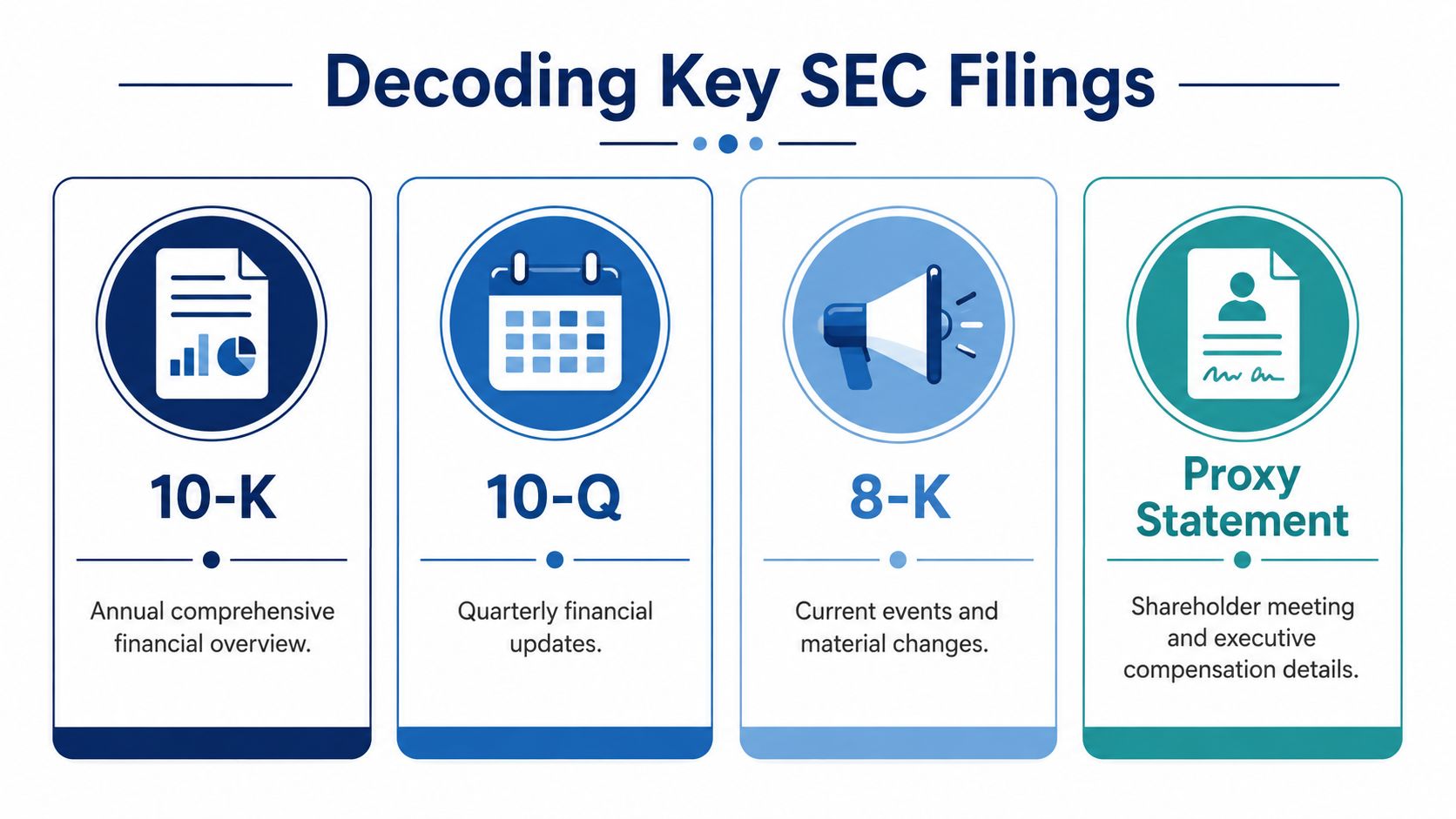
You don't need to master every SEC form. For most B2B sales motions, four filings do the heavy lifting: 10-K, 10-Q, 8-K, and DEF 14A.
The sections with the most sales value are usually the Management's Discussion and Analysis, often called MD&A, plus material-event filings. MD&A gives management's narrative explanation of performance and outlook, and paired with 8-Ks it creates a repeatable cadence for account monitoring and trigger-based outreach, as discussed in this MD&A and 8-K overview.
What each filing tells a rep
A good way to think about these documents is simple.
- 10-K tells you how the company sees itself over a full operating year.
- 10-Q tells you what's changing right now.
- 8-K tells you what happened that management couldn't wait to disclose later.
- DEF 14A tells you what executives are being pushed to achieve.
That last one is badly underused. Proxy statements often reveal how boards tie compensation to priorities. If leadership incentives point toward efficiency, transformation, expansion, or integration, sellers should pay attention. That's one reason this guide on using DEF 14A for account research and strategic value selling is useful for reps working larger accounts.
SEC Filings Cheat Sheet for Sales Reps
| Filing Type | What It Is | Key Sales Triggers to Look For |
|---|---|---|
| 10-K | Annual report with broad business, operational, and risk disclosure | Strategic priorities, risk factors, segment breakdowns, business model shifts, litigation, governance themes |
| 10-Q | Quarterly update on performance and operations | Trend direction, commentary changes, new pressures, changing language around spend, execution, or demand |
| 8-K | Current report for material events | Leadership changes, acquisitions, material contracts, restructures, departures, major operational updates |
| DEF 14A | Proxy statement for shareholder meeting and executive compensation matters | Executive incentives, board priorities, KPI-linked compensation themes, governance shifts |
Where reps usually find the real signal
In a 10-K, start with:
- Business overview: What the company sells, where it operates, and how it talks about customers
- Risk factors: The cleanest list of what can hurt performance
- MD&A: Management's own explanation of results, priorities, and outlook
- Segments and customers: Where growth or concentration may be shaping decisions
In a 10-Q, pay attention to changes in wording versus the prior quarter. Repeated language often signals a durable issue. New language often signals an emerging one.
In an 8-K, look for moments that create urgency. A leadership change, acquisition, or material agreement can affect budgets, timelines, org design, and vendor appetite fast.
DEF 14A is where strategy gets teeth. If leadership pay depends on a business outcome, that outcome matters operationally.
How to Find Actionable Sales Triggers in the Text
Most reps waste time because they read filings from page one as if they're studying for an exam. That's the wrong workflow. A filing is not bedtime reading. It's an account-planning input.
A stronger method is to decide what you need before you open the document. Guidance on filing-based prospecting recommends systematically extracting signals from business description, risk factors, MD&A, executive compensation, and litigation, so research supports an outreach hypothesis instead of turning into random background reading, as noted in this sales prospecting methodology.

Start with a keyword map
Before you touch the filing, build a search list tied to your category.
If you sell cybersecurity, search terms might include:
- Security language: “cybersecurity,” “information security,” “incident,” “breach,” “threat”
- Control language: “compliance,” “risk management,” “governance”
- Operational pressure: “third-party,” “vendor,” “business continuity”
If you sell supply chain or operations software, search for:
- Flow issues: “inventory,” “transportation,” “fulfillment,” “procurement”
- Cost pressure: “input costs,” “logistics,” “delays,” “disruption”
- Expansion indicators: “distribution,” “network,” “capacity”
If you sell RevOps, analytics, finance systems, or workflow tools, search for:
- Execution themes: “efficiency,” “forecasting,” “visibility,” “automation”
- Growth themes: “segment,” “expansion,” “go-to-market,” “productivity”
- Control themes: “margin,” “spend,” “integration,” “reporting”
Read in this order
I'd use this sequence for almost any public-company target account.
-
Risk factors first
This gives you the company's stated friction. You're looking for recurring pain, not legal boilerplate alone. -
MD&A second
Here, management explains what happened and what they intend to do about it. -
Business description next
Use this to understand products, markets, and operating model so your outreach sounds commercially literate. -
Then 8-K or proxy context
Fill in immediate changes or executive incentives after you have the baseline story.
What counts as a real trigger
Not every disclosure deserves outreach. The useful signals are the ones that imply operational work.
Good examples:
- A company says it is entering a new market or launching a new business line
- Management describes ongoing cost pressure or execution complexity
- Leadership highlights system integration, transformation, or modernization needs
- The company discloses litigation, governance, or operational risk that may increase urgency around controls
Weak examples:
- Generic statements every public company includes
- Old issues repeated with no new angle
- A standalone phrase that doesn't connect to a business initiative
Search for tension, not trivia. The best trigger is usually a gap between what the company wants and what's getting in the way.

“All of the vendors that I've worked with, all of the onboarding that I have had to deal with, I will say, hands down, Salesmotion was the easiest that I have had.”
Lyndsay Thomson
Head of Sales Operations, Cytel
A Practical Example Mining a 10-K for Outreach Angles
The easiest way to make filings useful is to translate one into an actual email angle.
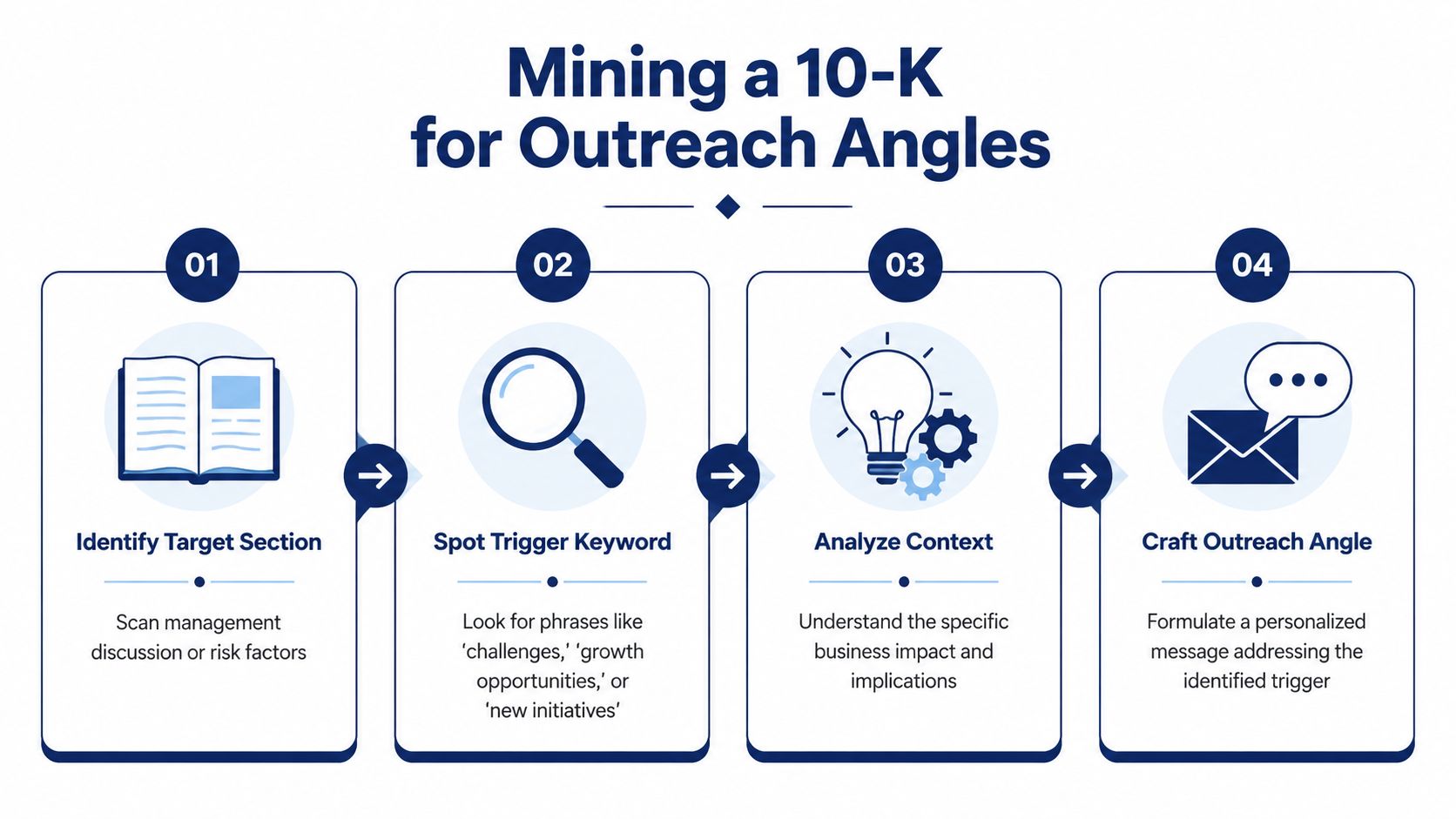
Let's use a fictional public software company. You open the latest 10-K. In the risk factors section, management says the business operates in a highly competitive market and must continue to innovate quickly to maintain position. In MD&A, leadership describes a priority around improving product execution and bringing offerings to market more efficiently.
That combination matters. One sentence describes the pressure. The other describes the response. That's enough to build an informed point of view.
How a rep should interpret it
A weak rep says, “They're growing and probably need our tool.”
A strong rep says, “Leadership is balancing competitive pressure with faster execution. If our product reduces bottlenecks between planning, development, and launch, we have a legitimate angle.”
That's a huge difference. The first is guesswork. The second is tied to disclosed business context.
Here's how I'd break the filing down:
- Risk signal: Competitive pressure and difficulty innovating fast enough
- Strategic response: Improve delivery speed, execution quality, or product throughput
- Commercial hypothesis: Teams responsible for product, operations, engineering, or revenue execution may be under pressure to shorten cycle times and improve coordination
- Outreach angle: Focus on removing friction in the workflow that slows execution
Turn the filing into talk tracks
Once the hypothesis is clear, build language around business outcomes, not filing jargon.
Possible opening lines:
- “I noticed your latest annual filing puts competitive pressure and execution speed in the same conversation.”
- “Your management discussion suggests faster delivery is becoming more important operationally, not just strategically.”
- “It looks like the team is trying to improve execution while protecting product momentum.”
Now you sound like someone who read the business, not someone who skimmed a company description.
For reps who want a broader framework for preparing that kind of account-specific message, this guide on how to research a company before a sales call is a useful companion.
A plausible email built from the 10-K
Subject: Reducing friction in product execution
Hi [Name],
I was reviewing your latest annual filing and noticed two themes showing up together: ongoing competitive pressure and a clear focus on improving execution.
That usually creates a practical challenge for teams trying to move faster without adding more operational drag across product, engineering, and go-to-market handoffs.
We work with teams that need better visibility into where execution slows down, especially when leadership is pushing for faster delivery and tighter coordination.
Worth comparing notes on whether that's showing up in your environment right now?
This works because it doesn't pretend you know everything. It shows enough context to earn a reply.
Turning Insights into Winning Outreach Sequences
A filing insight becomes useful only when the message sounds natural. The goal isn't to impress a buyer with SEC vocabulary. The goal is to prove that your outreach is anchored in their operating reality.
The mistake most reps make is going from disclosure straight to pitch. They find one line in a filing and immediately say, “We can help.” That jump is too fast.
Build around the signal stack
A single filing can start the hypothesis, but better outreach comes from combining signals.
A practical sequence looks like this:
- Touch one: Lead with the filing-based issue or priority
- Touch two: Add a corroborating signal such as hiring, an executive move, or a public initiative
- Touch three: Reframe around a business trade-off the team is likely facing
- Touch four: Offer a short, specific conversation with a point of view
One common mistake in filing-based prospecting is treating a one-time event as a durable signal. A better approach is to identify operational change in a 10-K or 10-Q, then corroborate it with other signs such as hiring or executive changes before outreach, as explained in this 10-K sales prospecting guidance.
Before and after messaging
Weak email
“Hi [Name], saw your recent filing and thought our platform could help your business. We help companies streamline operations and improve efficiency. Open to a quick chat?”
This fails because it could go to anyone.
Better email
“Hi [Name], in your recent quarterly filing, leadership emphasized execution pressure around [issue]. I also noticed the company recently added senior leadership in [function] / appears to be investing in [initiative]. That combination usually means teams are being asked to improve visibility and move faster at the same time. We help companies tighten that operating layer without creating more system sprawl. Worth a brief conversation if that's on your plate?”
That version does three things:
- Anchors to context
- Makes a business inference
- Keeps the ask modest
The filing should explain why you're reaching out. Your message should explain why the buyer should care.
DEF 14A is especially powerful in sequences
Proxy statements are perfect for later touches because they let you frame the issue at the executive level.
If incentive design points toward transformation, margin discipline, integration, or growth execution, your message can connect your solution to the outcomes leadership is being measured on. You don't need to overstate it. Just show you understand how board-level priorities flow into operator-level pressure.
That's usually more credible than another “saw your latest announcement” follow-up.
Automating Your SEC Prospecting Workflow
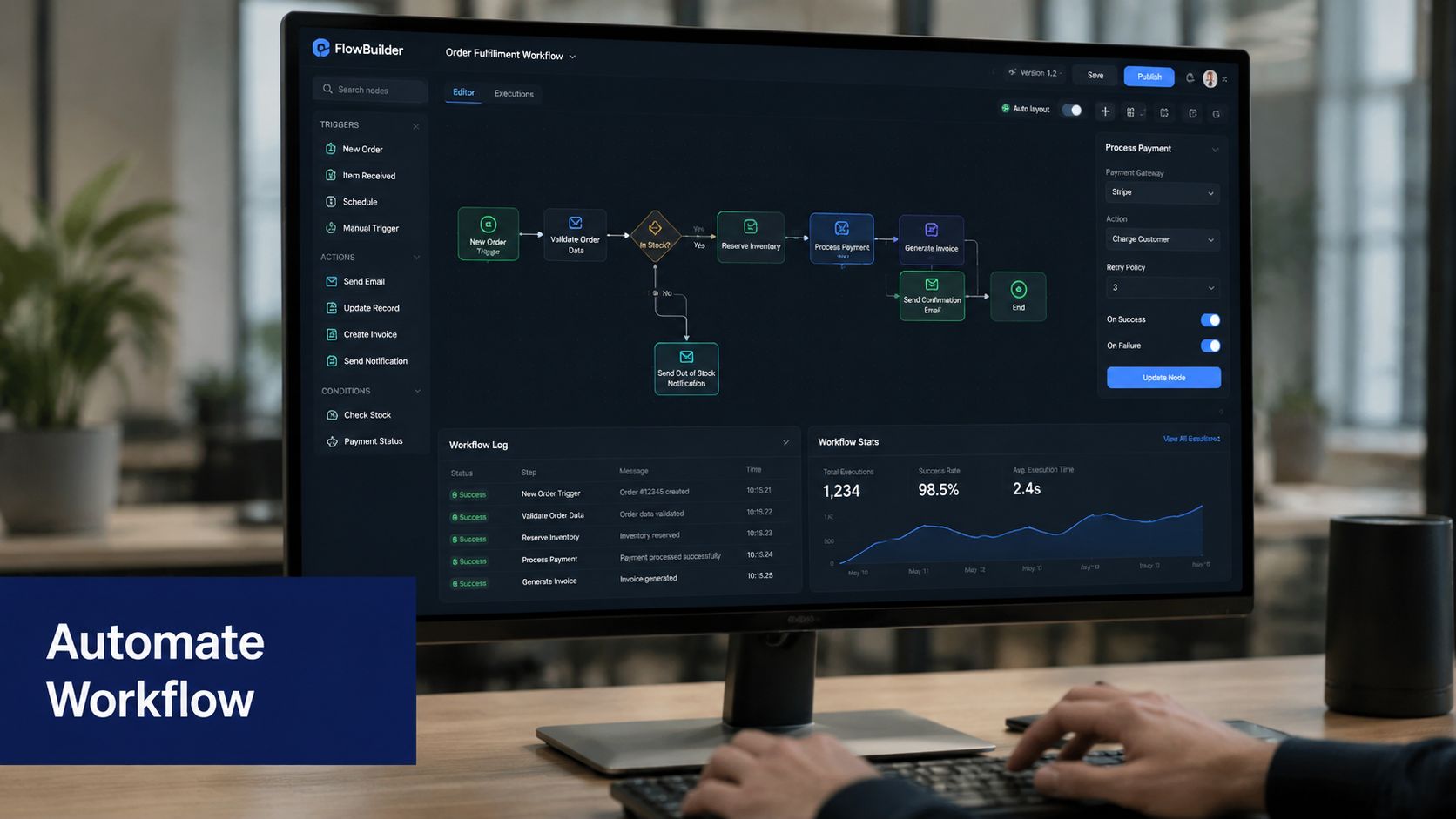
Manual filing review is fine for a small named-account list. It breaks fast once you have a broad territory, multiple verticals, or a team that needs consistent coverage. No manager wants reps spending half a day inside EDGAR just to find one usable angle.
The scalable answer is a workflow, not heroics.
What a practical workflow looks like
A workable motion usually has four layers:
-
Account list selection
Start with the public companies that match your ICP and are worth sustained monitoring. -
Filing watch coverage
Track 10-K, 10-Q, 8-K, and DEF 14A activity for those accounts. -
Signal interpretation
Classify what changed. Is it a strategic priority, material event, leadership shift, incentive clue, or operating risk? -
Rep-ready output
Push a short brief to Slack, CRM, or email with the source context and a suggested outreach angle.
That fourth step is a common point of failure for teams. They can collect alerts. They struggle to turn alerts into action.
What to automate and what to keep human
You should automate:
- Monitoring: Filing detection across target accounts
- Extraction: Pulling sections such as MD&A, risk factors, and executive compensation themes
- Routing: Sending account-specific alerts to the right owner
- Drafting: Creating a first-pass outreach suggestion tied to the signal
Keep human judgment on:
- Signal quality: Is this relevant to your solution?
- Account priority: Does this account deserve immediate action?
- Message tone: Is the draft too aggressive, too vague, or too early?
One option in this category is Salesmotion, which monitors public account signals including SEC filings and turns them into research briefs, alerts, and outreach drafts. In practice, that's useful when a team wants automated filing monitoring, extracted sales-relevant context, and DEF 14A analysis without asking reps to do the parsing manually. If you're evaluating this kind of workflow more broadly, this article on sales research automation is a good starting point.
The real benefit
The benefit isn't “more alerts.” It's better timing with less research tax.
A rep shouldn't have to open a filing cold, scan dozens of pages, interpret what matters, compare it to recent account changes, and then draft a message from scratch every time. Good automation shortens that loop. The rep still decides whether the signal is worth acting on, but the heavy lifting gets done in advance.
That's how SEC filings for sales prospecting become a repeatable motion instead of an occasional clever tactic.
Public company accounts are telling you more than most reps realize. Salesmotion helps teams monitor those signals, including SEC filings, and turn them into account context and ready-to-review outreach so reps can spend less time digging and more time selling.