SaaS companies are among the fastest-moving buying targets in B2B sales. A 2025 Gartner forecast projected global SaaS spending would surpass $300 billion by 2026, and behind every dollar is a procurement decision shaped by funding events, product launches, tech stack changes, and leadership transitions. Tracking SaaS buying signals is not optional if your territory includes technology companies. It is the difference between relevant outreach and noise.
TL;DR: SaaS buying signals include funding rounds, tech stack changes, hiring surges, product launches, leadership changes, IPO filings, and competitive moves. Tracking these 15 triggers helps B2B sales teams identify which SaaS companies are actively evaluating new solutions.
What Makes SaaS Buying Signals Unique
SaaS companies move faster than most industries. A Series B round can unlock $50 million in new spending within weeks. A product launch can shift an entire team's technology priorities. A leadership change at the VP level can trigger a vendor review within a month. The velocity of change in SaaS means signals have a shorter shelf life. A signal that is a week old may already be stale.
SaaS buying decisions are also more distributed than in traditional industries. Engineering leaders buy developer tools. Product leaders buy analytics platforms. Revenue leaders buy sales tools. Marketing leaders buy their own stack. This means the same company might be a buyer across multiple categories simultaneously, and different signals map to different buying committees.
The other unique factor: SaaS companies understand the value of software. They are not going to question whether a technology purchase is worthwhile. They question whether this specific tool is the right one. That makes signal quality and timing even more important than in industries where software adoption is still an uphill battle.
See Salesmotion on a real account
Book a 15-minute demo and see how your team saves hours on account research.
Funding and Financial Signals
Funding Rounds
A funding announcement is the clearest buying signal in SaaS. Series A companies are building their initial stack. Series B companies are scaling and replacing early tools with enterprise-grade solutions. Growth-stage and late-stage rounds signal hiring surges and infrastructure investments. Track funding announcements on Crunchbase and in press releases.
The specific amount matters. A $10M Series A creates different buying behavior than a $100M Series C. Map funding size to the likely spending categories: smaller rounds fund core operations tools, while larger rounds fund expansion across sales, marketing, engineering, and infrastructure.
IPO Filings and Public Market Events
S-1 filings reveal extraordinary detail about a company's technology stack, growth challenges, and strategic priorities. When a SaaS company files to go public, it is also under pressure to professionalize operations: compliance tools, financial reporting platforms, security infrastructure, and vendor management systems become urgent purchases. Track SEC filings and pre-IPO reporting.
Earnings Guidance and Revenue Commentary
For public SaaS companies, quarterly earnings calls contain direct signals. Mentions of "investing in sales capacity," "expanding our go-to-market," "consolidating our vendor landscape," or "building out our data infrastructure" are explicit statements of purchase intent. Search earnings transcripts for technology and operations keywords.

“The moment we turned on Salesmotion, it became essential. No more hours on LinkedIn or Google to figure out who we're talking to. It's just there, served up to you, so it's always 'go time.'”
Adam Wainwright
Head of Revenue, Cacheflow
Technology and Product Signals
Tech Stack Changes
When a SaaS company switches its CRM, marketing automation platform, data warehouse, or core infrastructure, it creates a ripple effect. Adjacent tools need to integrate with the new platform. Teams need training and implementation support. Competitive displacement in one category often triggers reviews in related categories. Track tech stack changes via technographic data providers and job postings that mention specific platforms.
Product Launches and Feature Expansions
When a SaaS company launches a new product line or expands into a new market segment, it needs supporting infrastructure. A company launching an enterprise tier needs security certifications, compliance tools, and enterprise sales enablement. A company launching a developer platform needs documentation tools, community platforms, and technical support infrastructure.
Competitive Moves and Market Repositioning
When a SaaS company's competitor raises a large round, launches a competing product, or gets acquired, it creates urgency. The company may accelerate its own product development, increase sales hiring, or invest in differentiation. These competitive pressures drive technology and services purchases.
Organizational Signals
Hiring Surges
Hiring patterns are among the most reliable SaaS buying signals. A surge in engineering hires indicates product investment. A surge in sales hires indicates go-to-market expansion (and a need for sales tools, training, and enablement). A surge in data and analytics hires indicates infrastructure investment. Track job postings across your territory to identify hiring trends that precede purchasing decisions.
Leadership Changes
A new CRO brings a new sales methodology and often new tools. A new CTO may overhaul the engineering stack. A new CMO will reevaluate the marketing technology landscape. In SaaS, leadership changes at the VP and C-suite level trigger vendor reviews more quickly than in traditional industries because the culture favors rapid decision-making.
Office and Geographic Expansion
A new office opening, international expansion, or remote-first announcement all signal organizational growth. Geographic expansion into new markets requires localization tools, compliance solutions, and often new partnerships. Salesmotion tracks these organizational changes alongside financial and technology signals, giving reps a complete picture of each account's trajectory.
Conference Sponsorships and Speaking Engagements
When a SaaS company sponsors SaaStr, Web Summit, Dreamforce, or a vertical-specific conference, it signals marketing investment and a desire for visibility. Conference participation also reveals strategic priorities: which tracks they sponsor, which topics their executives speak on, and which audiences they target.
How to Operationalize SaaS Buying Signals
The volume of signals in the SaaS space is high. Every day brings funding announcements, job postings, product launches, and leadership changes across hundreds of companies. The challenge is not finding signals but filtering and prioritizing them.
Score signals by urgency. Not all signals are equal. A Series B round with hiring surges is higher urgency than a conference sponsorship. A CRO hire is higher urgency than a marketing intern posting. Build a signal scoring model that weights events by their correlation with buying behavior.
Cluster signals for insight. A single signal is an event. Multiple signals tell a story. Funding + hiring surge + leadership change = a company in transformation mode with budget and urgency. Use signal clusters to prioritize your highest-opportunity accounts.
Automate monitoring. Reps cannot manually track Crunchbase, LinkedIn, SEC filings, job boards, and tech review sites across a territory of 100+ SaaS accounts. Salesmotion aggregates signals from 1,000+ sources and delivers enriched account briefs that connect financial, organizational, and technology signals in one view. This gives reps hours back each week for actual selling.
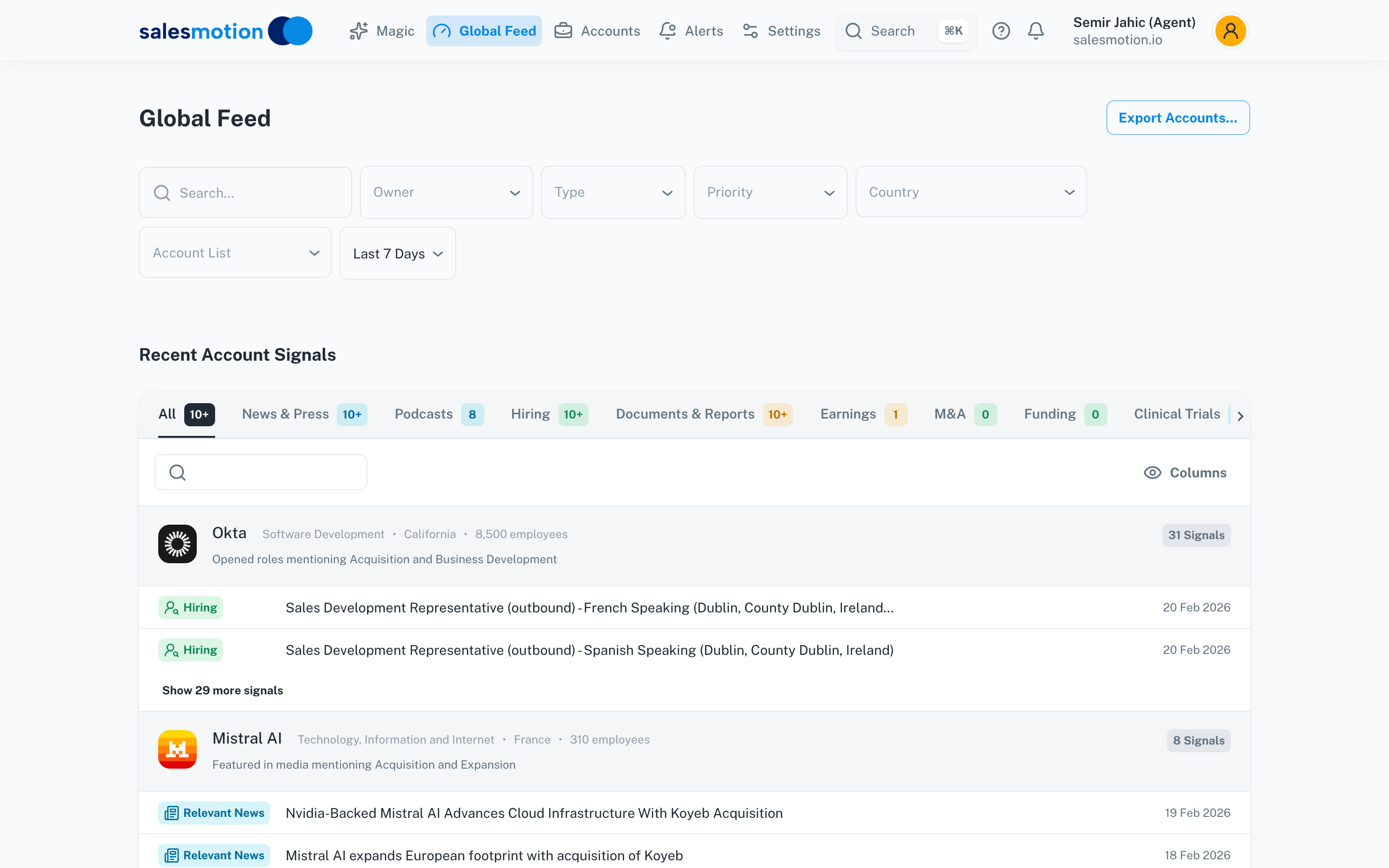 Salesmotion surfaces buying signals — hiring, earnings, news, M&A, funding — across your entire territory in a single feed, so reps act on the highest-value signals first.
Signal-Based Workflow: SaaS Example
Trigger: A Series B SaaS company announces a $60M round led by a top-tier firm. In the same week, they post 8 new sales roles and a VP of Revenue Operations position.
Platform action: Salesmotion flags the funding event, the hiring surge, and the RevOps leadership role. The account brief updates with the funding details, the company's current tech stack (from technographic data), recent product announcements, and key stakeholder profiles.
Rep action: The rep sees that the company is scaling sales rapidly and hiring RevOps leadership, which means they are building their sales infrastructure. The rep reaches out to the hiring manager for the VP of RevOps, referencing the funding news and the scaling challenge: "As you build out your revenue operations team post-Series B, here is how similar companies have structured their account intelligence workflow."
Outcome: The outreach lands because it addresses the company's exact moment: rapid scaling with new budget and a mandate to build infrastructure. The conversation starts at the strategic level, not as a cold pitch.
Building a SaaS-Specific Signal Playbook
SaaS accounts respond best to outreach that demonstrates understanding of their specific stage and challenges. Here is how to build repeatable plays:
By funding stage. Seed/Series A: focus on foundational tools. Series B: focus on scaling and professionalization. Series C+: focus on enterprise infrastructure and consolidation. Each stage has different needs and different economic buyers.
By signal type. Funding round triggers a "growth infrastructure" play. CRO hire triggers a "sales stack review" play. IPO filing triggers a "compliance and professionalization" play. Standardize the messaging and case studies for each play.
By function. Map which team is most likely buying based on the signal. Engineering hires suggest developer tools. Sales hires suggest CRM and enablement. Marketing hires suggest analytics and automation. Route signals to the rep or team that owns that functional relationship.
For more on signal-driven selling to technology companies, visit our sales intelligence for SaaS page.
Internal resources for deeper context: buying signals guide, sales intelligence tools comparison, and our alternatives page.
Key Takeaways
- SaaS buying signals have a shorter shelf life than most industries. Funding rounds, leadership changes, and tech stack shifts trigger fast decision-making, so timing matters more than in traditional sales cycles.
- Funding stage determines buying behavior. Seed companies build foundational stacks, Series B companies scale and professionalize, and Series C+ companies consolidate and optimize. Tailor your outreach to the stage.
- Signal clusters (funding + hiring + leadership change) are more predictive than isolated events. A company with three concurrent signals is actively in a buying window.
- Hiring patterns are the most reliable leading indicator. A surge in specific roles (RevOps, data engineering, sales) reveals which categories the company is investing in before they issue an RFP.
- Automate signal monitoring across your SaaS territory. Manual tracking does not scale past 20 accounts, and the speed of SaaS decision-making means a week's delay can cost you the deal.
Frequently Asked Questions
What are the top buying signals for selling into SaaS companies?
The strongest SaaS buying signals are funding rounds (especially Series B and C), leadership changes at the VP/C-suite level, hiring surges in specific functions, tech stack changes, product launches, and IPO filings. These events indicate budget availability, strategic shifts, and active vendor evaluation.
How does a funding round create buying opportunities?
Funding unlocks budget for growth initiatives. Series A companies build their initial technology stack. Series B companies invest in scaling infrastructure (sales tools, analytics, security). Series C+ companies consolidate vendors and invest in enterprise-grade solutions. The specific amount and investor signal how aggressively the company will spend. A $60M Series B with hiring surges across sales and engineering signals imminent purchasing across multiple categories.
Why are hiring patterns such a strong buying signal in SaaS?
Hiring precedes purchasing. A company hiring 10 sales reps needs CRM capacity, sales enablement tools, training, and analytics. A company hiring a VP of Revenue Operations is about to evaluate and restructure their entire revenue tech stack. Job postings reveal buying intent weeks or months before an RFP is issued, giving signal-tracking teams a significant timing advantage.
How should B2B sales teams track SaaS buying signals at scale?
SaaS companies generate high signal volume across funding databases, job boards, tech review sites, SEC filings, and news sources. Manual tracking collapses past 20-30 target accounts. Teams need a sales intelligence platform that aggregates signals from multiple sources, scores them by urgency, and delivers enriched account briefs directly to the CRM. This is how top-performing teams stay ahead of the SaaS buying cycle.