Salesforce just shipped Prospecting Agent, the GA relaunch of Bluebirds inside Sales Cloud. It is good. Reps wake up to a prioritized list, the "why now" is attached to each account, and the first messaging draft is ready to go. Customers like Perk are reportedly building 60% of their North America SDR pipeline through it. Credit where it is due.
But the Salesforce Prospecting Agent is, by design, a Salesforce-shaped product. It runs on CRM history, past calls, past emails, and a handful of approved third-party feeds (notably ZoomInfo, plus intent providers). That is the right scope for a CRM-native agent. It is not the same scope as deep account research.
Salesmotion sits in a different lane. We pull from 1,000+ public and private sources, including earnings calls, podcasts, clinical trial registries, regulatory filings, hiring patterns, and tech adoption signals. The platform works standalone or sits inside Salesforce. And every claim in a research brief is cited back to the underlying source.
This post is a fair side-by-side. Where Prospecting Agent is the right answer, we will say so.
TL;DR: Salesforce Prospecting Agent is a strong fit for Salesforce-native teams that want a CRM-grounded SDR agent powered by ZoomInfo. Salesmotion is the better fit when you need depth across sources Salesforce does not see (earnings, podcasts, clinical trials, hiring patterns, web research), verified citations, multiple email writing styles, and a tool that works with or without Salesforce.
What Salesforce Prospecting Agent does well
The relaunched Prospecting Agent deserves the praise it has been getting. A few things stand out.
It sets up in natural language. No object model gymnastics, no per-skill configuration in clicks-not-code form. A revenue ops lead can describe the ICP, the priority signals, and the acceptable outreach tone, and the agent scaffolds itself from there. For Salesforce admins who have suffered through old prospecting toolkits, this is a real improvement.
It is genuinely native. Recommendations land where reps already work, in Sales Cloud and Slack. The agent runs as a distinct user with controlled permissions and traceable activity. Audit, governance, and security follow Salesforce's existing posture, which matters in regulated industries.
And the data layer underneath is real. ZoomInfo's contact, company, intent, and Scoops data sits behind the recommendations. For accounts ZoomInfo covers well, the "why now" reason has weight.
For a Salesforce-only sales org, that is a serious starting point. If your reps live in Salesforce, your data is mostly in Salesforce, and your CRM history is rich, Prospecting Agent will probably take you further than any patchwork of point tools you cobble together yourself.
See Salesmotion on a real account
Book a 15-minute demo and see how your team saves hours on account research.
Where the depth gap shows up
Here is where the comparison gets interesting.
Prospecting Agent's research surface is, as Salesforce's own product page describes, "CRM history, call recordings, past emails, and third-party data sources." That is a powerful surface for accounts you have already worked. It is a thinner surface for accounts you have not.
We built Salesmotion to research accounts a rep has never touched. The source list is intentionally wide:
- Earnings calls and investor presentations. When a CFO mentions "sales transformation" three times on the Q2 call, that is a direct buying signal. We extract the quote, link the timestamp, and surface it on the account.
- Podcasts featuring executives. Senior leaders telegraph priorities on podcasts months before they show up in a 10-K. We index the audio, transcribe it, and tag the speaker.
- Clinical trial registries. For pharma, biotech, and CROs, ClinicalTrials.gov, EU CTR, and JPRD changes are leading indicators. A new Phase 3 enrollment is a hiring and tooling event 18 months out.
- Regulatory filings. SEC, FDA, MHRA, and equivalent. M&A talk, segment reorganizations, and material events that move accounts into a buying window.
- Hiring patterns. Not just "they hired a VP of Sales." We track role density, geographic shifts, and skill clusters that signal a strategic build.
- Tech stack adoption. What got added, what got dropped, and what that implies about the next year of vendor evaluations.
- News, blogs, and the open web. Continuously reindexed, deduplicated, and ranked.
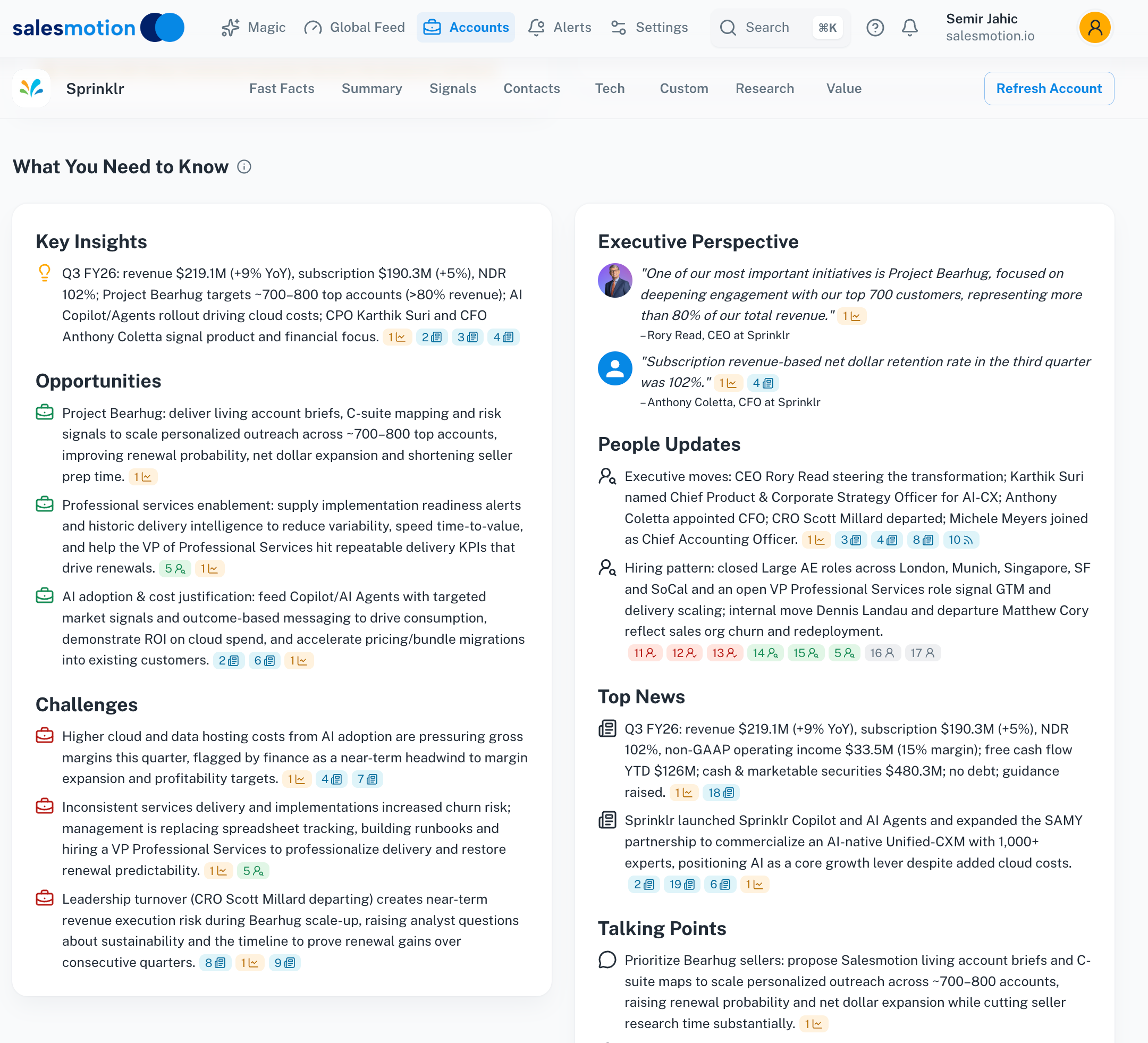 A Salesmotion account summary stitches earnings commentary, leadership changes, hiring patterns, and news into a single brief, with each claim linked back to its source.
If your prospect is a public SaaS company that ZoomInfo profiles deeply, Prospecting Agent will see most of what matters. If your prospect is a privately held CRO, a German Mittelstand manufacturer, a regional health system, or a research-heavy account where the buying signal lives in a podcast or a trial filing, the depth gap is real.

“All of the vendors that I've worked with, all of the onboarding that I have had to deal with, I will say, hands down, Salesmotion was the easiest that I have had.”
Lyndsay Thomson
Head of Sales Operations, Cytel
Verified data and the "why now" problem
Every AI sales agent has the same risk: plausible-sounding output that is not actually true.
This is not theoretical. According to a recent enterprise AI study, 47% of enterprise AI users had based at least one major business decision on hallucinated content. Sales is exactly where this hurts. A rep cannot send "I saw your CFO mention X on the Q2 call" if the CFO never said it.
Our answer is verified data with inline citations. Every signal on an account brief, every line of the account research summary, and every claim used in an outreach draft is sourced. Reps can hover, see the underlying earnings quote or news article, and decide whether to use it.
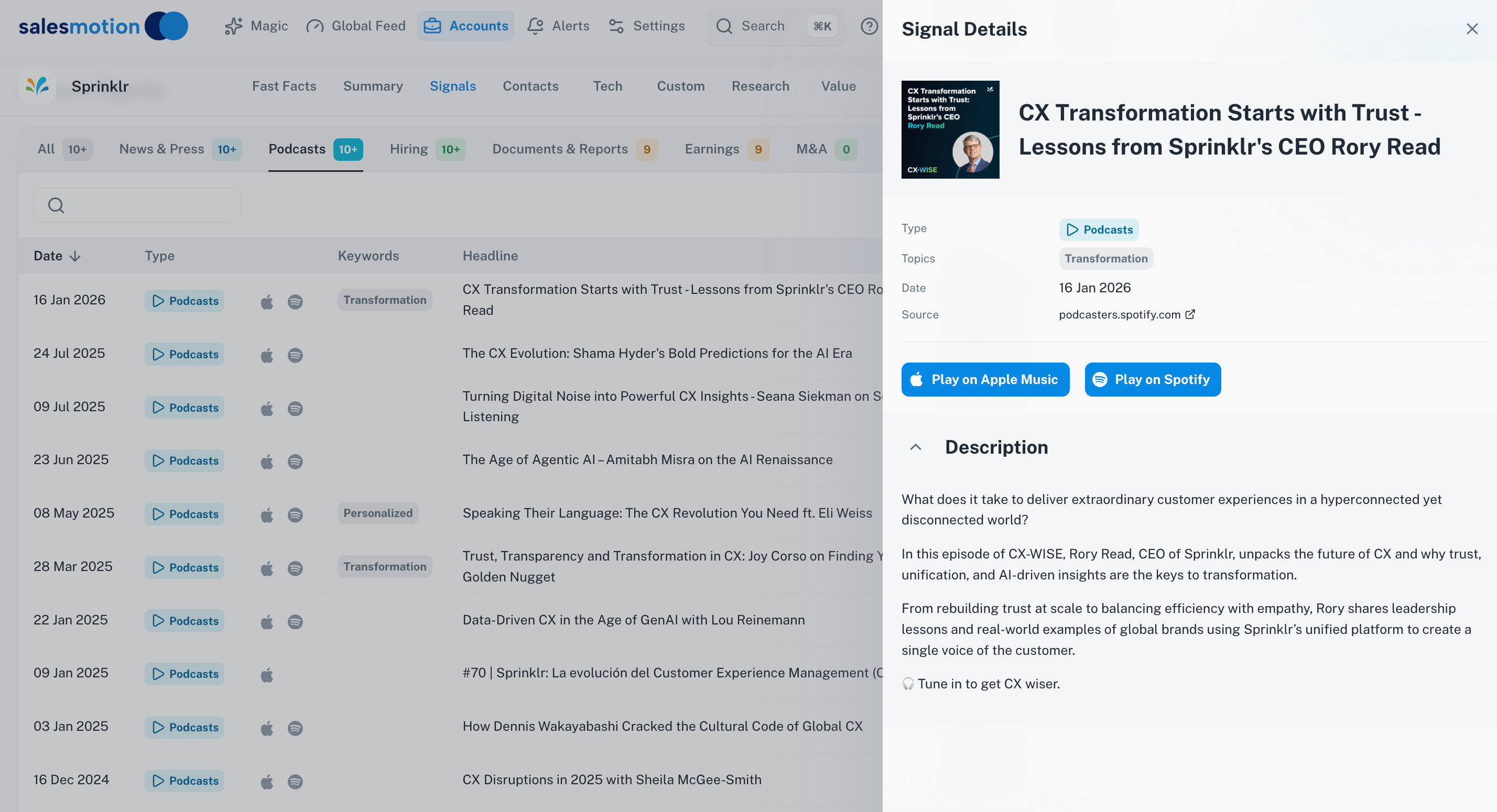 Each signal links back to the underlying source, including podcast timestamps, earnings transcripts, and news URLs, so reps can verify before they send.
Prospecting Agent inherits the strengths and limits of its sources. Where ZoomInfo or CRM history is the source, the data is structured and reliable. Where the agent reasons across less-structured inputs, the same hallucination risk applies as with any LLM-driven workflow. Salesforce's governance and audit posture helps, but the math underneath is the same. Verifying claims still belongs to the rep.
Email writing that does not sound like a template
The first generation of "AI outreach" was generic. Pull the prospect's name, plug in a job title, drop in a line about their recent funding round. Buyers learned to delete those in under a second.
The second generation, which both Prospecting Agent and our agent belong to, anchors messaging to a specific signal. The bar is now: did the agent reference something that actually moved on this account?
Salesmotion takes one more step with multiple writing styles. Reps choose the voice they want — direct and provocative, consultative and warm, technical and detail-led, executive and concise — and the email is generated in that style, anchored to a real signal pulled from research. The agent does not just personalize the opening line. It writes the whole message in a voice that matches the rep and the buyer.
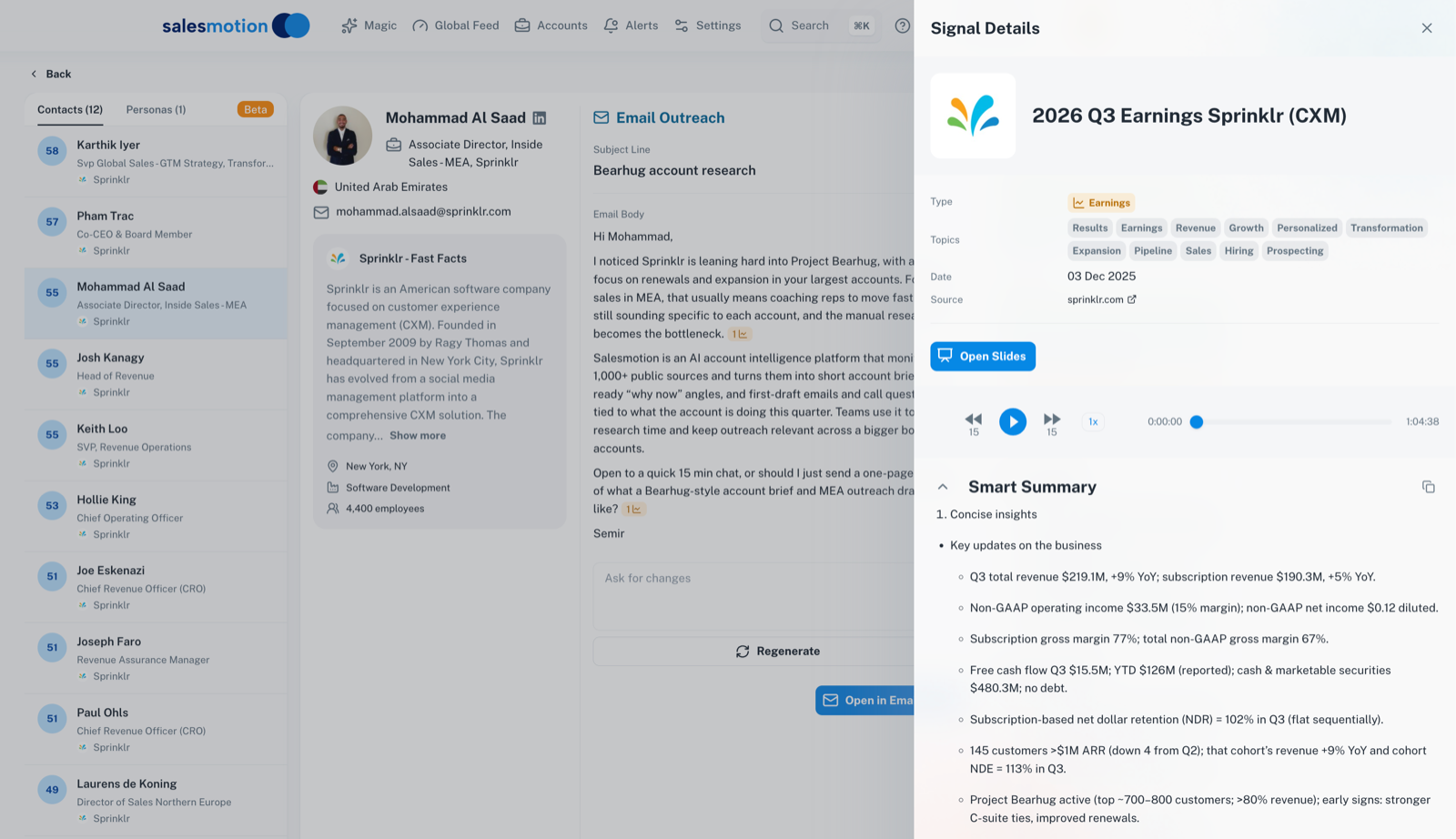 A Salesmotion email drafted from an earnings call signal. The opening cites the CFO's exact phrasing, the body ties to the strategic initiative, and the rep can switch writing styles before sending.
This matters more for senior reps and account executives than for SDR-style activity. An enterprise AE writing into a $2M opportunity does not want a generic "I saw your funding round" line. They want something that sounds like they actually read the earnings call, listened to the podcast, and connected dots that the prospect's own team might not have connected. That is what a writing style + verified signal combination produces.

“The Business Development team gets 80 to 90 percent of what they need in 15 minutes. That is a complete shift in how our reps work.”
Andrew Giordano
VP of Global Commercial Operations, Analytic Partners
Works inside Salesforce, and outside it
Prospecting Agent requires Salesforce. That is the point.
A meaningful number of B2B teams do not run on Salesforce. HubSpot is the obvious one. So are Pipedrive, Microsoft Dynamics, Zendesk Sell, Attio, and Folk. So are early-stage teams using a Notion database and a shared Gmail. For all of these teams, "buy Sales Cloud to get an AI prospecting agent" is not a real path.
Salesmotion is fully standalone: no integrations required. A rep can log in, build their book of accounts, and start working signals on day one. CRM and email integration layer in when it makes sense.
For Salesforce customers who do want the integration, the platform embeds inside Salesforce. Account briefs, signals, and writing prompts surface on the account record itself, alongside the Prospecting Agent if the team is running both. The goal is not to replace Salesforce's native agent; it is to extend the research depth that feeds it.
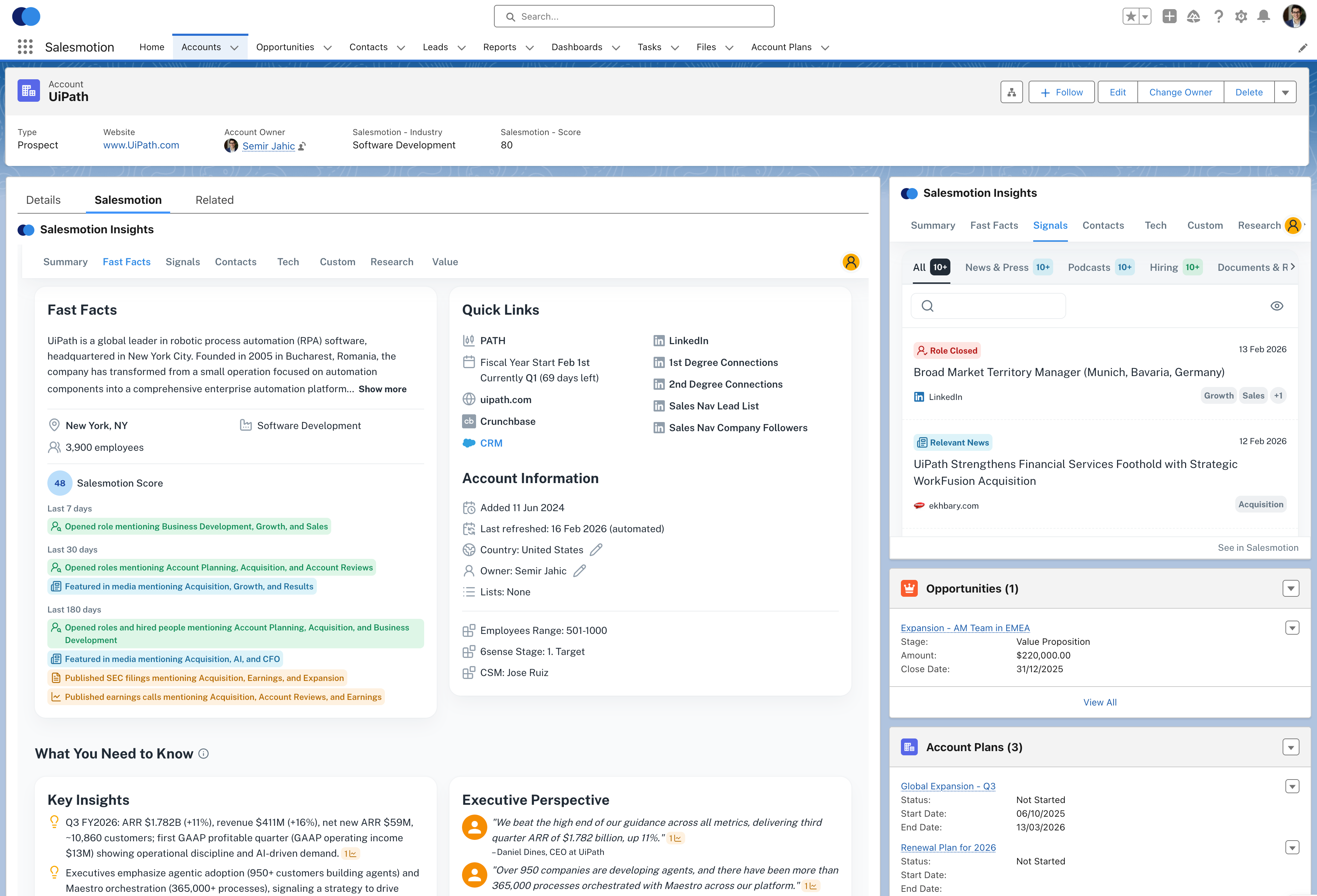 Salesmotion embedded directly in a Salesforce account record, surfacing deep research alongside native Salesforce data.
The practical takeaway: if you are debating Prospecting Agent and your team is mid-migration, on a different CRM, or split across multiple systems, Salesmotion does not force the migration question. You can adopt research depth now and decide on the CRM separately.
A workflow example: pharma BD opening a new account
Concrete is better than abstract. Here is the same workflow run through both tools, in life sciences where Salesmotion sees a lot of usage.
Trigger. A target sponsor announces a new Phase 3 trial in oncology on ClinicalTrials.gov. The trial sites span three countries. The CRO has not been named.
Prospecting Agent path. Trigger surfaces if the trial announcement was picked up by a news source ZoomInfo indexes. The account brief shows: company size, recent funding, key contacts pulled from ZoomInfo, recent CRM activity if any. Outreach draft references "recent expansion" or similar generic language unless the rep manually pulls in the trial detail.
Salesmotion path. The trial registry change fires a signal directly. The account brief auto-updates with: the trial design, the indication, the site list, the principal investigator, and any prior earnings or podcast commentary about the program. The outreach draft cites the specific Phase 3 by name, references the CCO's earlier comment about partnership economics from the Q2 call, and offers a CRO partnership conversation in the rep's chosen writing style.
Outcome. Same first meeting on the calendar. Different first meeting in the room. The deeper-research rep walks in with the partnership thesis already in hand. The Prospecting Agent-prepped rep walks in with a strong CRM-grounded intro and learns the partnership context in the meeting itself.
This is not a knock on Prospecting Agent. For an SMB software account where the CRM has 18 months of history and ZoomInfo coverage is dense, the calculus flips and Prospecting Agent likely produces the better starting point. The question is which workflow your reps are actually running most.
When each tool is the right fit
Honest "best for" splits, not marketing copy.
Salesforce Prospecting Agent is the right starting point if:
- Your CRM is Salesforce, end of sentence
- ZoomInfo is your primary external data source and coverage is strong on your ICP
- Your sales motion leans high-volume SMB or commercial mid-market
- You want a Salesforce-native, audit-friendly agent governed by your existing trust posture
- You are comfortable with research depth that ends at CRM + ZoomInfo + intent feeds
Salesmotion is the right fit if:
- Your reps need to research accounts ZoomInfo does not cover well (private companies, regulated industries, international markets, life sciences)
- Earnings calls, podcasts, clinical trials, regulatory filings, or hiring patterns are real buying signals for you
- You sell into senior or technical buyers who notice generic outreach instantly
- You run a non-Salesforce CRM, or split across multiple CRMs, or no CRM
- You want verified, cited research over plausible-sounding summaries
- You want multiple writing styles for outreach, not a single house voice
The two tools are not mutually exclusive. The most sophisticated Salesforce customers we work with run both: Prospecting Agent on the high-volume, ZoomInfo-rich segments of their book, Salesmotion on the strategic accounts where research depth pays back tenfold on a single closed deal.
Key Takeaways
- Salesforce Prospecting Agent is a real upgrade for Salesforce-native teams. The natural-language setup, ZoomInfo data layer, and Slack/Salesforce delivery are genuine wins, and the Perk customer result of 60% of NA SDR pipeline is credible.
- Prospecting Agent's source surface is CRM history, past calls and emails, and third-party feeds. That is enough for accounts ZoomInfo profiles deeply. It is thin for private companies, international accounts, and signals that live in earnings calls, podcasts, or trial filings.
- A 1,000+ source surface that includes earnings, podcasts, clinical trials, regulatory filings, hiring patterns, and tech stack data closes the depth gap. Every claim is cited back to its source, which directly addresses the hallucination risk that makes 47% of enterprise AI users second-guess their tools.
- Multiple email writing styles, anchored to verified signals, let reps pick the voice that matches the buyer instead of accepting one default house tone.
- Working standalone or embedded in Salesforce means teams not on Salesforce, mid-CRM-migration, or split across systems can adopt research depth without forcing a CRM decision first.
- The best path forward for many teams: run Prospecting Agent on the high-volume, ZoomInfo-rich part of the book; run a deeper-research tool on strategic accounts where one signal-led conversation can drive the next $1M+ deal.
Frequently Asked Questions
Is Salesmotion an alternative to Salesforce Prospecting Agent?
It is positioned as complementary, not strictly an alternative. Prospecting Agent is the right starting point for Salesforce-native teams running on ZoomInfo. Salesmotion adds research depth across sources Prospecting Agent does not see and works for teams not on Salesforce. Many sophisticated customers run both, with Prospecting Agent on high-volume segments and the deeper-research layer on strategic accounts.
Does Salesmotion require Salesforce?
No. The platform is fully standalone, with no CRM required. Reps can log in and start working signals on day one. For teams on Salesforce or HubSpot, a native integration surfaces account briefs and signals inside the CRM. For teams on other systems, the platform runs independently.
What sources does Salesmotion research that Prospecting Agent does not?
The source surface includes earnings calls and investor presentations, executive podcasts, clinical trial registries (ClinicalTrials.gov, EU CTR, JPRD), regulatory filings (SEC, FDA, MHRA), hiring patterns, tech stack adoption changes, and continuously indexed news and web content. Prospecting Agent's research surface is primarily CRM history, past calls and emails, and third-party data feeds like ZoomInfo. The two surfaces overlap at company-level basics and diverge sharply on signals that live outside structured CRM and intent data.
How does Salesmotion handle data accuracy and AI hallucinations?
Every signal, summary line, and outreach draft links back to the underlying source. Reps can hover any claim and see the original earnings transcript, podcast timestamp, news article, or filing. This is a deliberate counter to the risk that 47% of enterprise AI users have already encountered, where a major decision was based on hallucinated content. The combination of verified, cited research plus multiple writing styles means reps can move fast without sending claims they have not validated.