Five tools. Zero integration. That is the setup at one large diagnostics company we've spoken with, where reps bounce from a pharma-signal tool to a contact database to manual email drafting to a general-purpose AI copilot to a financial-data platform before they can do anything resembling selling. Every handoff is manual. Every tool is a silo. And every rep on the team repeats this circus for every account, every week, burning hours on tool orchestration instead of pipeline.
They are not unusual. They are average.
TL;DR: The typical B2B sales team runs 10+ tools, but reps actively use about 3. The rest create overlap, data inconsistency, and integration overhead that costs $2,600 to $14,000 per user per year. The "5-tool trap" (CRM + contact database + intent provider + sequencer + research tool) is the most common pattern, and it bleeds productivity at every handoff. Teams that consolidate their intelligence layer see 43% higher win rates and 37% faster deal cycles. This post maps the trap, calculates the real costs, and gives you a stack audit framework to fix it.
The 5-Tool Trap: A Pattern Hiding in Every Sales Org
Talk to enough sales leaders and the same architecture shows up again and again. The tools change, the vendors rotate, but the shape stays constant:
- CRM (Salesforce, HubSpot) for the system of record
- Contact database (ZoomInfo, Apollo, Cognism, Lusha) for finding people to call
- Intent or signal provider (Bombora, 6sense, or a vertical signal tool) for timing
- Sequencer (Outreach, Salesloft, Apollo sequences) for sending at scale
- Research tool (ChatGPT, Pitchbook, LinkedIn Sales Nav, Google) for everything else
Each tool solves a real problem in isolation. Together, they create a chain of manual handoffs where context gets lost, data contradicts itself, and reps spend more time operating tools than operating deals.
Here is what this looks like in practice, drawn from real conversations with sales teams.
Pattern 1: The enterprise life sciences stack
One large diagnostics company runs a stack that maps one-to-one onto those categories: a vertical signal-monitoring tool, a contact database (a Cognism-class product), manual email composition (no templates, no AI), a general-purpose AI copilot for ad hoc research, and a financial-data platform for company intelligence. Five tools, zero native integration. Every piece of account context that moves between systems travels through a human clipboard.
Pattern 2: The growth-stage overbuyer
A frontline workforce platform runs HubSpot as the CRM, Outreach for sequences, Attention for call intelligence, LinkedIn Sales Navigator for prospecting, and ZoomInfo for enrichment. That is already six tools. When we spoke with their team, they were actively evaluating whether to build or buy a seventh tool for account research. The instinct when something is missing is always to add, never to consolidate.
Pattern 3: The accuracy trap
An early-stage B2B startup uses Outreach for sequencing and Apollo for contact enrichment. Simple stack, two tools. But accuracy problems with both platforms mean reps spend significant time verifying data before they trust it enough to use in outreach. A small stack can still be a broken stack if the data layer is unreliable. When evaluating Apollo alternatives, the most common complaint is contact data accuracy degrading outside of the technology and SaaS verticals.
Pattern 4: The new outbound team
A logistics technology company just stood up its first outbound function. The initial stack: Salesforce, LinkedIn Sales Navigator, Salesloft, and ZoomInfo. Four tools from day one. The team is still small, but they have already locked into contracts and workflows that will be difficult to unwind in six months. The earlier you think about consolidation, the less painful it is.
The Real Costs Nobody Puts in the Business Case
When finance evaluates sales tools, the analysis usually starts and stops at subscription cost. But subscription cost is the smallest part of the equation.
Context-switching time: 3 to 5 hours per rep per week
Research from Forrester shows that sales reps spend less than 30% of their week actually selling. A major contributor is the time lost switching between disconnected tools to gather account context.
For a 10-rep team, 3 to 5 hours of weekly context-switching translates to 1,560 to 2,600 lost selling hours per year. At a blended cost of $75/hour (base + commission + benefits), that is $117,000 to $195,000 in annual productivity loss. No single subscription costs that much.
Data inconsistency across tools
When the same account exists in five systems, you get five versions of the truth. The CRM says the company has 500 employees. The contact database says 800. The intent provider has them in the "Cybersecurity" industry while the CRM lists "IT Services." Reps do not know which source to trust, so they either spend time reconciling manually or (more often) they just guess.
A 2025 Gartner survey found that 68% of sales leaders struggle with tool overlap and data silos. This is not a niche problem. It is the default state of most sales orgs.
Integration maintenance: the invisible tax
The average B2B company uses 87 software tools, but only 23% of them directly impact revenue. Every integration between two tools requires setup, monitoring, and ongoing maintenance. When APIs change, fields get renamed, or a vendor pushes an update, someone on the RevOps team has to fix it.
Industry analysis pegs this "integration tax" at 25% to 40% of total tech spend. For a sales stack costing $50,000 per year in subscriptions, that is another $12,500 to $20,000 in hidden costs for the engineering and operations time required to keep everything connected.
Onboarding overhead for new hires
When a new rep joins a team running five sales tools, they need to learn five interfaces, five sets of credentials, and five workflows. That extends ramp time significantly. Instead of learning one system deeply and getting productive fast, new hires spend their first weeks getting shallow training on each tool and figuring out the duct-tape integrations on their own.
Teams with fewer, more capable tools consistently report faster ramp times. When reps only need to learn one account intelligence platform alongside their CRM, they start contributing weeks earlier.

“We had a variety of tools, and that was the pain — the variety. We had to go to multiple places to get streamlined data.”
Lyndsay Thomson
Head of Sales Operations, Cytel
Mapping the Overlap: What Actually Needs to Be Separate
Not every tool in the stack is a consolidation candidate. The key is separating tools that serve distinct functions from tools that overlap in the account intelligence layer.
Must stay separate:
| Tool | Why It Stays |
|---|---|
| CRM (Salesforce, HubSpot) | System of record, deeply embedded in workflows |
| Conversation intelligence (Gong, Chorus) | Call recording and analysis is a different function |
| Marketing automation (Marketo, HubSpot Marketing) | Demand gen workflows sit upstream of sales |
| Compliance tools | Legal and audit requirements are non-negotiable |
| Consolidation candidates (the intelligence layer): | Capability |
| --- | --- |
| Contact enrichment | ZoomInfo, Apollo, Cognism, Lusha |
| Signal monitoring | Bombora, 6sense, vertical signal tools, Google Alerts |
| Account research | ChatGPT, Perplexity, Pitchbook, Sales Nav |
| Outreach drafting | ChatGPT, Copilot, manual |
| Sequencing | Outreach, Salesloft, Apollo |
The pattern is clear. Contact data, signal monitoring, account research, and outreach personalization are four capabilities that overlap heavily across 3 to 5 different tools in most stacks. That overlap is where the waste lives.
When you evaluate ZoomInfo alternatives or research whether ZoomInfo is too expensive, the question is rarely "do we need contact data?" It is "do we need a $40,000 contact database when our account intelligence platform already covers contacts alongside signals and research?"
The Stack Audit Framework
Before you consolidate anything, you need a clear picture of what you have. Here is a practical framework you can run in a single afternoon.
Step 1: List every tool your reps touch
Go beyond the tools with formal contracts. Include free tools, browser extensions, ChatGPT subscriptions, and anything reps open during a typical day. Shadow a rep for one account preparation session and write down every tab they open.
Step 2: Map capabilities to tools
Create a simple matrix. Capabilities down the left side, tools across the top. Put a checkmark where each tool delivers that capability. The columns with the most checkmarks are your overlap zones.
| Capability | CRM | Contact DB | Intent Tool | Sequencer | Research Tool |
|---|---|---|---|---|---|
| Contact data | Partial | Yes | No | Partial | No |
| Company research | Partial | Partial | Partial | No | Yes |
| Buying signals | No | No | Yes | No | Partial |
| Outreach drafting | No | No | No | Partial | Yes |
| CRM sync | Yes | Partial | Partial | Partial | No |
If three tools all claim to do "company research" but your reps only trust one of them, the other two are cost without value.
Step 3: Calculate total cost of ownership
For each tool, add up:
- Annual subscription (per-seat cost multiplied by current headcount)
- Integration cost (estimate hours/month your RevOps team spends maintaining the connection)
- Training cost (time to onboard new reps on this tool)
- Context-switching cost (estimated minutes per rep per day spent moving between this tool and others)
The average sales tech stack costs $2,600 to $14,000 per user per year in direct subscription costs alone. Once you add the hidden costs above, the true number is typically 40% to 60% higher.
Step 4: Identify the consolidation opportunity
Look for clusters of 2 to 4 tools where:
- Capabilities overlap significantly
- Data flows between them are manual or brittle
- Reps only use a fraction of each tool's features
- A single platform could cover the combined use case
The third point is the one buyers raise themselves. A sales rep at an HR services firm told us: "a lot of people use technology. Don't really use technology in the way you could. They're using 5% of it, right?"
For most teams, the consolidation opportunity sits in the account intelligence layer: contact enrichment, signal monitoring, company research, and outreach personalization.
Step 5: Build the business case
Frame the ROI around three pillars:
- Direct savings: sum of subscriptions you can eliminate
- Time savings: hours returned to reps multiplied by blended hourly cost
- Performance impact: teams with consolidated stacks see 43% higher win rates and 37% faster deal cycles
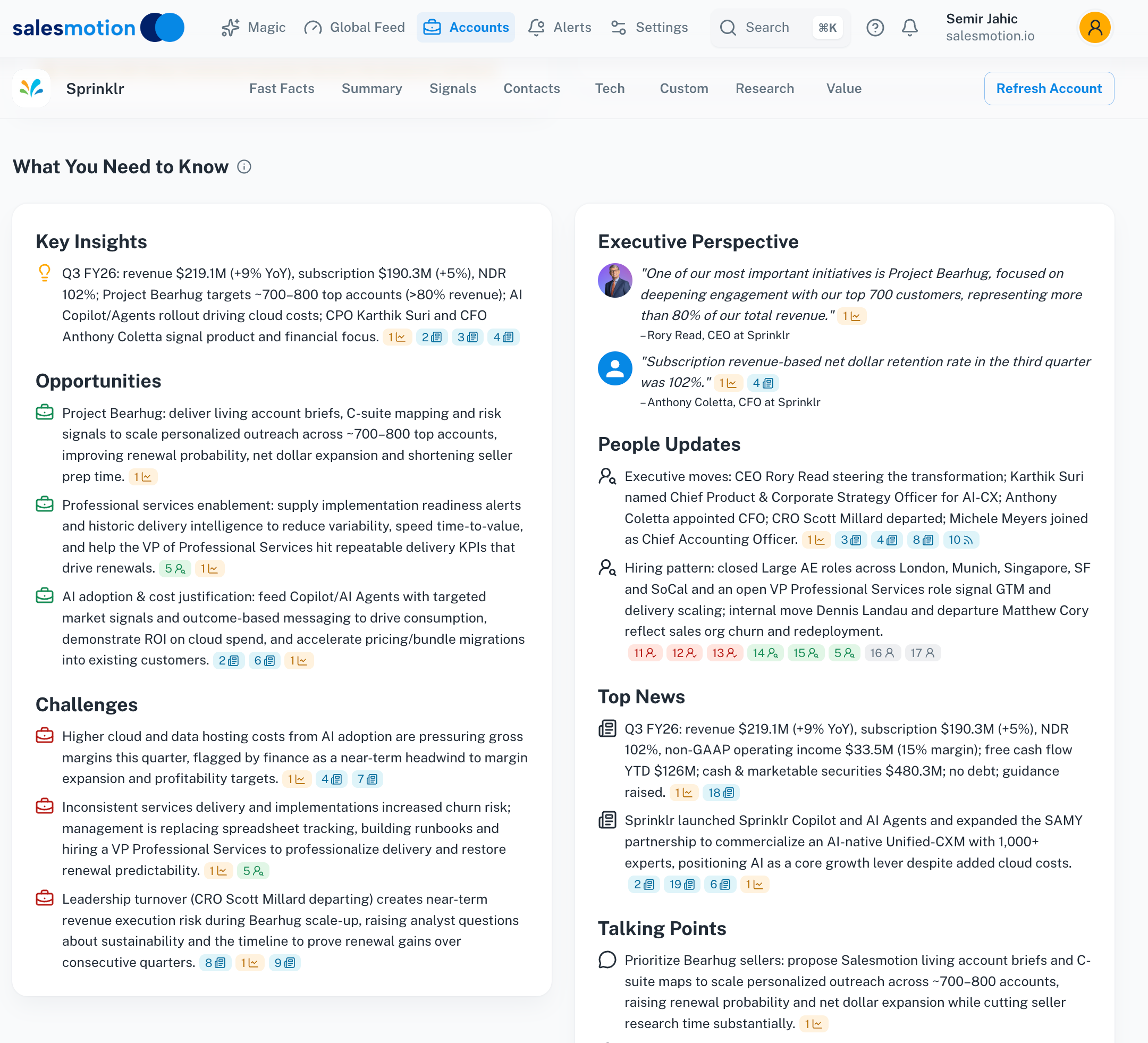 A consolidated account view brings signals, company research, and contact intelligence into a single screen, replacing the 5-tab workflow.
See Salesmotion on a real account
Book a 15-minute demo and see how your team saves hours on account research.
What Consolidation Looks Like in Practice
The theory is straightforward. The proof is in the results.
Cytel, a 2,000-person life sciences analytics company, was running five separate tools for account intelligence. Their reps visited 5+ websites just to prepare for quarterly business reviews. After consolidating to a single platform, they cut account research time by 50% and reduced account planning prep by 30%. Five tools became one. The manual handoffs disappeared.
At Analytic Partners, an enterprise analytics firm, consolidation delivered a different kind of win. Their team found that Salesmotion surfaced 80% to 90% of everything reps needed within 15 minutes, a workflow that previously required bouncing between multiple research sources for an hour or more. The depth of insight did not shrink. The time to reach it did.
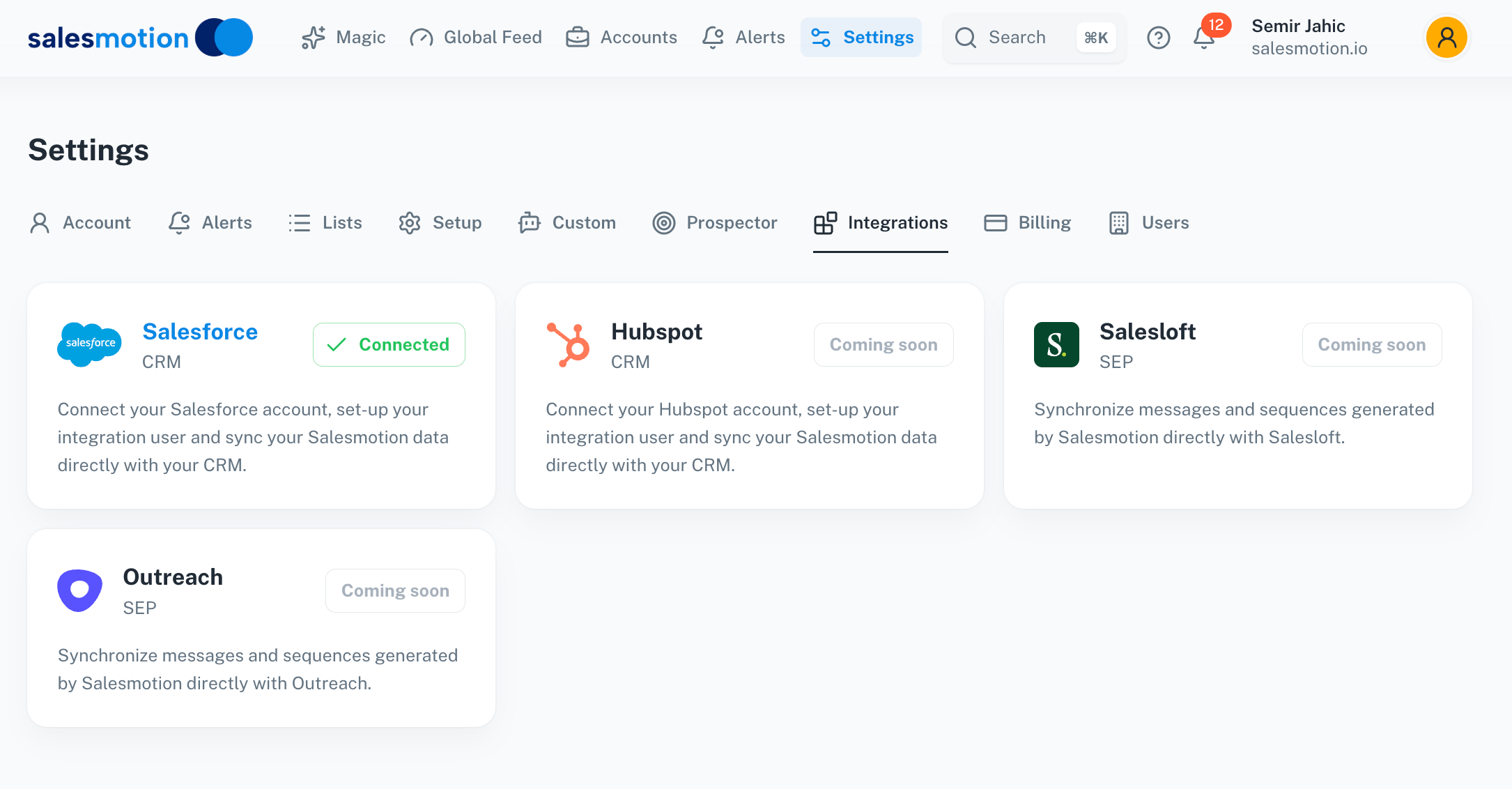 Native CRM integrations eliminate the manual data transfer that creates inconsistency across tools.
The common thread across teams that consolidate successfully: they do not lose capability. They lose complexity. The signals, contacts, and research are still there. They are just in one place instead of five, with context that flows between them automatically instead of through a human clipboard.
Avoiding the Rebound: Why Teams Re-Fragment
Consolidation is not a one-time event. Without deliberate governance, sales stacks tend to re-fragment over time. A new manager brings their favorite prospecting tool. A rep starts expensing an AI subscription. The vendor for your intent data gets acquired and the product changes.
Three practices that prevent rebound:
- Quarterly stack reviews. Every quarter, audit what tools reps are actually using (not just what is contracted). Usage data from SSO and IT can reveal shadow tools.
- A single owner for the intelligence layer. Whether it is RevOps, Sales Ops, or a dedicated enablement leader, one person needs authority over what tools get added to (and removed from) the seller's workflow.
- New tool justification threshold. Before adding any tool, require a clear answer: what existing capability does this replace, and what is the measurable gap it fills? If the answer is "it does something our current tool also does, just slightly differently," that is not justification.
An enablement and operations leader at a software firm told us her tools were bought in silos, do not talk to each other, and that she is mapping every tool to a job before buying anything else. That is the third practice in action.
Key Takeaways
- The "5-tool trap" is nearly universal. CRM + contact database + intent provider + sequencer + research tool is the default sales stack, and it creates manual handoffs at every step.
- Subscription cost is the smallest part of the problem. Context-switching (3 to 5 hours per rep per week), data inconsistency, integration maintenance (25% to 40% of tech spend), and onboarding overhead add up to more than the licenses themselves.
- The consolidation opportunity is in the intelligence layer. Contact enrichment, signal monitoring, account research, and outreach personalization are four capabilities that overlap across 3 to 5 tools in most stacks. CRM, conversation intelligence, and compliance tools should stay separate.
- Run a stack audit before making any changes. Map tools to capabilities, calculate total cost of ownership, and identify overlap clusters. One afternoon of analysis can reveal $50,000+ in annual waste.
- Real teams see real results. Cytel consolidated 5 tools to 1 and cut research time by 50%. Analytic Partners gets 80% to 90% of what reps need in 15 minutes. Teams with consolidated stacks report 43% higher win rates and 37% faster sales cycles.
Frequently Asked Questions
How do I know if my sales stack is too fragmented?
Three signals indicate a fragmented stack: reps open more than 3 tools to prepare for a single meeting, the same account data exists in multiple systems with conflicting values, and new hires take more than 4 weeks to learn the full toolset. If any of these apply, your stack likely has consolidation opportunities. Run the stack audit framework above to quantify the overlap and cost.
What is the typical cost savings from consolidating sales tools?
Direct subscription savings typically range from $20,000 to $60,000 per year, depending on which tools you eliminate. But the bigger number is recovered selling time. At 3 to 5 hours per rep per week, a 10-person team recovers 1,560 to 2,600 selling hours annually, worth $117,000 to $195,000 at blended cost. Combined with the 25% to 40% reduction in integration maintenance overhead, total annual savings for a mid-market team often exceed $150,000.
Will reps resist giving up their favorite tools?
Resistance is common and understandable. The key is positioning consolidation as giving reps time back, not taking tools away. Run a parallel pilot where reps use both the new platform and their existing tools for 2 to 4 weeks. When they experience the difference firsthand (one tab instead of five, research in minutes instead of an hour), adoption tends to happen naturally. The teams that struggle are the ones that mandate a switch without showing reps the benefit first.
How long does a stack consolidation take from start to finish?
Plan for 8 to 12 weeks total. Weeks 1 to 2 for the stack audit and vendor evaluation. Weeks 3 to 6 for a pilot with a subset of the team. Weeks 7 to 10 for full team rollout and migration of saved searches, account lists, and workflows. Weeks 11 to 12 for sunsetting legacy tools and canceling contracts. The platform switch itself is fast (often days). The organizational change management is what takes time.
Should I consolidate if my team is small (under 10 reps)?
Yes, and arguably it is even more important. Small teams feel the pain of fragmentation more acutely because there is no dedicated RevOps person to maintain integrations or reconcile data. Every hour a rep spends on tool orchestration is an hour not spent selling, and small teams cannot afford that. The cost savings are also proportionally significant: eliminating even two overlapping tools at $10,000 each saves $20,000 per year, which is meaningful for a startup or early-stage sales org.
What You Cannot Retire
An honest consolidation plan names the tools that stay, because a business case that promises to replace everything loses credibility the first time a rep finds a gap.
Your sequencer. Consolidating research and signals does not remove the need to send, track, and manage replies at volume. Intelligence platforms draft outreach; sending infrastructure is a different job.
Contact enrichment, in some motions. If you routinely need verified contact details for people at companies outside your tracked list, a dedicated enrichment layer still earns its place. Monitoring narrows the field; enrichment resolves individuals. Many teams run both deliberately, and the sequencing matters: narrow with signals first, then enrich the shortlist rather than the territory.
Your CRM. Consolidation should reduce the number of places intelligence lives, not move your system of record.
Specialist vertical sources with unique depth. Where a tool carries data genuinely unavailable elsewhere, keep it and consolidate around it. The goal is fewer overlapping subscriptions, not fewer tools for its own sake.
The realistic outcome is usually five tools down to two, not five down to one. That is still a substantial saving, and it is a claim that survives contact with your reps.